Create my document
Login

Choose country

United KingdomUnited KingdomChoose country
Personal

Deed of Assignment of Tenancy | s.15 Housing Act 1988

Assign an assured periodic tenancy with landlord consent as required by section 15 Housing Act 1988, updated for the Renters' Rights Act 2025. Word and PDF.
4.8/521 reviews50 000+ downloadsInstant download
Share

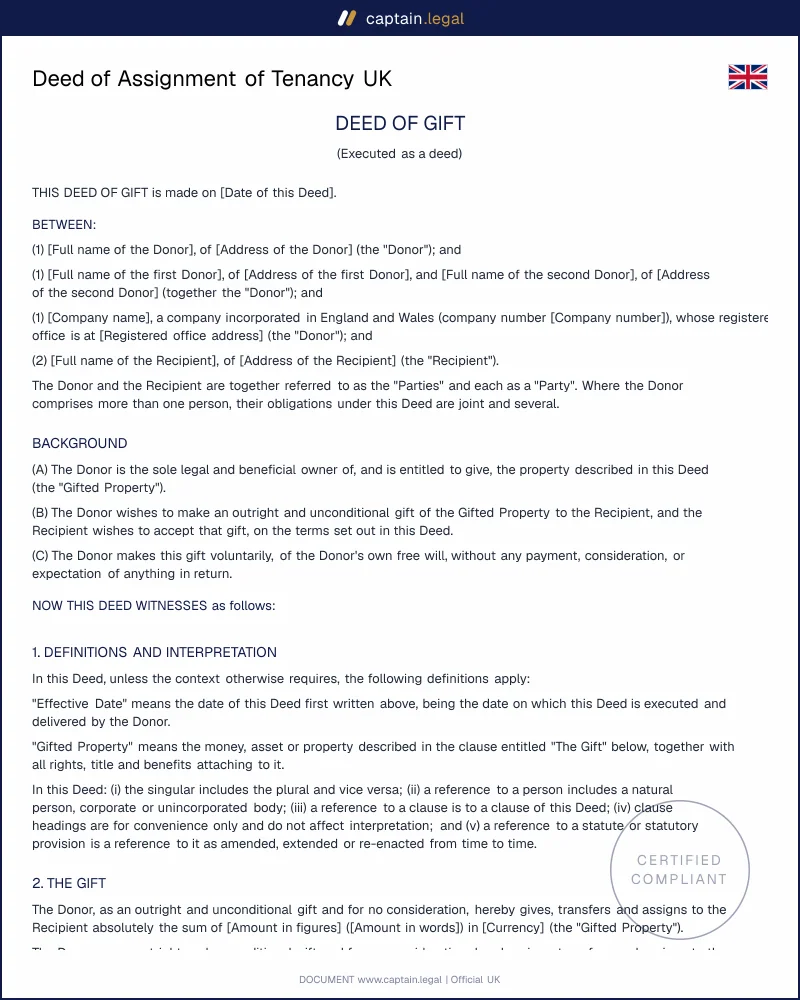
A Deed of Assignment of Tenancy transfers a residential tenancy from the existing tenant to a new one, with the landlord's written consent, so that the incoming tenant steps fully into the shoes of the outgoing tenant. It is the document you need when one renter leaves a shared let, a couple separates, or a tenant wants to hand the tenancy to someone else without the landlord granting a brand-new agreement. Since section 15 of the Housing Act 1988 makes consent a statutory precondition for assigning an assured periodic tenancy, getting the paperwork right is not optional. This template records the assignment, the landlord's consent and the release of the outgoing tenant in a single executed deed, ready in Word and PDF.

Used correctly, a deed of assignment keeps the original tenancy alive on its existing terms rather than ending it and starting again, which matters a great deal under the post-reform regime introduced by the Renters' Rights Act 2025.

Compliant

2026 Legislation

50,000+ clients

trust us

Affordable

From $4.90 / doc

Secure payment

Instant download

Deed of Assignment of Tenancy | s.15 Housing Act 1988

Secure payment · No subscription

Fill in the template

What is a deed of assignment of tenancy?

A deed of assignment of tenancy is a formal instrument that transfers the whole of a tenant's legal interest in a let to a new tenant. The assignor (the outgoing tenant) gives up the tenancy; the assignee (the incoming tenant) takes it over and becomes liable for the rent and the covenants from the assignment date forward. The landlord is almost always a party too, because their written consent is what makes the transfer lawful and because the deed is where that consent is recorded.

It helps to be precise about what assignment is not. Assignment is not subletting: a sublet creates a new, separate tenancy underneath the original one, and the head tenant stays liable to the landlord. Assignment is not a surrender and re-grant either, where the existing tenancy ends and a fresh one begins. With a true assignment, the same tenancy continues, on the same terms, simply with a different person holding it. That distinction carries real weight after the Renters' Rights Act 2025, because a surrender and re-grant would reset the tenant's twelve-month protected period and trigger fresh written-statement obligations, whereas a clean assignment preserves the continuity of the original assured periodic tenancy.

The instrument must be a deed, not a simple agreement, because the assignment of a tenancy is a disposition of a legal interest in land. A deed has to be in writing, make clear on its face that it is intended as a deed, and be validly executed and witnessed under section 1 of the Law of Property (Miscellaneous Provisions) Act 1989. Our rent guarantee deed for post-reform lettings follows the same execution formalities and is worth reviewing if a guarantor sits behind the incoming tenant.

2

When do you need this document?

The classic trigger is a change of sharer in a joint tenancy. Three friends rent a house, one moves out, and a replacement moves in. Rather than end everyone's tenancy and grant a new one, the departing tenant assigns their interest with landlord consent, and the household continues seamlessly on the same agreement. Handled this way, the remaining tenants keep their accrued protected period and the landlord avoids re-papering the whole let.

Relationship breakdown is the next most common scenario. Where a couple holds a joint tenancy and one partner leaves, a deed of assignment can transfer the departing partner's share to the one who stays, cleanly removing the leaver from future rent liability. This is far tidier than informal arrangements where the leaver simply stops paying but remains legally on the hook. A business reason sits alongside these: an employer who holds a tenancy for staff accommodation may assign it to an incoming employee when roles change.

Two edge cases deserve a flag. First, assignment by operation of law on death or bankruptcy follows different rules, and a voluntary deed is not the right tool there. Second, where a guarantor stands behind the original tenant, assignment does not automatically carry the guarantee across, so a fresh guarantee is usually needed for the assignee, much like the protections set out in our tenant referencing and Right to Rent pack. Never let an assignee move in before the deed is executed and consent is documented, because retrofitting consent after the fact is where disputes start.

3

Key clauses included in our template

  • The identification of the parties names the landlord, the outgoing tenant as assignor, and the incoming tenant as assignee in full, together with the address of the let and the date and type of the original tenancy. Vague drafting here is fatal: the deed must tie back precisely to the tenancy being assigned, otherwise it is unclear what interest has actually moved.
  • The assignment of the tenancy is the operative clause, transferring the whole of the assignor's interest to the assignee from a stated date. It confirms the assignee takes the tenancy subject to and with the benefit of all the existing terms, so there is no doubt that the same assured periodic tenancy continues rather than a new one beginning.
  • The landlord's consent is recorded expressly within the deed, satisfying the requirement under section 15 of the Housing Act 1988. Capturing consent in the same instrument removes any later argument that the landlord did not agree or agreed only on different terms.
  • The release of the outgoing tenant discharges the assignor from liabilities accruing after the assignment date, while preserving the landlord's right to pursue arrears or breaches that predate it. This is the clause the leaving tenant cares about most, and it is frequently missing from improvised assignments.
  • The assignee's covenants and acknowledgements confirm the incoming tenant has read the tenancy, accepts the rent and obligations, and has received the prescribed post-reform information. It is sensible to pair this with a refreshed deposit position, drawing on our deposit receipt and prescribed information template.
4

Regional considerations

Assignment of an assured tenancy is governed by the same primary legislation across England and Wales, but the surrounding compliance picture diverges enough to matter. In England, the Renters' Rights Act 2025 regime applies in full: all lettings are assured periodic tenancies, the government Information Sheet must reach every named tenant, and an incoming assignee should be treated as a tenant for the purpose of Right to Rent immigration checks under the Immigration Act 2014. Skipping that check on an assignee is a common and expensive oversight, since the penalty regime bites per occupier. Confirm the position with our Assured Shorthold Tenancy agreement guidance, which explains how existing agreements converted on 1 May 2026.

In Wales, residential lettings fall outside the Housing Act 1988 framework entirely and are instead governed by the Renting Homes (Wales) Act 2016, which uses occupation contracts rather than assured tenancies. Assignment there follows the rules on transfer of an occupation contract, and the section 15 mechanism described above simply does not apply. If your property is in Wales, this England-and-Wales deed will need to be adapted to the occupation-contract model, and you should not assume the consent rules transfer across unchanged.

A point relevant across both jurisdictions concerns shared houses that are licensed as Houses in Multiple Occupation. Changing the identity of an occupier through assignment can affect the basis on which an HMO licence was granted, and some local authority licence conditions require the licence holder to notify the council of occupier changes. Before signing the deed, check whether the let is licensed and whether the assignment needs to be reported, because a breach of licence conditions carries its own penalties separate from anything in the tenancy.

5

How to fill out this deed of assignment of tenancy

You begin by confirming the most important fact: that the landlord actually consents to the assignment, because without it the deed has no foundation. From there you enter the details of the original tenancy, the property address, the start date and the type of agreement, so the deed locks onto the exact interest being transferred. The form then asks for the full names of the assignor and assignee, and prompts you to set the assignment date from which liability shifts.

Next you confirm whether the outgoing tenant is being fully released and whether any pre-assignment arrears are being preserved against them, which the template phrases for you so nothing is left ambiguous. You record the landlord's consent in the body of the deed and set out the assignee's acknowledgement of the tenancy terms and post-reform information. The final stage is execution: each party signs in the presence of an independent witness, because this is a deed and the Law of Property (Miscellaneous Provisions) Act 1989 execution formalities must be met. If a guarantor is involved, prepare their fresh documentation in parallel rather than after signing. For broader business transfers of property interests, our UK commercial and business document templates cover related ground.

6

Common mistakes to avoid

The single most damaging error is treating consent as an afterthought. Because section 19 of the Landlord and Tenant Act 1927 is disapplied, a landlord's refusal cannot be challenged as unreasonable, so an assignment attempted without clear, documented consent is simply ineffective, and the would-be assignee acquires nothing. Almost as common is confusing assignment with subletting: people use a deed of assignment when they actually intend the original tenant to stay liable, which defeats the purpose and leaves the leaver exposed. A third recurring mistake is forgetting the release clause, so the outgoing tenant believes they have walked away while remaining contractually bound for rent that accrues after they have gone.

The remaining pitfalls cluster around formalities and compliance. Executing the document as an ordinary agreement rather than a properly witnessed deed undermines the whole transfer, since a disposition of a legal estate must be by deed. Landlords frequently overlook the Right to Rent check on the incoming assignee, treating them as somehow exempt because the tenancy already exists, which is wrong. And many parties forget that the assignment does not carry an existing guarantee across automatically, leaving the landlord unsecured the moment the original tenant departs. A short checklist before signing prevents nearly all of these, and our periodic tenancy notice to quit template is the right document if the answer turns out to be ending the tenancy rather than transferring it.

Key takeaways

CONSENT

Landlord consent is a legal precondition

If the tenancy is an assured periodic tenancy, section 15 of the Housing Act 1988 implies a term banning assignment unless the landlord gives consent. That means you cannot lawfully transfer the tenancy to someone else on a handshake or a side letter. The deed is where the landlord’s written consent is recorded, alongside the assignment itself, in one enforceable document.

CONTINUITY

Assignment keeps the same tenancy alive

A true assignment swaps the tenant, not the tenancy: the original assured periodic tenancy continues on the same terms, just with a new tenant holding it from the assignment date. That is different from subletting (where the original tenant stays liable) and from surrender and re-grant (which ends the old tenancy and starts a new one). Post-reform, continuity can affect what obligations are triggered and when.

FORMALITIES

It must be executed as a deed

Because a tenancy is a legal interest in land, the transfer needs a deed, not a simple agreement. The document must be in writing, state clearly it is intended to be a deed, and be properly signed and witnessed in line with section 1 of the Law of Property (Miscellaneous Provisions) Act 1989. Get the execution wrong and you risk a failed assignment, leaving the outgoing tenant still on the hook.

Frequently Asked Questions

Yes, provided it is executed correctly. Assignment of a tenancy is a disposition of a legal interest in land, so the instrument must take the form of a deed under section 1 of the Law of Property (Miscellaneous Provisions) Act 1989: in writing, clearly expressed to be a deed, and signed by each party in the presence of an independent witness who also signs. Equally important, the landlord's consent must be present, because section 15 of the Housing Act 1988 implies a prohibition on assigning an assured periodic tenancy without it. Get both the execution formalities and the consent right, and the deed binds all parties from the assignment date.

In almost every case, yes. Section 15 of the Housing Act 1988 implies into every assured periodic tenancy a term that the tenant must not assign without the landlord's consent. Unusually, the law does not require that consent to be given reasonably, because section 19 of the Landlord and Tenant Act 1927 is expressly excluded for this implied term. That means a landlord can refuse for any reason, and you have no statutory power to compel them. The honest practical answer is that a deed of assignment only makes sense once the landlord has agreed, which is why consent is recorded inside the deed itself.

Assignment transfers your entire tenancy to someone else, who replaces you and becomes the tenant under the same agreement, while you drop out. Subletting is different: you stay the tenant, keep your relationship with the landlord, and create a separate tenancy underneath yourself for the subtenant. With assignment you leave; with subletting you remain liable to the landlord for everything. The two also have different consent positions and different consequences if things go wrong, so choosing the correct route matters. If your real intention is to leave the property and hand it to another person permanently, assignment is the right tool, not subletting.

Both. You can download the completed deed as an editable Microsoft Word file and as a ready-to-print PDF. The Word version is useful where solicitors or a managing agent want to adjust wording for an unusual arrangement, while the PDF is the clean copy for signing and storage. Because a deed must be signed in wet ink before a witness in the standard case, most users print the PDF for execution and keep the Word file as their working record. Each party should retain a signed counterpart.

No, and this is one of the main reasons to use a proper assignment rather than ending and re-granting the tenancy. Because assignment keeps the same assured periodic tenancy in existence, the continuity of the tenancy is preserved, including the protected period during which a landlord cannot seek possession to sell or move in. A surrender and re-grant, by contrast, would start a fresh tenancy and reset that clock. This continuity is precisely why the Renters' Rights Act 2025 framework makes the assignment-versus-re-grant distinction more consequential than it was before reform.

The drafting itself takes minutes with the template, but the timeline depends on the landlord. Once consent is agreed in principle, you complete the deed, arrange for the assignor, assignee and landlord to sign before witnesses, and the transfer takes effect from the assignment date stated in the document. There is no statutory waiting period and no court involvement for a voluntary assignment, unlike a possession route. The realistic bottleneck is coordinating signatures and confirming the incoming tenant's Right to Rent status, so allow a few days rather than counting on same-day completion.

No. A guarantee given for the original tenant does not follow the tenancy across to an assignee by default, because the guarantor agreed to stand behind a specific person, not whoever happens to hold the tenancy later. After an assignment the landlord is often left unsecured unless a fresh guarantee is put in place for the incoming tenant. The sensible approach is to prepare a new guarantor deed alongside the assignment and have it signed at the same time, so there is no gap in security from the moment the outgoing tenant is released.

4.8/5

21 verified reviews · 50 000+ downloads

Deed of Assignment of Tenancy | s.15 Housing Act 1988
  • Immediate access to the document
  • PDF + Word download
  • Compliant with 2026 legislation
  • Reviewed by lawyers
Fill in the template
Secure payment · No subscription
Updated on June 23, 2026

You might also like

Debt Acknowledgement Letter
CPR Part 32 Witness Statement