Create my document
Login

Choose country

FranceBelgiqueEspañaUnited StatesUnited KingdomMarocDeutschlandItaliaSchweiz
Real Estate

Notice to Quit Template | Protection from Eviction Act 1977

Solicitor-grade Notice to Quit under s.5 Protection from Eviction Act 1977. Updated for the Renters' Rights Act 2025 two-month rule. Word & PDF download.
4.7/523 reviews50 000+ downloadsInstant download
Share

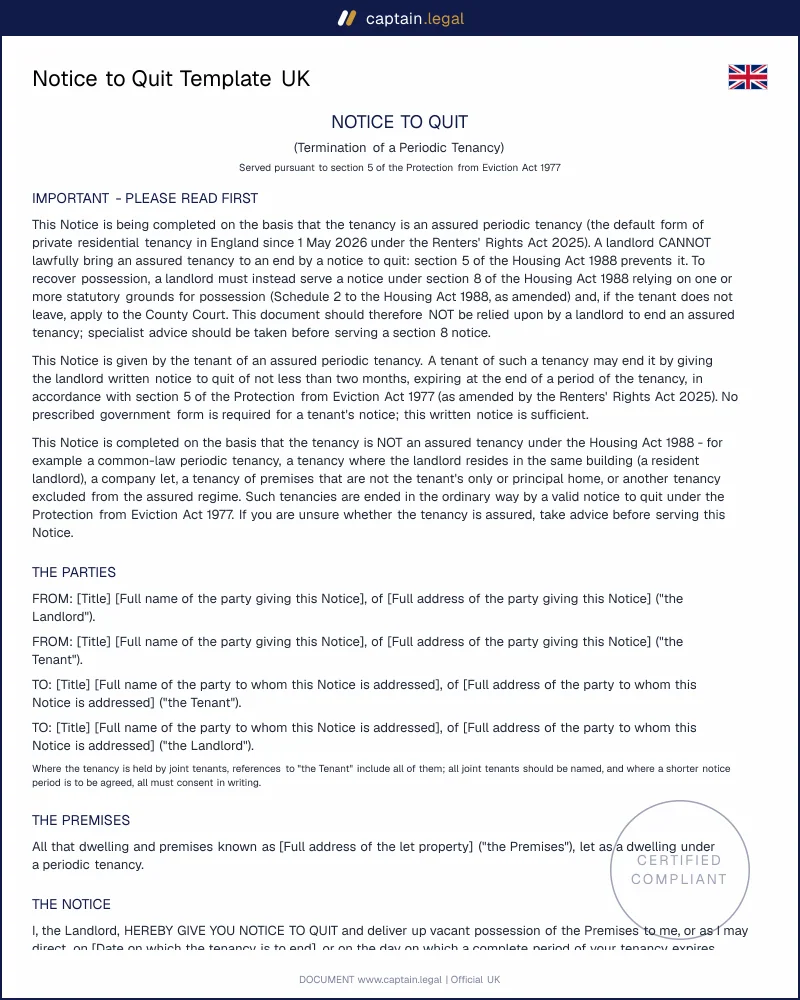
A Notice to Quit is the written notice a tenant or, in limited cases, a landlord uses to bring a periodic tenancy to a lawful end. This template is built for periodic tenancies in England and Wales and gives the statutory minimum notice required under the Protection from Eviction Act 1977, with the correct prescribed information and an expiry date that lines up with the rent period. It is the document you reach for when a tenancy rolls on month to month and one side needs to end it cleanly, without a dispute over whether the notice was even valid. You can edit it in Word, sign it, and export a clean PDF for service.

Most people who land here are tenants ending an assured periodic tenancy, or occupiers and licensees outside the assured regime who still need a notice that holds up. The rules changed materially on 1 May 2026, and a notice drafted to the old wording is a notice that can be challenged.

Compliant

2026 Legislation

50,000+ clients

trust us

Affordable

From $4.90 / doc

Secure payment

Instant download

Notice to Quit Template | Protection from Eviction Act 1977

Secure payment · No subscription

Fill in the template

What is a Notice to Quit?

A Notice to Quit is a unilateral, written notice that terminates a periodic tenancy at the end of a rental period. It is the common law instrument for ending a tenancy that runs from week to week or month to month, as opposed to a fixed-term tenancy that ends by effluxion of time. The notice does not ask the other side to agree. Served correctly, it brings the legal relationship to an end on the date it specifies, and the tenancy simply stops renewing.

It helps to separate the Notice to Quit from the two documents people confuse it with. A landlord seeking possession on fault grounds now serves a section 8 notice under the Housing Act 1988, not a Notice to Quit. The old section 21 "no-fault" route was abolished for assured tenancies on 1 May 2026 by the Renters' Rights Act 2025, so a landlord can no longer end an assured tenancy by Notice to Quit at all. The Notice to Quit survives in two practical situations: a tenant ending their own assured periodic tenancy, and a landlord or tenant ending a tenancy that sits outside the assured regime, such as a common law tenancy or certain licences. If you are a landlord trying to recover possession of an assured tenancy, this is the wrong document and you need a possession route under the Housing Act. Our Section 8 notice template for possession proceedings covers that path. Getting the label right matters, because the law treats the substance of the arrangement, not the heading you put at the top.

2

When do you need this document?

The most common scenario by far is a tenant ending an assured periodic tenancy because they are moving on. Since the 2025 reforms removed fixed terms, a tenant no longer waits out a contractual end date; they serve two months' written notice and leave. A tenant taking a new job in another city, buying a home, or simply wanting out of a tenancy that has gone sour all uses the same instrument. The second frequent case is a joint tenancy where the tenants are separating. Here the notice is delicate, because all joint tenants usually must agree to any shorter notice period, and one tenant's notice can end the tenancy for everyone.

Beyond assured tenancies, the Notice to Quit remains the right tool for common law tenancies that fall outside statutory security, for example a company let or a tenancy at a high rent, and for periodic licences to occupy that are caught by the four-week rule. Resident landlords letting on a non-excluded basis also rely on it. One edge case worth flagging is the excluded occupier, such as a true lodger sharing the owner's home: that arrangement sits outside the Protection from Eviction Act 1977 regime entirely, so the strict prescribed-information rules do not bite and the notice follows the contract instead. If you are letting a room in your own home, the lodger agreement and excluded occupier licence explains where that line falls. Mislabelling an excluded occupier as an assured tenant, or the reverse, is the single most expensive mistake in this area.

3

Key clauses included in our template

  • The identification of the parties and the premises names the tenant, the landlord or their agent, and the full address of the let property. A notice that misnames a joint tenant or describes the property loosely invites a challenge, so the template prompts for every adult tenant in possession, not only the person who signed the original agreement.
  • The statement of the notice period and expiry date is the clause that most often fails in practice. The template fixes the period to your rent cycle, applies the Protection from Eviction Act 1977 four-week floor or the assured two-month rule as relevant, and sets an expiry date that falls at the end of a rental period rather than mid-month.
  • The prescribed information block reproduces the wording required by the Notice to Quit (Prescribed Information) Regulations 1988, telling the recipient that a court order is needed before eviction and where to get advice. Omitting this renders the notice void, even where the period is otherwise correct.
  • The service and dating clause records how the notice was given and when, because the four-week or two-month clock runs from service, not from drafting. The template leaves room to record personal delivery, first-class post, or any method the tenancy agreement specifies.
  • The signature and authority line confirms who is giving the notice and in what capacity. Where an agent serves on behalf of a landlord, the notice states the agent's authority, a detail that closes off a common technical objection.
4

Regional considerations

England and Wales share the Protection from Eviction Act 1977, but the wider tenancy regime has diverged since devolution, so the route depends on where the property sits. In England, the Renters' Rights Act 2025 reforms took effect on 1 May 2026: all assured tenancies are now periodic, section 21 is gone, and a tenant's Notice to Quit must give at least two months unless a shorter period is agreed in writing. A landlord cannot use a Notice to Quit to end an assured tenancy here at all, and must instead rely on a section 8 ground.

In Wales, the framework is the Renting Homes (Wales) Act 2016, which replaced tenancies with "occupation contracts" and uses its own notice machinery rather than the Notice to Quit familiar in England. A periodic standard contract holder gives notice under that Act, and the terminology and minimum periods differ, so an England-drafted notice should not be used for a Welsh let without adjustment. Check which side of the border the property falls before serving.

Scotland sits entirely outside this regime. The private residential tenancy under the Private Housing (Tenancies) (Scotland) Act 2016 governs most lets, with tenant notice given to the landlord under that Act and landlord possession routed through the First-tier Tribunal. Northern Ireland runs its own scheme under the Private Tenancies (Northern Ireland) Order 2006 as amended, with notice periods that scale by length of tenancy. For employment-linked accommodation that ends when a job ends, the position can interact with the contract of employment, and our full-time employment contract template is a useful reference point for tied housing arrangements.

5

How to fill out this Notice to Quit

You start by telling the template who is serving the notice and on what kind of tenancy, because that single answer decides whether the four-week floor or the two-month assured rule applies. From there you enter the parties and the property address, and the form prompts for every adult tenant so a joint tenancy is captured correctly. Next you set the rent period and the day rent falls due, and the template calculates an expiry date that respects both the statutory minimum and the common law requirement that the notice end at the close of a period.

The prescribed information is built in, so you do not have to draft the court-order and advice wording yourself; it is inserted automatically to match the Notice to Quit (Prescribed Information) Regulations 1988. You then record how and when you intend to serve the notice, which fixes the start of the notice clock. Finally you review, sign, and export. The document downloads in Word if you need to adjust a clause and in PDF for clean service and your records. If your situation also involves a deposit or rent evidence, the rent receipt and tenancy rent statement template pairs naturally with the notice for a complete file.

6

Common mistakes to avoid

The error that sinks more notices than any other is the wrong expiry date. A monthly tenant who serves notice to end on the 20th, when rent falls due on the 1st, has served an invalid notice, because the common law requires expiry at the end of a rental period. The fix is simple arithmetic done up front, but it is missed constantly. Close behind is the period itself: tenants of assured tenancies who still give one month, on the assumption the old rules apply, fall two clear months short of what the Renters' Rights Act 2025 now requires. Serving four weeks where two months is needed is the same as serving nothing.

Two further traps recur. Joint tenants frequently forget that all of them must agree before a shorter notice period binds, and that one tenant acting alone can end the tenancy for the whole household, sometimes unintentionally. And many people leave out the prescribed information entirely, copying a bare "I give you notice to quit" line from an old letter; without the Notice to Quit (Prescribed Information) Regulations 1988 wording, the notice is void no matter how generous the period. Finally, keep proof of service. A notice that cannot be shown to have been delivered, and dated, is a notice you may have to serve all over again, and the clock starts from zero each time. The statutory declaration template for sworn evidence is one way landlords and tenants record service when a dispute looks likely.

Key takeaways

Who can use it

This is mainly for tenants, not landlords

A Notice to Quit is designed to end a periodic tenancy without needing the other side to agree. Since 1 May 2026, landlords cannot use a Notice to Quit to end an assured tenancy at all because the old section 21 route has gone. If you are a landlord seeking possession of an assured tenancy, you need the Housing Act 1988 route (typically a section 8 notice), not this template.

Notice period

Two months minimum for assured tenants

For a tenant ending an assured periodic tenancy, the rule now bites hard: since 1 May 2026 you must give at least two months' notice unless the landlord agrees to a shorter period. A notice drafted to the pre-2026 wording can be challenged, which risks the tenancy continuing and you still being liable for rent. Build the expiry date around that two-month floor.

Validity rules

Writing, prescribed info, and the right expiry date

Section 5 of the Protection from Eviction Act 1977 makes validity technical. The notice must be in writing, include the prescribed information, and meet minimum timing rules. Four weeks is the statutory floor, but common law often requires more: the notice should run for a full rental period and expire at the end of a tenancy period (or the day before the next one starts). Get this wrong and the notice may fail.

Frequently Asked Questions

Yes. A Notice to Quit is a legal instrument under the Protection from Eviction Act 1977, and once served correctly it ends the periodic tenancy on the date it specifies, with no further agreement needed from the other side. The template is drafted to the statutory requirements: written form, the prescribed information from the Notice to Quit (Prescribed Information) Regulations 1988, and a compliant minimum period. What makes it binding is correct completion and proof of service, not the document alone. If the expiry date or notice period is wrong, the notice fails regardless of how it is worded, which is why the template calculates those elements for you rather than leaving them to guesswork.

For an assured periodic tenancy in England, a tenant must give at least two months in writing, unless the landlord agrees a shorter period in writing, following the Renters' Rights Act 2025 changes that took effect on 1 May 2026. For tenancies outside the assured regime, and for periodic licences caught by the Protection from Eviction Act 1977, the minimum is four weeks, or a full period if the rent period is longer than four weeks. A quarterly tenancy needs a full quarter, and a yearly tenancy needs six months. The notice must also expire at the end of a rental period.

No, not since 1 May 2026. The Renters' Rights Act 2025 abolished both fixed terms and the old section 21 route for assured tenancies, so a landlord can no longer end an assured tenancy by Notice to Quit. A landlord who wants possession must rely on one of the statutory grounds in section 8 of the Housing Act 1988 and serve the corresponding notice, then obtain a court order. The Notice to Quit remains available to landlords only for tenancies outside the assured regime, such as certain common law tenancies. Using a Notice to Quit against an assured tenant achieves nothing and wastes time you may not have.

Three elements are non-negotiable. The notice must be in writing, it must give the correct minimum period, and it must include the prescribed information set out in the Notice to Quit (Prescribed Information) Regulations 1988. That prescribed wording tells the recipient that a landlord needs a court order before eviction, that proceedings cannot start until the notice expires, and that the recipient can get advice from a solicitor, Citizens Advice or a housing aid centre. A notice missing any of these is void, even if the notice period itself is generous. The template builds all three into the document automatically.

It should expire at the end of a rental period, or on the day before the next period begins. If your rent runs from the 1st to the last day of the month, the notice should end on the last day of a month, not part-way through. This common law rule applies in addition to the minimum period, so a monthly tenant giving two months' notice on 10 June would set expiry for the end of August, not 10 August. Government guidance for the 2026 reforms refers to ending on a rent day or the day before, which works where rent falls due on the first of the period. The template handles this calculation once you enter your rent date.

Yes, in one specific situation. The Renters' Rights Act 2025 inserted a new section 5A into the Protection from Eviction Act 1977, which lets a tenant withdraw a Notice to Quit on an assured tenancy before it takes effect, provided the tenant and landlord agree the withdrawal in writing. This reversed the long-standing common law rule that a notice, once served, could not be retracted. Outside assured tenancies the old position broadly still applies, so a notice on a common law tenancy or licence cannot simply be cancelled. Where there are joint tenants, all of them and the landlord must agree to any withdrawal in writing.

The Notice to Quit downloads in both Word and PDF. The Word version lets you adjust any clause to match an unusual rent period, an agent's authority, or a shorter agreed notice, while the PDF gives you a clean, fixed copy for service and for your records. Keeping the signed PDF, together with a note of how and when you served it, builds the proof of service you will need if the date is ever questioned. For tenants and landlords assembling a wider tenancy file, the deposit receipt and prescribed information template and other real estate documents export in the same formats so everything stays consistent.

4.7/5

23 verified reviews · 50 000+ downloads

Notice to Quit Template | Protection from Eviction Act 1977
  • Immediate access to the document
  • PDF + Word download
  • Compliant with 2026 legislation
  • Reviewed by lawyers
Fill in the template
Secure payment · No subscription
Updated on June 7, 2026

You might also like

Form 4A Section 13 Notice UK
Deposit Receipt & Prescribed Information