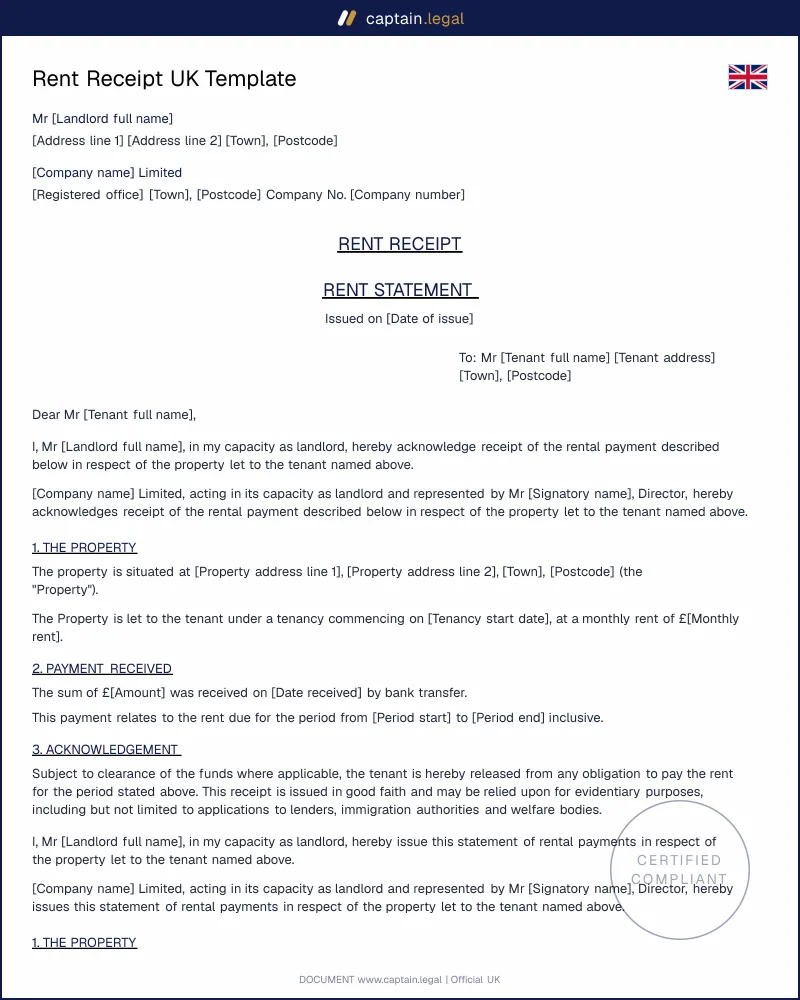
A rent receipt is a written acknowledgement signed by the landlord (or the managing agent) confirming that a specific sum of rent has been paid by the tenant for a defined period. Under English law it is not a tenancy contract but an evidentiary document : it proves payment, dates the transaction, and protects both parties if a dispute later arises before a county court or the First-tier Tribunal (Property Chamber). Tenants typically request one when applying for Universal Credit, when a mortgage lender asks for proof of housing costs, when claiming Housing Benefit from a local authority, or simply when the deposit is being returned at the end of an assured shorthold tenancy. Captain.Legal generates a UK-compliant rent receipt or rent statement in PDF and Word, ready to sign and send.
The document exists in two flavours that practitioners often confuse. A rent receipt covers a single payment, dated and signed at the moment the funds are received. A rent statement is a cumulative ledger that lists every payment over a tenancy or financial year, useful for landlords filing a Self Assessment return with HMRC and for tenants needing a paper trail for credit applications.
Compliant
2026 Legislation
50,000+ clients
trust us
Affordable
From $4.90 / doc
Secure payment
Instant download
Rent Receipt UK Template | PDF & Word Download
Secure payment
What is a rent receipt?
A rent receipt under English and Welsh law is a unilateral written statement issued by the landlord — or the letting agent acting on the landlord's behalf — that records the payment of a specific instalment of rent. It must identify the property, the parties, the period covered, the amount paid, the method of payment (bank transfer, standing order, cash, cheque), and the date the funds cleared. Once signed, it becomes admissible as evidence under section 9 of the Civil Evidence Act 1995 and discharges the tenant pro tanto from the corresponding rent obligation.
The document is distinct from a rent book, which is a continuous record of payments that a landlord must legally provide when rent is paid weekly under section 4 of the Landlord and Tenant Act 1985. A rent receipt is single-occurrence ; a rent book is cumulative and statutory in narrow circumstances. The rent statement sits between the two : it is not legally mandatory but follows the same logic as a rent book, listing every payment received over a tenancy, often with running balances and arrears columns. For tenants relying on benefit applications or mortgage referencing, the statement is usually the more comprehensive UK real estate document of the two, because it shows continuity rather than a one-off transaction.
Legal framework
English and Welsh tenancy law does not impose a general duty to issue a rent receipt for every payment, but the Landlord and Tenant Act 1985 contains a narrow obligation that catches landlords by surprise. Section 4 requires that, where rent is payable weekly, the landlord must provide the tenant with a rent book or similar document containing prescribed information. Failure to comply is a criminal offence punishable by a fine on the standard scale, prosecuted by the local authority. Most modern assured shorthold tenancies under the Housing Act 1988 are paid monthly, which technically takes them outside the section 4 obligation, but tribunals and county courts routinely expect a paper trail and treat its absence as evidence of poor management. The Department for Levelling Up, Housing and Communities published clear guidance for both parties, summarised on the official gov.uk page on private renting and landlord responsibilities, which remains the reference point for evidentiary practice.
Beyond the 1985 Act, several statutes interact with rent receipts in practice. The Tenant Fees Act 2019 prohibits landlords from charging for the issuance of receipts, since these are not within the limited list of permitted payments. The Data Protection Act 2018 and UK GDPR impose retention and minimisation duties when rent records contain personal data, which is almost always the case. HMRC requires landlords subject to Self Assessment to retain rental records for at least five years and ten months after 31 January following the tax year, under the Finance Act 2009. For Section 21 possession proceedings, accurate rent records are essential because a Section 21 eviction notice in the UK cannot be served if certain prescribed information has not been provided to the tenant, and arrears statements are routinely produced at the Form N5B stage. Recent case law from the Court of Appeal (Trecarrell House Ltd v Rouncefield [2020] EWCA Civ 760) has reinforced that documentary compliance is reviewed forensically, which makes a clean receipt trail more than a courtesy.
When do you need this document?
The single most common trigger is a tenant request for proof of payment, usually when applying for Housing Benefit or Universal Credit Housing Element through the local authority or the Department for Work and Pensions. Caseworkers want a dated receipt or a rolling statement covering at least the last three months ; without it, the housing element can be suspended pending verification. The next scenario is a mortgage application : when a tenant moves towards purchasing a property, the lender's underwriting team will demand twelve months of rent payments evidenced in writing, and a series of bank statements alone is rarely accepted because it does not prove that the recipient was actually the landlord. A signed rent statement closes that evidential gap.
Cash payments make a written receipt non-optional. Where a tenant pays in cash — still common in houses in multiple occupation and short-term licensee arrangements — the absence of a receipt creates a prima facie presumption against the landlord if arrears are later disputed. Letting agents handling client money under the Client Money Protection Schemes (Approval and Designation of Schemes) Regulations 2018 must, in practice, issue receipts to maintain audit compliance with their CMP scheme. Two edge cases deserve flagging : tenants on a tenancy agreement template offered by Captain.Legal UK who pay through a third-party guarantor often need the receipt issued in the guarantor's name for tax purposes, and serviced-accommodation hosts subject to VAT must annotate the receipt with the VAT element to support input-tax recovery.
Key clauses included in our template
- The identification of the parties and the property is drafted to satisfy Land Registry conventions : full legal name of the landlord (or the registered company number when the freeholder is a limited company), the tenant's full name as it appears on the tenancy agreement, and the property address with postcode in the format used on HM Land Registry title plans. Vague descriptions like "the flat above the shop" are replaced with the demised premises as defined in the underlying assured shorthold tenancy.
- The payment details block records the gross amount in pounds sterling, the rental period it covers (start and end dates inclusive), the method of payment, and the date the funds were received in cleared form, not the date the standing order was issued. This distinction matters when arrears are computed, because under the Common Law Procedure Act 1852 and modern banking practice the obligation is discharged on receipt, not on dispatch.
- The acknowledgement of discharge is the operative wording that turns the document into evidence. It states that the sum acknowledged is received in full and final settlement of the rent due for the stated period, with an express reservation in respect of any other sums (utilities, service charge contributions, dilapidations) that remain outstanding under the tenancy. The reservation prevents a tenant from arguing accord and satisfaction over unrelated breaches.
- The running balance section in the rent statement variant lists every payment made over the chosen period, with columns for date, amount, method, and arrears or credit balance. The template auto-totals the figures so that the document can be lodged with our UK personal legal documents library as supporting evidence in benefit appeals or possession proceedings.
- The signature block carries the landlord's or agent's signature, a printed name, the capacity in which the document is signed (landlord, agent, director), and the date of signature. Where an agent signs, the template inserts the standard "for and on behalf of" wording that prevents personal liability under the Companies Act 2006 signing rules.
How to fill out this rent receipt
You begin by selecting whether the document is a one-off rent receipt or a multi-line rent statement, and the form adjusts the layout accordingly. The next screen asks for the property address and the type of underlying tenancy, because the statutory references printed in the footer differ between an assured shorthold tenancy under the Housing Act 1988, a common law tenancy outside the AST regime (high-value lettings above the £100,000 annual rent threshold, company lets, holiday lets), and a licence to occupy in shared accommodation. From there, you fill in the parties, the rental amount, the payment method, and either the single payment date or the date range for the statement.
Captain.Legal then generates a print-ready PDF and an editable Word file with your firm's or your personal letterhead at the top, the body in standard Times New Roman 11 used by most English county courts, and the signature block aligned for handwritten or e-signed execution. The system stores the document in your dashboard, where you can re-issue it later for the same tenancy without re-entering the parties, which saves time across a portfolio of properties drawn from our UK business legal documents catalogue when a limited-company landlord manages multiple lets.
Common mistakes to avoid
Practitioners see the same handful of errors repeated, and each one undermines the evidential weight of the receipt. The first is dating the document with the date of issue rather than the date of receipt of cleared funds ; when a standing order arrives on the 28th but the receipt is signed on the 30th, the tenant should not be shown as in arrears for those two days, and a sloppily dated receipt creates exactly that confusion in front of a district judge. The second is omitting the rental period altogether — "received £1,200 from John Smith" says nothing about whether the payment relates to March, April, or a part-period, and the burden of clarification falls on the landlord at trial.
A third common slip is signing in a personal capacity when the freehold is held by a limited company. Under section 44 of the Companies Act 2006, a company executes a document either by two authorised signatories or by a single director in the presence of a witness ; a casual scribble from a sole shareholder-director without the "for and on behalf of" wording can be challenged. Fourth is the failure to reserve other sums : a receipt phrased as "in full settlement" without the carve-out can be deployed by a tenant to defeat a later claim for unpaid utilities or end-of-tenancy dilapidations, on the basis of accord and satisfaction. Finally, landlords frequently forget to keep their own copy ; under HMRC retention rules and routine tenancy disputes, the absence of a counter-signed file copy is treated as a gap in the records, and tribunals draw an adverse inference accordingly.
Frequently Asked Questions
30 verified reviews · 50 000+ downloads
- Immediate access to the document
- PDF + Word download
- Compliant with 2026 legislation
- Reviewed by lawyers
You might also like