For charities in England and Wales the governing statute is the Charities Act 2011, read alongside the common law of fiduciary duties and the Charity Commission's guidance CC29, which the Commission refreshed and reissued on 22 April 2026 after a rise in conflict-related casework. The underlying principle is far older than the statute. A trustee must not place themselves in a position where interest and duty conflict, a rule the courts have applied stringently since Keech v Sandford (1726) and restated in cases such as Re Thompson's Settlement. The rule bites on the existence of the conflict itself, not on proof that the trustee was actually influenced, which is why declaration and withdrawal matter even when everyone trusts everyone.
The statute supplies the specifics. Connected persons are defined at section 188, capturing a trustee's spouse or civil partner, children, parents, siblings, grandchildren and grandparents, business partners, and any organisation in which the trustee or those relatives hold a controlling or substantial interest. Section 185, as amended by the Charities Act 2022 with effect from 31 October 2022, sets out the statutory power and the four conditions (A to D) under which a trustee or connected person may be paid for providing goods or services to the charity, the reference to goods being the substantive 2022 reform. Where the board cannot meet those conditions, or the charity's own governing document prohibits the payment, authority must come from the Commission under section 201. Disposals of charity land to a connected person engage separate rules under section 118. Trustees making any such decision are held to the duty of care in section 1(1) of the Trustee Act 2000.
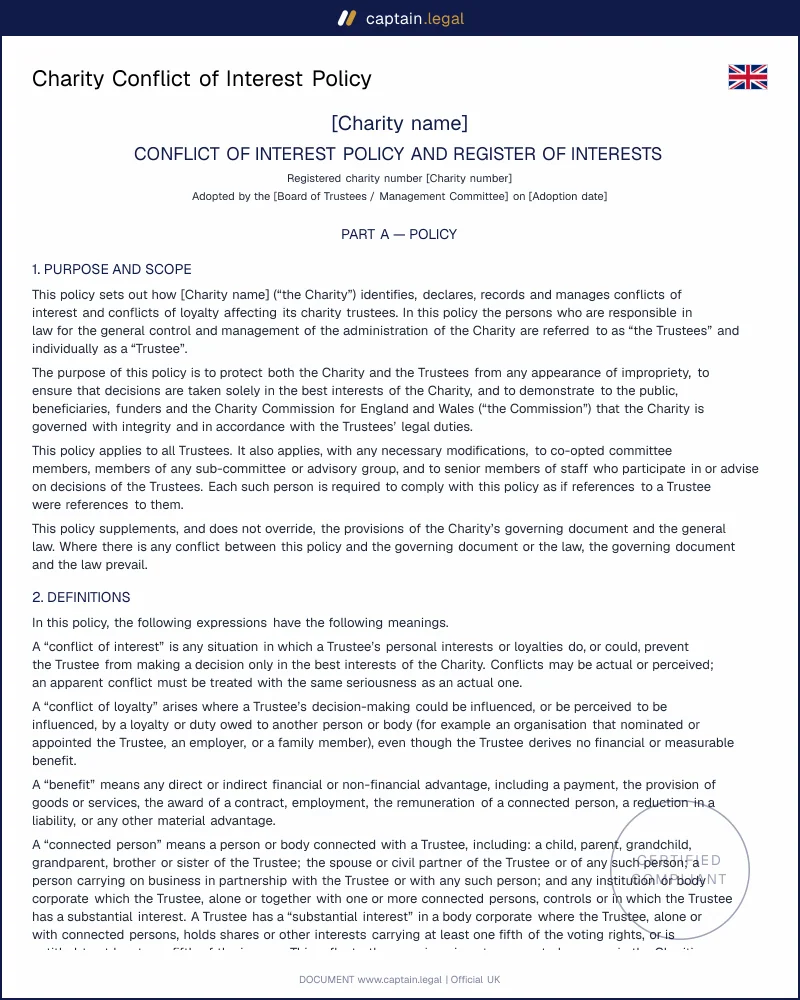
Layered on top, charitable companies carry director duties under the Companies Act 2006, and CIOs are governed by the Charitable Incorporated Organisations (General) Regulations 2012. The Commission's full position is set out in its official CC29 guidance on identifying and managing conflicts of interest in a charity, which the board should treat as the benchmark its conduct will be measured against. A robust policy is the natural companion to your charity's governing constitution under the Charities Act 2011, since the two documents must not contradict each other on quorum and voting.