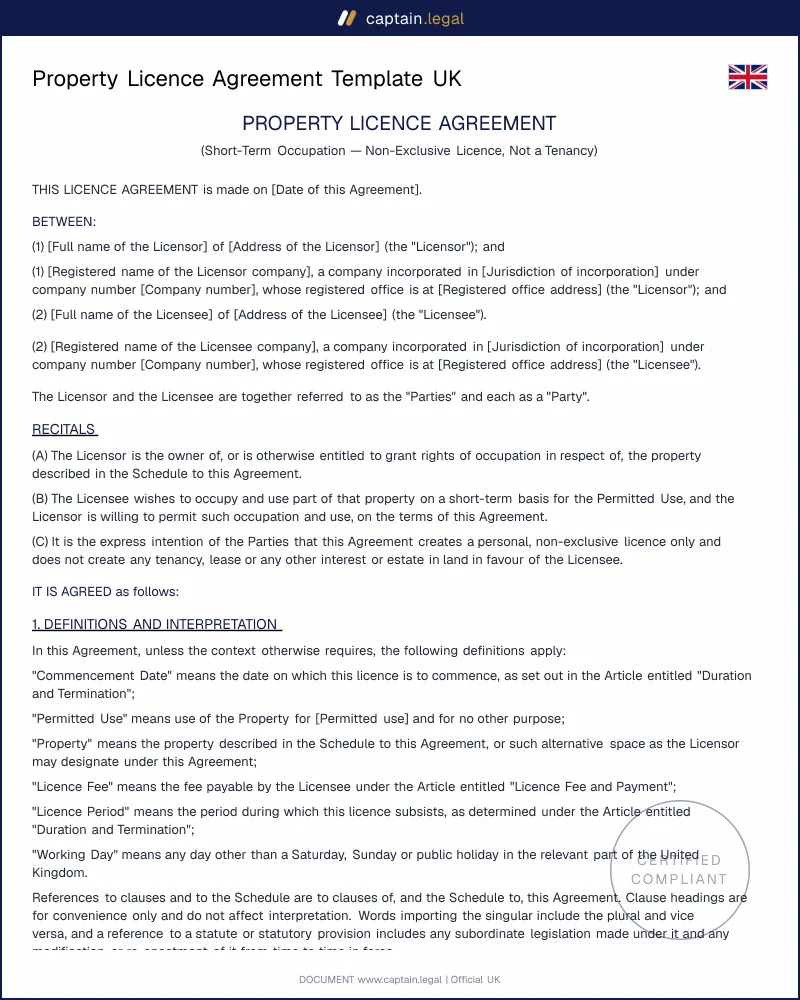
The governing authority is Street v Mountford [1985] AC 809, the House of Lords decision that fixed the modern test. Lord Templeman held that an occupier of residential premises at a rent for a term is either a tenant or a lodger, and that the decisive question is whether the agreement grants exclusive possession. His reasoning is famous: if you build a five pronged tool for digging, you have made a fork, even if you insist on calling it a spade. Applied to property, this means that a document headed "licence" creates a tenancy if it actually grants exclusive possession for a term at a rent, and the parties cannot contract out of that result by choosing a different name. Courts are expressly directed to detect and frustrate sham devices whose only object is to disguise the grant of a tenancy.
For residential occupiers, the Protection from Eviction Act 1977 sits over the top. Section 3 requires a court order to evict most residential occupiers, but section 3A carves out excluded licences, the classic example being a licensee who shares living accommodation with a resident owner. An excluded licensee can be required to leave on reasonable notice without a possession order, although the owner still cannot use force or harassment, since section 1 makes unlawful eviction and harassment a criminal offence. The full statutory wording is published by the government on the official record of the Protection from Eviction Act 1977 maintained by legislation.gov.uk, which is the source you should check before relying on any notice period.
Where the arrangement is genuinely commercial, a separate consideration applies. A true licence falls outside the Landlord and Tenant Act 1954, so the occupier acquires no security of tenure and no automatic right to renew. That is often the precise commercial reason for using a licence rather than the structured commercial lease for business premises in England and Wales, where security of tenure is a deliberate feature. The Renters' Rights Act 2025, which reshaped residential possession from 1 May 2026, applies to tenancies, not to genuine licences, which is another reason the licence route remains useful for short and non-exclusive occupation.