Create my document
Login

Choose country

FranceBelgiqueEspañaUnited StatesUnited KingdomالمغربDeutschlandItalia
Leave Request

Statutory Sick Pay Decision Letter UK | Word & PDF Template

Tell employees clearly if they qualify for SSP, which days are paid and what happens if not. Avoid the "agreed in the corridor" dispute. Download now.
4.7/512 reviews50 000+ downloadsInstant download
Share

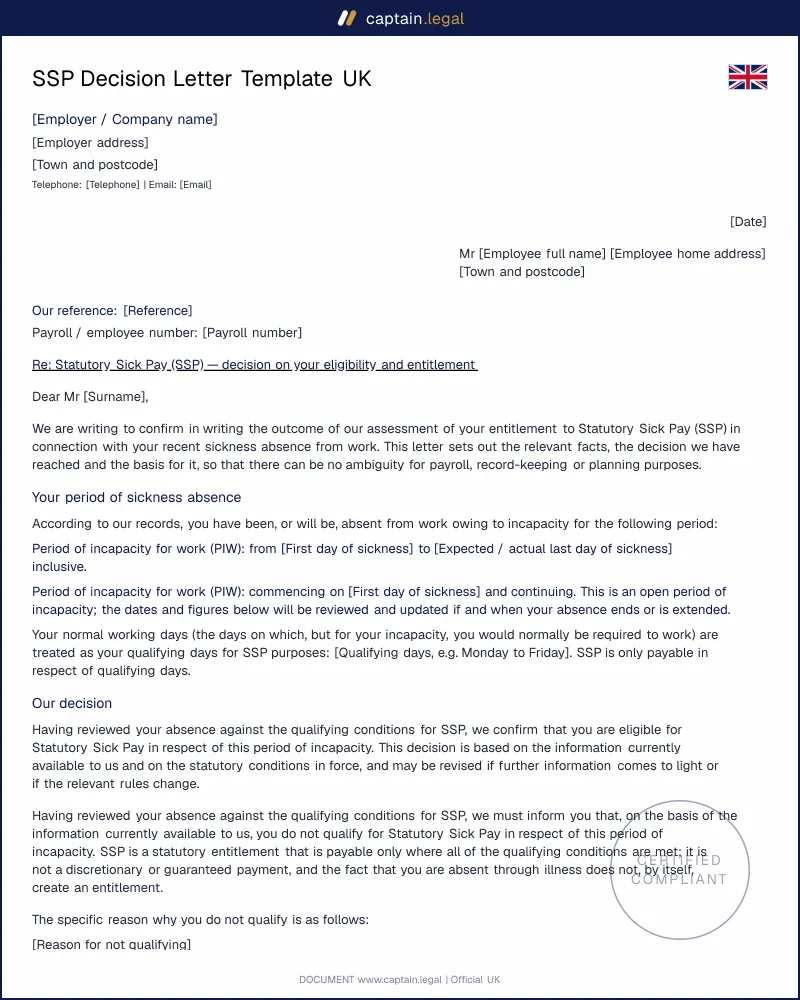
A Statutory Sick Pay decision letter is the document a UK employer issues to tell an employee, in writing, exactly how their sickness absence will be treated for SSP purposes: whether they qualify, which days are being paid, and what happens if they do not meet the statutory test. It is aimed at line managers, HR officers, and small business owners who need to confirm a sick pay outcome cleanly, without leaving the worker guessing and without exposing the business to a later dispute. A good SSP decision letter records the decision payroll will act on, gives the employee a clear explanation of the law applied to their absence, and protects you when someone later claims they were "told" something different in passing.

Most sick pay arguments do not start over the money. They start over what was said, when, and by whom. A letter closes that gap.

Compliant

2026 Legislation

50,000+ clients

trust us

Affordable

From $4.90 / doc

Secure payment

Instant download

Statutory Sick Pay Decision Letter UK | Word & PDF Template

Secure payment · No subscription

Fill in the template

What is a Statutory Sick Pay decision letter?

A Statutory Sick Pay decision letter is a written notification from employer to employee confirming the outcome of an SSP assessment for a specific period of sickness absence. It is not the absence policy, and it is not the fit note. It is the decision itself: the employee was off from a stated date, you assessed eligibility against the statutory rules, and this is the result, set out so that payroll, the employee, and any future reader all see the same thing.

People often confuse this letter with two neighbours. The first is the self-certification form, which the employee completes for short absences and which feeds into your decision rather than replacing it. The second is form SSP1, the statutory exclusion notice you must issue when an employee does not qualify for SSP or when their entitlement is ending, so they can claim Universal Credit or Employment and Support Allowance instead. A decision letter can sit alongside an SSP1, but it does a different job: it explains the reasoning in plain English and confirms the approved dates for your own records. Where the absence overlaps with annual or family leave, the letter also stops the two entitlements being quietly conflated, which is why it pairs naturally with the rest of your UK leave request and absence templates.

2

When do you need this document?

The obvious trigger is an employee returning from, or remaining on, sickness absence where you need to confirm in writing what they will be paid. A verbal "yes, you'll get sick pay" is the seed of most later complaints, because the employee hears a guarantee and you meant something more conditional. Issue the letter as soon as the eligibility position is clear, ideally before the next payroll run so the figures on the payslip match the figures in the letter.

You also need it when you are saying no. Telling someone they do not qualify is harder than telling them they do, and doing it in a measured letter, with the reason and the route to other support, is far safer than a hurried message. Where the answer is no, the decision letter should be issued alongside the statutory SSP1 form, not instead of it, because the SSP1 is what lets the employee claim other benefits. A separate situation arises when an absence is long and you are confirming that the 28-week SSP maximum is approaching, which the employee needs to plan around. The harder edge cases are the ones that justify a careful template. An employee whose sickness absences fall within 56 days of each other forms a single linked period, so the entitlement clock does not reset, and a letter that treats each spell as fresh will overpay or underpay. The other classic is the disability-related absence, where a correct SSP calculation can still sit inside an unlawful pattern of treatment, and the letter should be drafted with that risk in mind rather than as a pure payroll note. If the absence is being managed alongside a formal process, align the wording with your UK dismissal letter that follows the ACAS Code so the two documents do not contradict each other.

3

Key clauses included in our template

  • The identification and absence dates open the letter by naming the employee, their role, and the precise first and last days of the sickness period being assessed. Confirming approved dates in writing is the single most useful function of the document, because it removes the "agreed in the corridor" dispute where nobody can later say which days were actually authorised.
  • The eligibility determination states plainly whether the employee qualifies for SSP and applies the current statutory test rather than the pre-2026 one. It is drafted so that a positive decision does not accidentally imply a guarantee for future absences, and a negative decision gives the genuine reason rather than a vague refusal.
  • The payment detail sets out the weekly rate applied, the qualifying days used in the calculation, and the period covered, so payroll can act on the letter without a second conversation. Where the earnings-linked figure bites, the clause explains why the amount is lower than the headline flat rate.
  • The evidence and certification clause records what was relied on: the employee's self-certification for the first seven calendar days, and the fit note required after that. It avoids asking for medical detail the law does not entitle you to see, keeping the request proportionate under data protection principles.
  • The SSP1 and signposting clause appears where the employee does not qualify or is reaching the 28-week limit, confirming that an SSP1 is enclosed and pointing the employee toward the benefits they can claim instead. Pairing this with a clean record of the decision protects both sides if the matter is ever reviewed.
4

Regional considerations

Statutory Sick Pay is a single UK-wide regime, so the same statutory rate, eligibility test, and 28-week maximum apply in England, Scotland, Wales, and Northern Ireland without the local variation you see in tenancy or family law. An employer in Glasgow and an employer in Cardiff assess SSP identically, and the Employment Rights Act 2025 changes took effect everywhere on the same date. This is one of the few areas of UK employment administration where you do not need to ask which nation the worker is in before answering the pay question.

The variation that does matter is contractual rather than geographic. Many employers operate an occupational or company sick pay scheme that sits on top of SSP, often paying full salary for a set number of weeks before dropping to the statutory floor. Where that is the case, the decision letter should make clear which layer it is dealing with, because an employee who reads "you qualify for sick pay" may assume the enhanced contractual rate when you mean the statutory minimum. The terms of any enhanced scheme will live in the contract or the staff handbook, so the letter should cross-refer to those documents rather than restate them. If your contractual sick pay terms are unclear or outdated, that is a contract problem to fix at source, for example through your Section 1 statement of written particulars, not something to patch over in a one-off decision letter. Northern Ireland operates parallel legislation in some employment areas, but for SSP the position mirrors Great Britain, so a template drafted to the current statutory rules works across the whole United Kingdom.

5

How to fill out this Statutory Sick Pay decision letter

You begin by entering the employer and employee details and the exact dates of the sickness absence, because everything else in the letter depends on the period being defined precisely. From there the template asks whether the employee meets the current eligibility test, and it deliberately does not surface the old waiting-days or earnings-threshold language, so you cannot accidentally apply the pre-2026 rules. Once you confirm eligibility, you enter the qualifying days the employee normally works and the average weekly earnings figure where relevant, and the document frames the payment outcome around those inputs.

If the decision is that the employee does not qualify, the letter shifts tone and prompts you to enclose an SSP1 and to signpost alternative support, rather than leaving a bare refusal. You then add any reference to a contractual sick pay scheme so the statutory figure is not mistaken for an enhanced one. The final step is to record the evidence relied on, the self-certification or fit note, and to date and sign the letter for your records. The output downloads in editable Word and clean PDF so you can keep a consistent house style across every absence decision, much as you would with a zero-hours contract template for irregular staff.

6

Common mistakes to avoid

The most damaging error is sending a letter built on the old SSP rules. Plenty of templates still in circulation talk about three unpaid waiting days and a lower earnings limit, and using one now misstates the employee's entitlement in writing, which is exactly the kind of document that surfaces against you later. The second common failure is implying that SSP is guaranteed. A warm, reassuring letter that says the employee "will of course be looked after" reads as a promise, and if the statutory criteria are not met you have created an expectation you cannot honour. State the position as a decision under the rules, not as a favour.

Managers also routinely forget that linked periods within 56 days are treated as one continuous absence, so they reset the clock with each spell and either overpay or, worse, deny entitlement that has actually carried over. Another frequent slip is treating a disability-related absence as a pure payroll matter; the SSP figure can be perfectly correct while the wider handling breaches the Equality Act 2010. Finally, employers either ask for too much medical evidence too early, demanding a fit note inside the first seven days when self-certification is sufficient, or they fail to issue the SSP1 when someone does not qualify, leaving the worker unable to claim other support. Keep the evidence request proportionate and the signposting complete, and most of these problems disappear. If absence has tipped into a capability process, make sure your redundancy notice letter compliant with the ERA 1996 or other formal documents do not cut across the sick pay position.

Key takeaways

Purpose

Put the SSP decision in writing

This letter is not a fit note or your absence policy: it is the written outcome of an SSP assessment for a specific sickness period. It should state the dates off, whether SSP is payable, and which days payroll will pay. Getting it down in black and white stops the later “you told me in passing” argument about what was said, when, and by whom.

2026 reforms

Use the post-6 April 2026 rules

From 6 April 2026 the old SSP mechanics no longer apply, and a letter repeating them is worse than silence because it misstates rights in writing. The three unpaid waiting days have been removed, so SSP can be due from the first qualifying day. The lower earnings limit has also gone, so eligibility no longer turns on an earnings threshold.

Pay and proof

Confirm the rate and keep records

Your decision letter should make clear what will be paid and why, so payroll and the employee see the same calculation. Under the 2026/27 approach, SSP is the lower of 80% of average weekly earnings or the flat weekly rate of £123.25, worked out by reference to the days normally worked. Enforcement has tightened, so accurate records and prompt payment reduce exposure to non-compliance action.

Frequently Asked Questions

The letter itself is a record of a decision rather than a contract, so it does not create rights on its own; the entitlement comes from the Social Security Contributions and Benefits Act 1992 and the Statutory Sick Pay (General) Regulations 1982 as amended by the Employment Rights Act 2025. What the letter does is evidence how you applied those rules to a particular absence, which is what protects you in a payroll query, a grievance, or a tribunal. To be reliable it must reflect the current law, including day-one payment and the removal of the earnings threshold from 6 April 2026. A letter that states the position accurately and is signed and dated carries real evidential weight even though it is not, in itself, the source of the obligation.

SSP is payable for a maximum of 28 weeks in any single period of incapacity for work. Crucially, separate absences are treated as one continuous period where they fall within 56 days of each other, so the 28-week limit is not refreshed every time someone returns and goes off sick again shortly after. When the 28 weeks are approaching, you must issue an SSP1 form so the employee can claim other support such as Universal Credit or Employment and Support Allowance. Your decision letter should flag the approaching limit in advance rather than letting the payment simply stop, because a worker who is surprised by the cut-off is far more likely to dispute it than one who was told in writing.

You do not refuse SSP as a discretion; you assess whether the statutory criteria are met, and if they are not, you confirm that the employee does not qualify. Since 6 April 2026 the eligibility test is much wider, because the lower earnings limit no longer applies, so refusals are rarer than they used to be. Where someone genuinely does not qualify, for example because they are self-employed and pay their own tax, you must issue an SSP1 alongside your decision letter so they can pursue other benefits. Communicate the no in writing, with the reason and the alternative route, never as an offhand verbal comment. A measured letter reduces the chance the decision is read as personal or unfair.

The template downloads in both editable Microsoft Word and clean PDF. The Word version lets you adjust the wording for your house style, insert your letterhead, and tailor the eligibility and payment clauses to the specific absence, while the PDF gives you a tidy, fixed copy to send to the employee and file with your payroll records. Keeping both is sensible: edit in Word, send and archive the PDF. Because sick pay decisions tend to recur across a workforce, having a reusable editable master saves you rebuilding the letter from scratch each time and keeps your absence correspondence consistent.

Issue it as soon as the eligibility position is settled, and in practice before the next payroll cut-off so the figures on the payslip match the letter. The longer the gap between the absence and the written confirmation, the more room there is for the employee to misremember what was agreed, which is the precise dispute the document exists to prevent. For ongoing long-term sickness, do not wait until the absence ends; confirm the position periodically and flag the 28-week point well ahead. Prompt, dated letters also matter more now that the Fair Work Agency can pursue SSP non-compliance, since they demonstrate you handled the decision properly and on time.

No fit note is required for the first seven calendar days of sickness, during which the employee self-certifies, usually on a short form you provide. From the eighth day onward you can reasonably require a fit note from a healthcare professional to support continued absence. Asking for medical evidence inside the first week is not only unnecessary but risks looking heavy-handed, and you should never demand clinical detail beyond what the fit note provides, since the data you collect must stay proportionate. Your decision letter should record which evidence you relied on so the basis of the SSP outcome is transparent, but it should not reproduce sensitive medical information that you have no need to retain.

It can, and the overlap is where mistakes happen. SSP and annual leave can run concurrently in some situations, and an employee on long-term sick can continue to accrue statutory holiday, which then needs handling on return. Family leave such as maternity or shared parental leave has its own pay and notice rules that should not be folded into a sick pay decision. The cleanest approach is to keep each entitlement on its own document so the dates and amounts never blur together. If an absence is shifting between sickness and another type of leave, record each change distinctly rather than treating it all as one continuous "time off", and lean on dedicated forms for each category so the audit trail stays clear.

4.7/5

12 verified reviews · 50 000+ downloads

Statutory Sick Pay Decision Letter UK | Word & PDF Template
  • Immediate access to the document
  • PDF + Word download
  • Compliant with 2026 legislation
  • Reviewed by lawyers
Fill in the template
Secure payment · No subscription
Updated on May 30, 2026

You might also like

adoption-leave-request-form-uk-statutory-template-word-pdf
Maternity Leave Request