Create my document
Login

Choose country

FranceBelgiqueEspañaUnited StatesUnited KingdomالمغربDeutschlandItalia
Leave Request

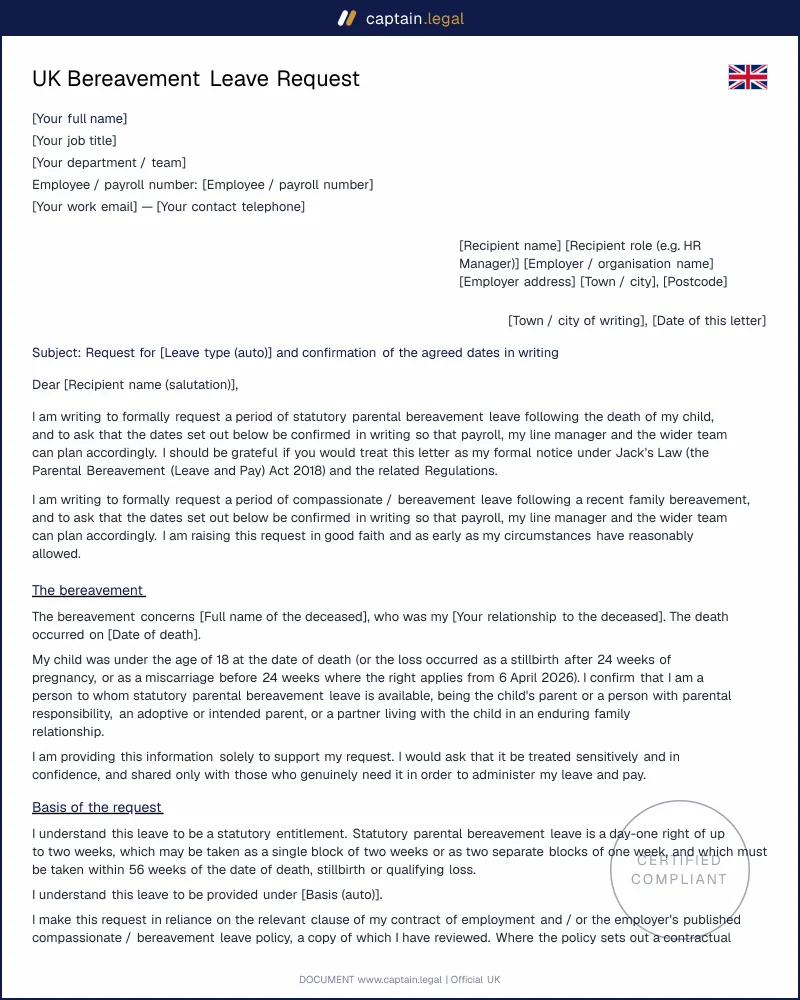
UK Bereavement Leave Request Template (Word & PDF)

Handle bereavement and compassionate leave properly. Capture dates, basis and pay in writing, avoid the "agreed in the corridor" dispute. Word & PDF.
4.7/517 reviews50 000+ downloadsInstant download
Share

A compassionate or bereavement leave request is the written application an employee uses to ask for time away from work after the death of a relative, partner, or someone close, or when a loved one is seriously ill. In the UK there is no single statutory entitlement covering every situation, so the form does double duty: it captures the request, and it records whether the leave being granted is contractual, discretionary, or statutory. For an employer, that distinction is the whole point. A request logged properly tells payroll how to treat the days, tells the team when the absence starts and ends, and settles in advance the question that causes most grievances later, namely what was actually agreed and on what basis.

Compliant

2026 Legislation

50,000+ clients

trust us

Affordable

From $4.90 / doc

Secure payment

Instant download

UK Bereavement Leave Request Template (Word & PDF)

Secure payment · No subscription

Fill in the template

What is a compassionate or bereavement leave request?

A compassionate leave request and a bereavement leave request are close cousins, and UK workplaces often use the terms loosely, but they are not identical. Bereavement leave is time off following a death. Compassionate leave is the wider umbrella, covering a death but also a critically ill relative, a family emergency, or the aftermath of a loss that needs practical attention. The request document sits underneath both: it is the employee's written ask, addressed to a line manager or HR, naming the person affected, the relationship, the dates sought, and whether the employee expects the time to be paid.

What makes the UK version distinctive is that the request must flag its legal basis, because the answer changes the employer's obligations entirely. If the deceased was a dependant, the Employment Rights Act 1996 gives a right to reasonable unpaid time off. If the employee is a bereaved parent, Statutory Parental Bereavement Leave applies and the days are protected from day one. Everything else is governed by the contract or by the employer's goodwill. A well-drafted request prompts for exactly the information needed to place the absence in the right box, without demanding intrusive detail the employer has no business asking for. That balance, dignity for the employee and a clean record for the business, is what separates a professional template from a scribbled note approved in passing.

2

When do you need this document?

The most obvious trigger is the death of an employee's immediate family member, where the person needs a few days to grieve, arrange a funeral, and deal with the estate. Here the request should record the relationship and the dates, and the employer's response should state plainly whether the days are paid under the contract or taken as discretionary compassionate leave. The second common scenario is a critically ill relative, where the time off is anticipatory rather than reactive: an employee whose parent is in end-of-life care may need intermittent days, and a written request lets both sides plan around a difficult and unpredictable period.

A third situation is the time off for dependants emergency under section 57A, which often arrives with no warning at all, a sudden death requiring the employee to leave mid-shift. The request may be completed after the fact in these cases, formalising an absence that was authorised verbally in the moment. Bereaved parents form a distinct category: a parent invoking Jack's Law is exercising a statutory right, not asking a favour, and the document should record it as such so payroll applies statutory parental bereavement pay correctly.

Two edge cases regularly catch employers out. The first is the death of someone who is not a legal dependant, a grandparent who raised the employee, a long-term partner not formally a civil partner, a close friend treated as family. There is no statutory right here, but refusing all flexibility is a fast route to resentment and reputational damage; the request gives the employer a structured way to exercise discretion fairly. The second is a request that overlaps with an existing entitlement, such as an employee on maternity leave who suffers a bereavement, where you need to be careful not to disturb a protected leave period. Where an absence may stretch into longer-term sickness, pairing this document with our UK leave request category for sickness and unpaid absence keeps the paper trail consistent.

3

Key clauses included in our template

  • The statement of the basis for leave is the clause that does the heavy lifting. It asks the employee, and then confirms with the employer, whether the time off is statutory (Jack's Law), contractual (a defined compassionate leave entitlement in the handbook), or purely discretionary. This single field determines pay treatment, length, and the employee's protection, so it sits at the top of the form rather than buried in the detail.
  • The relationship and circumstances field captures who has died or fallen ill and the employee's relationship to them, in proportionate terms. It is drafted to gather only what the employer reasonably needs to assess the request, never sensitive medical or family detail beyond that, which keeps the document compliant with data-minimisation expectations and respectful at a painful moment.
  • The dates and duration block records the first and last day of absence and any phased or intermittent pattern, so payroll, the rota, and any handover can be planned precisely. This is the clause that defeats the "agreed in the corridor" dispute, because the approved dates are confirmed in writing and signed off.
  • The pay treatment confirmation states explicitly whether the days are paid in full, paid at a statutory rate, taken as annual leave, or unpaid. Leaving this implied is the single most common cause of post-absence payroll arguments, so the template forces a decision.
  • The handover and cover note lets the employee flag urgent matters and the manager record who will cover them, turning a sensitive absence into a managed one without adding pressure on the grieving employee.
4

Regional considerations

Employment law in this area is largely uniform across England, Wales, and Scotland, since the Employment Rights Act 1996, the Parental Bereavement (Leave and Pay) Act 2018, and the Equality Act 2010 all apply on a Great Britain basis. The right to reasonable time off for dependants, Jack's Law, and the absence of any general right to paid bereavement leave are the same whether the employer is in Cardiff, Edinburgh, or Manchester. Scotland's separate body of law touches family and succession matters, but the leave entitlements themselves are not devolved, so a single GB-wide template serves all three jurisdictions without modification.

Northern Ireland is the genuine exception and the point employers most often miss. Employment law there is devolved, and the governing statute is the Employment Rights (Northern Ireland) Order 1996 rather than the 1996 Act, with bereavement provisions delivered through the Parental Bereavement (Leave and Pay) Act (Northern Ireland) 2022. The substance closely mirrors the GB position, including the two-week parental entitlement, but the statutory references differ and the relevant guidance comes from the Labour Relations Agency rather than Acas. An employer operating in Belfast should confirm the citations in any written policy point to the Northern Ireland legislation. Using a GB-drafted document referencing Acas and the 1996 Act in a Northern Ireland workplace will not invalidate the leave, but it undermines the professionalism of the record if a dispute ever reaches a tribunal. Where a business operates across both, our UK employment contract and policy templates help align the wider paperwork so the leave request fits a coherent set of documents.

5

How to fill out this compassionate or bereavement leave request

You start by identifying yourself and your role, then naming the person who has died or is critically ill and your relationship to them, keeping the detail proportionate to what your employer reasonably needs. From there the form asks you to set out the dates you are requesting and whether you expect the absence to run as a continuous block or as separate days, which matters where a funeral and the estate sit weeks apart. The next step is the part most people skip and later regret: stating what basis you believe the leave falls under, whether you are a bereaved parent invoking your statutory right, relying on a compassionate leave clause in your contract, or simply asking your employer to exercise discretion.

The employer's side of the document then confirms the decision, records the agreed dates, and sets out the pay treatment in plain terms, so there is no ambiguity when payroll runs. If evidence is appropriate, such as confirmation of the funeral date for a parental bereavement claim, the form prompts for it without demanding anything intrusive. You finish by both parties dating and signing, which fixes the agreement and gives each side a copy. For a request you can complete and confirm in minutes, our UK leave request forms drafted for employers and staff walk you through each field in order.

6

Common mistakes to avoid

The error that causes the most trouble is failing to state the basis of the leave. A manager who approves "a few days off" without recording whether they are paid, statutory, or discretionary creates exactly the dispute the document is meant to prevent, because payroll, the employee, and any future tribunal all reconstruct the agreement differently. Closely related is treating every bereavement the same: applying a rigid "three days for any death" rule ignores that a parent losing a child has a statutory two-week right under Jack's Law, and that flattening it into a short contractual allowance can amount to denying a legal entitlement. Employers also routinely confuse compassionate leave with sick leave, paying Statutory Sick Pay for a bereavement that does not qualify, or vice versa, which creates payroll corrections and an unhappy employee.

A second cluster of mistakes turns on overreach and inconsistency. Asking a grieving employee for a death certificate or intrusive family detail, when none is needed, is both insensitive and a data-protection risk, so the request should gather only what the decision requires. Inconsistency is just as dangerous: approving one employee's compassionate leave generously and refusing another's on similar facts invites a discrimination or unfair-treatment claim, particularly where the difference correlates with a protected characteristic under the Equality Act 2010. Finally, many employers still rely on a verbal agreement and assume goodwill will hold, only to find months later that nobody can say what was promised. Capturing the decision in writing, with our UK dismissal and HR letter templates available for the harder conversations that sometimes follow long absences, keeps the whole record defensible.

Key takeaways

LEGAL BASIS

One form, three possible entitlements

In the UK there is no single bereavement right that fits every situation, so the request must state whether the leave is statutory, contractual, or purely discretionary. That label changes what the employer must do and how payroll treats the days. The template is designed to capture the facts needed to put the absence in the right box, without pushing for intrusive detail.

STATUTORY RIGHTS

Know what the law actually guarantees

Section 57A of the Employment Rights Act 1996 gives a right to a reasonable amount of unpaid time off when a dependant dies, but it does not set a fixed number of days. The main firm entitlement is Jack's Law: two weeks' parental bereavement leave from day one after the death of a child under 18 (or stillbirth after 24 weeks), with statutory pay only if eligibility conditions are met.

RECORD KEEPING

Put dates and pay in writing

Most disputes come from vague, informal agreements: who approved what, for how long, and whether it was paid. A written request fixes the start and end dates, names the relationship, and records what the employee expects on pay. That gives the team clarity for cover, gives HR an audit trail, and stops later grievances about what was agreed in a quick corridor chat.

Frequently Asked Questions

Once both parties complete and sign it, the document is a binding written record of what was agreed: the dates, the basis for the leave, and how the time is paid. It does not create a legal entitlement on its own, because the underlying right comes from your contract or from statute such as the Parental Bereavement (Leave and Pay) Act 2018. What the signed form does is fix the agreement in evidence, so neither side can later dispute the approved dates or the pay treatment. For an employer that is its real value: a clean, dated record that stands up if a grievance or tribunal claim ever questions how the absence was handled.

For most bereavements there is no fixed legal minimum. Section 57A of the Employment Rights Act 1996 gives a right to a "reasonable" amount of unpaid time off when a dependant dies, and reasonable usually means one to a few days to deal with the immediate practicalities. The clear exception is parental bereavement: a parent who loses a child under 18 has a day-one right to two weeks, taken in one block or as two separate weeks within a long window after the death. Many employers offer more than the legal floor through their own compassionate leave policies, which is why recording the basis of each request matters.

In most cases, no. UK law gives no general right to be paid for bereavement leave; the reasonable time off under section 57A is unpaid unless your contract says otherwise. The single statutory exception is Statutory Parental Bereavement Pay, available to eligible bereaved parents who have at least 26 weeks' continuous service. Many employers do choose to pay compassionate leave as a matter of policy, and some let you take the time as annual leave or sick leave instead so that you are paid. The request form confirms which of these applies so there is no surprise on your payslip.

Bereavement leave is time off specifically after a death. Compassionate leave is broader, covering a death but also situations like a critically ill relative or a family emergency that needs your attention. UK law does not formally define either term outside the parental bereavement rules, so most workplaces use "compassionate leave" as the umbrella and treat bereavement as one part of it. What matters in practice is not the label but the basis: whether the time is statutory, contractual, or discretionary, and whether it is paid. The request template records that basis clearly whichever name your employer uses.

Bereavement is by nature unforeseen, so the usual annual-leave notice rules do not apply. The expectation is simply that you tell your employer as soon as reasonably possible, give an estimate of how long you will be away, and confirm it in writing when you can. For an emergency death of a dependant, you may take the time first under section 57A and complete the request afterwards. For parental bereavement leave you have a generous window after the death to take the two weeks, so there is no pressure to decide the exact dates immediately.

Yes. The compassionate and bereavement leave request is delivered in an editable Word file and a clean PDF. The Word version lets you adapt the wording to your own handbook, add your organisation's name, and adjust the pay-treatment options to match your policy before circulating it to staff. The PDF gives you a fixed, professional copy to file once the request is approved and signed. Customising it once and reusing it across the business keeps your approach consistent, which is exactly what helps you defend a decision if two similar requests are ever compared.

It does. The template is built to handle discretionary requests as well as statutory ones, which matters because the people closest to us do not always fit the legal definition of a dependant. A grandparent, a close friend, or a long-term partner outside a civil partnership may not trigger the section 57A right, but a good employer will often grant time anyway. The request gives you a structured, dignified way to ask, and gives the employer a consistent basis on which to say yes, so discretion is exercised fairly rather than on the spot.

4.7/5

17 verified reviews · 50 000+ downloads

UK Bereavement Leave Request Template (Word & PDF)
  • Immediate access to the document
  • PDF + Word download
  • Compliant with 2026 legislation
  • Reviewed by lawyers
Fill in the template
Secure payment · No subscription
Updated on May 30, 2026

You might also like

Parental Bereavement Leave Form
Fit Note Request Letter Template