Create my document
Login

Choose country

FranceBelgiqueEspañaUnited StatesUnited KingdomالمغربDeutschlandItalia
Leave Request

UK Unpaid Leave Request Form | Word & PDF Template

Approve, refuse or counter discretionary unpaid leave in writing. UK-compliant form covering dates, conditions, service and benefits. Customise and download in minutes.
4.8/514 reviews50 000+ downloadsInstant download
Share

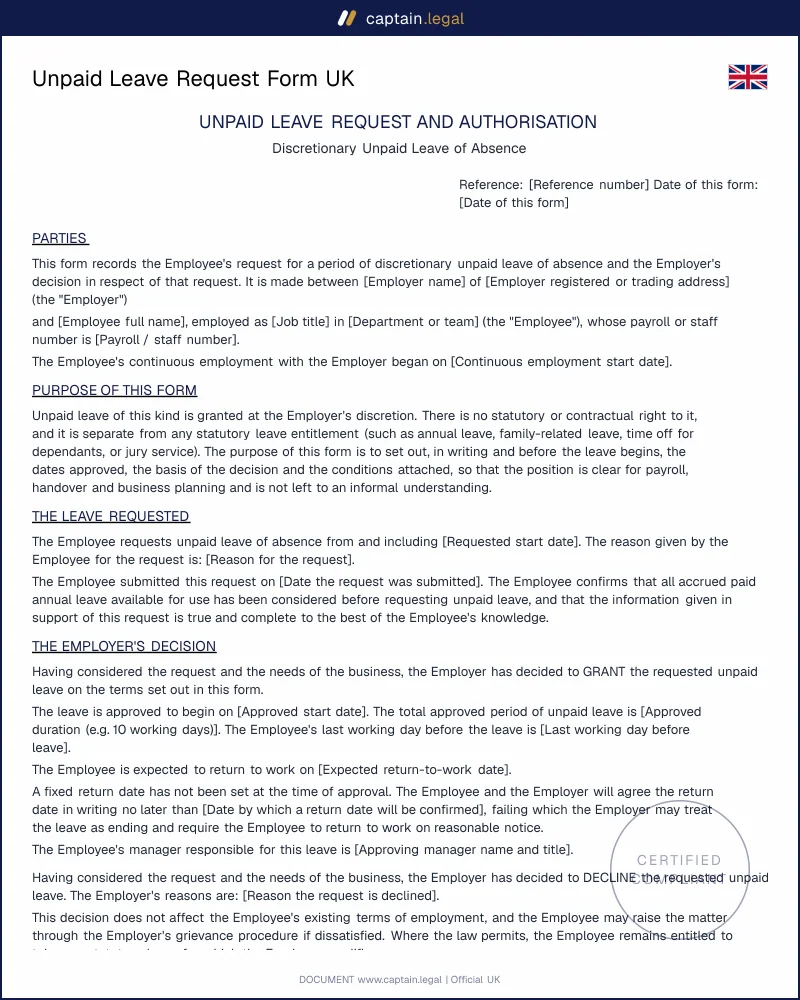
A discretionary unpaid leave request form records a request for time away from work where the employee has no statutory right to be paid and, in most cases, no automatic right to the leave at all. It sits in the grey area that every UK employer eventually meets: the career break, the extended trip home, the month off to care for a relative who does not meet the dependant test. The form captures the dates, the reason, the decision, and any conditions attached, then confirms everything in writing so that payroll, handovers, and rota planning all run from the same agreed facts rather than a half-remembered conversation by the kettle.

Compliant

2026 Legislation

50,000+ clients

trust us

Affordable

From $4.90 / doc

Secure payment

Instant download

UK Unpaid Leave Request Form | Word & PDF Template

Secure payment · No subscription

Fill in the template

What is an unpaid leave request form?

An unpaid leave request form is the document an employee completes to ask for a defined period away from work that the employer is not obliged to pay for and, outside a handful of protected categories, is not obliged to grant. It is the practical answer to a recurring problem: most unpaid absence in Britain is discretionary, meaning it rests on the employer's judgement and the wording of the contract rather than on any single statute. The form forces the request into a clear shape, with start and end dates, the reason where one is appropriate, and a space for the manager to approve, refuse, or propose alternatives.

It helps to separate this document from its statutory cousins. Unpaid parental leave and time off for dependants are legal rights with their own notice rules and cannot simply be refused on a whim, so they deserve their own dedicated paperwork. A discretionary unpaid leave form is for everything else: sabbaticals, study trips, religious observance beyond the holiday allowance, or extended personal time once annual leave runs out. If the request is actually a statutory one in disguise, do not process it on this form, because the legal tests and protections are different. Used correctly, this is the record that turns "I think we said yes to roughly two weeks" into a dated, signed decision both sides can rely on.

2

When do you need this document?

The most common trigger is the extended personal trip once an employee has exhausted their annual leave for the year. Someone wants four weeks to attend a family event abroad, has only one week of holiday left, and asks for the balance unpaid. The form lets you grant exactly three weeks unpaid, log it, and protect the rota rather than letting an open-ended absence drift. The second frequent scenario is the sabbatical or career break, where a long-serving employee wants several months away with a job to return to. Here the conditions matter as much as the dates, so the written decision should spell out whether continuous service, pension contributions, and benefits pause or continue.

Study and training absence is the next category. An employee on a part-time course may need block release for exams or placements beyond any contractual study leave, and recording it as discretionary unpaid leave keeps the arrangement clean. Religious observance is a quieter but real use: festivals that fall outside the standard holiday calendar are often handled as unpaid leave, and a consistent written approach is your best protection against a discrimination complaint. Treat two similar requests differently and you create the dispute yourself.

One edge case worth flagging is the request that looks discretionary but is not. An employee asking for a day to handle a sudden childcare collapse is exercising a statutory right to time off for dependants, not asking a favour, and you should reach for the right paperwork. The same is true of a parent invoking unpaid parental leave for a child under 18. Misfiling these as ordinary discretionary leave is a common route into an avoidable tribunal claim.

3

Key clauses included in our template

  • The request details capture the exact start and end dates, the total working days affected, and the reason for the absence where the employee chooses to give one. Precise dates are the single most useful thing on the form because they feed straight into payroll and rota planning and remove the "we said roughly a fortnight" argument before it starts.
  • The statement of discretionary status makes explicit that the leave is granted at the employer's discretion, is unpaid, and confers no precedent for future requests. This wording matters: it stops one approval being weaponised by the next applicant who points to it and says you must say yes again.
  • The decision and conditions section gives the manager room to approve, refuse with a reason, or counter-offer alternative dates, and to attach conditions such as completing a handover or returning company equipment. A refusal with a short, business-based reason is far easier to defend than a flat no.
  • The effect on service and benefits clause confirms what happens to continuous employment, pension contributions, holiday accrual, and other benefits during the absence, since employees routinely assume the answer and are then surprised. Annual leave continues to accrue during unpaid leave, so the form prompts you to address it rather than leave it ambiguous.
  • The return-to-work confirmation records the agreed return date and any phased or adjusted arrangement, closing the loop so the employee's reappearance is expected rather than a scramble. For longer breaks this is what stops a sabbatical quietly turning into an unauthorised absence.
4

Regional considerations

Employment law on leave is largely uniform across England and Wales and Scotland, since the Employment Rights Act 1996 and the Equality Act 2010 apply across Great Britain, so a single discretionary unpaid leave form works in all three nations. The practical differences sit in the surrounding processes rather than in the entitlement itself. In Scotland, court and tribunal procedure differs, and employment tribunals operate under their own Scottish arrangements, so an employer defending an inconsistent refusal should take local procedural advice rather than assuming the English route applies identically.

Northern Ireland is the genuine outlier and deserves a careful note. Employment law there is devolved and does not run on the Employment Rights Act 1996; the equivalent provisions live in the Employment Rights (Northern Ireland) Order 1996, with its own time-off-for-dependants and parental leave rules administered through separate machinery. The substance is broadly similar, but the statutory citations, the enforcement body, and several procedural deadlines differ, so a template built strictly to the Great Britain framework should be checked against Northern Ireland provisions before it is relied on across the Irish Sea. If you employ staff in both jurisdictions, do not assume one form covers both without review.

Beyond the national borders, the only regional variation that bites in practice is internal. Larger employers often delegate leave decisions to local managers, and that is precisely where consistency breaks down. A request approved in one office and refused in another, for no recorded reason, is the textbook setup for a grievance. Documenting each decision on the same form, with the same fields, is what keeps a multi-site business defensible.

5

How to fill out this unpaid leave request form

You start by entering the employee's details and the precise dates of the requested absence, including the total number of working days affected, because that figure is what payroll and your rota will key off. From there the form asks for the reason, which the employee can keep brief, and it prompts you to confirm whether any annual leave is being used alongside the unpaid period. The next stage hands the decision to the manager, who can approve the request as submitted, refuse it with a short business-based reason, or propose alternative dates that protect a busy period without sounding personal.

Once the decision is made, you set out the conditions: what happens to continuous service and pension contributions, whether benefits pause, and any handover the employee must complete before they go. The form then captures the agreed return date so the absence has a clear end. You finish by confirming everything in writing to the employee and keeping a signed copy on file, which is the step most "agreed in the corridor" disputes skip. The whole sequence is designed so the document adjusts to the type of request as you go, prompting for evidence or notice only where it is genuinely needed.

6

Common mistakes to avoid

The most expensive mistake is treating a statutory request as discretionary. An employee invoking time off for dependants or unpaid parental leave has a right you cannot simply decline, and processing it as an optional favour, then refusing, is a direct path to a claim. The mirror error is inconsistency: approving one person's month abroad and refusing another's with no recorded reason invites a grievance and, where the pattern tracks a protected characteristic, a discrimination complaint under the Equality Act 2010. Write the reason down every time, even when the answer is yes.

Employers also stumble on the boring details. Forgetting to confirm the decision in writing leaves both sides guessing about dates, which is exactly how the "we said roughly two weeks" argument starts. Failing to address continuous service, pension, and benefits means employees assume the most favourable answer and feel misled later. And leaving a long break open-ended, with no agreed return date, lets a sabbatical drift into what looks like an unauthorised absence. Pin the return date and the conditions before the leave begins, not after the employee has already gone. None of these errors is dramatic on its own, but each one quietly converts a routine absence into a dispute.

Key takeaways

Discretionary leave

Most unpaid leave is not a right

This form is for unpaid time off where there is usually no automatic entitlement and no obligation to pay. Think career breaks, extended travel, study trips, or extra religious observance once annual leave is used up. Because approval depends on the contract and your judgement, the form pins down start and end dates, the reason where relevant, and a clear yes, no, or counter-proposal.

Statutory exceptions

Do not use it for protected leave

Some unpaid leave is a legal right and needs different handling. Unpaid parental leave under the Maternity and Parental Leave etc. Regulations 1999 allows up to 18 weeks per child and can only be postponed for genuine business reasons. Time off for dependants under section 57A of the Employment Rights Act 1996 must be allowed when the test is met. Carer’s leave adds a day-one right to one week a year.

Written record

Put the decision and conditions in writing

A vague chat by the kettle is how disputes start. Recording the request, the decision, and any conditions means payroll, handovers, and rota planning all work from the same agreed facts. It also helps defend consistency: the Employment Rights Act 1996 offers little protection for discretionary leave, so a decision with no written basis is easier to challenge later as inconsistent or unfair.

Frequently Asked Questions

Yes, once both parties complete and sign it, the form records a binding agreement on the agreed dates, conditions, and treatment of pay. The document does not create new legal rights or override your contract; it captures the discretionary decision and the terms attached to it. For purely discretionary leave there is no statute dictating its content, so what makes it enforceable is the clear written agreement between employer and employee. If the leave is actually statutory, such as unpaid parental leave, the underlying legal right governs regardless of what the form says, which is why it matters to use the correct document for the type of request you are handling.

For genuinely discretionary unpaid leave, yes. Because there is no general statutory right to it, an employer can decline a request, particularly where granting it would disrupt the business, provided the refusal is consistent and not discriminatory. The picture changes for protected categories: unpaid parental leave can only be postponed for sound business reasons, not refused outright, and time off for dependants cannot be refused when the statutory emergency test is met. A short, business-based reason recorded on the form is far easier to defend than a flat no, and our UK employment contract templates reviewed by employment law professionals help set out the contractual position from the start.

The template is delivered in editable Microsoft Word format alongside a clean PDF. The Word file lets you adapt the wording to your own policy, add company branding, and adjust the conditions to fit a specific request, while the PDF gives you a tidy version to issue and store once the decision is final. Most employers customise the Word document once, then reuse it across the business so every leave decision runs on the same fields. Keeping a signed PDF on file is the record you will be glad of if a dispute over dates ever surfaces months later.

There is no fixed statutory notice period for discretionary unpaid leave, so the sensible default is whatever your contract or policy specifies, and failing that, as much notice as the length of the absence reasonably demands. A day off needs less warning than a three-month sabbatical, which realistically requires months of lead time so cover can be arranged. The form prompts the employee to state their proposed dates clearly, giving you time to assess the impact on the rota. Statutory categories carry their own notice rules, so a request for unpaid parental leave follows the parental leave notice requirements rather than your internal policy.

Generally no on continuity: a period of agreed unpaid leave does not normally break your continuous service, which protects rights that depend on length of employment. Statutory annual leave continues to accrue during unpaid leave, so you do not lose your holiday entitlement simply because you were away unpaid, though the detail of how it is calculated should be confirmed on the form. Pension contributions and other benefits are different and depend on the arrangement, which is exactly why the template includes a clause to record what pauses and what continues. Settling these points in writing before the leave starts avoids an unpleasant surprise on return.

For discretionary unpaid leave, you usually do need to give a reason, because the employer is being asked to exercise judgement rather than honour an automatic right, and the reason helps them weigh the request against operational needs. That said, the reason can be kept brief and the form does not require intrusive personal detail. Where the request falls under a statutory right, the position differs: time off for dependants, for instance, is tied to a specific emergency rather than a justification you must argue. Keeping requests proportionate, and decisions consistent, is the practical guide for both sides.

Yes, and most well-run approvals do. Conditions commonly cover completing a proper handover before departure, returning company equipment, confirming a fixed return date, and clarifying whether benefits or pension contributions pause for the period. Attaching reasonable conditions is entirely legitimate for discretionary leave and protects the business without making the decision feel personal. The key is that the conditions are recorded on the form and communicated clearly, so the employee agrees to them as part of the approval rather than discovering them afterwards. For longer absences, a documented return date is the single most useful condition you can set.

4.8/5

14 verified reviews · 50 000+ downloads

UK Unpaid Leave Request Form | Word & PDF Template
  • Immediate access to the document
  • PDF + Word download
  • Compliant with 2026 legislation
  • Reviewed by lawyers
Fill in the template
Secure payment · No subscription
Updated on May 30, 2026

You might also like

Fit Note Request Letter Template
Self-Certification Sickness Form