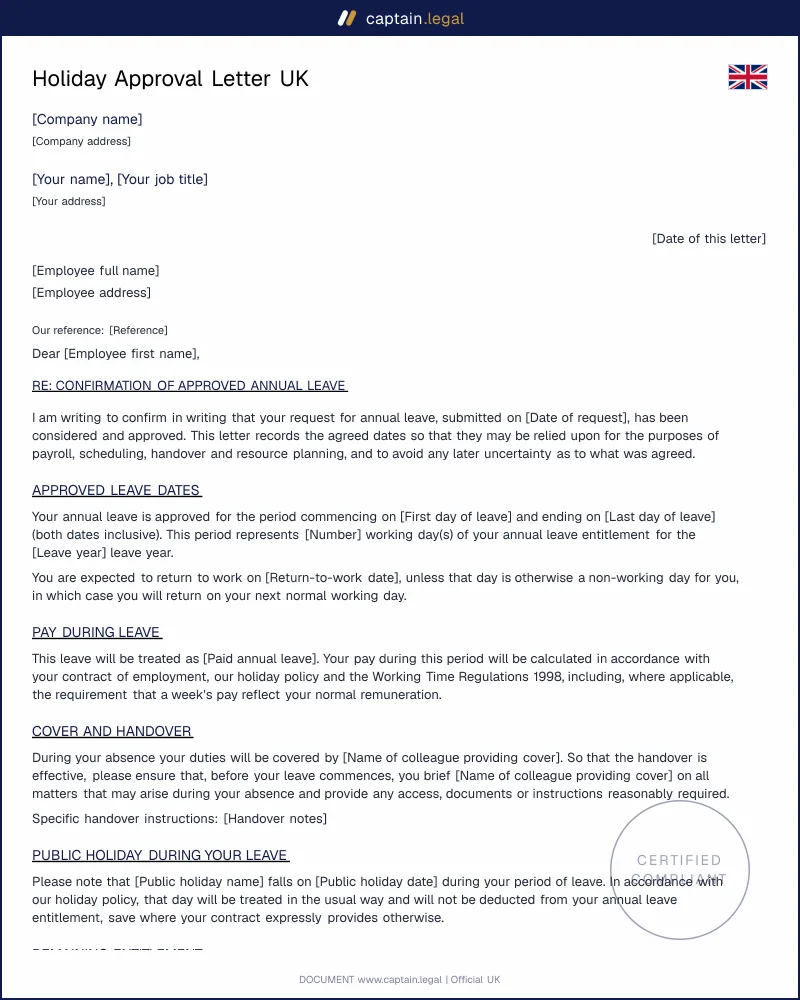
Holiday law in the United Kingdom is largely uniform, but the document should reflect the right legal backdrop depending on where your staff are employed.
England and Wales share the same framework under the Working Time Regulations 1998 and the Employment Rights Act 1996, and this is the baseline our template is built around. The eight permanent bank holidays in England and Wales are not a separate statutory right; whether they count towards the 5.6-week entitlement or sit on top of it depends entirely on the contract. An approval letter should therefore make clear whether bank holidays inside the requested period are being deducted or not, because silence on this point is a frequent cause of friction. Employers here also rely on the same notice and counter-notice mechanism in regulation 15 when managing competing requests.
Scotland applies the same Working Time Regulations and the same 5.6-week minimum, since employment law is reserved to Westminster rather than devolved. The practical difference is the public holidays : Scotland observes a different mix, including dates such as 2 January and local trades holidays, so a letter approving leave around those dates should be drafted against the Scottish calendar rather than the English one. The substance of the approval is identical, only the surrounding holiday pattern shifts.
Northern Ireland runs on its own statute, the Working Time Regulations (Northern Ireland) 2016, which mirrors the Great Britain entitlement of 5.6 weeks but is a distinct legal instrument. Northern Ireland also has additional public holidays, notably St Patrick's Day and the Twelfth of July, that affect how working days are counted. An employer with staff across the Irish Sea should adapt the statutory reference accordingly, while the operative content of the approval, dates, day-count, and balance, stays the same throughout.