Create my document
Login

Choose country

United KingdomUnited KingdomChoose country
Personal

Deed Poll UK | Enrolment of Deeds Regulations 1994

Deed poll drafted to the Enrolment of Deeds (Change of Name) Regulations 1994. Unenrolled or enrolment-ready, wet-ink execution. Word & PDF download.
4.8/519 reviews50 000+ downloadsInstant download
Share

A deed poll is the standard legal instrument used to change your name in England and Wales, and this template gives adults a properly drafted, ready-to-sign version accepted by HM Passport Office, the DVLA, banks, HMRC and employers. At common law your name changes the moment you start using a new one consistently, but institutions rarely take your word for it. They want a signed deed that records the old name, the new name, and a binding promise to abandon the former. This page explains how a deed poll works, what the Enrolment of Deeds (Change of Name) Regulations 1994 actually require, the difference between an unenrolled and an enrolled deed, and how to execute the document so no bank or passport caseworker sends it back.

Compliant

2026 Legislation

50,000+ clients

trust us

Affordable

From $4.90 / doc

Secure payment

Instant download

Deed Poll UK | Enrolment of Deeds Regulations 1994

Secure payment · No subscription

Fill in the template

What is a deed poll for an adult change of name?

A deed poll is a deed made by one party only, which is where the name comes from : historically the parchment was "polled", or cut straight along the edge, to distinguish a one-sided deed from an indenture signed by two parties. In name-change practice it is the written record that you have renounced your former name and adopted a new one for all purposes. The document does three things at once. It states your intention to abandon the old name absolutely, it commits you to use the new name at all times, and it authorises third parties to address you and record you under the new name.

The key point most people miss is that the deed does not create your new name; your usage does. English law has never operated a central name register, and a person aged 16 or over is free to adopt any name at common law. The deed poll is evidential and formal only, a proposition confirmed by the High Court in Re PC (Change of Surname) [1997] 2 FLR 730. That is why an unenrolled deed, signed and witnessed at your kitchen table, carries the same legal effect as one lodged at the Royal Courts of Justice. What changes between the two is not validity but the strength and permanence of the proof. If you are recording a change after marriage or divorce, note that a deed poll and a change of name after separation are governed by the same common-law freedom, though a marriage or final order can sometimes evidence the change without a separate deed.

2

When do you need this document?

The most common trigger is a straightforward personal decision : reverting to a birth name after divorce, adopting a partner's surname without marriage, or simply choosing a name you identify with. In each case the passport, driving licence and bank records need a document they will accept, and a properly executed deed poll is the format every UK institution recognises. A second frequent scenario is updating identity documents after a long period of informal use, where you have been known socially by a new name but never recorded it formally and now need to align your paperwork.

Deed polls also come into play when surnames need to match within a family, for instance where a step-parent's surname is adopted by agreement, or when someone wants their documents to reflect a religious or cultural name. Watch this edge case : if you are married or in a civil partnership and you intend to enrol the deed, the 1994 Regulations require your spouse to be notified and to consent, which the unenrolled route avoids entirely. Another situation worth flagging is the multiple change. If you have changed your name more than once, HM Passport Office expects a complete paper trail linking every version, and without it caseworkers will ask for a statutory declaration instead. This template is built for adults aged 18 and over; a person aged 16 or 17 can make their own unenrolled deed, while a change for a younger child requires everyone with parental responsibility to act on the child's behalf under the Children Act 1989.

3

Key clauses included in our template

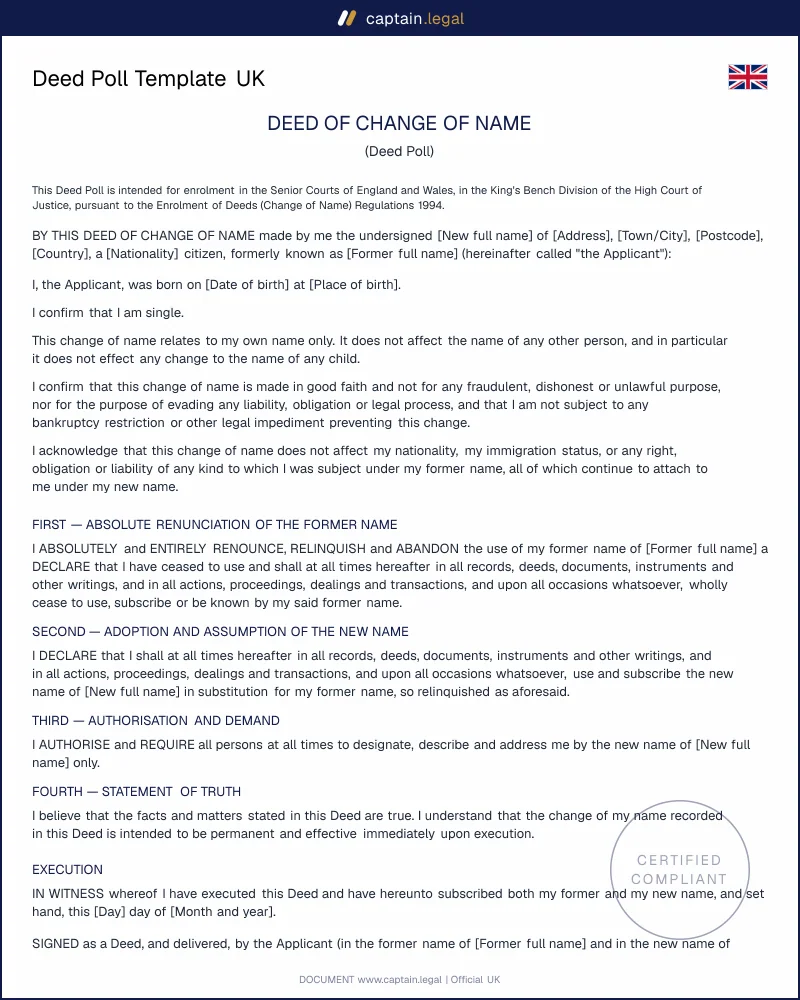
  • The declaration of abandonment and adoption is the operative heart of the deed. It states unequivocally that you renounce your former name, that you adopt the new name for all purposes, and that you undertake to use the new name at all times and to require others to do the same. Vague drafting here is the single most common reason a bank rejects a home-made deed.
  • The dual-signature execution block is drafted so that you sign in both your old name and your new name, which the 1994 Regulations require for enrolment and which most institutions expect even for unenrolled deeds. The block is laid out for wet-ink signature, since digital signatures are not accepted on a deed poll.
  • The witness attestation provides for the required independent adult witnesses, with space for their full names, addresses and occupations. Our template accommodates two witnesses so the same document works whether you keep it unenrolled or later decide to enrol, and it flags that a witness should not live at your address or be a close relative.
  • The citizenship and status recital lets you describe yourself as a British citizen with the relevant section of the British Nationality Act 1981, and as single, married, widowed or divorced. This wording is optional for a purely unenrolled deed but becomes mandatory if you ever enrol, so building it in now saves redrafting.
  • The date and delivery clause records the date of execution and confirms the deed is delivered, satisfying section 1 of the Law of Property (Miscellaneous Provisions) Act 1989. A deed that is signed but never dated invites argument about when the change took effect.
4

Regional and practical considerations

This deed poll is drafted for England and Wales, where the common-law freedom to change your name and the enrolment procedure at the Royal Courts of Justice both apply. If you were born or currently live in Scotland, the position differs : a change of name is usually recorded through National Records of Scotland, which can issue a new Scottish birth certificate rather than relying on a deed poll, and many Scottish residents use that route instead. A deed poll executed in England and Wales is still recognised by UK-wide bodies such as HM Passport Office and the DVLA regardless of where you live, so the document remains useful across the whole of the United Kingdom.

In Northern Ireland, deed polls operate on similar common-law principles, but enrolment where required is handled through the Royal Courts of Justice in Belfast rather than London, so check the local procedure before assuming the England and Wales enrolment route applies. For anyone with a connection to the Isle of Man or the Channel Islands, the deed will generally be accepted by UK government departments, though local registries may have their own preferences.

The practical distinction that matters most is not geographic but institutional. Some banks, building societies and utility providers still insist on an enrolled deed poll even though government departments accept the unenrolled version. If a specific organisation has told you it requires enrolment, you need the fuller court process. For everyone else, the unenrolled deed executed with this template is sufficient, and if you later need certified copies for different institutions, keeping several signed originals is far simpler than requesting them from the central document catalogue after the fact.

5

How to fill out this deed poll

You begin by entering your current full legal name exactly as it appears on your existing identity documents, then the new full name you intend to adopt, taking care that the new name is pronounceable and free of numbers, symbols or titles, since the courts refuse names that imply a rank or commercial status you do not hold. From there the template assembles the abandonment and adoption wording around your details and prepares the dual-signature block in both names. You then add your citizenship description and marital status, which you can leave in whether or not you plan to enrol.

When the document is ready, you print it on good-quality single-sided paper and sign it in wet ink in the presence of your witnesses, who sign immediately afterwards and add their details. Do not sign before the witnesses are watching, because a deed witnessed after the fact is exactly what caseworkers are trained to reject. Once executed, the deed takes effect at once and you can start notifying institutions. Our witness statement template uses the same attestation discipline if you need a companion document, and the deed downloads in both Word and PDF so you can adjust wording before printing the final version.

6

Common mistakes to avoid

The most frequent error is treating the deed as self-executing paperwork that needs no witnesses, or having a spouse or housemate witness it. An independent adult who neither lives with you nor is closely related to you is what institutions expect, and a deed witnessed by a family member at the same address is routinely refused. Almost as common is the digital-signature trap : people sign a PDF electronically and are surprised when the bank returns it, because a deed poll must be signed in wet ink by both the maker and the witnesses. A third recurring problem is an incomplete name history, where someone who has changed their name before submits only the latest deed and cannot produce the earlier documents linking each version, which forces HM Passport Office to demand a statutory declaration instead.

People also stumble over the enrolled-versus-unenrolled question, paying for the court process when a simple deed would have done, or assuming enrolment makes the change "more legal" when the Court of Appeal has confirmed it does not. Watch the choice of name itself, since names that are offensive, that end in something like "Ltd", or that imply a professional qualification you lack will be refused. Finally, many people forget that the deed is only the first step. The change has no practical effect until you actually notify each institution, and the ones you overlook, an old pension provider or a dormant account, are precisely the ones that cause problems years later. Recording the change carefully alongside your will and estate documents avoids a mismatch that can complicate probate.

Key takeaways

LEGAL EFFECT

Your name changes by use, not paperwork

In England and Wales, your name changes at common law when you start using the new name consistently; the deed poll is evidence, not the source of the change. The High Court in Re PC (Change of Surname) [1997] 2 FLR 730 supports that point. Institutions still expect a signed deed because it records the old and new names and your promise to give up the former.

SIGNING

Execution as a deed makes it usable

What usually gets a deed poll rejected is not the wording but the execution. A deed poll must be signed, witnessed and delivered as a deed under section 1 of the Law of Property (Miscellaneous Provisions) Act 1989. Do it properly and an unenrolled deed signed at home can be accepted by HM Passport Office, the DVLA, banks, HMRC and employers.

ENROLMENT

Enrolment adds formality, not validity

Enrolling a deed poll is a separate process governed by the Enrolment of Deeds (Change of Name) Regulations 1994 (SI 1994/604). It affects how the change is recorded and publicised, not whether the change works in law. Enrolment requires extra steps such as signing in both old and new names, stating marital status, and supporting documents including a statutory declaration and publication in the London Gazette.

Frequently Asked Questions

Yes. An unenrolled deed poll is fully valid and legally binding once it is correctly worded, signed in both your old and new names, and witnessed by independent adults. English common law establishes a name change through usage, and the deed is formal evidence of that change rather than the thing that creates it. The High Court confirmed in Re PC (Change of Surname) that enrolment is not a prerequisite, so an unenrolled deed carries the same legal weight as an enrolled one. It never expires and remains valid for life, which is why keeping several signed originals is worthwhile.

They will. HM Passport Office, the DVLA, HMRC and DWP all accept properly executed unenrolled deed polls as evidence of a name change. For a passport, you submit the original deed together with two supporting documents, such as payslips or utility bills, showing you are actively using the new name. If you have changed your name more than once, the passport office needs the full history connecting every name. The private loan agreement and other records in your new name help demonstrate active use.

An unenrolled deed poll is a private document you sign and keep yourself, effective immediately and accepted by government departments. An enrolled deed poll is lodged with the Royal Courts of Justice under the Enrolment of Deeds (Change of Name) Regulations 1994, which places your old and new names and address on the public record and advertises them in the London Gazette. Enrolment adds no legal validity ; its only advantages are unquestionable proof and a permanent court record. Most people never need it, and it involves a court fee, a statutory declaration and a loss of privacy.

For an ordinary unenrolled deed, one independent adult witness is the practical minimum, though our template provides for two so the same document also satisfies enrolment requirements if you go that route. The witnesses must be over 18, should not live at your address, and should not be close relatives, because institutions frequently reject deeds witnessed by a spouse or housemate. For enrolment specifically, the court forms require the deed to be signed before two witnesses, and a separate statutory declaration must be made by a householder who has known you for at least ten years.

This template is drafted for adults aged 18 and over. Changing a child's name is a different process that requires the consent of everyone with parental responsibility under the Children Act 1989. If all holders of parental responsibility agree, a deed can be executed on the child's behalf ; if they do not agree, you need a court order before the change can proceed. A person aged 16 or 17 can make their own unenrolled deed poll without parental consent, so an older teenager does not need an adult to act for them.

The deed poll downloads in both Word and PDF. The Word version lets you adjust the wording, add your citizenship recital or refine the witness details before printing, while the PDF gives you a clean, professional final version ready to sign. Remember that whichever format you use, the deed must be printed and signed in wet ink, because electronic signatures are not accepted on a deed poll. Printing on single-sided paper without crossings-out is also recommended, particularly if you might later enrol the document.

Almost, but not quite. English law places very few restrictions on name choice compared to countries such as Germany, and you can generally adopt any name you like. The limits are that the name must be pronounceable, must not contain numbers, symbols or punctuation beyond hyphens and recognised forms like O'Hara, and must not be offensive or imply a rank, title or professional status you do not hold. Names ending in something like "Ltd" are refused, and a deed poll cannot confer titles such as Dr, Sir or Lady.

Immediately on execution. Once you have signed the deed in front of your witnesses and they have signed it, the change is legally effective and you can begin using your new name straight away. The practical work then begins, because each institution updates its records only when you notify it and produce the deed. There is no waiting period and no approval step for an unenrolled deed, unlike enrolment, which involves court processing time before your name appears in the London Gazette.

4.8/5

19 verified reviews · 50 000+ downloads

Deed Poll UK | Enrolment of Deeds Regulations 1994
  • Immediate access to the document
  • PDF + Word download
  • Compliant with 2026 legislation
  • Reviewed by lawyers
Fill in the template
Secure payment · No subscription
Updated on July 1, 2026

You might also like

Deed of Assignment of Tenancy UK
Debt Acknowledgement Letter