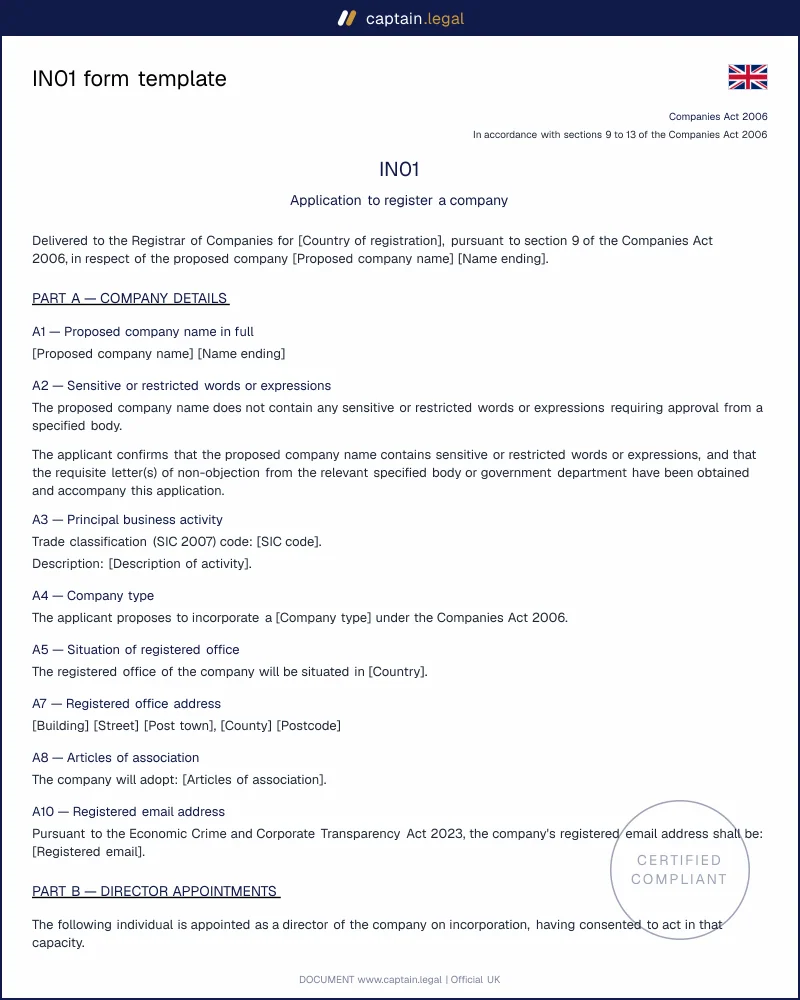
The IN01 form is the statutory application that brings a UK company into legal existence. Filed with Companies House under the Companies Act 2006, it captures every detail the Registrar needs to enter the company on the public register: proposed name, registered office, directors, subscribers, share capital and persons with significant control. Whether you incorporate a private company limited by shares, a private company limited by guarantee or a public limited company, the same form sits at the heart of the application. Most founders submit it electronically through the Companies House Web Incorporation Service or a formation agent, but the paper version remains in regular use for complex structures, corporate directors and section 243 or section 790ZF exemption cases.
Captain.Legal generates a properly formatted IN01 with all supporting declarations in Word and PDF, ready for postal filing or to mirror an online submission, including the latest fields introduced by the Economic Crime and Corporate Transparency Act 2023.
Compliant
2026 Legislation
50,000+ clients
trust us
Affordable
From $4.90 / doc
Secure payment
Instant download
IN01 form for UK company registration | Word & PDF template
Secure payment
What is an IN01 form?
The IN01 is a prescribed Companies House form, currently at version 11.0, used by subscribers to apply for the registration of a new company in England and Wales, Scotland or Northern Ireland. It is the legal vehicle through which the statement of capital and initial shareholdings, the statement of proposed officers and the statement of compliance required by sections 9 to 13 of the Companies Act 2006 are delivered to the Registrar in a single instrument. Without an accepted IN01, the company simply does not exist as a legal person, and any contract signed in its name before incorporation binds the signatory personally under section 51 CA 2006.
The form is sometimes confused with the memorandum of association that must accompany it. The two documents serve distinct functions. The memorandum is a short constitutional statement signed by every subscriber confirming they wish to form a company and become its first members, while the IN01 carries the operational data Companies House places on the public register. A practitioner should never substitute one for the other, even where the company adopts the unaltered model articles. An incorporation file missing either document will be rejected outright, and the cheque or fee returned. For an overseas company opening a UK establishment, the analogous instrument is the OS IN01, which is governed by Part 34 of the Companies Act 2006 and follows a different filing route.
Legal framework
The legal authority for the IN01 lies in Part 2 of the Companies Act 2006, sections 7 to 16, supplemented by the Companies (Registration) Regulations 2008 (SI 2008/3014) which prescribe the form and content of the application. Section 9 fixes the mandatory contents of the application: the proposed name and the country in which the registered office is to be situated, whether the liability of members is limited and, if so, by shares or by guarantee, and whether the company is private or public. Section 10 governs the statement of capital and initial shareholdings, section 12 the statement of proposed officers, and section 13 the statement of compliance through which the subscribers or their agent confirm that the requirements of the Act have been met.
The most consequential recent reform is the Economic Crime and Corporate Transparency Act 2023, whose phased implementation has reshaped the IN01 since late 2025. Mandatory identity verification now applies to every director and to every individual person with significant control, with each verified person allocated a unique Companies House personal code that must appear on the form. The Registrar has acquired enhanced powers under section 1062A CA 2006 to query, reject and remove information that appears inaccurate or fraudulent, and the registered office must now meet the appropriate address test of section 86A introduced by the same Act. A registered email address is also required for the receipt of statutory communications. The official guidance for completing the paper IN01 is published by Companies House on the GOV.UK page for form IN01 and should be consulted before any postal filing.
Specific filing rules sit alongside the substantive law. The form must be printed at full size on white A4 paper, signed by hand where the paper route is used, and accompanied by the memorandum and the prescribed statutory fee paid by cheque to Companies House. Where a section 243 or section 790ZF exemption from public disclosure of the residential address is sought, the application is posted to the dedicated PO Box in Cardiff alongside the supporting application. An IN01 dated more than two months before delivery will be rejected as stale. For most founders, the better starting point before drafting the application is to settle the constitution by reviewing our private limited company articles of association template for UK incorporation, since the choice between model articles, amended model articles and bespoke articles must be reflected in section A8 of the form.
When do you need this document?
The IN01 is required whenever a new corporate entity is being created under the Companies Act, and the most common case is the formation of a private company limited by shares by a small group of founders launching a trading business. In that scenario the form crystallises the cap table at day one: subscribers, share classes, nominal values, amounts paid up and unpaid. A founder who skips the form and relies solely on a shareholders' agreement has built a contract on quicksand, because no shares legally exist before incorporation is complete. The same logic applies to private companies limited by guarantee, typically used for membership organisations, professional bodies and many social enterprises that elect not to register as charities. Here the IN01 records the maximum amount each member undertakes to contribute on a winding up, often a nominal £1.
The form is also indispensable for public limited company formation, where the bar is materially higher: a minimum allotted share capital of £50,000 under section 763 CA 2006, at least one company secretary qualified under section 273, and at least two directors appointed on incorporation. Founders preparing an IPO route typically incorporate as a private limited company first and re-register as a PLC later under sections 90 to 96, but where speed to a regulated listing matters, a direct PLC incorporation through the IN01 is faster overall. A more delicate edge case is the formation of a UK subsidiary by an overseas parent acting as corporate director: the form must include the parent's full registration data, the law it is governed by and the register on which it is entered, and the Small Business, Enterprise and Employment Act 2015 restriction on corporate directors must be navigated with the relevant exemption. Founders also turn to a shareholders' agreement template aligned with UK company law once incorporation is complete, since the IN01 alone does not regulate deadlock, drag-along or pre-emption rights.
Key clauses included in our template
- The proposed company name with the correct name ending (Limited, Ltd, Public Limited Company, PLC, or their Welsh equivalents Cyfyngedig and Ccc), and the boxes for any sensitive or restricted words requiring consent under section 55 CA 2006. The drafting also covers the optional exemption from the Limited ending where the company qualifies under section 60.
- The registered office and registered email address sections, set up to reflect the appropriate address test of section 86A introduced by the Economic Crime and Corporate Transparency Act 2023. The template prevents the most frequent rejection cause, a registered office in the wrong jurisdiction, by tying the address fields to the country selected in section A2.
- The statement of capital and initial shareholdings required by section 10 CA 2006. Each share class is captured with its nominal value, total number, currency and prescribed particulars, with separate tables for any non-sterling tranches. The aggregate amount unpaid on the issued shares is computed and disclosed, since the Registrar cross-checks the line totals against the per-class breakdown.
- The statement of guarantee for companies limited by guarantee, replacing the share capital tables when relevant. The template handles the dual-route logic so the same instrument supports both limited-by-shares and limited-by-guarantee formations without leaving residual fields visible.
- The statement of proposed officers for each director, secretary and corporate appointee, including the Companies House personal code now required after identity verification under the ECCT Act 2023. Service address, residential address, date of birth and nationality fields follow the order of sections D1 to D6 of the official IN01.
- The PSC statement identifying every person with significant control under Schedule 1A CA 2006, with the nature-of-control checkboxes mapped to the five statutory conditions, including ownership thresholds at more than 25 %, more than 50 % and 75 % or more. Relevant Legal Entities and Other Registrable Persons are handled in dedicated sub-sections.
- The statement of compliance drafted under section 13 CA 2006, with the P1 / P2 split between subscriber-delivered and agent-delivered applications, and the lawful purpose declaration required since the ECCT Act 2023 amendments to section 13A.
Regional considerations
The IN01 looks like a single national form, but it operates very differently across the four UK jurisdictions, and getting the situation of the registered office right at section A2 is the single most important strategic choice before drafting begins.
England and Wales is the default jurisdiction and accounts for the overwhelming majority of incorporations. Companies registered here are subject to the Companies Act 2006 in its English-language form, and correspondence with Companies House passes through the Cardiff office. Founders may select either England and Wales or Wales as the situation. Choosing Wales triggers the option of a bilingual filing on form IN01c and binds the company to maintain its registered office in Wales specifically rather than anywhere in England and Wales. The practical consequence is that a later move of the registered office to Manchester would require a re-registration step that the England and Wales election would have avoided.
Scotland has its own Companies House office in Edinburgh and applies the same Companies Act 2006 but with notable procedural overlays, in particular the Bankruptcy and Diligence (Scotland) Act 2007 on enforcement and the use of LP numbers (legal post in Scotland) in service of corporate documents. Section A2 must select Scotland, and the registered office must remain in Scotland for the life of the company. Practitioners regularly advise against incorporating in Scotland for groups whose centre of gravity is in London, because the cross-border procedural friction outweighs any perceived nexus advantage. Where the operating presence is genuinely Scottish, the local jurisdiction is preferable for litigation and security registration purposes alike.
Northern Ireland combines the Companies Act 2006 with surviving local legislation, including the Limited Liability Partnerships Act (Northern Ireland) 2002 for LLP-related interactions. Incorporations are processed through the Belfast Companies House office. The same identity verification regime under the ECCT Act 2023 applies, but founders should plan for slightly longer paper processing windows due to lower document volumes and the dedicated review queue. Cross-border groups commonly establish a Northern Ireland subsidiary to access the Single Market under the Windsor Framework arrangements; in those cases an employment contract template that complies with Northern Ireland labour rules should be ready before the first hire is made.
How to fill out an IN01 form
Captain.Legal walks you through the form section by section in the order Companies House expects to read it, so the resulting file mirrors the sequence on the official PDF rather than a re-engineered flow that risks losing information at upload. You begin with the company name and jurisdiction, where the platform runs an availability check against the live Companies House register and flags any name treated as the same as an existing entry under section 66 CA 2006. The articles of association choice follows immediately, since model, amended or bespoke articles drive several downstream fields, including the option to entrench specific provisions.
You then enter the registered office and registered email address, the statement of capital with each share class on its own line, and the proposed officers. For every individual director and PSC, the platform asks for the Companies House personal code issued after identity verification, mirroring the ECCT Act 2023 requirement, and prevents you from saving an incomplete record. The PSC nature-of-control checkboxes are presented as plain English options rather than statutory cross-references, with the underlying Schedule 1A trigger displayed on hover. The statement of compliance closes the file, with the P1 or P2 path selected automatically based on whether you marked the application as subscriber-delivered or agent-delivered earlier in the journey. Once generated, the document is available in Word and PDF, ready for signature and postal filing, or to be used as a clean reference set when keying the same data into the Web Incorporation Service. Founders frequently pair the IN01 with a non-disclosure agreement compatible with UK confidentiality law at the same drafting stage, since first-week conversations with investors and advisers usually need both documents in hand.
Common mistakes to avoid
The most frequent rejection cause is a registered office that does not match the chosen jurisdiction. Founders selecting England and Wales who enter a Belfast address are bounced immediately, and the cheque returned uncashed. The fix is mechanical, but it costs days of delay and forces a second postal cycle. Almost as common is the mismatch between the company type at section A4 and the name ending at section A1. A private company limited by shares cannot end its name with PLC, and a PLC cannot end with Limited; the Registrar treats the contradiction as a fatal defect rather than a typo. Both errors require a fresh form and a fresh fee, since the existing application is rejected outright rather than corrected on file.
A more dangerous category of error involves the PSC nature-of-control statement. Founders sometimes tick ownership of shares — more than 25 % for every shareholder regardless of their actual holding, simply because that box appears most often in templates seen online. The People with Significant Control Regulations 2016 require the precise tier to be selected, and a misstatement is a criminal offence under section 790F CA 2006. The same caution applies to the statement of capital: the aggregate unpaid amount must equal the sum of unpaid amounts per class, and the Registrar's automated check rejects any line that does not reconcile. A final pitfall, increasingly common since late 2025, is forgetting to enter a Companies House personal code for an officer who has completed identity verification but whose code has not been retrieved by the agent. The form will pass surface validation and fail at the IDV check, leaving the application in a limbo that can take weeks to resolve.
Frequently Asked Questions
20 verified reviews · 50 000+ downloads
- Immediate access to the document
- PDF + Word download
- Compliant with 2026 legislation
- Reviewed by lawyers
You might also like