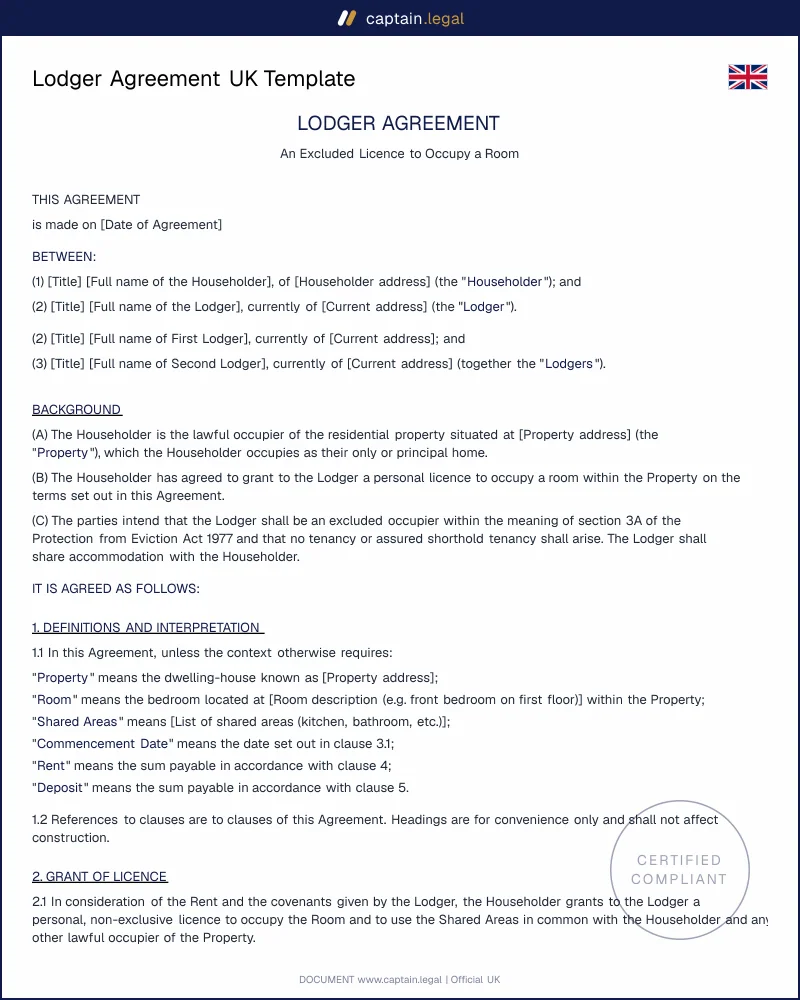
A lodger agreement sets out the terms on which a resident landlord lets a furnished room in their own home to a paying occupant who shares the kitchen, bathroom or living areas. The arrangement is a licence to occupy rather than a tenancy, which places the lodger in the narrow legal category of excluded occupier under the Protection from Eviction Act 1977. That distinction matters: the rules on notice, eviction and deposit protection that apply to the average private tenant simply do not bite here. This template is drafted for England and Wales for live-in landlords letting a room under the Rent a Room Scheme, and it captures every clause needed to keep the licence excluded, the rent enforceable and the relationship workable in a shared home.
Compliant
2026 Legislation
50,000+ clients
trust us
Affordable
From $4.90 / doc
Secure payment
Instant download
Lodger Agreement UK Template | Word & PDF in 5 Minutes
Secure payment
What is a lodger agreement?
A lodger agreement is a written licence to occupy, not a tenancy. The legal hinge is the test set out by the House of Lords in Street v Mountford [1985] AC 809: a tenancy exists where the occupier has exclusive possession for a term at a rent. A lodger fails that test because the resident landlord retains unrestricted access to the rooms used by the lodger, including the bedroom, and the parties share the living accommodation of the property. The Housing Act 1988 echoes the point at section 1, Schedule 1, paragraph 10, which excludes lettings by a resident landlord operating under UK real estate rules from assured tenancy status.
Lawyers and letting agents often confuse a lodger agreement with an assured shorthold tenancy (AST), and the consequences of getting it wrong are real. An AST grants statutory security of tenure, requires a section 8 or section 21 notice for possession and triggers the Tenancy Deposit Scheme obligations under the Housing Act 2004. None of that applies to a properly drafted lodger arrangement. The lodger has a personal permission to occupy that ends with reasonable notice, and possession can be recovered without a court order in most cases. The single fact that destroys the lodger status is the landlord ceasing to occupy the property as their only or principal home, even temporarily in some circumstances. Get that wrong and the lodger drifts into basic protection or full assured tenancy territory overnight.
Legal framework
The governing statute for excluded occupiers in England and Wales is the Protection from Eviction Act 1977, as amended by the Housing Act 1988. Section 3A of the 1977 Act lists the categories of excluded tenancy and licence; section 3A(2) covers the resident landlord scenario, requiring that the occupier shares accommodation with the landlord and that the landlord occupies the same dwelling as their only or principal home both at the grant of the licence and immediately before its termination. Where both limbs are satisfied, the lodger is an excluded occupier and the protections of the 1977 Act on notice and forcible eviction do not apply. The leading practitioner authority remains the Shelter Legal England analysis of excluded occupier eviction rules, which sets out the common law position on notice length and possession.
The Housing Act 1988 completes the picture. Schedule 1, paragraph 10 removes lettings by resident landlords from the assured tenancy regime, provided the resident landlord condition is met from the date the tenancy is granted and at all material times thereafter. The Act also distinguishes between an excluded tenancy (where the lodger has exclusive possession of the room itself) and an excluded licence (where the landlord retains a right of access). Both fall outside assured tenancy protection, but the distinction affects notice in the absence of express terms. Tax sits in Part 7, Chapter 1 of the Income Tax (Trading and Other Income) Act 2005, which codifies the Rent a Room Scheme and its £7,500 annual tax-free threshold. The Tenancy Deposit Scheme under the Housing Act 2004 sections 212–215 does not apply to lodger arrangements because there is no assured shorthold tenancy, but a deposit may still be taken under contract and held outside the statutory schemes. Live-in landlords are not exempt from gas safety obligations: the Gas Safety (Installation and Use) Regulations 1998 extend to any premises let for residential use, lodgers included, and the annual CP12 certificate must be carried out by a Gas Safe registered engineer.
When do you need this document?
Most lodger agreements are signed by homeowners with a spare room and a mortgage that allows lodgers, often after children have moved out or following a separation. The scenario is straightforward: the landlord lives in the property as their main home, the lodger takes one bedroom, and the kitchen, sitting room and bathroom are shared. The written agreement matters here because verbal arrangements between strangers tend to break down precisely on the questions a written contract resolves first: rent due date, who pays the council tax, whether overnight guests are allowed, what happens if the lodger leaves before the term ends.
The second common scenario is the Rent a Room Scheme household, where the landlord is letting expressly to capture the £7,500 tax-free allowance under section 791 ITTOIA 2005. The threshold is per property, not per lodger, and gross receipts include charges for meals, laundry and bills, not just the headline rent. A lodger paying £600 in rent plus £80 in bills and meals reaches £8,160 in gross receipts and tips over the threshold, requiring Self Assessment. The agreement should isolate the rent figure and set out separately the cost of any services that fall under business income rules so the live-in landlord can document the calculation.
A third trigger is the live-in landlord taking on a lodger short-term while the property is on the market or pending a major renovation. The flexibility of an excluded licence becomes useful here because the contractual notice period can be aligned to the rental cycle without exposing the landlord to assured tenancy rules. Tenants of social housing or private rentals can also become live-in landlords by taking in a lodger, but the lease must permit subletting, and Universal Credit reporting obligations apply. One edge case worth flagging: arrangements in self-contained annexes or granny flats with their own kitchen and bathroom are not lodger arrangements at all, because the living accommodation is not shared. Those lettings fall under standard assured shorthold tenancy rules, deposit protection included, and a lodger agreement signed in those circumstances will not protect the landlord.
Key clauses included in our template
Each clause below is drafted to keep the licence within the excluded category and to make the obligations of both parties enforceable in a county court if needed. The template adapts to weekly or monthly rental cycles and to fixed-term or rolling arrangements.
- The identification of the parties and the property sets out the landlord's address as their only or principal home and confirms the resident landlord status under section 3A Protection from Eviction Act 1977. The lodger is named individually; joint lodgers create complications around joint and several liability and are handled in a separate clause. The agreement specifies which room is allocated to the lodger and which areas are shared, language that goes directly to the Street v Mountford test.
- The rent and payment terms clause fixes the weekly or monthly rent, the payment date and the bank details. It separates rent from charges for bills, meals or services, which matters for the Rent a Room Scheme calculation under ITTOIA 2005 section 791. A late-payment provision allows interest at the Bank of England base rate plus 2 per cent, which is the conventional commercial rate.
- The deposit clause governs a damage deposit held by the landlord directly. Because the arrangement is not an assured shorthold tenancy, the deposit is not protected under the Housing Act 2004 sections 212–215 and falls outside the Tenancy Deposit Scheme. The clause sets out what the deposit can be used for at the end of the licence and the timeframe for return.
- The notice clause is the critical one. It mirrors the rental period (one week's notice for weekly rent, one month for monthly rent) for an excluded tenancy under common law principles, or sets a contractual reasonable notice period for an excluded licence. It also includes a break clause for the fixed-term variant, which is required if either party wants to end the licence before the agreed end date.
- The house rules schedule addresses the practical realities of a shared home: overnight guests, smoking, pets, kitchen and bathroom etiquette, quiet hours and use of communal spaces. These are contractual obligations whose breach justifies notice, and the schedule should be tailored to the household rather than copied wholesale from a precedent.
- The landlord's access and inspection clause confirms the landlord's right to enter the room without permission, which preserves the licence character of the agreement. It also sets reasonable expectations on inspection frequency and on the landlord's privacy obligations under data protection rules relevant to personal arrangements.
Regional considerations
England and Wales operate under the same Protection from Eviction Act 1977 and Housing Act 1988 framework, but localised rules can shift the analysis.
London and the South East see the largest volume of lodger arrangements, driven by London property prices and the Rent a Room Scheme. Boroughs such as Camden, Islington and Hackney operate selective licensing schemes for private rented accommodation, but these schemes generally exempt resident landlords letting under a lodger agreement. The London-specific point that catches landlords out is council tax: a single-occupancy discount of 25 per cent under the Local Government Finance Act 1992 is lost the moment a lodger moves in, regardless of whether the lodger is treated as a disregarded person (for example, a full-time student). The agreement should make clear which party bears the lost discount.
Wales applies a separate regime under the Renting Homes (Wales) Act 2016, which replaced ASTs with occupation contracts in December 2022. Lodger arrangements with a resident landlord remain outside the scope of the 2016 Act because the resident-landlord exclusion in Schedule 2 preserves the licence-not-tenancy analysis. However, Welsh landlords letting under Rent Smart Wales registration should confirm that the resident-landlord exemption applies before relying on a lodger agreement template drafted for England.
Scotland is a different jurisdiction altogether. The Private Housing (Tenancies) (Scotland) Act 2016 introduced the Private Residential Tenancy, but resident landlords letting to a lodger remain outside that regime under the resident-landlord exception. Scottish landlords should not use an England-and-Wales lodger agreement without legal review, because Scottish common law on notice, possession and contractual interpretation differs in material respects from English law. The Sheriff Court rather than the County Court hears any possession claim that does proceed.
Northern Ireland has its own Private Tenancies (Northern Ireland) Order 2006 and the Houses in Multiple Occupation Act (Northern Ireland) 2016. Lodger arrangements in Belfast or elsewhere in the province are governed by Northern Irish law and the standard England-and-Wales template will need adaptation. If the property is in Scotland, Wales or Northern Ireland, the references in this template to specific English statutes should be reviewed by a local practitioner before signing.
How to fill out this lodger agreement
You start by selecting the country the property sits in, which determines whether the template applies the Protection from Eviction Act 1977 framework for England and Wales or routes you to a Scottish or Welsh variant. You then enter the parties' details: the resident landlord's full name and the address of the property, which doubles as the landlord's main home, and the lodger's full legal name. The system flags any mismatch between the property address and the landlord's stated main residence, because that mismatch is the single most common drafting error and the one that strips the licence of its excluded status.
The next stage covers the financial terms. You enter the weekly or monthly rent, the payment date and the deposit amount. The form separates rent from bills and from any charge for meals, cleaning or laundry, which keeps the Rent a Room Scheme calculation transparent. You then choose between a fixed term (typically six or twelve months with a break clause) and a periodic arrangement that runs until either party gives notice. The notice period defaults to the rental cycle but can be extended by agreement.
The house rules schedule comes last. You select the rules that apply to your household from a checklist (smoking, pets, overnight guests, communal cleaning rota) and add bespoke provisions in free text. The system generates the final document in Word and PDF, signed electronically or by wet signature. You can revisit the document later from your dashboard alongside any other employment or HR templates you might be drafting or other personal-life documents stored in your account.
Common mistakes to avoid
The most damaging mistake live-in landlords make is taking on a lodger and then moving out for an extended period, without grasping that the lodger's status flips the moment the resident-landlord condition fails. A landlord who lets to a lodger and then spends six months working abroad, leaving the property in the lodger's hands, has converted an excluded licence into an assured tenancy under the Housing Act 1988 by operation of law. Possession then requires a section 8 or section 21 notice and a court order, and the deposit (if any) becomes liable to statutory protection retroactively, exposing the landlord to a claim for one to three times the deposit value under section 214 Housing Act 2004.
The second recurrent error is treating the lodger agreement as a tenancy by accident. Drafting language that grants exclusive possession of the room, fitting a lock the landlord cannot bypass, and refusing to enter the room without the lodger's consent for months on end can together convert the licence into a tenancy in the Street v Mountford sense. The agreement should preserve the landlord's contractual right of access and the parties should behave consistently with that right. The third mistake is ignoring the Gas Safety (Installation and Use) Regulations 1998: the annual gas safety check is mandatory in any home where a gas appliance is used by an occupier paying rent, lodgers included, and a missing certificate exposes the landlord to prosecution and a fine. The fourth, more mundane, is the council tax single-occupier discount: landlords forget to notify the council and continue claiming the 25 per cent discount, which the council later recovers with interest. Finally, landlords often neglect the immigration Right to Rent check under the Immigration Act 2014, which extends to lodger arrangements where rent is paid for the right to occupy; the £80 to £20,000 civil penalty for letting to a person without the right to rent applies whether the contract is a tenancy or a licence.
Frequently Asked Questions
50 verified reviews · 50 000+ downloads
- Immediate access to the document
- PDF + Word download
- Compliant with 2026 legislation
- Reviewed by lawyers
You might also like