Create my document
Login

Choose country

FranceBelgiqueEspañaUnited StatesUnited KingdomالمغربDeutschlandItalia
Leave Request

Annual Leave Request Form UK — WTR 1998 Compliant

Record holiday dates, remaining entitlement and a clear approval decision in one signed form. Lawyer-drafted for UK employers. Editable Word and PDF download.
4.7/519 reviews50 000+ downloadsInstant download
Share

An annual leave request form is the document a UK employee completes to ask for paid holiday, and the document an employer signs to approve, refuse, or counter-propose those dates. It records the requested days, the leave year they fall in, the holiday already taken, the remaining entitlement, and a dated approval box that converts a corridor conversation into a defensible record. Used properly, it satisfies the notice mechanics of the Working Time Regulations 1998 and keeps payroll, line managers, and the employee working from the same set of dates. This template is built for small and mid-sized UK employers who manage absence by hand and want one clean form that survives a tribunal bundle.

Compliant

2026 Legislation

50,000+ clients

trust us

Affordable

From $4.90 / doc

Secure payment

Instant download

Annual Leave Request Form UK — WTR 1998 Compliant

Secure payment · No subscription

Fill in the template

What is an annual leave request form?

An annual leave request form is a short internal document, not a statutory form, but it does statutory work. There is no prescribed wording in UK law for asking to take holiday, which is precisely why a badly drafted request causes trouble : the Working Time Regulations 1998 turn on notice and counter-notice, and a request with no recorded date cannot prove either was given in time. The form fixes that by capturing the request date, the first and last day of leave, the total working days involved, and the manager's decision in a single signed sheet.

People sometimes confuse the request form with a holiday policy or a leave entitlement statement. The policy sets the rules for the whole workforce, the entitlement statement tells one person how many days they hold, and the request form is the transactional document that moves a specific block of days from "available" to "booked". A request form should reference the leave year (most UK employers run April to March or January to December) because entitlement resets then, and carry-over rules differ between the core four weeks under Regulation 13 and the additional 1.6 weeks under Regulation 13A. A form that does not state the leave year invites disputes about whether the days came out of the right allowance. Our template ties every request to a named leave year and a running balance, so the figure in the box is the figure payroll relies on.

2

When do you need this document?

The everyday trigger is the routine holiday booking : an employee wants a week in August, the team rota needs protecting, and someone has to confirm the dates in writing before flights are booked. A verbal "yes" in the kitchen is worthless three months later when two people claim the same fortnight. The form also earns its keep when you need to refuse or move dates without it turning personal, because a written counter-proposal reads as scheduling, not punishment. Consistency is the quieter reason. If you approved one person's last-minute leave and then refused another's, a paper trail showing the same form and the same reasoning is your defence against a fairness complaint.

Several less obvious situations justify keeping the form on hand. Leavers are one : untaken accrued holiday must be paid out on termination, so the running balance on the last approved request feeds straight into the final payslip. Long-term sickness is another edge case worth flagging, because workers continue to accrue annual leave while off sick and may want to carry it over rather than lose it. A third is the worker on irregular or part-year hours, whose entitlement accrues using the 12.07% method rather than arriving as a fixed block of days, so the "remaining entitlement" figure must be calculated on hours actually worked. If your business uses casual or zero-hours staff, pairing this form with our UK zero-hours contract template drafted for variable shift patterns keeps the accrual basis consistent across both documents.

3

Key clauses included in our template

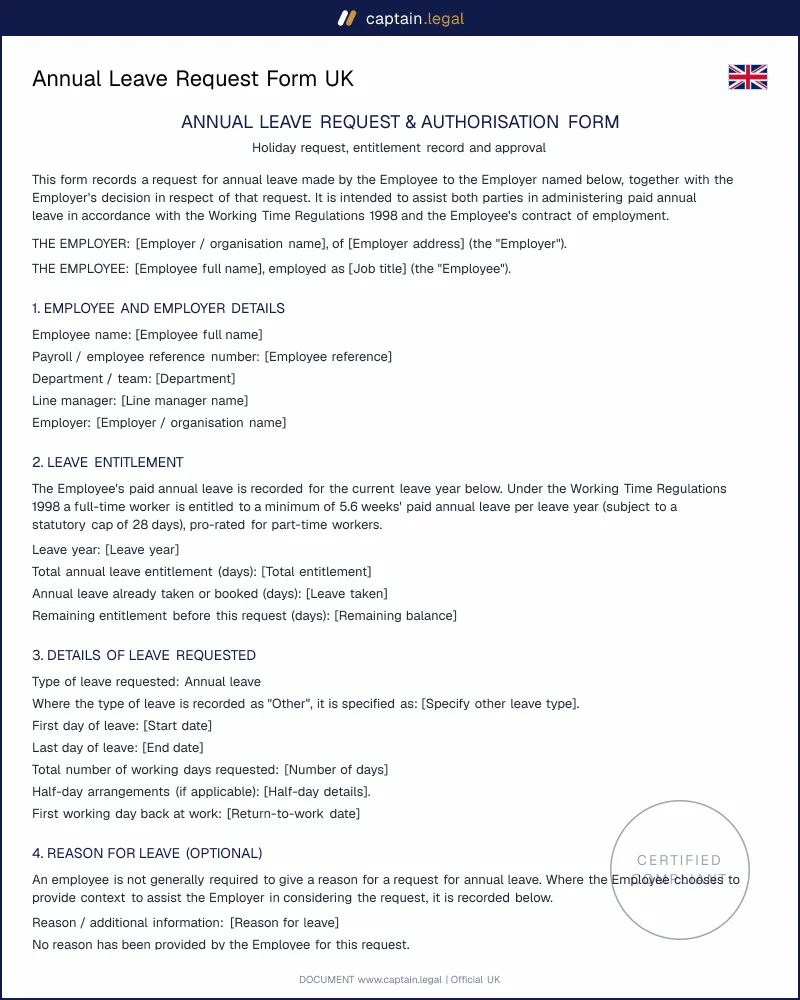
  • The employee and request details block captures the worker's name, department, line manager, and the date the request was made. That request date is not decoration : it is the evidence that statutory notice under Regulation 15 was given, and it is the first thing a tribunal looks for when notice is disputed.
  • The leave dates and working-day count field records the first and last day off plus the number of actual working days consumed, so a Friday-to-Monday request reads as one day, not four. This stops the common error of deducting calendar days from an allowance measured in working days.
  • The remaining entitlement and leave year section shows the opening allowance, days already taken, the days now requested, and the closing balance, all tied to a named leave year. It also flags whether the days fall in the core four weeks or the additional 1.6 weeks, which governs carry-over.
  • The approval, refusal, and alternative-dates box lets the manager tick a decision, propose substitute dates, and date the response. The dated response is what proves counter-notice was served inside the statutory window, the single most litigated point in holiday disputes.
  • The manager signature and comments line records the reasoning behind any refusal in neutral language. A documented operational reason, such as a clash with a project deadline, is far stronger than an unexplained "no" if the decision is ever challenged.
4

Regional considerations

Holiday entitlement under the Working Time Regulations 1998 applies uniformly across England, Wales, and Scotland, so the 5.6-week floor and the notice mechanics do not change as you cross a border. The practical differences sit in the public holidays. England and Wales observe eight bank holidays, Scotland has its own pattern including 2 January and St Andrew's Day, and Scottish employers should make sure their form's leave-year calculation reflects whichever bank holidays the contract treats as paid leave rather than assuming the English calendar.

Northern Ireland is the genuine outlier. Holiday rights there flow from the Working Time Regulations (Northern Ireland) 2016 rather than the 1998 Regulations, though the headline 5.6-week entitlement is the same. Northern Ireland also observes additional bank holidays, including St Patrick's Day and the Battle of the Boyne, which means a form designed for a Belfast workforce should account for up to ten bank holidays when reconciling the annual balance. Using a Great Britain bank-holiday count for a Northern Ireland employee will understate or overstate the remaining entitlement.

Across all four nations the Equality Act 2010 (or its Northern Ireland equivalent) sits behind the leave process. Refusing or clawing back leave in a way that disadvantages someone connected to a protected characteristic, such as religious observance dates, can expose an employer to a discrimination argument. The form helps here by recording a clear, operational reason for any refusal. When a request shades into family leave rather than ordinary holiday, our UK Section 1 written statement of particulars template clarifies which entitlements the contract already promises.

5

How to fill out this annual leave request form

You start by entering the employee's name, department, and line manager at the top, then the date the request is being made, which sets the statutory notice clock running. From there you record the first and last day of the intended leave and let the form total the actual working days involved, so a long weekend does not get over-counted against the allowance. The next section is the balance : you enter the opening entitlement for the current leave year, the days already taken, and the days now requested, and the closing figure populates the remaining-entitlement box that payroll will trust.

The manager then takes over the lower half. They choose approve, refuse, or propose alternative dates, add a short operational note where a refusal needs explaining, and sign and date the response. That signature date is the proof that counter-notice was served in time, so it should never be left blank. Once both halves are complete, the form is saved to the employee's record and a copy goes to whoever runs payroll. If you need to formalise an unrelated workplace decision in the same neutral, defensible style, our UK dismissal letter template built around the ACAS Code follows the same evidence-first structure.

6

Common mistakes to avoid

The most expensive mistake is treating the request as a formality and skipping the dates. Employers who approve holiday by text or in passing have no record of when notice was given or when counter-notice was served, and under Regulation 15 both timings decide who wins a dispute. A close second is deducting calendar days instead of working days, which quietly inflates the allowance an employee appears to have used and creates an argument at year end. A third recurring error is forgetting that the core four weeks and the additional 1.6 weeks carry over differently, so days are either lost that should have rolled over or rolled over that should have expired.

Employers also stumble on refusals. A blunt "no" with no reason and no alternative dates reads as arbitrary, and if the refused employee shares a protected characteristic the Equality Act 2010 can convert a scheduling decision into a discrimination claim. Equally risky is ignoring the special accrual rules for irregular-hours and part-year staff, whose entitlement builds at 12.07% of hours worked rather than arriving as a fixed block. The last common slip is failing to account for accrued holiday at termination, where untaken statutory leave must be paid out, so the final approved balance feeds directly into the leaving payslip.

Key takeaways

WTR 1998

Holiday requests live or die on notice

The Working Time Regulations 1998 are not picky about wording, but they are strict on timing. Under Regulation 15, the employee should give notice at least twice the length of the leave requested unless the contract changes that. If you cannot prove the request date and the proposed dates, you cannot show notice was in time, which is where disputes begin.

Counter-notice

Miss the refusal window, leave may proceed

If a manager wants to refuse or propose different dates, the employer must give counter-notice at least as long as the leave requested. A week off needs a week’s counter-notice before the leave would start. If that window is missed, the employee can be entitled to take the leave by default. A signed decision box turns a chat in the corridor into evidence.

Leave year

Track entitlement, year, and running balance

A request form is the transactional record that moves days from available to booked, so it should state the leave year and the remaining entitlement. Without the leave year, arguments follow about which allowance the days came from when entitlement resets (often April to March or January to December). The split between Regulation 13 and 13A also affects carry-over, so accuracy matters.

Frequently Asked Questions

The form itself is an internal record rather than a statute-prescribed document, but it carries real legal weight once both parties sign it. A completed and dated approval creates a clear agreement on which days have been booked, and because the Working Time Regulations 1998 turn on notice and counter-notice timings, the dated entries are exactly the evidence a tribunal asks for. To be enforceable in practice the form should sit alongside a contract that sets out the leave year and entitlement, since the form allocates days but the contract defines how many exist. Used together they give you a defensible position on any holiday booked, refused, or carried over.

Yes, an employer can refuse a request, but only by following the procedure in Regulation 15 of the Working Time Regulations 1998. The refusal has to be served as counter-notice at least as long as the leave requested, so a one-week holiday must be refused at least a week before it would have started. Miss that window and the leave can effectively be taken by default. A refusal should also rest on a genuine operational reason, such as a staffing clash or a project deadline, and the form's comments box exists to record exactly that. An unexplained refusal that disadvantages a protected group risks an Equality Act 2010 challenge.

Almost every UK worker is entitled to a statutory minimum of 5.6 weeks of paid holiday per leave year under the Working Time Regulations 1998, which equals 28 days for someone working a five-day week. The figure is capped at 28 days, so a six-day-a-week worker still receives 28 rather than more. Part-time staff get the same 5.6 weeks applied pro rata, so three days a week produces 16.8 days. Your contract may offer more than the statutory floor but never less. Whether bank holidays sit inside or on top of that figure depends on what your contract says.

Under the default rule in the Working Time Regulations 1998, you must give notice equal to at least twice the length of the leave you want, so booking one week off requires two weeks' notice and two weeks off requires four. Your employment contract can set a different notice period, and many do, which is why the form records the request date against the leave dates. That recorded date is what proves you gave proper notice if the timing is ever questioned. If you are setting up these rules for a fixed-term hire, our UK fixed-term employment contract template for cover and project roles lets you state the notice period clearly from day one.

Yes. The annual leave request form is supplied in an editable Word version and a clean PDF. The Word file lets you drop in your company name, adjust the leave-year dates, and tailor the entitlement fields to match your own holiday policy, then reuse it across the whole workforce. The PDF gives you a tidy, print-ready copy for signing or for filing in an employee's record once a decision is made. Most employers keep the Word master for editing and circulate the PDF for completion, so the form stays consistent every time it is used.

When employment ends, any statutory annual leave you have accrued but not taken must be paid out in your final wages, calculated up to your leaving date. This is why the running balance on your most recent approved request matters : it feeds directly into the termination payment. The core four weeks of leave under Regulation 13 generally cannot be carried into a new role and is instead paid out, while accrued additional leave depends on your contract. Keeping the form's remaining-entitlement figure accurate throughout the year means the final reconciliation is straightforward rather than disputed.

Yes. Workers continue to accrue their statutory 5.6 weeks of annual leave during periods of sickness absence, even long-term sickness, under the Working Time Regulations 1998. If you are too unwell to take holiday in the relevant leave year, you may be able to carry it over rather than lose it, which is one of the limited situations where the core four weeks can roll forward. The request form helps by keeping your entitlement balance visible, so when you return you can see exactly how many days carried across. For the wider absence picture, recording sickness separately from holiday on your file keeps the two entitlements from being confused.

4.7/5

19 verified reviews · 50 000+ downloads

Annual Leave Request Form UK — WTR 1998 Compliant
  • Immediate access to the document
  • PDF + Word download
  • Compliant with 2026 legislation
  • Reviewed by lawyers
Fill in the template
Secure payment · No subscription
Updated on May 29, 2026