A Section 8 notice is the formal document a landlord serves on a tenant in England to start the process of regaining possession of a rented property when one or more statutory grounds for possession apply. Since the abolition of Section 21 on 1 May 2026 under the Renters' Rights Act 2025, it has become the only route available to private landlords seeking to end an assured periodic tenancy against the tenant's wishes. The notice must cite at least one ground listed in Schedule 2 of the Housing Act 1988, in the form prescribed by the Ministry of Housing, Communities and Local Government, and observe the notice period attached to that ground.
This page is written for landlords, letting agents and small portfolio investors who need a Section 8 notice that is procedurally watertight on the day it is served. The template available on Captain.Legal generates the current Form 3 with the right wording for each of the 37 statutory grounds now in force.
Compliant
2026 Legislation
50,000+ clients
trust us
Affordable
From $4.90 / doc
Secure payment
Instant download
Section 8 Notice Template UK | Notice Seeking Possession
Secure payment
What is a Section 8 notice?
A Section 8 notice, also called a notice seeking possession, is a written warning that the landlord intends to ask the County Court for an order ending the tenancy. It originates in section 8 of the Housing Act 1988 and is now the gateway to every possession claim against an assured periodic tenancy in England. The document must be served in the prescribed form (currently Form 3, published by MHCLG and updated to reflect the Renters' Rights Act 2025), state every ground on which the landlord will rely, and quote the statutory wording of each ground so the tenant can respond meaningfully.
A Section 8 notice is not a court order. It is a precondition to one. After the notice period expires, the landlord must issue a possession claim at court ; the tenant can defend, and a judge decides whether the ground is made out and, for discretionary grounds, whether possession is reasonable. Serving the notice does not end the tenancy on its own : the tenant remains in lawful occupation, owes rent, and cannot be physically removed without a warrant of possession executed by a County Court bailiff or a High Court enforcement officer.
The document is sometimes confused with a notice to quit, which only ends a contractual periodic tenancy at common law and has no effect on a statutory assured tenancy. It is also distinct from a residential tenancy agreement, which creates the relationship the Section 8 notice seeks to terminate.
Legal framework
The statutory anchor is section 8 of the Housing Act 1988, read together with Schedule 2 (the list of grounds) and the Assured Tenancies and Agricultural Occupancies (Forms) (England) Regulations 2015 as amended in 2026. The form prescribed since 1 May 2026 is Form 3, and a notice that uses the wrong form, omits a required ground, or misstates the earliest date for proceedings is liable to be struck out at the door of the court. Practitioners who attempt to repurpose pre-RRA templates are seeing this happen routinely.
The Renters' Rights Act 2025 received Royal Assent on 27 October 2025 and brought its tenancy reforms into force on 1 May 2026. The Act abolished section 21 of the Housing Act 1988, converted every assured shorthold tenancy in existence into an assured periodic tenancy, and rewrote Schedule 2 to expand the grounds from 17 to 37. It also reshaped two of the most-used grounds : mandatory Ground 8 now requires three months' rent arrears (up from two) at both notice and hearing, with a four-week notice period replacing the previous two weeks, and Ground 1 and the new Ground 1A impose a four-month notice and a twelve-month protected period during which they cannot be relied upon.
Service has to comply with section 196 of the Law of Property Act 1925 or the service clause in the tenancy agreement, whichever is more generous. The notice must be addressed to every tenant named on the agreement, and a notice naming only one of two joint tenants is invalid. Authoritative guidance on the new framework is published by the Ministry of Housing, Communities and Local Government in the official guide for landlords on the possession process from 1 May 2026, which sets out the prescribed forms, notice periods and pre-action conduct expected by the courts.
When do you need this document?
The most common scenario is persistent rent arrears. Once the tenant owes at least three months' rent and has continued to fall behind, a landlord typically pleads mandatory Ground 8 alongside the discretionary Grounds 10 and 11 as a safety net : if the arrears drop below three months between notice and hearing, the discretionary grounds keep the claim alive. The four-week notice period under the new Ground 8 has shifted the practical calculation, and landlords who served notices before 1 May 2026 have generally re-served under the new rules to avoid a procedural challenge.
The second most frequent trigger is the landlord's own need for the property. Ground 1 covers the case where the landlord, the landlord's spouse or civil partner, or a close family member intends to occupy the dwelling as their only or principal home. Ground 1A, introduced by the Renters' Rights Act 2025, covers the intention to sell with vacant possession. Both demand four months' notice and cannot be invoked during the first twelve months of the tenancy ; landlords who try to short-circuit this protected period find their claims dismissed. The four-month notice runs from the date of service, not from the day the tenant receives the letter, which makes the choice of service method consequential.
Anti-social behaviour is the third significant family of cases, pleaded under Ground 14 (discretionary, immediate notice possible) and reinforced by the new Ground 14ZA dealing with domestic abuse perpetrators. Property damage, breach of a tenancy term, false statements made to obtain the tenancy, and the new repeat-arrears Ground 8A (three separate occasions of two months' arrears within three years) round out the list. One edge case worth flagging : tenants in tied accommodation linked to employment contracts trigger Ground 16 when the employment ends, but only if the original letting was made in consequence of the job.
Key clauses included in our template
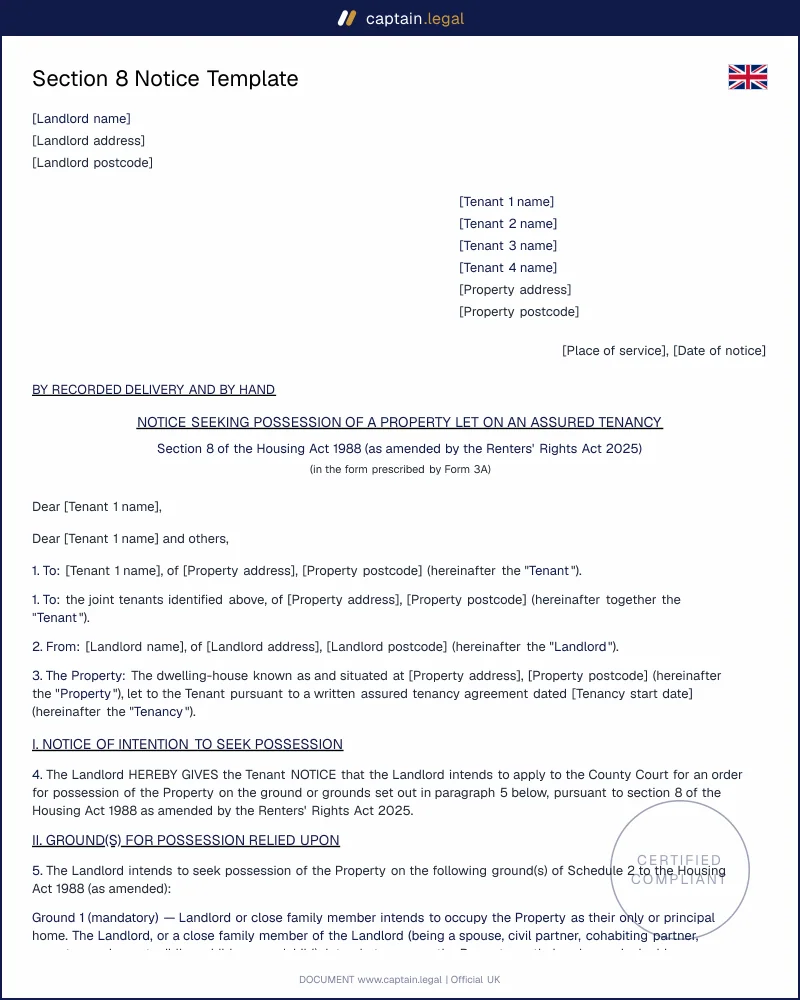
The Captain.Legal template generates the current Form 3 and adapts every variable section to the grounds you select. The clauses below are the load-bearing parts of the document.
- The identification of the parties lists every tenant named on the original tenancy agreement, including any joint tenant who may have moved out informally. A notice that omits a named tenant is invalid for the whole tenancy, not merely as against the missing party. The template also captures the address of the dwelling exactly as it appears on the tenancy agreement, since variations such as adding or dropping a flat number have led to dismissed claims.
- The statement of grounds reproduces the statutory text of each ground relied upon, in full, as required by section 8(2) of the Housing Act 1988. The template offers all 37 current grounds and inserts the wording verbatim from Schedule 2 as amended in 2026, so the notice cannot fall foul of the rule that paraphrased grounds make a notice defective.
- The particulars of breach describe the factual basis for each ground in concrete terms : dates, amounts, incidents, witnesses where relevant. For Ground 8, the template generates a rent schedule showing arrears at the date of notice ; for Ground 14, it allows free-text entry of the conduct relied upon, with prompts to include dates and corroborating evidence.
- The earliest date for proceedings is calculated automatically from the grounds chosen and the date of service. The template applies the longest notice period among the grounds pleaded, since section 8(4A) requires this. A notice that quotes the wrong earliest date is invalid even if every ground is otherwise made out.
- The service clause records the method of service and the deemed date of receipt, drawing on the service provisions in the tenancy agreement or, in their absence, the default rules under section 196 of the Law of Property Act 1925.
Common mistakes to avoid
The single most common defect is an arithmetical error on the earliest date for proceedings. Landlords who plead Ground 8 alongside Ground 1A sometimes use the four-week period of Ground 8 instead of the four-month period of Ground 1A : the notice is then invalid as a Ground 1A notice, and the landlord cannot amend without re-serving and waiting again. The cure is to let the template do the calculation, which always picks the longer period.
The second recurring problem is reliance on a pre-RRA template downloaded from a generic forms site. Forms produced before October 2025 do not include the new grounds (1A, 8A, 14ZA), use the abolished Form 6A layout, and quote Schedule 2 in its old wording. Judges have been unsympathetic to landlords who pleaded the old grounds in the months following commencement. A template aligned with the current residential rental documents catalogue is the simplest hedge. Other frequent errors include serving on only one of two joint tenants, omitting the particulars of breach for Ground 8 on the assumption that the schedule of arrears speaks for itself, and dating the notice on a day before the tenant could realistically have received it, which raises an evidential difficulty if service is later contested.
How to fill out this Section 8 notice
You start by entering the names of every tenant from the tenancy agreement and the address of the property exactly as it appears in that agreement. The form then asks for the date of the original tenancy and whether it has since converted into an assured periodic tenancy under the Renters' Rights Act 2025, which is the default for any tenancy that existed on 1 May 2026.
The next step is the choice of grounds. The template displays every current ground with a one-line description, lets you select as many as apply, and inserts the verbatim statutory wording into the body of the notice. For each ground chosen, a context-aware prompt asks for the particulars of breach : a rent schedule for Ground 8, a description of incidents for Ground 14, an explanation of the intended occupier or sale for Grounds 1 and 1A. The earliest date for proceedings is then calculated from the longest applicable notice period and the date of intended service.
You finish by selecting the method of service (first-class post, personal delivery, or via a clause in the tenancy agreement) and adding the landlord's signature block. The output is a fully populated Form 3 available as Word and PDF, ready to be served and to support a later court possession claim without further drafting.
What changed under the Renters' Rights Act 2025
Three changes matter most for anyone preparing a Section 8 notice today. First, the form itself : Form 3 replaces Form 6A and includes fields that did not exist before, such as the declaration of compliance with the new pre-action conduct expected by the County Court. Second, the substantive grounds : Ground 1 now requires four months' notice rather than two and cannot be used in the first twelve months ; Ground 1A offers a parallel route for sale with vacant possession ; Ground 8 requires three months of arrears and four weeks' notice ; Ground 8A targets repeat offenders.
Third, the consequences of getting it wrong have hardened. Because Section 21 is no longer available as a fallback for landlords who simply want their property back, a Section 8 notice that is struck out forces the landlord to start over, often months later. The transitional rules permit landlords who served valid Section 21 notices before 1 May 2026 to issue proceedings up to 31 July 2026, but that window is closing fast and is no help to anyone who needs to start a fresh case. The practical effect is that the Section 8 notice has moved from being a backstop to being the centrepiece of every contested possession in England, and the level of care taken in drafting needs to match that shift. Landlords who run multiple lets often pair the notice with refreshed letting business documents to make sure the entire paperwork chain reflects the new regime.
Frequently Asked Questions
68 verified reviews · 50 000+ downloads
- Immediate access to the document
- PDF + Word download
- Compliant with 2026 legislation
- Reviewed by lawyers
You might also like