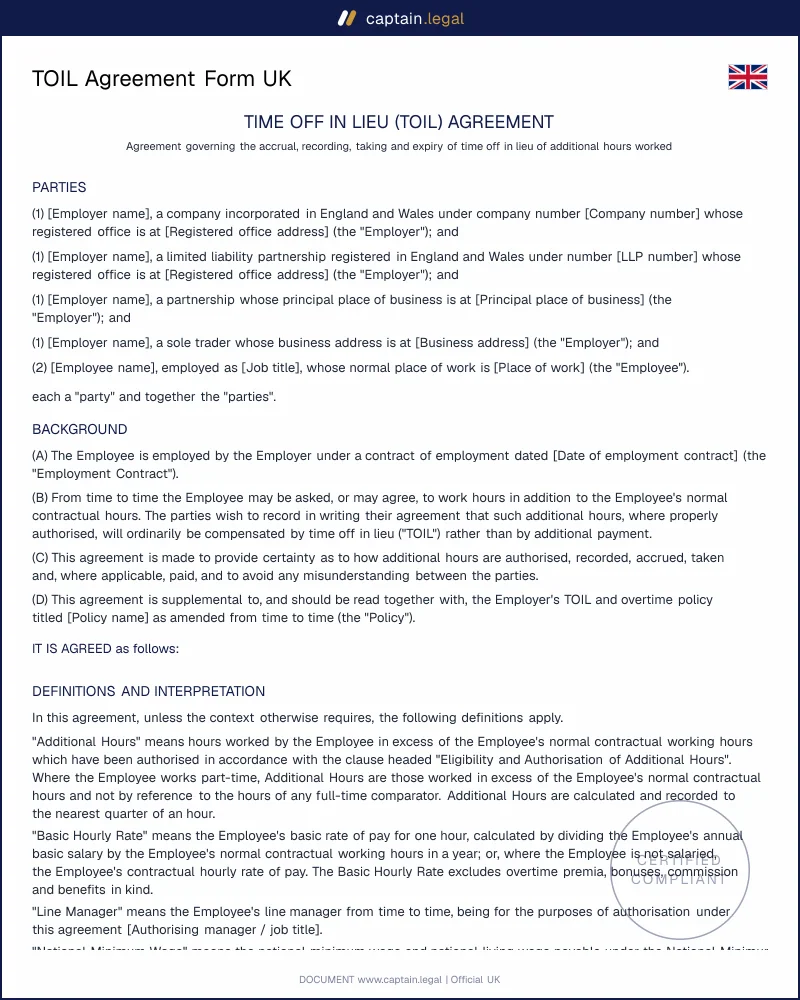
Time off in lieu is not created by any single statute. There is no "TOIL Act", and UK law does not oblige an employer to offer it, nor to pay enhanced rates for overtime at all. What the law does is set the boundaries inside which any TOIL arrangement has to operate, and the dominant instrument is the Working Time Regulations 1998 (SI 1998/1833). Under regulation 4, a worker's average working time must not exceed 48 hours for each seven days, normally averaged over a rolling 17-week reference period. Banked overtime counts toward that average. An employee who consistently works long hours and accrues a large TOIL balance can quietly breach the limit, and the liability sits with the employer, not the worker. Regulation 9 requires you to keep adequate records of hours worked, which is precisely what a properly completed form delivers.
The 48-hour ceiling can be set aside, but only through the opt-out mechanism in regulation 5: a voluntary written agreement signed by the worker, who can withdraw it on notice and who must not suffer any detriment for refusing to sign. An opt-out covers the 48-hour limit and nothing else. It does not touch the daily rest entitlement of 11 hours, the weekly rest period, or the 20-minute break after six hours of work, all of which remain in force regardless of how willing the employee is to keep working. The other live constraint is the National Minimum Wage Act 1998. When extra hours are repaid in time rather than money, the cash pay for the relevant pay reference period stays the same while the hours rise, which can drag the effective hourly rate below the statutory minimum. You have to watch that calculation, especially for lower-paid staff. Disability-related absence brings the Equality Act 2010 into play as well, so a rigid approach to banked time can carry discrimination risk. For the authoritative position on the 48-hour limit and how the reference period works, the ACAS guidance on working time rules is the reference point most tribunals and HR teams treat as definitive.