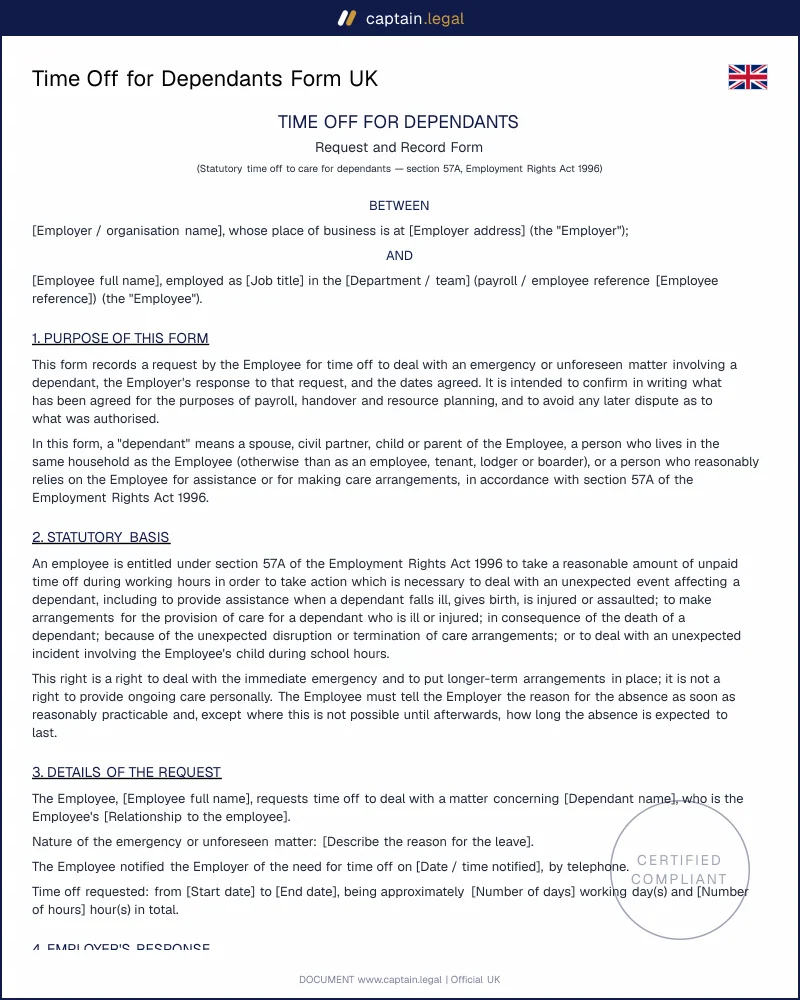
The governing provision is section 57A of the Employment Rights Act 1996, introduced through the Employment Relations Act 1999 to implement the EU Parental Leave Directive. It gives every employee, from day one of employment, the right to take a reasonable amount of unpaid time off to take necessary action where a dependant falls ill, gives birth, is injured or assaulted, dies, where care arrangements unexpectedly break down, or to deal with an unexpected incident involving a child during school hours. There is no minimum service requirement, which surprises many employers who assume the right vests over time. It does not.
Two words in the statute do most of the heavy lifting, and both are about proportionality. The leave must be reasonable in length, and it must be for necessary action. Case law has shaped what that means. In Qua v John Ford Morrison Solicitors [2003], the Employment Appeal Tribunal held that the right is to deal with the immediate crisis and put arrangements in place, typically a day or two, not to provide the care personally over an extended period. In Royal Bank of Scotland v Harrison [2009], the EAT confirmed that "unexpected" can still apply even where the employee had some advance warning, provided the breakdown in care was genuinely outside their planning. Your form should never try to override these limits, but it should record enough detail to apply them sensibly.
The statute also requires the employee to tell the employer the reason for the absence and how long they expect to be away as soon as reasonably practicable. There is no statutory right to paid time off for dependants; payment is a matter for your contract or discretion. An employee who is refused the leave, or subjected to a detriment or dismissal for taking it, can complain to an employment tribunal under section 57B. The authoritative starting point for the statutory text is the Employment Rights Act 1996 as published by the National Archives, in the UK legislation database entry for section 57A on time off for dependants. Read it alongside Acas guidance before you draft any internal policy, because the right interacts closely with the contracts of employment your business already uses, such as our UK full-time contract of employment template under section 1 ERA 1996.