Create my document
Login

Choose country

United KingdomUnited KingdomChoose country
Leave Request

Jury Service Leave Form UK | Juries Act 1974

Stop the corridor agreement. Capture a jury summons cleanly: dates, pay arrangement and return date confirmed in writing. Editable Word and PDF.
4.8/517 reviews50 000+ downloadsInstant download
Share

A jury summons rarely arrives at a convenient moment. One of your team opens a brown envelope from the court, and suddenly you are looking at up to ten working days of absence with very little notice. The Jury Service Leave Request and Response Form exists to take that envelope and turn it into something orderly: confirmed dates, a recorded decision on pay, and a clear understanding of when the employee comes back to their desk. It records the request from the employee and the formal response from the employer on a single document, so nothing is left to memory or to a hurried conversation by the kettle.

This template is built for UK employers and HR managers who want a clean paper trail when staff are called to serve as jurors. It captures the summons reference, the court, the dates, and the pay arrangement, then sets out the return-to-work position in writing.

Compliant

2026 Legislation

50,000+ clients

trust us

Affordable

From $4.90 / doc

Secure payment

Instant download

Jury Service Leave Form UK | Juries Act 1974

Secure payment · No subscription

Fill in the template

What is a jury service leave request and response form?

A jury service leave request and response form is a short administrative document that does two jobs in one place. The first half is completed by the employee who has received a jury summons under the Juries Act 1974, setting out the court name, the summons reference number, the start date, and the expected length of service. The second half is the employer's formal written response: whether the time off is granted (it almost always must be), how pay will be handled during the absence, and the agreed return date.

People often confuse this with a holiday or annual leave form, and the distinction matters. Annual leave is something you can grant or refuse on operational grounds. Jury service is not. An employee who has been summoned has a protected right to attend, and the most you can normally do is ask them to apply for a deferral if their absence would seriously disrupt the business. Treating a juror's request like a discretionary holiday request is the single most common drafting error we see, and it is the kind of mistake that surfaces later in a tribunal bundle. This form is therefore phrased as a confirmation and acknowledgement document, not an approval gate. You are recording a decision the law has largely made for you, and documenting the pay and cover arrangements you control.

2

When do you need this document?

The obvious trigger is the moment a staff member tells you they have been summoned. Use the form straight away to capture the court, the dates, and the summons reference, because the worst version of this process is the one where the employee mentions it in passing and you reconstruct the details three weeks later for payroll. A second common scenario is the part-day juror: courts run roughly from 10am to 5:30pm, jurors are often released early or held back, and you need an agreed expectation in writing about whether they return to work on days they are not needed at court. Our return to work interview form aligned with ACAS guidance pairs naturally with this once service ends.

The third situation is the one that worries small employers most: service that lands during a peak trading period or while the team is already short-staffed. Here the form doubles as the record of a deferral conversation. You can ask the employee to apply to postpone, but only where the absence would seriously harm the business, and the request must be evidenced and co-signed. An employee may defer only once in a twelve-month period, so this is not a lever you can pull repeatedly. The form captures whether deferral was discussed, the business reasons given, and the outcome.

One edge case worth flagging concerns long trials. Jury service usually lasts up to ten working days, but complex fraud or murder cases can run for weeks. If the court warns that a trial will significantly overrun, jurors may be excused or allowed to defer, and your cover arrangements need to flex accordingly. Recording the expected length on the form, then updating it, keeps payroll and rota planning honest.

3

Key clauses included in our template

  • The summons and eligibility details section records the court, the summons reference number, the first day of attendance, and the employee's declared availability. This is the spine of the document, because every later decision about pay and cover hangs on these dates being accurate rather than approximate.
  • The employer acknowledgement and grant of time off confirms in plain terms that the absence is permitted and that the employee will not be penalised for attending. The wording deliberately tracks the protection in the Employment Rights Act 1996 against dismissal and detriment, so the document itself evidences that you understood the obligation.
  • The pay arrangement clause sets out one of three positions: full pay maintained, a top-up of the court's loss of earnings allowance to normal take-home, or unpaid with a court claim. It also flags where you will complete the certificate of loss of earnings, removing the most frequent payroll ambiguity.
  • The deferral and business-impact record documents whether a postponement was discussed, the operational reasons, and the employee's agreement to co-sign any deferral request. It exists to show that any conversation about timing was about genuine business disruption, not pressure to avoid the duty.
  • The return-to-work and cover provisions fix the expected return date, set out what happens on days the juror is released early, and note any handover or temporary cover. For more involved temporary arrangements, our UK fixed-term employment contract template covers maternity-style cover and project hires.
4

Regional considerations

Jury service operates on a single legislative framework across England and Wales under the Juries Act 1974, so unlike tenancy or holiday rules there is no patchwork of regional variation to navigate within that jurisdiction. The practical differences are administrative rather than legal, and they are worth understanding before you complete the form.

England and Wales share the same Crown Court summoning system administered by the Jury Central Summoning Bureau, the same eligibility criteria, and the same loss of earnings allowance structure. A Welsh-language telephone line exists for the Bureau, and a juror in Wales may give evidence and serve in Welsh, but the employer's obligations and the pay framework are identical to England.

Scotland runs a separate system. Scottish jury service is governed by its own legislation and court structure, juries in criminal trials are larger, and the citation and excusal arrangements differ from the England and Wales model. If your employee is summoned to a Scottish court, the loss of earnings allowance and the certificate process are administered through the Scottish Courts and Tribunals Service rather than the Bureau, and you should not assume the figures or notice rules are interchangeable.

Northern Ireland likewise has its own jury arrangements administered through the Northern Ireland Courts and Tribunals Service. The underlying employment protections against dismissal and detriment broadly mirror Great Britain, but the summoning and allowance mechanics are distinct. For employers with staff across the UK, the safest approach is to treat the Juries Act 1974 form as your England and Wales template and to confirm the local court's certificate process when a Scottish or Northern Irish summons appears. The acknowledgement and pay clauses transfer cleanly; the allowance figures and excusal routes do not.

5

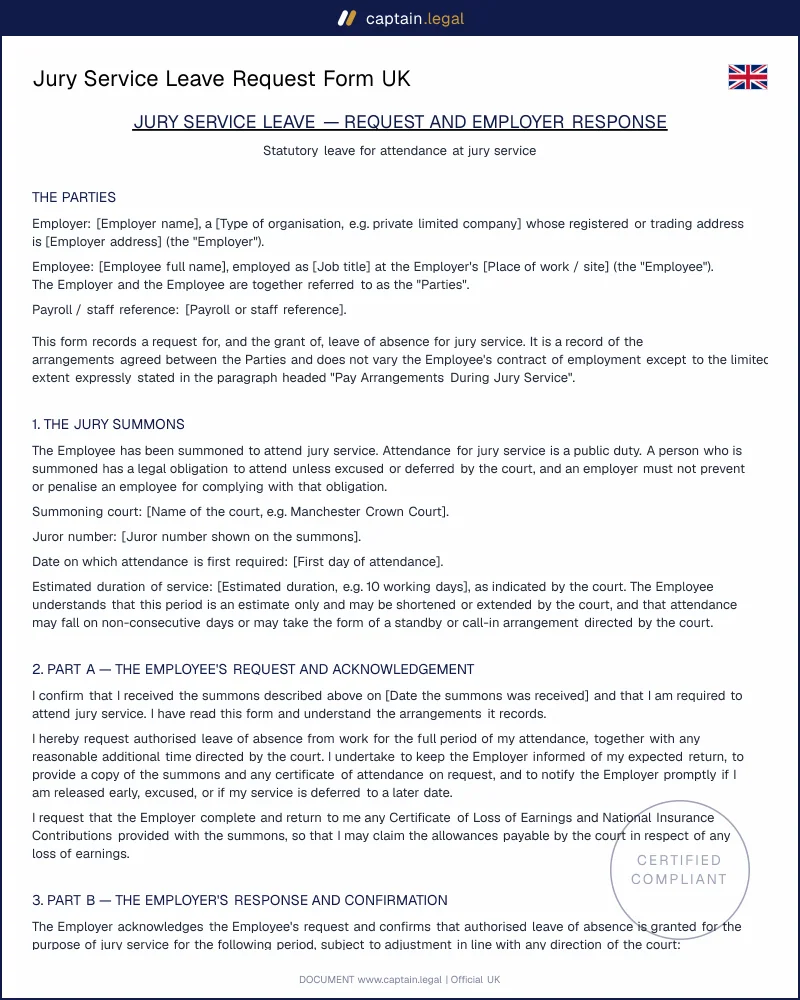
How to fill out this jury service leave request and response form

You begin in the employee section, entering the court named on the summons, the reference number printed on the letter, and the date service starts. From there the form prompts for the expected duration, which for most Crown Court trials sits at up to ten working days, though the field allows for longer estimates where the court has warned of a lengthy case. The employee signs to confirm the details match the summons, which removes the usual back-and-forth over dates.

The document then moves to the employer response. You select the pay position from the three standard options, confirm whether you will complete the certificate of loss of earnings, and record any agreement about returning to work on days the juror is released early. If business disruption is a genuine concern, the deferral block captures the operational reasons and the employee's agreement to co-sign a postponement request. Finally, you set the expected return date and any cover notes, then both parties sign. The whole exercise takes a few minutes and leaves you with a single signed record for payroll, the rota, and the personnel file. Our unpaid leave request form for discretionary leave follows the same logic where the absence is not statutory.

6

Common mistakes to avoid

The first and most damaging error is treating the summons as a request you can decline. You cannot refuse jury service the way you refuse a holiday clash, and any document that frames it as a discretionary approval invites a detriment claim. The second mistake is silence on pay. Employers who never decide their position, or who pay informally one year and stop the next, can find that a settled custom has hardened into a contractual obligation they did not intend. State the pay position clearly on the form and apply it consistently.

A third trap is the careless deferral request. You may ask an employee to postpone only where the absence would seriously harm the business, the request must be evidenced, and the employee can defer only once in any twelve months. A vague "it's inconvenient" letter to the court will rightly be ignored, and pressuring someone to defer without genuine business grounds can itself look like detriment. Fourth, employers forget the certificate of loss of earnings, leaving the juror unable to recover anything from the court while also unpaid by the business. Finally, do not let jury service blur into unrelated absence issues; if performance or sickness problems predate the summons, manage them separately and document the real reason, or you risk a dismissal that looks retaliatory even when it is not.

Key takeaways

Jury service

It is not annual leave you approve

A jury summons under the Juries Act 1974 is not a discretionary holiday request. The employer will almost always have to allow the time off, and the most you can usually do is ask the employee to seek a deferral if their absence would seriously disrupt the business. Treating it like annual leave is a common mistake that can resurface later in a tribunal bundle.

Paper trail

Confirm dates, pay and return-to-work

Use one document to turn the court envelope into an auditable record. The employee section captures the court, summons reference, start date and expected length. The employer section confirms the organisation’s response, the pay arrangement during the absence, and the agreed return date. That stops corridor agreements and avoids disputes about what was said in a rushed chat by the kettle.

Employment risk

No dismissal or detriment for attending

Even though the Juries Act 1974 governs the summons, the employment risk sits elsewhere. Under the Employment Rights Act 1996 there is no positive statutory right to time off for jury service, but there is protection against dismissal and detriment for being summoned or attending. Dismissal for jury service is automatically unfair with no qualifying service period, and quieter penalties can also trigger claims.

Frequently Asked Questions

The form records a decision and an acknowledgement rather than creating new legal rights, but it carries real evidential weight. By signing, you confirm in writing that you granted the time off, agreed the pay arrangement, and did not penalise the employee for attending, which directly mirrors the protections in the Employment Rights Act 1996 against dismissal and detriment. If a dispute ever reached a tribunal, a clear signed record of fair treatment is exactly the kind of contemporaneous evidence that helps an employer. The pay clause, once agreed and signed, can also become contractually enforceable, so treat the figures you commit to as binding.

No, there is generally no statutory requirement to pay normal wages during jury service in the UK. Many employers choose to pay, and some maintain a top-up so the employee does not lose out, but the baseline legal position is that the juror claims a loss of earnings allowance from the court instead. The catch is contractual: if your contract promises pay, or if you have always paid in the past, that custom may bind you. Decide your position before you complete the form. If you are not paying, you must complete the certificate of loss of earnings so the employee can recover money from the court.

Most jury service runs for up to ten working days, with jurors typically attending from around 10am to 5:30pm Monday to Friday. Many trials finish well inside that window, and jurors are often released early on quieter days or held only on standby. Longer trials do happen: complex fraud or serious criminal cases can run for several weeks. If the court warns that a trial will significantly overrun the expected length, jurors are usually given the option to be excused or to defer. Record the expected duration on the form and update it if the position changes, so your cover and payroll planning stays accurate.

You can, but only on genuine business grounds. If the absence would seriously harm operations, for example where the employee is the only person trained to run payroll or open the premises, you may ask them to apply for a deferral. The request needs a supporting letter setting out the business reasons, the employee must co-sign it, and it goes to the court within the timeframe stated on the summons. An employee can defer only once in any twelve-month period, and the court decides whether to allow it. Keep the reasons objective and documented, because pressuring someone to defer without real grounds can amount to unlawful detriment.

The template downloads in editable Word format and as a clean PDF. The Word version lets you adapt the wording to your own house style, add your letterhead, and adjust the pay clause to match your policy, while the PDF gives you a tidy version to sign and file. You customise it once, then reuse it every time a summons lands, which is the practical advantage over drafting a fresh letter each time. Both versions capture the same fields, so whichever you circulate, the summons details, pay arrangement, and return date are recorded consistently for payroll and the personnel file.

As soon as reasonably possible after the summons arrives. There is no fixed statutory notice period the employee owes the employer, but early notice is what lets you arrange cover, decide the pay position, and consider whether a deferral is justified before the deadline on the summons passes. A well-drafted employee handbook aligned with the ACAS Code and Equality Act 2010 usually requires staff to report anything affecting their attendance at work, including a jury summons, which gives you a contractual hook for prompt notification. Capturing the summons date on this form then fixes the timeline for everyone.

No. Time spent on jury service does not break continuity of employment, and the employee's statutory rights that depend on length of service continue to accrue as normal. The employment relationship simply continues through the absence, which is why the protection against dismissal and detriment applies from day one with no qualifying period. Pension, holiday accrual, and other service-linked entitlements are unaffected by the time away. The return-to-work section of this form exists precisely to underline that the employee slots back into their existing role on the agreed date, with their position and continuity intact, rather than returning to any altered arrangement.

4.8/5

17 verified reviews · 50 000+ downloads

Jury Service Leave Form UK | Juries Act 1974
  • Immediate access to the document
  • PDF + Word download
  • Compliant with 2026 legislation
  • Reviewed by lawyers
Fill in the template
Secure payment · No subscription
Updated on June 24, 2026

You might also like

Unpaid Leave Request Form UK
UK Sabbatical & Career Break Agreement