Create my document
Login

Choose country

FranceBelgiqueEspañaUnited StatesUnited KingdomالمغربDeutschlandItalia
Leave Request

UK Parental Bereavement Leave Form | 2 Weeks Statutory

Confirm your 2 weeks' parental bereavement leave in writing. Day-one right under the 2020 Act, no death certificate needed. Editable Word and PDF template.
4.7/521 reviews50 000+ downloadsInstant download
Share

A Parental Bereavement Leave Request Form is the written notice an employee uses to claim the statutory entitlement to two weeks off work after the death of a child under 18 or a stillbirth from 24 weeks of pregnancy. Sometimes called Jack's Law, this right sits in the Employment Rights Act 1996 and applies from the first day of employment, regardless of length of service. The form captures the three things an employer needs to act on a request: confirmation of the date of death, the date the leave is to start, and whether one week or two is being taken. It exists so that grief is not compounded by a payroll error or a forgotten conversation, and so that approved dates are confirmed in writing for handovers, planning, and the pay run.

Compliant

2026 Legislation

50,000+ clients

trust us

Affordable

From $4.90 / doc

Secure payment

Instant download

UK Parental Bereavement Leave Form | 2 Weeks Statutory

Secure payment · No subscription

Fill in the template

What is a parental bereavement leave request form?

A parental bereavement leave request form is the document an employee gives an employer to trigger their entitlement to Parental Bereavement Leave (PBL) under the Parental Bereavement (Leave and Pay) Act 2018 and the Parental Bereavement Leave Regulations 2020. It is a notice, not an application for permission. An employer cannot refuse, postpone, or amend the dates the employee has chosen, which makes the form fundamentally different from an annual leave request that a manager can approve or decline. The manager's role is to record the request accurately, confirm it back, and make sure the payroll team treats the absence correctly.

People often confuse three overlapping rights, and the form should make clear which one is in play. Time off for dependants under section 57A of the Employment Rights Act 1996 gives a short, usually unpaid right to deal with an emergency involving a dependant, including a bereavement. Compassionate leave is typically a contractual or discretionary policy that varies between employers. Parental bereavement leave is the statutory two-week entitlement specific to the death of a child, and it stacks on top of, rather than replaces, those other rights. A bereaved parent might take a day of dependants' leave to deal with the immediate aftermath, then a full block of PBL afterwards. The form needs to name the right correctly so the absence is coded properly and the employee is not quietly pushed onto sick leave or annual leave instead.

2

When do you need this document?

The most common situation is straightforward and painful: an employee has lost a child and needs to tell their employer they are taking the two weeks the law gives them. The form turns a phone call or a tearful corridor conversation into a clear record that protects everyone, which matters because the entitlement runs for a 56-week window from the date of death and can be split into two separate weeks taken months apart. A parent might take one week immediately and a second week around the anniversary or a birthday. Without a written request for each block, the second period is the one most likely to be missed or mishandled.

A second scenario is the deferred claim. Some parents return to work quickly and only later find they cannot cope, so they take their leave several weeks or months after the death. Leave taken in the first week after the death needs no notice at all, while leave taken later requires at least one week's notice. The form is where that notice is given and dated, which is what keeps a deferred request enforceable. A third trigger is the stillbirth case: a baby stillborn after 24 weeks of pregnancy counts, and the right belongs to both parents, so two separate forms may land on a manager's desk from the same household.

The edge cases are where expertise earns its keep. Where more than one child has died, whether at the same time or not, each death carries its own two-week entitlement and its own request. And a parent who loses the child while already on maternity, paternity, or adoption leave keeps that existing leave running and can add PBL afterwards, a sequencing point that catches out many payroll teams handling concurrent family and parental leave entitlements.

3

Key clauses included in our template

  • The bereaved parent declaration is the heart of the form. It records the employee's relationship to the child, since the entitlement extends beyond birth parents to adopters, intended parents in a surrogacy arrangement, and certain carers defined in the 2020 Regulations. Getting this right is what distinguishes a valid claim from a rejected one.
  • The date of the child's death or stillbirth anchors the whole entitlement, because every deadline runs from it: the 56-week window, the notice rules, and the 26-week service calculation for pay. The form prompts for it plainly, without asking the parent to attach any certificate, which the law expressly forbids requiring.
  • The chosen leave dates and duration let the employee state whether they are taking one week or two, and when each block begins. Because weeks must normally be taken in full and can start on any day, the form is structured so a parent can request a single fortnight or two separate weeks without ambiguity.
  • The pay eligibility section captures the written declaration needed for SPBP, confirming continuous service and earnings. This is the part HMRC and your payroll provider will rely on, and a vague version here is what causes underpayments and clawbacks later.
  • The employer confirmation block records the manager's written acknowledgement of the approved dates back to the employee, closing off the "we never agreed those days" dispute. It mirrors the discipline of a properly documented statement of written particulars of employment, where what is written down is what governs.
4

Regional considerations

Parental bereavement leave is a UK-wide statutory right, so the core two-week entitlement, the day-one access, and the 56-week window apply identically in England, Wales, Scotland, and Northern Ireland. The underlying statutes, the Employment Rights Act 1996 and the Social Security Contributions and Benefits Act 1992, extend across Great Britain, with parallel provision for Northern Ireland, so a form built to the statutory test works wherever your employee is based. There is no devolved variation to manage in the way you would with, say, housing or tenancy law.

Where local practice does diverge is in what employers choose to offer on top of the minimum. Many organisations enhance the statutory floor, paying full salary during the leave rather than the flat statutory rate, or extending the entitlement beyond two weeks. Public sector employers and larger firms are the most likely to do this, and a sensible form leaves room to record an enhanced contractual entitlement alongside the statutory one, so the two are not confused at payroll. Where a contract offers more than the statute, the more generous term applies, but the statutory minimum can never be reduced by contract.

The other practical regional point is interaction with other family-leave rights, which differ slightly in how they sequence. An employee in any nation who loses a child while on a fixed-term contract still qualifies for the day-one leave right, though their pay eligibility depends on the 26-week service test. Employers running short engagements should map this against their other fixed-term employment contract obligations so a bereavement during a temporary placement is handled correctly rather than treated as a gap to be ended early, which would itself raise detriment and dismissal protection issues under the 2018 Act.

5

How to fill out this parental bereavement leave request form

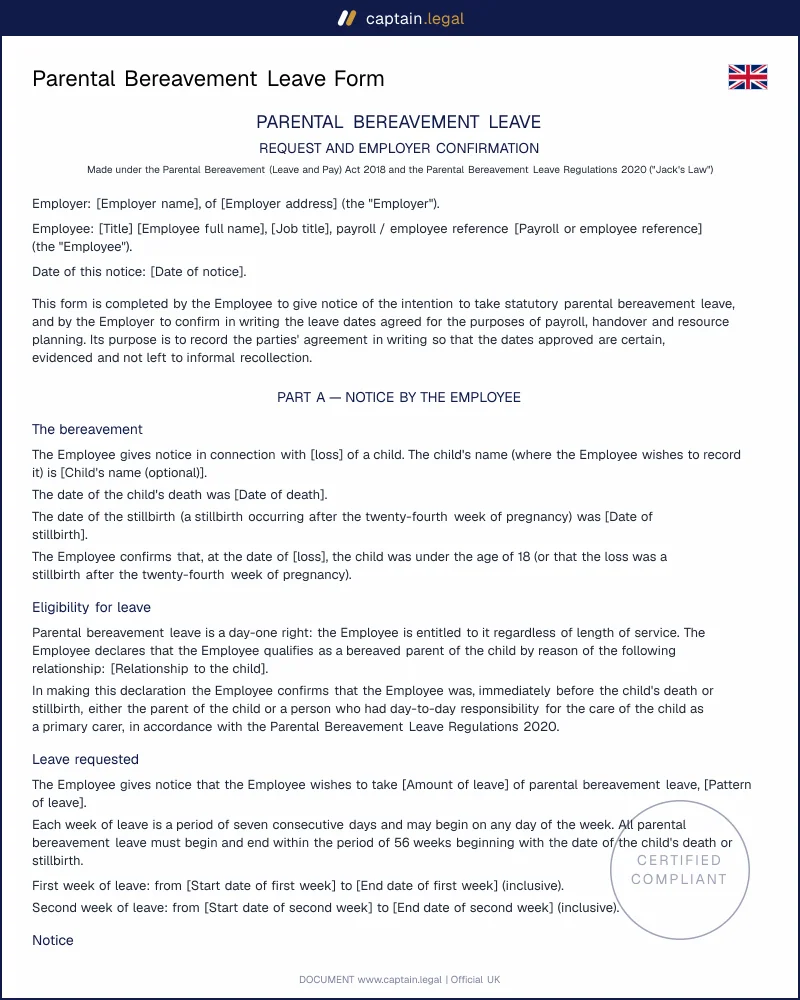
You start with the employee's details and their relationship to the child, because that relationship is what establishes the right to leave in the first place. From there, the form asks for the date of the child's death or stillbirth, the single fact every subsequent calculation depends on, and it does so without ever requesting a supporting certificate. Next, the employee states the leave they want: one week or two, and the start date for each block, with the form making clear that the 56-week window and the full-week rule both apply so the dates chosen are genuinely valid.

The pay section then guides the employee through the eligibility declaration for SPBP, confirming continuous service and earnings rather than leaving payroll to guess. Once the employee has completed and signed their part, the form moves to the employer confirmation, where the manager records the approved dates in writing and notes any enhanced contractual entitlement. That written confirmation is what you keep on file for the pay run and any later HR and dismissal documentation you may need to evidence fair treatment. The whole process is built to be completed in minutes, at a moment when no one has the patience for bureaucracy.

6

Common mistakes to avoid

The single most common error is treating the request as something to approve or refuse. Managers used to handling holiday requests reach for the same instinct and try to push the dates, but the law gives the employee the choice, and an employer who postpones or rewrites the chosen dates is acting unlawfully. The second frequent mistake is demanding evidence: a well-meaning HR adviser asks for the death certificate to "process the claim", which the 2020 Regulations expressly prohibit. A request for a certificate is not just unnecessary, it can itself become the basis of a detriment complaint, given how sensitive the moment is.

Payroll mistakes form the next cluster. Employers routinely confuse the day-one leave right with the 26-week service test for pay, and either deny leave to a short-serving employee who is fully entitled to it, or pay someone who has not met the service and earnings conditions and then face a clawback. Coding the absence as sick leave or annual leave is another quiet error that strips the employee of a right Parliament gave them. Finally, employers forget that the entitlement can be split and deferred across the full 56 weeks, so they close the file after the first week and miss the second request months later. A standing record from a properly completed form is the simplest defence against every one of these, far cheaper than recreating events from memory when a redundancy or restructuring notice later puts the same employee's treatment under scrutiny.

Key takeaways

Statutory leave

Two weeks off is a day-one right

Parental bereavement leave gives you up to two weeks off after the death of a child under 18, or a stillbirth from 24 weeks of pregnancy. It applies from your first day of employment, whatever your length of service. This form is written notice to trigger that entitlement, so the dates are recorded properly and the absence is handled as statutory leave, not as sickness or annual leave.

Notice details

You choose the dates and duration

This is a notice, not a request for permission. The employer cannot refuse, postpone, or change the dates you have chosen. The form should capture the three points the employer needs to action it: the date of death, the leave start date, and whether you are taking one week or two. Putting it in writing avoids misunderstandings, helps handovers, and keeps the pay run accurate.

Pay vs leave

Leave is automatic; pay has conditions

Do not assume pay and leave are the same thing. Leave is a day-one right, but Statutory Parental Bereavement Pay has a qualifying test: at least 26 weeks’ continuous employment ending with the week of the child’s death, and earnings at or above the lower earnings limit over the relevant period. If you do not qualify for pay, you can still take the full two weeks, just unpaid.

Frequently Asked Questions

The form is the written notice that triggers a genuine statutory entitlement, so it carries real legal weight rather than being a courtesy document. The right to Parental Bereavement Leave comes from the Employment Rights Act 1996 and the Parental Bereavement Leave Regulations 2020, and a completed form is your evidence that proper notice was given and the correct dates agreed. For the employer, the written confirmation block creates the audit trail that protects you if treatment of the bereaved employee is ever questioned at a tribunal. The form does not create the right, the statute does, but it is what makes that right administratively enforceable on both sides.

No. This is the feature that sets the entitlement apart from ordinary holiday. An employer cannot refuse, postpone, or amend the dates you have chosen for your two weeks, provided you give the notice the regulations require and stay within the 56-week window from the date of death. Leave taken in the week immediately after the death needs no notice at all, while leave taken later requires at least one week's notice. The manager's job is to record your request and confirm it back, not to negotiate it. That is exactly why the form is structured as a notice rather than an application.

Yes. Parental bereavement leave is a day-one right, so you are entitled to the two weeks from your very first day of employment, regardless of how long you have worked there. What depends on length of service is the pay, not the leave. To receive Statutory Parental Bereavement Pay, you generally need at least 26 weeks' continuous employment ending with the week of the child's death, together with average earnings at or above the lower earnings limit. If you take the leave but do not meet the pay test, you still take the full two weeks, just without statutory pay for that period.

The form is provided in editable Microsoft Word format and as a clean PDF, so you can either customise the wording to fit your organisation's policy or use it straight away. The Word version is useful where you offer an enhanced contractual entitlement and want to record it alongside the statutory minimum, while the PDF gives you a tidy, fixed copy to keep on file for payroll and HR records. Both versions cover the same statutory points, including the eligibility declaration and the employer confirmation block, so you are never left rebuilding the structure yourself.

It depends on when you take it. For leave taken in the first week after your child's death, no notice is required at all, in recognition that bereavement cannot be planned. For any leave taken later in the 56-week window, you must give your employer at least one week's notice before the leave is due to start, stating the date of death, the start date you want, and whether you are taking one week or two. The form captures all three points in one place. Notice for the leave itself need not be in writing unless the employer asks, but putting it in writing is strongly advisable, and a claim for statutory pay does require a written declaration.

Yes. You can take your entitlement as a single block of two weeks or as two separate weeks at different points, and each week can start on any day. The only constraints are that leave must normally be taken in full weeks and that the whole entitlement must start and end within the 56-week window from the date of death. This flexibility is deliberate, so that a parent can take time immediately and then take a second week later, perhaps around an anniversary. Each separate block needs its own notice, which is why keeping a completed form for every period of leave matters.

Each child's death carries its own separate entitlement to two weeks of leave, and to pay if you qualify, whether the children died at the same time or on different dates. There is no combining or capping across multiple bereavements. Practically, that means a separate request and a separate record for each child, so the dates, the notice, and any pay declaration are documented cleanly for each. An employer handling such a situation should treat each entitlement on its own terms rather than trying to merge them, and the form is designed to be completed once per child for exactly this reason.

4.7/5

21 verified reviews · 50 000+ downloads

UK Parental Bereavement Leave Form | 2 Weeks Statutory
  • Immediate access to the document
  • PDF + Word download
  • Compliant with 2026 legislation
  • Reviewed by lawyers
Fill in the template
Secure payment · No subscription
Updated on May 30, 2026

You might also like

SSP Decision Letter Template UK
Shared Parental Leave Notice Pack UK