Create my document
Login

Choose country

FranceBelgiqueEspañaUnited StatesUnited KingdomMarocDeutschlandItaliaSchweiz
Employment

PIP Template UK | s.98 ERA 1996 Capability Process

Lawyer-drafted UK performance improvement plan aligned to s.98 ERA 1996 and the ACAS Code. Capability framing, review timeline and outcome wording included.
4.8/517 reviews50 000+ downloadsInstant download
Share

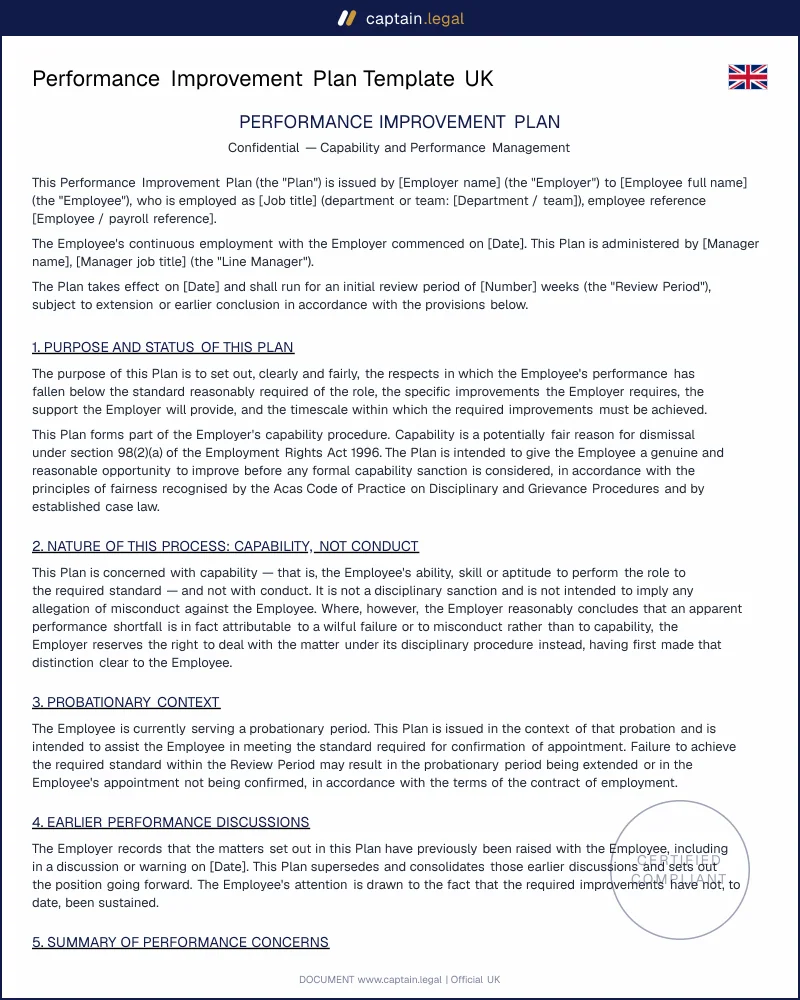
A Performance Improvement Plan is the structured route a UK employer takes when an employee's work has fallen below the required standard and you want to fix it properly, or build a defensible record if it cannot be fixed. A well-drafted PIP sets out the specific shortfalls, measurable objectives, realistic review dates and the support you will provide, all framed within the capability limb of dismissal under section 98(2)(a) Employment Rights Act 1996. This template is built for employers in England and Wales who need to manage underperformance without handing the employee an easy unfair dismissal claim. It pairs the plan itself with review-meeting records and outcome wording, in editable Word and clean PDF.

Most performance problems are recoverable. The ones that are not still need a paper trail that a tribunal would recognise as fair. This document gives you both.

Compliant

2026 Legislation

50,000+ clients

trust us

Affordable

From $4.90 / doc

Secure payment

Instant download

PIP Template UK | s.98 ERA 1996 Capability Process

Secure payment · No subscription

Fill in the template

What is a performance improvement plan?

A performance improvement plan is a formal, time-bound process that records where an employee is falling short, what "good" looks like, and how long they have to get there. It is not a warning in the disciplinary sense, and it is not a redundancy tool. It sits inside the capability framework, where section 98(3)(a) ERA 1996 defines capability by reference to skill, aptitude, health or any other physical or mental quality. In plain terms, a PIP addresses someone who is trying but underperforming, not someone who is wilfully breaking the rules: that latter situation is misconduct and runs through a different procedure.

People often confuse a PIP with a final written warning, and the distinction matters. A warning is the output of a disciplinary process; a PIP is a management plan that may eventually feed into a capability dismissal if targets are missed. A PIP is not required by statute, but the moment you use one it becomes part of the fairness assessment a tribunal will scrutinise. That is the trap. Employers reach for a PIP thinking it is informal, then treat it carelessly, and the carelessness becomes evidence. The companion to performance management is often a clear contract, so it helps to have a properly drafted full-time UK employment contract aligned to Section 1 ERA 1996 underpinning the role expectations you are now enforcing.

2

When do you need this document?

The clearest trigger is sustained underperformance against an objective standard: missed targets, recurring quality failures, deadlines slipping past the point where informal conversations have stopped working. By the time you reach for a PIP, you should already have raised the concern verbally and seen no durable change. The plan formalises what was previously a quiet chat, and that formalisation is precisely what gives you a defensible record later.

A second scenario is the new starter or recently promoted employee who is not meeting role expectations. Promotion cases are awkward because the person performed well at the lower grade, so the plan has to define the new standard rather than assume it. A third is the employee returning from a long absence who cannot yet hit pre-absence output: here you tread carefully, because performance shortfalls linked to a disability under the Equality Act 2010 engage the duty to make reasonable adjustments, and a PIP that ignores that duty is itself evidence of discrimination.

Two edge cases legitimately complicate things. Where underperformance shades into ill-health, you may be in capability on medical grounds, which calls for occupational health input before any target-setting. And where a manager is using a PIP to manufacture an exit rather than secure improvement, tribunals see through it: a plan with unachievable targets and a foregone conclusion reads as a sham and supports a constructive dismissal argument. If the relationship is genuinely beyond repair after a fair process, the proper next step is documented through a UK dismissal letter built around the five fair reasons in s.98 ERA 1996.

3

Key clauses included in our template

  • The statement of performance concerns sets out each shortfall against the actual role requirement, with dates and concrete examples rather than vague labels. "Poor communication" is replaced by the specific incidents and the standard expected, because a tribunal cannot test fairness against an objective it cannot see.
  • The SMART objectives are drafted to be specific, measurable, achievable and time-bound, each tied to the role the employee was actually engaged to perform. This is where most plans fail: targets that are aspirational, moving or impossible hand the employee a ready-made argument that improvement was never realistically on offer.
  • The review timeline and meeting schedule fixes the length of the improvement period and the interim check-in dates, so progress is assessed in stages rather than judged once at the end. The period is calibrated to seniority, with prompts to extend it for complex roles where a short window would look unreasonable.
  • The support and resources section records the training, mentoring, equipment or workload adjustment the employer will provide. An absence of any support is one of the most common procedural gaps that turns a capability dismissal unfair, so this clause is deliberately prominent.
  • The right to be accompanied wording confirms the employee may bring a colleague or union representative to formal meetings under section 10 Employment Relations Act 1999, and the outcome and escalation clause sets out what happens if objectives are met, partially met or missed, including the route to a formal capability hearing.
4

Regional considerations

This template is drafted for England and Wales, where the Employment Rights Act 1996 and the ACAS Code apply directly and capability dismissals are litigated in the Employment Tribunal. The substantive law on unfair dismissal and the procedural expectations described above operate identically across both nations, so a plan compliant in Cardiff is compliant in Manchester.

Scotland shares the same primary employment statutes, since unfair dismissal and capability law are reserved to Westminster rather than devolved to Holyrood. The ERA 1996, the Equality Act 2010 and the ACAS Code apply in full. The practical difference is forum and procedure: Scottish claims run through the Employment Tribunals (Scotland), and any related civil litigation follows Scots law and terminology, so references to court process should not be lifted unaltered from English precedents.

Northern Ireland is the genuine departure. Employment law there is devolved, and the Employment Rights Act 1996 does not apply; the equivalent is the Employment Rights (Northern Ireland) Order 1996. Crucially, Northern Ireland retains the statutory dismissal and disciplinary procedures, and the qualifying period and tribunal system differ, with claims heard by the Industrial Tribunal rather than the Employment Tribunal. An employer operating in Belfast should not assume an England and Wales PIP is transferable without local review. For employers managing staff across borders, it is worth checking whether a separate Section 1 statement of written particulars reflects the correct jurisdiction before the performance process begins.

5

How to fill out this performance improvement plan

You start by entering the employee's details, role title and the date the plan begins, which anchors the review period that the document then calculates around. From there you describe each performance concern in the dedicated fields, and the structure prompts you to attach a concrete example and the standard expected rather than leaving a general complaint to stand on its own. The plan then guides you through drafting objectives, nudging you toward measurable wording and away from the aspirational phrasing that weakens a capability case.

Next you set the improvement period and the interim review dates, with built-in guidance on calibrating length to the seniority of the role. You record the support being offered in the same pass, so the finished plan reads as a genuine attempt to help rather than a paper exercise. The final stage covers the meeting record and outcome wording, letting you capture what was discussed and agreed, and producing a clean version for signature. You then export to Word if you expect to amend it through the review cycle, or to PDF for a fixed record. If the process ultimately points toward redundancy rather than capability, the parallel route is set out in our UK redundancy notice letter aligned to ERA 1996.

6

Common mistakes to avoid

The most damaging error is treating the PIP as a formality on the way to a predetermined exit. Tribunals are alert to plans with targets nobody could hit, review meetings that are box-ticking, and managers who have plainly decided the outcome before the period has run. A plan like that does not protect you: it becomes the central exhibit in the employee's claim, and it can convert a recoverable situation into a constructive dismissal argument. Equally common is the timescale that is too short for the role, where a complex senior function is given a fortnight to transform, which reads as unreasonable on its face. Closely related is the failure to offer any real support, since ACAS guidance treats adequate resources as a baseline expectation, and a plan that demands improvement while withholding the means to achieve it fails the reasonableness test.

The other recurring trap is ignoring the discrimination overlay. Where underperformance might be linked to a disability, pregnancy or a protected characteristic under the Equality Act 2010, pressing ahead without adjustments or medical input invites a discrimination claim that runs alongside, and is more expensive than, the unfair dismissal point. Employers also forget the right to be accompanied at formal meetings, and they keep poor contemporaneous notes, then try to reconstruct the process months later. If it is not written down at the time, a tribunal will often treat it as not having happened. Finally, do not skip the appeal stage if the process escalates to dismissal, because the absence of an appeal is a classic procedural defect.

Key takeaways

LEGAL BASIS

Treat underperformance as capability, not misconduct

A PIP belongs in the capability route to dismissal under section 98(2)(a) Employment Rights Act 1996, not the misconduct procedure. It should set out clear shortfalls, measurable targets, realistic review dates and the support you will provide. If you blur the line and use PIP language like a disciplinary warning, you risk undermining the fairness of any later capability dismissal.

FAIR PROCESS

Procedure can make or break dismissal

Section 98 requires more than a genuine concern: a tribunal will also test whether you acted reasonably under section 98(4) and within the range of reasonable responses. A PIP is not legally required, but once you use one, it becomes part of the fairness evidence. Rushed timelines, vague expectations or missing support can turn an otherwise sound decision into an unfair dismissal finding.

PRACTICAL RISKS

Follow ACAS, allow accompaniment, document reviews

Use the ACAS Code as your process yardstick. If you unreasonably fail to comply, a tribunal can uplift compensation by up to 25%, even where capability is the real issue. Build in genuine support (training, coaching or workload adjustment) and a reasonable improvement period that fits the role; a three-week plan for a senior, complex job is unlikely to look fair. Remember the right to be accompanied at formal capability meetings under section 10 Employment Relations Act 1999.

Frequently Asked Questions

The template is drafted to align with the capability framework under section 98 ERA 1996 and the procedural standards of the ACAS Code of Practice, which is what a tribunal examines when assessing fairness. A PIP itself is a management document rather than a contract, so it does not create binding obligations in the way an agreement does, but its real value is evidential. A clearly drafted plan, with measurable objectives, genuine support and proper review records, is precisely the material that demonstrates you acted reasonably. The document gives you the right structure; the fairness ultimately turns on how honestly you run the process, not on the form alone.

There is no statutory minimum, but the period must be genuinely reasonable given the role. In practice many employers set between four and twelve weeks, with junior or task-based roles at the shorter end and complex senior positions needing longer. A tribunal will ask whether the employee had a realistic chance to improve, so a plan that is too short undermines the whole exercise. The template prompts you to fix interim review dates rather than judging everything at the close, and it lets you extend the window where progress is partial, which is usually wiser than forcing an artificial deadline.

Yes, if the objectives are not met and you have followed a fair procedure. Dismissal on capability grounds is potentially fair under section 98(2)(a) ERA 1996, provided the targets were reasonable, support was given, the employee was warned that failure could lead to dismissal, and an appeal was offered. Dismissal should be a last resort after genuine attempts to manage and improve performance. Where the employee has the qualifying service for unfair dismissal protection, the paper trail from the PIP is what evidences that the decision sat within the range of reasonable responses.

ACAS guidance treats adequate support as a baseline requirement, not an optional extra. That means relevant training, coaching or mentoring, the right tools and equipment, and where appropriate an adjustment to workload or working pattern. The level scales with the shortfall and the role. A failure to offer any support is one of the most frequently cited reasons capability dismissals are found unfair, because it shows the employer demanded improvement without enabling it. The template includes a dedicated section to record exactly what is being provided, so the support is documented rather than assumed.

At any formal capability meeting the employee has the statutory right to be accompanied by a fellow worker or a trade union representative under section 10 Employment Relations Act 1999. This applies to formal review and outcome meetings, particularly where dismissal is a possible result. Informal check-ins do not always trigger the right, but the safe approach is to offer it whenever the meeting could affect the employee's continued employment. The template flags this in the meeting-record wording so it is not overlooked, which matters because forgetting it is a recognised procedural defect.

Both. You download an editable Word version and a clean PDF. The Word file is the practical choice while the plan is live, because you will usually amend objectives, log review outcomes and update the support section across the improvement period. The PDF gives you a fixed, signature-ready record for the file and for any later reference. Keeping a dated PDF at each stage is good practice, since contemporaneous records are far more persuasive to a tribunal than a single document reconstructed at the end.

The Employment Rights Act 2025 received Royal Assent in December 2025 and will reduce the qualifying period for ordinary unfair dismissal from two years to six months, with commencement scheduled for 1 January 2027, alongside removal of the statutory cap on compensation. The headline effect is that staff gain protection far earlier, so disciplined performance management from the opening months of employment becomes essential rather than optional. Running a clear, documented PIP early in the relationship is the sensible response. You can review the structure of probation and early-stage management through our zero-hours and flexible employment templates where engagement patterns are less conventional.

4.8/5

17 verified reviews · 50 000+ downloads

PIP Template UK | s.98 ERA 1996 Capability Process
  • Immediate access to the document
  • PDF + Word download
  • Compliant with 2026 legislation
  • Reviewed by lawyers
Fill in the template
Secure payment · No subscription
Updated on June 7, 2026

You might also like

Job Offer Letter Template UK
Employee Handbook Template UK