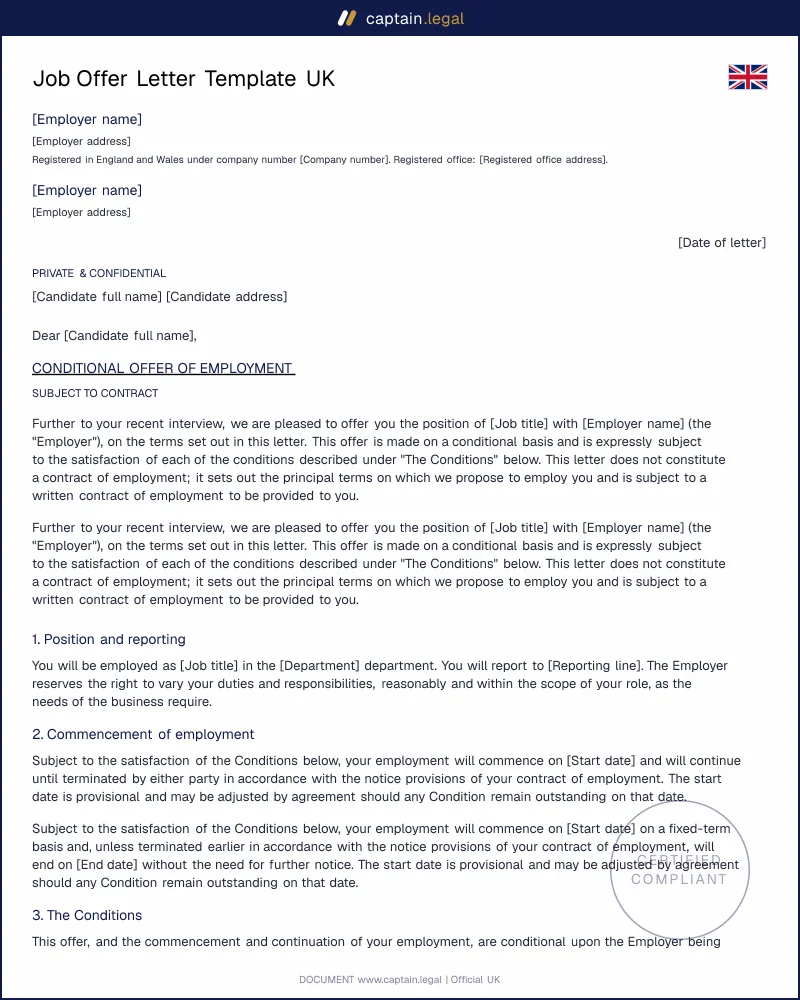
No single statute governs job offers; they live at the meeting point of contract law and employment legislation. The binding question is one of ordinary contract formation, offer, acceptance, consideration, intention, but the consequences are shaped by the Employment Rights Act 1996, which sets notice rights under section 86 and the duty to provide written particulars under section 1. The drafting choice that decides everything is whether your conditions are conditions precedent, which must be met before any contract comes into being, or conditions subsequent, which sit on top of a contract that has already formed.
This is not academic. A 2026 Employment Appeal Tribunal decision found that an offer setting out start date, salary, hours, job description, holidays, bonus and pension had created a binding contract, even though references and a right to work check were outstanding and the candidate had never returned a signed copy. The "conditions" were read as conditions subsequent, so the employer could not simply walk away when a project was delayed. The more complete your offer letter looks, the more it reads like a contract unless the conditional wording is unmistakable.
The right to work condition carries its own statutory weight. Under the Immigration, Asylum and Nationality Act 2006, you must complete a prescribed check before employment begins to hold a statutory excuse against a civil penalty, which now reaches £45,000 per worker for a first breach and £60,000 for repeats. The current rules sit in the Home Office guidance updated on 26 June 2025, covering manual checks, IDVT through a certified provider, and online checks using a share code for non-British and non-Irish nationals. The GOV.UK employer's guide to right to work checks is the authoritative reference. Reference checks and DBS screening, by contrast, have no single governing statute but must be applied consistently to avoid an Equality Act 2010 discrimination claim.