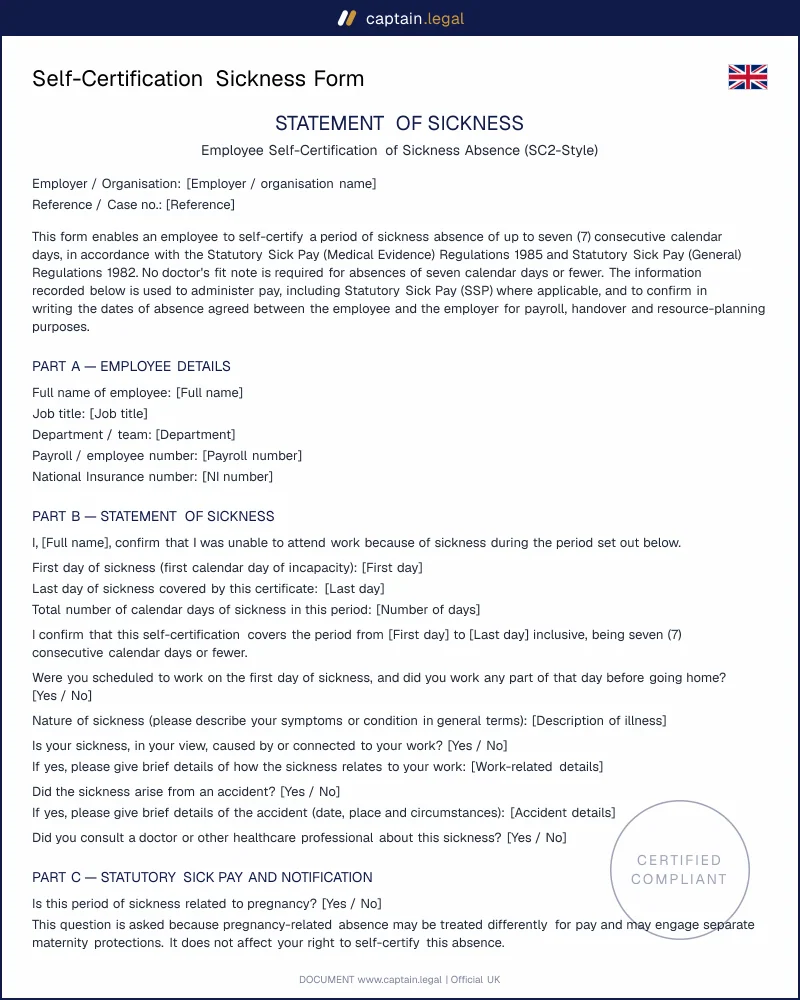
The everyday trigger is a routine short illness, the kind that lasts two or three days and never reaches a doctor. The employee phones in, recovers, returns, and on the first day back completes the form to confirm the dates. Without that signed confirmation you are relying on a voicemail and a memory, which is exactly the "agreed in the corridor" scenario that unravels when payroll queries the SSP entry. The form turns an informal call into a record you can stand behind.
A second common case is the absence that creeps towards the seven-day limit. Someone is off Thursday and Friday, stays unwell over the weekend, and is still poorly on Monday and Tuesday. You need the self-certification form to cover the whole stretch, and you need to know that day eight is the point at which you may lawfully ask for a fit note, not before. Getting that boundary right protects both the SSP calculation and the working relationship.
The form also earns its place when sickness sits alongside other absence types you already manage through your leave request and approval templates, because consistent paperwork across holiday, unpaid leave, and sickness is what demonstrates fair treatment if a pattern is ever challenged. Two edge cases reward attention. First, an employee who falls sick during booked annual leave can usually convert those days to sick leave and reclaim the holiday, but only with contemporaneous evidence, and the self-certification form is that evidence. Second, where an absence may be pregnancy-related or disability-related, the form should record only what you genuinely need, because over-collecting medical detail creates its own risk.