A sponsorship agreement is the contract a US nonprofit signs with a corporate supporter who provides money, goods, services, or media value in exchange for public recognition. Done right, it locks in funding, protects the charity's 501(c)(3) status, and gives both sides a clear record of what each party owes the other. Done casually, it can quietly convert a tax-free qualified sponsorship payment into taxable advertising income under IRC §513(i), and that is a conversation no executive director wants to have with the IRS.
This template is built for US charities, foundations, and tax-exempt associations that want a clean, lawyer-grade corporate sponsorship contract without paying a firm to draft one from scratch. It works for single-event sponsorships, multi-year naming arrangements, in-kind support, and media partnerships, and it is drafted to keep the payment inside the Treas. Reg. §1.513-4 safe harbor whenever the parties intend the funds to remain UBIT-exempt.
Compliant
2026 Legislation
50,000+ clients
trust us
Affordable
From $4.90 / doc
Secure payment
Instant download
Nonprofit Sponsorship Agreement Template | UBIT-Safe (US)
Secure payment
What is a sponsorship agreement?
A sponsorship agreement is a written contract between an exempt organization and a sponsor, typically a for-profit company, under which the sponsor transfers money or property to the nonprofit and the nonprofit acknowledges the sponsor publicly. The defining feature, in US tax terms, is that the recognition stays on the "acknowledgement" side of the line drawn by the IRS in §513(i) and Treas. Reg. §1.513-4: name, logo, value-neutral descriptions, contact information, and visual identity are fine ; qualitative claims, price information, endorsements, and calls to purchase are not. Cross that line and the payment becomes advertising revenue subject to unrelated business income tax.
People confuse sponsorship with three adjacent documents, and the distinction matters more than the labels suggest. A donation is a one-way transfer with no return benefit beyond a written acknowledgement letter. An independent contractor agreement governs paid services, not philanthropic support. An advertising contract delivers measurable promotional value to the buyer, generates UBTI, and requires a Form 990-T filing if gross receipts exceed $1,000. Sponsorship sits between donation and advertising, and the drafting language is what keeps it there. If the contract reads like a media buy, the IRS will treat it like one, no matter what the title says.
Legal framework
The federal anchor is Internal Revenue Code §513(i), enacted in 1997 and fleshed out by the Treasury Regulations at §1.513-4. Together they create the qualified sponsorship payment safe harbor: any payment by a person engaged in a trade or business is exempt from unrelated business income tax so long as there is no arrangement or expectation that the payor will receive a substantial return benefit beyond the use or acknowledgement of its name, logo, or product lines. The regulation treats a single event, a season of events, or continuing operational support equally ; what matters is the substance of the recognition the sponsor receives. The full operative text, including the disregarded-benefits threshold of 2% of the payment and the exclusive-provider rules of §1.513-4(c)(2)(vi), lives on the IRS site at the IRS guidance on advertising versus qualified sponsorship payments.
State law adds a second layer that nonprofit boards routinely forget. Most states regulate charitable solicitation through their attorney general or secretary of state, and sponsorship campaigns marketed to the public can trigger registration obligations under statutes such as New York Executive Law Article 7-A, California Government Code §12580 et seq., and Florida Solicitation of Contributions Act §496.401. Where the sponsor receives goods, services, or media in return, state sales and use tax rules may also apply to the in-kind portion. The board's corporate bylaws usually require board approval above a stated dollar threshold ; check that gate before signing.
Two recurring traps deserve specific mention. Contingent payments, those tied to attendance figures or broadcast ratings, fall outside the safe harbor under §1.513-4(e). And payments in exchange for acknowledgements in a regularly published periodical are treated as advertising regardless of the wording, per Treas. Reg. §1.513-4(b). The template flags both situations and gives drafting alternatives that preserve exempt treatment.
When do you need this document?
The most common trigger is a single-event sponsorship: a gala, a 5K, a benefit auction, or a conference where a company underwrites part of the program in exchange for logo placement and verbal recognition from the stage. You also need it for multi-year naming arrangements, the kind where a sponsor's name attaches to a scholarship, a building wing, or a recurring program, because the longer the term the higher the stakes if the relationship sours. Media partnerships sit in the same bucket: a local radio station that provides $40,000 of airtime in exchange for on-air mentions has just become a sponsor, and the in-kind valuation has to be documented like a cash gift.
In-kind sponsorships are where nonprofits improvise most often. A caterer covers the food, a printer donates the programs, a software vendor provides licenses for the year. Each of those transfers needs a written agreement that values the contribution at fair market value, identifies what recognition the donor will receive, and confirms that nothing the donor gets back crosses into qualitative product messaging. Without that paperwork, the donor cannot substantiate the deduction and the nonprofit cannot prove the recognition stays inside the safe harbor.
Two edge cases earn their own contracts. Exclusive provider arrangements, where the nonprofit agrees to use only the sponsor's product or service category at an event, almost always create a substantial return benefit under §1.513-4(c)(2)(iii) and must be allocated between the qualified and taxable portions. And cause-related marketing, where a for-profit promises a share of sales to the charity, is regulated as commercial co-venturing in roughly half the states and needs its own contractual layer on top of the standard sponsorship terms.
Key clauses included in our template
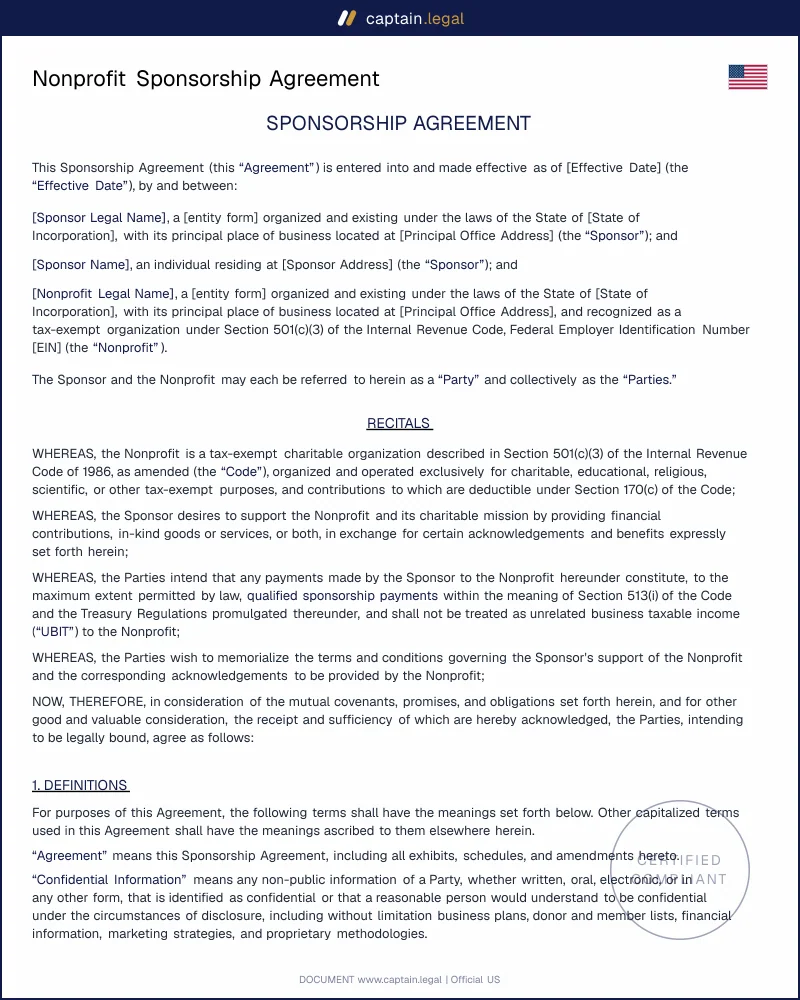
- The identification of the parties names the nonprofit corporation by its full legal name, its state of incorporation, and its EIN, then identifies the sponsor with the same level of precision. Vague references like "the Company" without legal-entity detail are the first thing a state regulator will pick at, and they create real problems if the sponsor reorganizes mid-term.
- The payment and consideration clause sets the cash amount, the in-kind valuation methodology, and the payment schedule, and it expressly states that the parties intend the payment to qualify as a qualified sponsorship payment under IRC §513(i). This intent language matters: the IRS gives weight to the parties' documented purpose when the recognition package is borderline.
- The acknowledgement and use of name clause lists every permitted use of the sponsor's name, logo, and product lines, and it explicitly excludes qualitative or comparative language, price information, endorsements, and inducements to purchase. This is the single most important paragraph in the contract, because it is the paragraph that keeps the payment outside UBTI.
- The substantial return benefit allocation addresses any tangible or service benefits provided to the sponsor (event tickets, hospitality, advertising in a periodical, exclusive provider rights) and allocates the contract value between the qualified portion and any taxable advertising portion, consistent with Treas. Reg. §1.513-4(d).
- The term, renewal, and termination provisions set a defined end date, address material-breach termination, and give the nonprofit a morals clause allowing termination if the sponsor's conduct threatens the charity's reputation. For multi-year deals, drafting a renewal mechanism rather than auto-renewal protects the board's annual approval rights under most employment policy frameworks the nonprofit already follows for its staff.
- The representations and warranties confirm the nonprofit's 501(c)(3) status, the sponsor's authority to enter the contract, and each party's compliance with applicable charitable solicitation registrations.
- The intellectual property and trademark license is a narrow, revocable, royalty-free license letting each side use the other's marks for the limited purposes of the sponsorship, with quality control and a clean termination tail.
- Indemnification, insurance, and limitation of liability allocate event-related risk and require commercial general liability coverage naming the nonprofit as an additional insured at industry-standard limits.
How to fill out this sponsorship agreement
You start by selecting the type of sponsorship at the top of the form: single event, multi-year program, in-kind only, or media partnership. From there, the template adjusts the consideration section, the acknowledgement language, and the termination triggers to the realities of that arrangement. You then enter the legal name and EIN of your organization, confirm its state of incorporation, and identify the sponsor with the same precision.
The next screen asks what the sponsor will receive in return. The form is built to keep you inside the §513(i) safe harbor: it accepts logo placement, value-neutral descriptions, contact information, and a website link, and it warns you in real time when a proposed benefit (such as a paid advertisement, an exclusive-provider clause, or a contingent payment tied to attendance) would push the contract into taxable territory. If the relationship genuinely includes advertising, the form lets you allocate the payment between the qualified and taxable portions instead of forcing an all-or-nothing structure.
You then set the term, the payment schedule, and the termination rights, and you confirm whether the board has approved the agreement under the nonprofit's internal authority limits. Once the draft is reviewed, you can export to Word for negotiation with the sponsor and to PDF for signature. The full editable file lives in your dashboard alongside any other legal document templates you have generated, so you can reuse the structure for the next sponsor without rebuilding it from scratch.
Common mistakes to avoid
The most expensive mistake is letting the sponsor write the recognition language. Marketing teams instinctively reach for qualitative claims, calls to action, and price points, and a single phrase like "the best logistics partner in the Midwest" on an event banner can convert the entire payment into taxable advertising revenue. The fix is to attach a recognition rider to the contract that lists exactly what the sponsor's name and logo will appear next to, with sample copy approved in advance. A second frequent mistake is paying no attention to exclusive-provider language: if the agreement says the sponsor is the "official" or "exclusive" something of the event, Treas. Reg. §1.513-4(c)(2)(vi) treats that as a substantial return benefit, and the contract must allocate value or the safe harbor evaporates.
Three other errors come up repeatedly in practice. Nonprofits fail to register for charitable solicitation in the states where the sponsor's marketing will reach donors, and the state attorney general's office is the one that notices first. They omit the fair market value documentation for in-kind sponsorships, leaving both sides without the substantiation the sponsor needs for its tax deduction and the nonprofit needs for Schedule M of Form 990. And they skip the board-approval step required by their own governance documents at the formation stage, which can expose individual officers if a deal later goes wrong. Each of these errors is cheap to prevent at the drafting stage and expensive to unwind once the cash has changed hands.
Frequently Asked Questions
18 verified reviews · 50 000+ downloads
- Immediate access to the document
- PDF + Word download
- Compliant with 2026 legislation
- Reviewed by lawyers
You might also like