Create my document
Login

Choose country

United StatesUnited StatesChoose country
Business

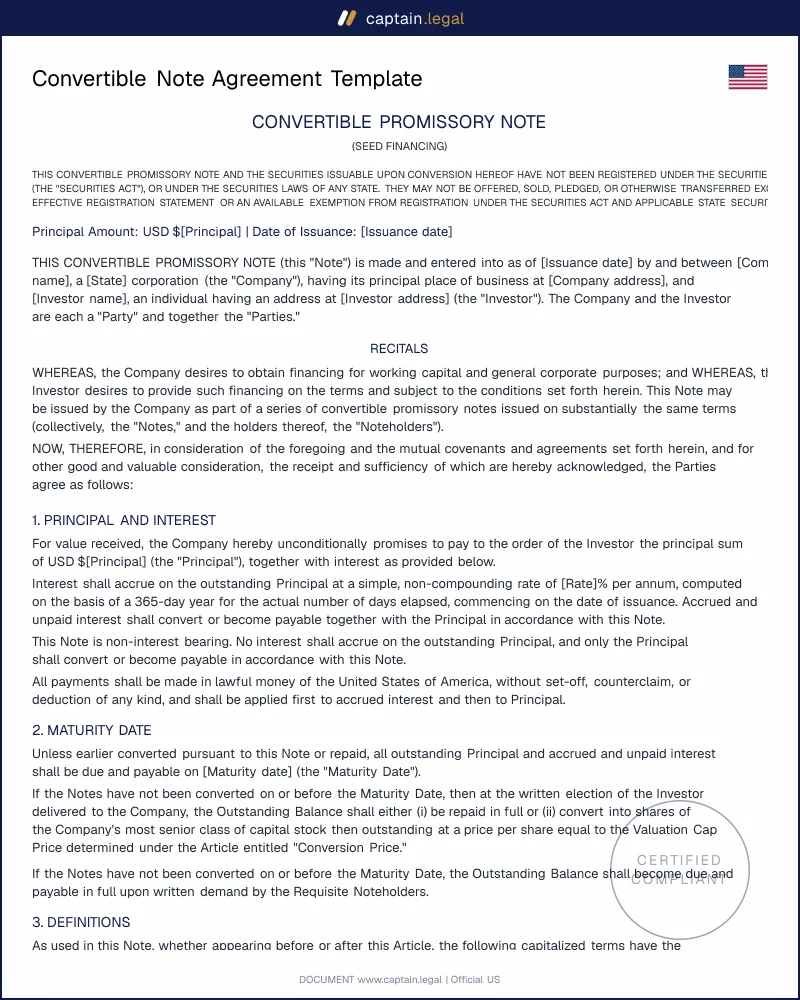
Convertible Note Agreement | Reg D Compliant Template

Issue convertible notes under Regulation D Rule 506 with valuation cap, discount and qualified-financing conversion. Form D ready. Word and PDF download.
4.7/521 reviews50 000+ downloadsInstant download
Share

A convertible note is the workhorse instrument of early-stage fundraising in the United States: short-term debt that postpones the valuation fight and converts into equity when your company raises its first priced round. Founders reach for a convertible note agreement when an angel or seed investor is ready to wire money but nobody wants to spend six weeks negotiating a Series A term sheet first. The note carries interest and a maturity date like any loan, but its real purpose is conversion, not repayment. With a valuation cap, a discount, and clean automatic-conversion mechanics, it lets you take capital today and price the equity later, once a venture investor sets the number.

Compliant

2026 Legislation

50,000+ clients

trust us

Affordable

From $4.90 / doc

Secure payment

Instant download

Convertible Note Agreement | Reg D Compliant Template

Secure payment · No subscription

Fill in the template

What is a convertible note agreement?

A convertible note agreement is a contract under which an investor lends money to a startup, and the loan automatically converts into equity on defined triggering events rather than being repaid in cash. Convertible notes give their holders the right to receive equity of the company on certain triggering events, such as a future equity financing, usually led by a VC fund, or a sale of the company. The instrument is sometimes called a convertible promissory note, a bridge note, or convertible debt, and the labels are interchangeable in practice.

The distinction founders most often blur is between a convertible note and a SAFE (Simple Agreement for Future Equity). A SAFE is not debt: it carries no interest, no maturity date, and no repayment obligation, which is why Y Combinator popularized it for the friendliest rounds. A convertible note is genuine debt that sits on your balance sheet, accrues interest, and comes due on a fixed date. That difference matters when a round stalls. While convertible notes arguably offer investors more protection than SAFEs, they still fall short of the comprehensive protections and governance standards found in priced equity rounds. The note also differs from a plain promissory note, which simply documents a debt with no equity feature at all. If you need a straight lending instrument rather than a fundraising one, a promissory note template with cosigner options is the better starting point. The convertible note exists precisely because the parties expect equity, not a payoff, to close the loop.

2

When do you need this document?

The textbook scenario is a seed or pre-seed raise where the company is too young to defend a fixed valuation. Pricing equity requires agreeing on what the business is worth, and at the idea-and-traction stage that number is a guess that can poison the founder-investor relationship. A note sidesteps the argument by deferring price to the next institutional round. The second common trigger is the angel check that arrives between rounds, the friend-of-a-friend who wants in now and will not wait for a formal Series A process to assemble. You take the money on a note and let it convert later on the same terms the lead investor negotiates.

Bridge financing is the third recurring use. A company that has raised a priced round but needs runway to reach the next milestone often layers convertible notes on top of existing equity, which is why practitioners still call them bridge notes. The instrument also fits the party round, where a dozen small investors come in at once and you cannot realistically negotiate a separate stock purchase agreement with each. One note form, one cap table entry per investor, done.

Two edge cases legitimately call for caution. If your investors include anyone who is not accredited, your 506(b) headcount matters, and a single investor over the 35 non-accredited limit can blow the entire exemption. And if the note may convert alongside employee equity grants, coordinate it with your governing documents early; the conversion mechanics interact with your authorized share count and your existing shareholder agreement covering drag-along and buy-sell rights. A note drafted in isolation from the cap table creates problems that only surface during due diligence.

3

Key clauses included in our template

  • The principal and interest terms set the loan amount and the annual rate, typically a modest 4 to 8 percent that accrues rather than being paid in cash. Accrued interest converts into equity along with principal, so the investor's effective ownership grows the longer conversion is delayed.
  • The maturity date fixes when the note comes due if no qualified financing has triggered conversion, usually 18 to 24 months out. If no qualified financing has triggered conversion, the note comes due, and in practice the parties usually amend to extend the term, convert at a pre-agreed valuation, or renegotiate; outright repayment is rare.
  • The valuation cap sets a ceiling on the company value used to price the investor's conversion, rewarding early risk with a better share price than later investors pay. The most typical formulation makes the conversion price the lower of an agreed valuation cap and a discount to the new issuance price, usually 15 to 25 percent of the price per share in the next financing.
  • The automatic conversion provision is the heart of the instrument. It stipulates the automatic conversion of outstanding principal and accrued interest into equity once a specified financing threshold, the Qualified Financing, is achieved. Our template defines that threshold in plain dollars so there is no ambiguity about what triggers it.
  • The qualified financing definition carries more weight than its length suggests. The definition of qualified financing is one of the most frequently negotiated terms in a convertible note because it determines when automatic conversion occurs and the floor below which founders retain the right to raise equity without triggering the note's conversion mechanics.
  • The investor representations, including accredited-investor status and investment intent, support your Regulation D exemption and belong in the closing binder. Pair them with the confidentiality posture you would expect from any sensitive financial negotiation, the same logic that drives a non-disclosure agreement for pitch decks and financials.
4

State-specific considerations

Delaware is the default home for venture-backed startups, and most convertible notes are drafted to Delaware law even when the founders live elsewhere. The reason is conversion: notes convert into preferred stock authorized under the Delaware General Corporation Law, and your charter and corporate bylaws drafted to §109 DGCL must reserve enough authorized shares to absorb the conversion. A note that converts into shares you have not authorized forces a charter amendment at the worst possible moment.

California layers its own securities rules on top of the federal exemption. The California Corporate Securities Law of 1968 requires a state notice filing for Reg D offerings sold to California residents, and the Department of Financial Protection and Innovation enforces it. California also applies aggressive worker-classification doctrine, which matters indirectly: if your early team is misclassified, that liability surfaces in the same diligence that scrutinizes your note round.

New York requires its own blue-sky compliance, and the Investor Protection Bureau under the Martin Act gives the Attorney General unusually broad anti-fraud authority over securities offered to New York residents. Notes sold to New York angels should be papered with the same disclosure discipline you would use for a registered offering, because the Martin Act does not require proof of intent to find a violation.

Texas has become a popular incorporation and operating alternative, and the Texas Securities Act requires a notice filing for 506 offerings with the State Securities Board. Texas founders frequently pair a note round with formal company records, and our articles of incorporation template filed same-day with the Secretary of State keeps the corporate foundation aligned with the financing. Across all four states, the federal preemption under NSMIA means states cannot block your raise on the merits, but they can and do require the notice filing and collect the fee.

5

How to fill out this convertible note agreement

You begin by entering the names of the company and each investor, then the principal amount of the loan and the date the funds will be advanced. From there the template asks for the interest rate and the maturity date, with sensible defaults of a single-digit accruing rate and an eighteen-to-twenty-four-month term that you can adjust to your deal. The next block is the conversion economics, where you set the valuation cap, the discount percentage, and the dollar threshold that defines your qualified financing. The form explains each field in plain language so you are not guessing what a cap actually does to your future ownership.

After the economics, you select your securities exemption, and the document adjusts the investor representations to match a 506(b) or 506(c) offering. You then choose the governing-law state, which sets the legal references and aligns the conversion language with that state's corporation law. Finally you generate the agreement in editable Word and a clean signature-ready PDF. Before you take a single dollar, calendar your Form D deadline and identify every state where an investor resides, because the document creates the security but the filings preserve the exemption.

6

Common mistakes to avoid

The error that costs founders the most is treating the note as a private favor rather than a securities offering. People wire money to a friend, skip the Form D, ignore the state notices, and discover the gap years later when a Series A lead's lawyers run diligence and find an unperfected exemption with live rescission rights. The fix is cheap and the failure is expensive, which is the worst kind of avoidable problem. A close cousin is sloppy investor records: keep the accreditation questionnaires, the subscription documents, and the dated communications, because if anyone later questions your exemption those records are the only thing that resolves it.

The second cluster of mistakes lives in the conversion math. Founders set a valuation cap without modeling what it does to the cap table, then act surprised when accrued interest and a low cap hand early investors far more ownership than expected once conversion runs. Vague drafting compounds it: a qualified financing defined loosely, or an MFN clause written too broadly, lets a single noteholder hold up a reasonable amendment. Push for an amendment provision that allows changes to terms like maturity or the qualified financing threshold with consent of noteholders representing a defined majority of principal, which prevents one obstinate investor from blocking a sensible modification. Finally, founders forget to reserve enough authorized shares for conversion, turning a routine close into an emergency charter amendment.

Key takeaways

SECURITY STATUS

A convertible note is a security

A convertible note is not just a private loan; it is a security because it is debt designed to convert into stock. That pulls the deal under the Securities Act of 1933, so you either register the offering or rely on an exemption. Seed-stage companies almost always use Regulation D under Section 4(a)(2), and the paperwork and selling rules follow from that choice.

RULE 506

Pick 506(b) or 506(c) early

Rule 506(b) lets you raise from unlimited accredited investors (and up to 35 sophisticated non-accredited purchasers), but you cannot use general solicitation or advertising. Rule 506(c) allows public marketing, but every investor must be accredited and you must take reasonable steps to verify it, often by reviewing documents like W-2s, tax returns, or brokerage statements. A questionnaire alone will not work for 506(c).

DEBT TERMS

It accrues interest and has maturity

Unlike a SAFE, a convertible note is real debt on the balance sheet: it accrues interest and has a maturity date. The economic deal is usually built around conversion at the next priced round, with a valuation cap, a discount, and automatic conversion mechanics. That structure helps avoid a valuation fight now, but if the next round stalls, the maturity date and repayment obligation can become a live issue.

Frequently Asked Questions

Yes, a properly completed and signed convertible note agreement is a binding contract and a valid debt instrument under U.S. law. What makes it enforceable is not the template itself but the surrounding compliance: the note must be issued under a valid securities exemption, almost always Regulation D, and the issuer must file Form D with the SEC within 15 days of the first sale plus any required state blue-sky notices. The signed note creates the obligation; the filings preserve the exemption that lets you issue it lawfully. Skip the filings and the contract still binds the parties, but you expose the company to rescission claims that can unwind the investment. Treat the document and the regulatory steps as one package.

Both reward early investors with a better price than later ones, but they work differently. A discount gives the noteholder a fixed percentage off the price per share that new investors pay in the qualified financing, commonly 15 to 25 percent. A valuation cap sets a maximum company valuation used to calculate the conversion price, regardless of how high the priced round values the business. Most notes include both and convert at whichever produces the lower price per share, which maximizes the investor's shares. The cap protects investors when the company's value jumps between the note and the priced round, while the discount protects them in a flatter raise. Modeling both against your expected round size before you sign is essential.

The note becomes due, but actual repayment is uncommon. In practice the parties renegotiate: they extend the maturity date, convert the note at a pre-agreed fallback valuation, or roll it into a new instrument. A startup that has not raised a priced round by maturity usually does not have the cash to repay, and most investors prefer equity to forcing a default. Our template includes an optional conversion mechanism that lets noteholders convert at the valuation cap after maturity rather than demand cash. Address the maturity scenario in the document rather than hoping it never arrives, because an unplanned maturity date can hand a single investor real leverage over the company's future.

It depends on your exemption. Under Rule 506(b) you may include up to 35 non-accredited investors, provided each is sophisticated enough to evaluate the risk, and you must give them detailed disclosure documents. Under Rule 506(c), which lets you advertise the raise publicly, every investor must be accredited and you must take affirmative steps to verify their status rather than accept a self-certification. For most seed rounds raised quietly through existing relationships, 506(b) with all-accredited investors is the cleanest path because it avoids both the disclosure burden and the verification process. Counting your non-accredited investors carefully matters: one over the limit and the entire offering can lose its exemption.

Yes, and it is common in a party round. You can issue separate notes to several investors under the same offering, typically on identical terms, and they convert together when the qualified financing triggers. Keep one signed note per investor and one cap-table entry each, and make sure your authorized share count can absorb every conversion. If different investors negotiate different caps or discounts, document each note's terms precisely rather than relying on a single master form, and watch any MFN clauses that promise one investor the best terms granted to another. Coordinating the round with your governing documents and any existing equity arrangements keeps the conversion clean.

The convertible note agreement generates in two formats: a fully editable Microsoft Word file and a clean, signature-ready PDF. The Word version lets you negotiate specific terms, adjust the cap or maturity, and add deal-specific language without retyping the document, which matters because investors often request small changes before signing. The PDF is the version you circulate for execution and store in your closing binder alongside the Form D confirmation, investor representations, and state notice filings. Having both formats means you can move from negotiation to signature without rebuilding the document, and you keep a stable record of exactly what each party agreed to.

A convertible note round can close far faster than a priced equity round, which is the whole point of the instrument. Because you defer the valuation negotiation, a single investor can review and sign a note in days rather than the weeks a Series A term sheet consumes. The practical gating items are not the document but the compliance steps: confirming each investor's accredited status, then filing Form D within 15 days of the first sale and the relevant state notices. Founders who prepare the note, the investor questionnaire, and a filing checklist in advance routinely close angel checks in under a week, while those who improvise on compliance lose time fixing it later.

4.7/5

21 verified reviews · 50 000+ downloads

Convertible Note Agreement | Reg D Compliant Template
  • Immediate access to the document
  • PDF + Word download
  • Compliant with 2026 legislation
  • Reviewed by lawyers
Fill in the template
Secure payment · No subscription
Updated on June 30, 2026

You might also like

Post-Money SAFE Template (YC-Style)
Terms of Service + Privacy Policy