A Rental Application Form is the standardized intake document a landlord uses to collect identity, employment, income, rental history, and consent-to-screen data from a prospective tenant before deciding whether to grant a lease. Used correctly, it sets the legal baseline for Fair Credit Reporting Act compliance, documents the applicant's permission to run a background check, and gives the property owner a defensible paper trail if a denial is later challenged. It is also the first place fair-housing exposure shows up: every question on the form must be tied to a legitimate, lawful screening criterion, applied uniformly to every applicant. This page walks through what a US rental application form is, what federal and state law require it to contain, and how to use the Captain.Legal template to produce a clean, FCRA-ready document in minutes.
Compliant
2026 Legislation
50,000+ clients
trust us
Affordable
From $4.90 / doc
Secure payment
Instant download
Rental Application Form Template (PDF & Word)
Secure payment
What is a rental application form?
A rental application form is a written instrument signed by a prospective tenant that supplies the landlord with the information needed to evaluate the candidacy and to lawfully procure a consumer report. It is not the lease, and signing it does not create a tenancy ; an application creates only an expectation that the landlord will review the file in good faith and respond. The document typically covers full legal name and date of birth, current and prior addresses with landlord references, employer and gross monthly income, social security number for credit-pull purposes, vehicle and pet information, occupant list, and an FCRA-compliant authorization clause for credit, criminal, and eviction screening.
The application is often confused with a letter of intent to lease or a holding deposit agreement. The first is a pre-negotiation summary, non-binding and unsigned by the landlord ; the second is a separate instrument that takes a unit off the market in exchange for a refundable or partially refundable fee. The application sits before both : it is the document on which the landlord runs tenant screening and decides whether to extend an offer at all. Treat it as a legal record from the moment it is signed, because once a landlord obtains a consumer report on the strength of that signature, the Fair Credit Reporting Act attaches and the applicant acquires enforceable rights.
Legal framework
Three federal statutes govern the rental application in the United States, and at least one of them applies to every landlord regardless of portfolio size. The Fair Credit Reporting Act of 1970, 15 U.S.C. §1681 et seq., controls the moment a landlord runs a credit check, an eviction history check, or a criminal background check through a consumer reporting agency. When a landlord uses consumer reports to make tenant decisions, they must comply with the Fair Credit Reporting Act , and the FCRA requires a "permissible purpose" before pulling any report ; written consent on the application form is the standard mechanism for establishing that purpose. If the landlord later denies the applicant, raises the deposit, requires a co-signer, or charges higher rent than other applicants, that is an "adverse action" and triggers a written notice obligation with the screener's name, address, and phone number, plus disclosure of the right to obtain a free copy of the report within 60 days and to dispute inaccuracies.
The Fair Housing Act of 1968, 42 U.S.C. §3601 et seq., prohibits any application question or screening criterion that has a discriminatory effect on the seven federal protected classes : race, color, national origin, religion, sex, familial status, and disability. State and local statutes layer additional classes on top, including source of income, sexual orientation, and arrest record. The application form is the visible face of compliance : any field that asks about a protected characteristic, even indirectly, exposes the landlord to a HUD complaint, and questions about disability or accommodations are particularly tightly regulated under §804(f)(3).
The third statute is the Equal Credit Opportunity Act, 15 U.S.C. §1691, which mirrors much of the FCRA's adverse-action regime when the screening involves credit information and overlaps in practice with notice obligations. For landlords seeking the canonical practitioner reference on how these rules interact, the FTC guidance for landlords on consumer reports and the FCRA is the authoritative starting point. Beyond federal law, state security-deposit caps, application-fee ceilings (Massachusetts and California are the strict outliers), and mandatory disclosures govern what the form may charge for and what it must inform the applicant about.
When do you need this document?
The most frequent trigger is the standard residential leasing cycle : a vacant unit, multiple inquiries, and a need to compare candidates on an apples-to-apples basis. Without a written application, the landlord has no documented basis for selection and no record of consent to screen, which collapses any FCRA defense if the rejected applicant complains. Property managers handling more than two or three units treat the form as non-negotiable for that reason alone, and most legal liability insurers now require it as a condition of coverage. The same logic applies to room rentals and house-shares where a primary tenant sublets : the head tenant becomes a landlord for FCRA purposes the moment they pull a report, and the application is what makes that pull lawful.
A second category is commercial-to-residential conversions and condo rentals, where the unit owner is leasing for the first time and often skips formal intake out of inexperience. The risk profile is identical to a professional landlord's, but the documentation gap is far worse. A third is lease renewal under stricter terms : a landlord who proposes a longer lease, a higher rent, or a co-signer requirement at renewal is taking what the FTC calls a new screening event, and a fresh application is the cleanest way to refresh consent and disclosures. Section 8 voucher recipients require a parallel intake under HUD rules, with the application referencing the Housing Assistance Payments contract rather than a standalone lease. Watch out for jurisdictions that ban application fees outright or cap them by statute, because charging beyond the cap voids the application even if every other element is in order.
One edge case worth flagging : if you are gathering applications before the unit is legally rentable, for instance during a renovation that has not yet passed final inspection, the application is enforceable against you as a residential lease document preliminary, but you cannot lawfully reject candidates on grounds tied to the not-yet-permitted condition.
Key clauses included in our template
- The applicant identification block captures full legal name, all aliases used in the past seven years, date of birth, and Social Security or ITIN number. Every adult who will occupy the unit must complete a separate form ; FCRA §1681b permits a credit pull only on the named consumer, and a single combined form for two adults is a recurring source of denial-letter litigation.
- The residence history section asks for every address the applicant has held over a defined lookback period, typically three to five years, with the landlord's name, phone number, monthly rent, and reason for leaving. Gaps must be explained in writing, because an unexplained gap is a recognized predictor of an undisclosed eviction and is the single most useful field for screening.
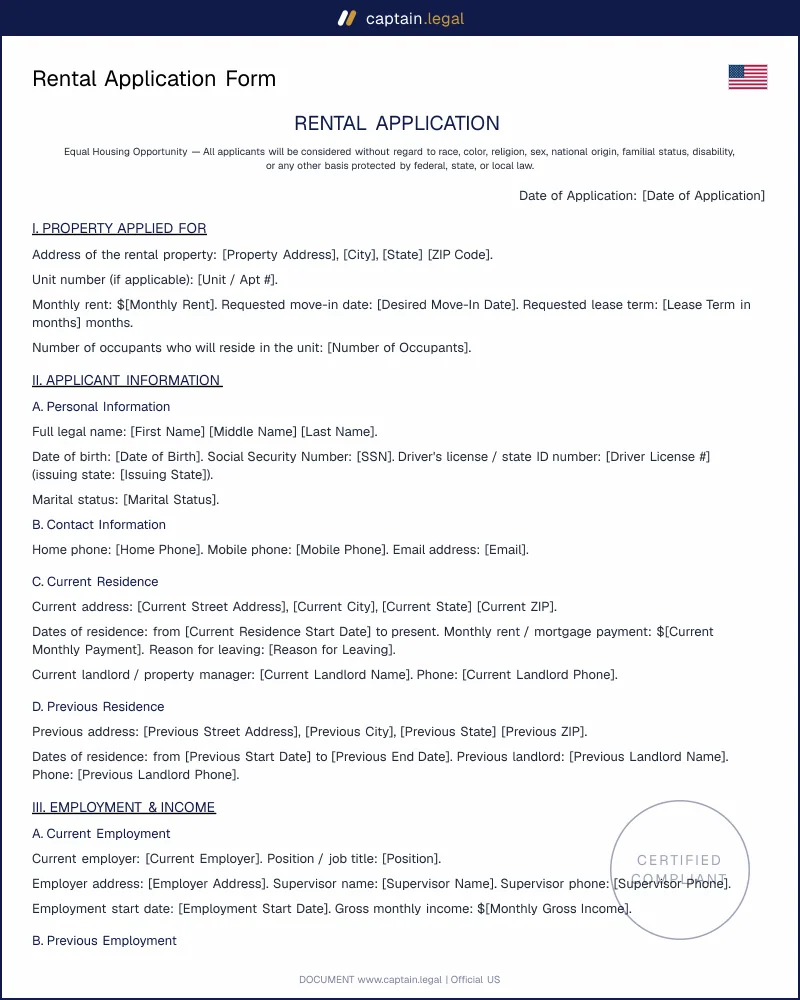
- The employment and income block requires employer name, position, length of service, supervisor contact, and gross monthly income, plus a separate line for additional verifiable income such as alimony, child support, or self-employment net receipts. The applicant signs a stand-alone verification of employment clause that authorizes the landlord to confirm the data directly with the employer.
- The FCRA authorization clause is the operative consent : a clear, conspicuous statement that the applicant authorizes the landlord and any designated screening company to obtain credit, criminal, and eviction reports, with a separate signature line. Before accessing a tenant's credit report, landlords must obtain written permission from the applicant, and this permission should be explicit and obtained through a separate authorization form or included as part of the rental application process . Burying the consent inside dense paragraphs is the leading FCRA challenge.
- The disclosure of fees and refundability itemizes the application fee, names the screening vendor, states whether the fee is refundable if the unit is rented before processing, and certifies compliance with state caps. California's $62.02 cap (adjusted annually under Civil Code §1950.6) and New York City's $20 cap under the 2019 Housing Stability and Tenant Protection Act are the most-cited examples.
- The certification and signature block binds the applicant to the truthfulness of the disclosures and authorizes the landlord to deem any material misstatement grounds for denial or, if discovered after move-in, lease termination under fraud in the inducement theories.
State-specific considerations
California. Application fees are statutorily capped under Civil Code §1950.6 and adjusted annually for inflation ; the landlord must provide an itemized receipt and may charge no more than the actual out-of-pocket screening cost plus reasonable processing time. Since the Tenant Protection Act of 2019 (AB 1482), questions about prior eviction filings that did not result in judgment are sharply restricted, and Oakland and San Francisco add local "Fair Chance Housing" ordinances that defer criminal-history review until after a conditional offer. A California application that asks about arrests rather than convictions is presumptively unlawful, and the rejection letter must state the specific basis for denial under Civil Code §1786.40. See the California real estate document templates collection for the corresponding lease forms that pair with this application.
Texas. Texas Property Code §92.351-§92.355 governs rental application notices and requires the landlord to either accept, conditionally accept, or reject in writing, with the application fee refundable if no decision is communicated within seven days. The Code also requires conspicuous disclosure of the screening criteria before the applicant pays the fee : a Texas landlord who collects a $50 application fee without first handing the applicant the screening criteria has violated §92.3515 and faces a statutory penalty of $100 plus three times the fee. Houston and Austin both impose source-of-income protections that exceed federal law and should be reflected in the questions asked.
Florida. Florida has no state-level cap on application fees and no mandatory written rejection, which makes the federal FCRA notice the primary safeguard for applicants. Florida Statutes §83.49 governs deposits rather than applications, and the screening practice in Miami-Dade and Broward is heavily commercial : large management companies typically use a RealPage or TransUnion SmartMove report. Local ordinances in Miami Beach and Orlando have begun restricting source-of-income discrimination, and the form must accommodate Section 8 inquiries without flagging them as an automatic disqualifier.
New York. The Housing Stability and Tenant Protection Act of 2019 capped application fees at $20 statewide and prohibits charging for background or credit checks beyond actual cost. General Obligations Law §238-a and Real Property Law §238 control deposit, and the New York City Fair Chance for Housing Act of 2024 deferred most criminal-history screening until after a conditional offer. A New York application that includes a $50 fee or a criminal-history question on the front page is non-compliant and exposes the landlord to a tenant-side claim plus NYC Commission on Human Rights enforcement.
How to fill out this rental application form
You start by selecting the state where the property is located, because the template adjusts fee caps, mandatory notices, and the wording of the criminal-history disclosure to local law. The form then walks through the property identification block (address, unit, monthly rent, security deposit) and asks for the names of every adult occupant, generating a separate authorization page for each one. From there, the document captures applicant identity, current and prior residence history with landlord references, employment and income data with explicit authorization to verify, and the standard FCRA consent language drafted to track the Federal Trade Commission model wording.
The interface flags the fields where state law restricts what you may ask : in California it greys out general arrest questions ; in New York it caps the application fee field at $20 ; in Texas it inserts the seven-day decision deadline. You then decide whether to require co-signers, pet addenda, or vehicle disclosures, and the template assembles the final PDF and Word file with all required notices appended. Once finalized, the form is downloadable for the landlord to send to applicants and for applicants to complete and return signed. The template integrates directly with the Captain.Legal full document catalog so that the matching lease, security deposit receipt, and adverse-action notice are one click away.
Common mistakes to avoid
The most frequent error is using a single application form across multiple states without adjusting fee caps or screening-criteria language. A landlord who copies a Texas-compliant form into a California rental immediately exceeds the Civil Code §1950.6 cap, voids the fee, and creates a refund obligation. Closely related is the failure to tailor the criminal-history question : the same boilerplate that is lawful in Florida is unlawful on its face in New York City and Cook County, Illinois. A second recurring mistake is failing to time-stamp and store applications : the FCRA statute of limitations runs two years from discovery and five years from the violation, and a landlord without a dated record of consent has no defense.
A third pattern is inconsistent application of screening criteria across applicants. Two candidates with similar income, one rejected for a five-year-old eviction filing and the other approved despite a similar record, generates a textbook Fair Housing Act disparate-treatment claim if the two candidates differ on a protected characteristic. The fourth is the adverse-action notice gap : the FCRA mandates landlords issue notice for any decision unfavorable to the applicant based on consumer report information, and willful noncompliance risks liability for actual damages or a $1,000 statutory fine per instance . Many small landlords skip the notice entirely on rejected applicants, mistakenly assuming verbal communication suffices. The fifth is treating the application as a binding lease : taking a "holding deposit" without a separate written holding agreement is a known source of small-claims litigation, and the employment document templates section addresses the parallel pattern in hiring contexts where landlords moonlight as small business owners.
Frequently Asked Questions
123 verified reviews · 50 000+ downloads
- Immediate access to the document
- PDF + Word download
- Compliant with 2026 legislation
- Reviewed by lawyers
You might also like