A fiscal sponsorship agreement is the written contract that lets an emerging charitable project receive tax-deductible donations through an existing 501(c)(3) public charity, called the fiscal sponsor. It is the legal scaffolding that turns a good idea, a community campaign, an artist collective, a grassroots program, into something a foundation can actually fund and a donor can actually deduct. Without it, the same gift is just a transfer of money with no charitable status attached.
This template is built for sponsors and sponsored projects that want a clean, board-defensible arrangement on day one. It works for Model A (comprehensive) and Model C (pre-approved grant relationship) structures, names the parties properly, locks in variance power, sets the administrative fee, and addresses the issues that make IRS examiners and grantmakers ask follow-up questions. Drafted to the standard a US nonprofit attorney would expect to see.
Compliant
2026 Legislation
50,000+ clients
trust us
Affordable
From $4.90 / doc
Secure payment
Instant download
Fiscal Sponsorship Agreement — 501(c)(3) Template (US)
Secure payment
What is a fiscal sponsorship agreement?
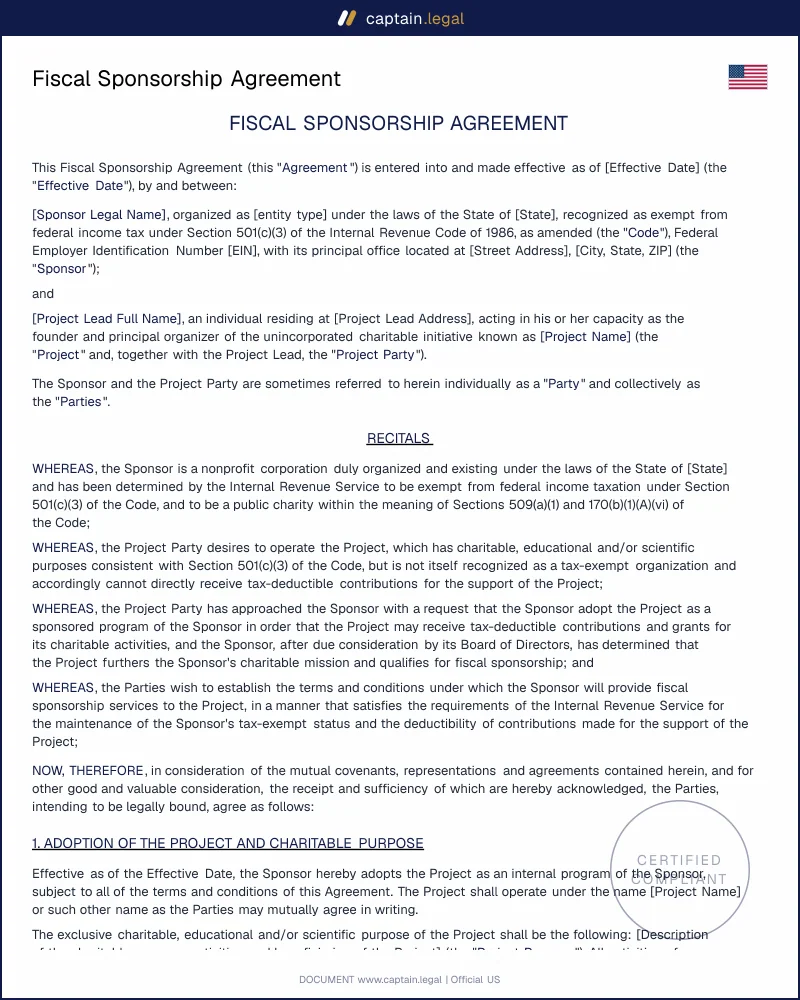
A fiscal sponsorship agreement is a written contract between a 501(c)(3) tax-exempt organization and a project, program, or unincorporated group that does not yet hold its own exemption. The sponsor lends its tax status to the project so contributions flow through a recognized charity, while the project carries out the charitable work on the ground. The agreement records the deal: who controls the money, who employs the people, who owns the intellectual property, what fee the sponsor takes, and how the relationship ends.
The label fiscal sponsorship is not defined anywhere in the Internal Revenue Code. There is no IRS form, no statutory template, no federal registry. Practice has been shaped by two sources: Revenue Ruling 68-489, which requires the sponsor to maintain discretion and control over donated funds, and Gregory L. Colvin's reference text Fiscal Sponsorship: 6 Ways to Do It Right, which mapped out the six models the IRS has accepted in practice. Two of those models do almost all the real-world work. Under Model A, the project lives inside the sponsor as an internal program ; staff are sponsor employees, assets belong to the sponsor, the sponsor files the Form 990. Under Model C, the project sits in a separate entity (an LLC, an unincorporated association, sometimes another nonprofit), and the sponsor regrants funds to it after pre-approving the project as a charitable grantee. Choosing the wrong model is the single most common drafting mistake, and it is usually irreversible without renegotiating with every donor on file.
Legal framework
US fiscal sponsorship sits at the intersection of three legal regimes, and the agreement has to satisfy all three simultaneously. The federal layer is Section 501(c)(3) of the Internal Revenue Code together with the published guidance the IRS has built around it. Revenue Ruling 68-489 is the foundational text : it holds that a 501(c)(3) organization may distribute funds to a non-exempt recipient only if it retains discretion and control over the use of those funds, ensuring they are spent for the sponsor's own exempt purposes. Revenue Ruling 66-79 adds a parallel rule for grants to individuals. Both rulings are why every clean fiscal sponsorship agreement contains an explicit variance power clause allowing the sponsor to redirect funds if the project departs from its charitable purpose. Strip the variance power and the IRS will treat the gift as a pass-through, denying deductibility to donors and putting the sponsor's exemption itself at risk.
The second layer is state nonprofit corporation law, which governs how the sponsor's board approves the arrangement and how a project structured as a separate entity in Model C is recognized in its home state. Most states follow some version of the Model Nonprofit Corporation Act, and the sponsor's board must approve fiscal sponsorship through a documented resolution consistent with its governance documents and bylaws. The third layer is state charitable solicitation law, often triggered the moment the project starts asking for money. Forty-one states plus the District of Columbia require registration before public fundraising, and the sponsor, not the project, is the entity that registers. The Charleston Principles address how this applies to online giving across state lines, and most state attorneys general have adopted them in practice.
A small but consequential body of IRS pronouncements rounds out the framework : Revenue Procedure 75-50 (recordkeeping for grants), Treasury Regulations §1.501(c)(3)-1(d) (operational test for exempt purposes), and the IRS's general administrative guidance summarized in Publication 557 on tax-exempt status and the conditions under which donations qualify for charitable deduction. Practitioners who draft these agreements without referencing this body of guidance routinely produce documents that look fine on paper and collapse under audit.
When do you need this document?
The textbook trigger is the time-sensitive grant. A foundation has approved your project, the funding letter requires a 501(c)(3) determination letter, and the IRS turnaround on Form 1023 is six to nine months on a good day. Sponsorship closes that gap in weeks, sometimes days. The same logic applies to disaster response, election-cycle civic projects, and short-lived arts programming where waiting on independent exemption would kill the project before it ships.
The second trigger is the testing phase. Founders who suspect they have a viable charity but do not yet want to underwrite annual filings, a board of three to five directors, conflict-of-interest policies, and the Form 990 discipline use sponsorship as a runway. Two or three years inside a sponsor reveals whether the program model works, whether revenue can sustain a standalone entity, and whether the founder actually wants to run a nonprofit. Many projects discover the answer is no, which is itself a useful finding.
The third trigger is collaborative or short-horizon work. A coalition of three established nonprofits running a joint pilot does not need a fourth corporation, it needs one of them to act as fiscal sponsor while the pilot runs. The same applies to artist projects, individual scholars receiving grants for charitable research, and community-led mutual aid funds that exist for a defined purpose and then wind down. An independent contractor agreement structured for IRS compliance often plugs into the sponsorship arrangement when the project pays a freelance project director.
One edge case worth flagging : projects involving international grantmaking or activity abroad. Sponsoring a project that operates outside the United States triggers an extra layer of equivalency determination or expenditure responsibility obligations, and the standard template needs additional language. Same caution for projects that intend to lobby or that will earn unrelated business income at any meaningful scale.
Key clauses included in our template
The identification of the parties and the project. The sponsor is named with its EIN and state of incorporation ; the project is described with a clear charitable purpose statement drafted to track Section 501(c)(3) operational language. Vague mission descriptions ("supporting the community") get rejected by sophisticated grantmakers and are precisely what IRS examiners flag during Form 990 review. Our template forces a concrete statement of who is served and how.
The model election clause, where the agreement declares whether the relationship is Model A comprehensive or Model C pre-approved grant, and tailors the rest of the document accordingly. The two models have different consequences for employment, liability, IP ownership, and tax filings, so a single document trying to be both creates audit risk.
The variance power clause, the irreplaceable heart of the agreement. The sponsor retains "complete discretion and control" over contributions and the right to redirect funds if the project ceases to advance the sponsor's exempt purposes. This language is what allows the IRS to treat every donation as a gift to the sponsor's 501(c)(3) rather than an earmarked transfer to a non-exempt recipient. Drafted with the Revenue Ruling 68-489 phrasing courts expect.
The administrative fee provision, expressed as a percentage of contributions or a defined schedule, with clear language about whether the fee applies to restricted grants, in-kind donations, and earned revenue. National Network of Fiscal Sponsors data places typical fees in the 5 % to 15 % range depending on services bundled.
The financial controls and reporting clause, governing how the sponsor segregates project funds in its books, how disbursements are approved, and how often the project receives statements. This clause sits naturally alongside an at-will employment contract in Model A arrangements where project staff become sponsor employees.
The intellectual property and asset clause, which specifies whether work product created during sponsorship belongs to the sponsor or transfers to the project at exit. This is the single most contentious clause when sponsorships end, and the template forecloses the dispute by stating ownership and transfer terms upfront.
The termination and exit clause, covering both voluntary spinoff to an independent 501(c)(3) and involuntary termination for cause. Transfer of restricted funds, donor notifications, and final accounting are all addressed.
State-specific considerations
California. Fiscal sponsors in California must comply with the Supervision of Trustees and Fundraisers for Charitable Purposes Act (Government Code §12580 et seq.), administered by the Attorney General's Registry of Charitable Trusts. Sponsors register on Form CT-1 and file Form RRF-1 annually, and the sponsorship arrangement does not exempt the sponsor from reporting solicitations conducted on the project's behalf. The Attorney General has been actively reviewing fiscal sponsorship arrangements where the "discretion and control" element looks weak on paper. Sponsors operating in California also need to factor in the California Nonprofit Integrity Act of 2004, which imposes audit committee and compensation review obligations once revenue thresholds are crossed.
New York. The Executive Law Article 7-A requires registration with the Charities Bureau of the Attorney General before any solicitation, and the Estates, Powers and Trusts Law §8-1.4 governs the sponsor's fiduciary duties over charitable funds. New York's Charities Bureau treats fiscal sponsors as the registrant for purposes of any project they sponsor, and CHAR500 filings must include sponsored project revenue. The Non-Profit Revitalization Act of 2013, codified in the Not-for-Profit Corporation Law, sets governance baselines (conflict-of-interest policy, audit committee for larger sponsors) that the board resolution approving a sponsorship should reference.
Texas. Texas does not require general charitable solicitation registration, which simplifies the compliance picture, but the Texas Business Organizations Code governs the sponsor as a Texas nonprofit corporation and Chapter 22 sets board duty rules. Veteran-related and law enforcement solicitations have specific registration regimes worth checking before a project in those spaces launches.
Florida. The Solicitation of Contributions Act (Chapter 496, Florida Statutes) requires registration through the Department of Agriculture and Consumer Services before any solicitation, with annual renewals on Form FDACS-10100. Florida treats the fiscal sponsor as the soliciting entity, and disclosure language must appear on every solicitation : the agreement should reference Florida's mandatory donor disclosure statement so the project's marketing materials comply automatically. Sponsors based outside Florida that accept Florida donations may still trigger registration depending on the Charleston Principles analysis.
Sponsors and projects that operate across multiple states benefit from filing the Unified Registration Statement, accepted in most jurisdictions, paired with state-specific supplements where required.
How to fill out this fiscal sponsorship agreement
You start by entering the sponsor's legal name, EIN, state of incorporation, and the principal officer authorized by board resolution to execute the agreement. The form then asks for the project name, a one-paragraph charitable purpose statement, and the name and contact details of the project director. From there you choose between Model A and Model C, and the template adjusts the downstream clauses, the employment language disappears in Model C, the regrant mechanism replaces it, the IP clause shifts to reflect separate-entity ownership.
The next section captures the financial structure. You enter the administrative fee percentage and indicate whether it applies to restricted grants and earned revenue, the disbursement schedule (typically monthly or upon request with a defined approval workflow), and the segregation method the sponsor uses for project funds. If the project will employ staff under Model A, the form prompts for compensation parameters that the sponsor's board must approve under its conflict-of-interest policy.
The final pages cover variance power language, the IP and asset disposition at exit, the termination notice period (commonly thirty to ninety days), and the indemnification structure between the parties. Once signed, the agreement should be approved by a board resolution that references the Form 1023 application's stated purposes ; many sponsors also catalog active sponsorships in a comprehensive document and policy register maintained for board and auditor review. Donor receipts, grant agreements with funders, and the sponsor's Form 990 Schedule R (related-organization reporting) flow downstream from the executed agreement.
Common mistakes to avoid
The first and most damaging is treating the arrangement as a pass-through. A sponsor that simply receives a donor's check, deducts a fee, and forwards the balance with no review, no discretion, no documented charitable purpose, is operating a conduit. The IRS has revoked exemption letters over this exact pattern, and the DC Bar has flagged it repeatedly in practitioner guidance. Variance power has to be more than boilerplate ; the board has to be able to point to actual oversight and the right (even if rarely used) to redirect funds.
The second mistake is using a Model A template for what is functionally a Model C arrangement, or the reverse. Putting a project's employees on the sponsor's payroll when the project intends to retain its own independent legal identity creates an employer of record problem the moment something goes wrong. Conversely, treating a project as a grantee when staff are actually being directed by sponsor management exposes the sponsor to misclassification liability. The third common error is the missing or anemic administrative fee clause : sponsors who agree to "no fee" or to a fee waiver "for the first year" routinely end up subsidizing project overhead from unrestricted reserves, which boards rightly object to during audit season.
A fourth mistake is silence on intellectual property. A project that develops a curriculum, a brand, a software platform, or a research dataset during sponsorship will eventually want to leave. If the agreement does not address whether those assets transfer to the new 501(c)(3), or stay with the sponsor, the spinoff turns into litigation. Finally, sponsors regularly skip the state charitable solicitation registration step on the assumption that the project's online fundraising is somehow exempt from state oversight. It is not, and an unregistered solicitation discovered by a state attorney general is a problem that lands on the sponsor, not the project. Pair the agreement with a clear solicitation compliance calendar before the first donation page goes live.
Frequently Asked Questions
21 verified reviews · 50 000+ downloads
- Immediate access to the document
- PDF + Word download
- Compliant with 2026 legislation
- Reviewed by lawyers
You might also like