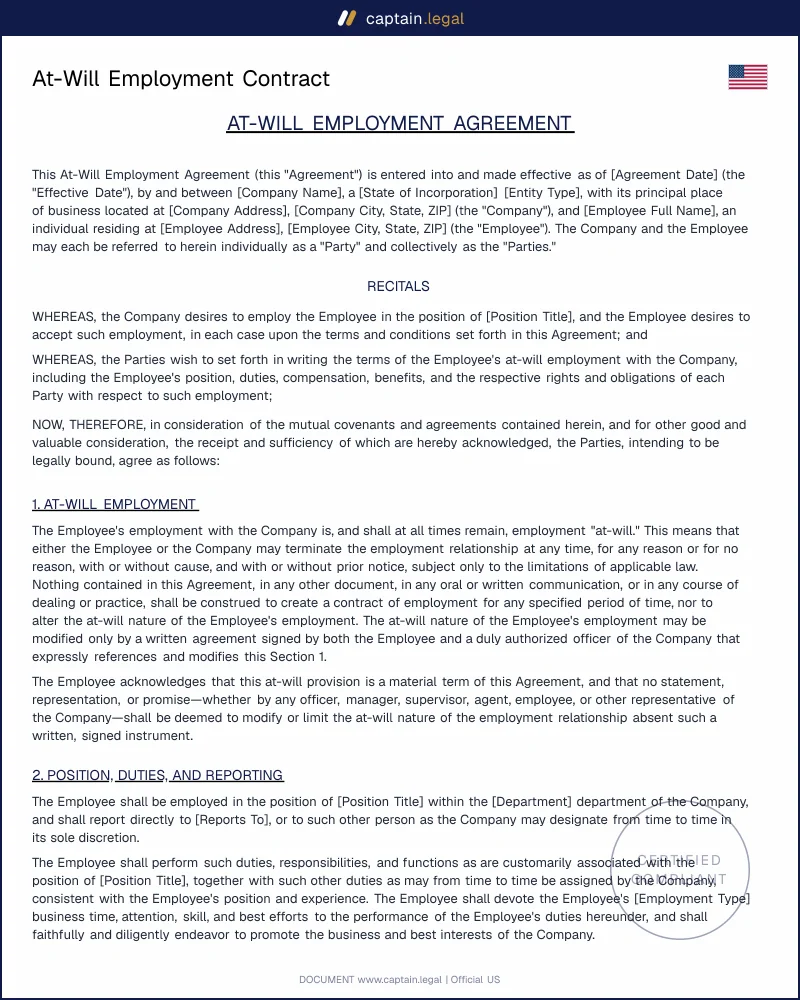
At-will employment is the default rule across 49 of the 50 states, and a written At-Will Employment Agreement is the document that makes that default unambiguous between an employer and a new hire. The agreement spells out compensation, job duties, the FLSA classification of the role (exempt or non-exempt), a probationary period, and the confidentiality obligations the employee takes on from day one. It is the contract small and mid-sized employers reach for when they hire a salaried manager, a sales rep, or a back-office staffer, and they want clarity without locking themselves into a fixed-term commitment.
The version below is drafted to satisfy federal Fair Labor Standards Act recordkeeping requirements, the at-will doctrine recognized by every state except Montana, and the standard Title VII, ADA, ADEA, and FMLA equal-opportunity language that any modern employment contract should carry. It is editable in Word, downloadable as PDF, and structured so a manager can localize it to a specific state in a few clicks.
Compliant
2026 Legislation
50,000+ clients
trust us
Affordable
From $4.90 / doc
Secure payment
Instant download
At-Will Employment Contract for US Employers | Lawyer-Drafted Template
Secure payment
What is an at-will employment agreement?
An at-will employment agreement is a written contract that confirms the employer can terminate the employee, and the employee can resign, at any time, for any lawful reason, with or without notice. The key word is lawful: at-will does not authorize firing in violation of Title VII of the Civil Rights Act of 1964, the Age Discrimination in Employment Act, the Americans with Disabilities Act, or any state anti-retaliation statute. What the agreement does is foreclose the argument that the employer made an implicit promise of continued employment, an argument plaintiffs raise routinely when there is no written contract at all.
The document is sometimes confused with an offer letter, and the two overlap, but they are not the same. An offer letter is typically a short summary of the position and the start date ; an at-will employment agreement is the binding contract that governs the relationship once the employee accepts. A signed at-will agreement always overrides an inconsistent offer letter unless the agreement itself says otherwise. The agreement also takes priority over any informal verbal promises a hiring manager may have made, which is precisely why employers use it. For a complementary tool when you need to formalize a separate confidentiality undertaking with a contractor or partner, our non-disclosure agreement template for US business use is built to sit alongside this contract without overlap or contradiction.
Legal framework
At-will employment has no single federal statute behind it. It is a common-law doctrine, codified state by state, and the Supreme Court has repeatedly recognized it as the background rule for the private sector. The U.S. Department of Labor and the EEOC do not police the at-will doctrine itself ; they police the carve-outs. The Fair Labor Standards Act (29 U.S.C. §§ 201 et seq.) sets the floor on minimum wage, overtime, and recordkeeping, and the FLSA exemption structure for executive, administrative, and professional employees turns on a duties test plus a salary basis test. After the November 2024 ruling in State of Texas v. U.S. Department of Labor, which vacated the 2024 DOL final rule, the minimum salary threshold for the EAP exemption reverted to $684 per week, or $35,568 per year, and the highly compensated employee threshold reverted to $107,432 per year. Any at-will agreement that labels a role as exempt must align with those figures and with the four duties tests, or the classification is vulnerable to a back-pay claim.
The anti-discrimination overlay comes from Title VII, the ADEA, the ADA, Section 1981, the Equal Pay Act, GINA, and the Pregnant Workers Fairness Act. None of these statutes prohibits at-will firing as such ; they prohibit firing motivated by protected characteristics. A well-drafted agreement acknowledges these protections in plain language rather than reciting them verbatim, which keeps the document readable and avoids inadvertently importing statutory definitions that vary by jurisdiction. The Cornell Legal Information Institute maintains a practitioner-grade overview of the at-will employment doctrine and its public-policy exceptions that is worth consulting before customizing the template for a high-risk role.
A separate consideration is the National Labor Relations Act. Confidentiality and non-disparagement clauses that are written too broadly can be deemed by the NLRB to chill Section 7 rights, the right of employees to discuss wages and working conditions. The template is drafted with that line in mind, so the confidentiality obligations attach to trade secrets and customer data, never to compensation or workplace conditions, in line with the Stericycle standard the Board reinstated in 2023. For employers who want to layer additional structural documents on top of a hiring process, our LLC operating agreement template for limited liability companies is the natural companion when the hiring entity itself is being formed.
When do you need this document?
The clearest moment is the day a new salaried employee accepts an offer, before the first paycheck and ideally before the first day on the floor. Handing the agreement over after the employee has already started raises a real legal problem in several states : courts can find that the post-hire imposition of new terms, especially restrictive covenants, lacked consideration and is unenforceable. Pennsylvania, Illinois, and Massachusetts are the textbook examples, but the issue surfaces in roughly a dozen jurisdictions. Sign the agreement before the start date, not after.
The second scenario is a material change in compensation, title, or duties for an existing employee. Promotions from non-exempt to exempt, or the reverse, are particularly sensitive because they shift the FLSA classification and the overtime entitlement. A new written agreement, dated the day of the change, prevents the argument that the employee continued to operate under the old terms and is owed retroactive overtime.
Employers also use the document when they bring on a salaried hire who will handle confidential information from day one. Sales engineers with access to pricing models, recruiters with access to candidate databases, finance staff with access to bank credentials : each of these roles benefits from confidentiality and return-of-property language signed before the employee is granted system access, not afterward. The template is also commonly used when converting a long-term independent contractor into an employee, a transition that triggers I-9 verification, W-4 elections, and benefits enrollment, all of which are easier to manage from a single signed instrument. One edge case worth flagging : if the employee will work remotely from a state different from the employer's principal office, the agreement should specify which state's law governs and where any dispute must be filed, because remote work has multiplied the number of jurisdictional fights over wage-and-hour and leave entitlements.
Key clauses included in our template
- The at-will statement is drafted in conspicuous language and placed in the opening paragraphs, not buried at page seven. Courts consistently look for prominence when deciding whether the at-will provision survives an implied-contract challenge based on a handbook, a verbal promise, or a performance review.
- The compensation and classification clause identifies the role as exempt or non-exempt under the FLSA, ties the salary to the current federal threshold of $684 per week, and adds a placeholder for any higher state threshold (California, New York, Washington, and Colorado all run higher than the federal floor).
- The probationary period is set by default to 90 days but can be extended, with the agreement making clear that completion of the period does not convert the employment into a for-cause arrangement. This is the clause that has to be redrafted entirely for Montana hires, since the Montana Wrongful Discharge from Employment Act changes the legal weight of the probationary period.
- The confidentiality and trade-secret clause covers customer data, pricing, source code, and proprietary processes, and it expressly carves out wage and working-condition discussions to stay on the right side of the NLRA and the Defend Trade Secrets Act whistleblower immunity.
- The invention assignment clause transfers ownership of work created on the job to the employer, with the California Labor Code §2870 carve-out, the Washington RCW 49.44.140 carve-out, and the equivalent statutory exclusions in Illinois, Minnesota, Delaware, Kansas, North Carolina, Utah, and Nevada applied automatically based on the work-state field.
- The governing law and venue clause lets the employer pick the state and forum, with a fallback to the employee's primary work location when the chosen forum lacks sufficient nexus, which is the standard most courts now apply post-Atlantic Marine.
- The termination and final pay clause mirrors the state's final-paycheck statute, which varies dramatically : California requires immediate payment on involuntary termination under Labor Code §201, while New York allows the next regular payday under Labor Law §191.
State-specific considerations
California is the most regulated jurisdiction in the country for employment contracts, and the template adjusts accordingly. The minimum salary for the EAP exemption runs at $68,640 per year for 2025, well above the federal floor, under Labor Code §515 and the IWC Wage Orders. Business and Professions Code §16600 voids virtually every post-employment non-compete, including the AB 1076 extension that took effect in 2024 and requires employers to notify current and former employees of unenforceable clauses. Final wages on involuntary termination are due immediately, with waiting-time penalties of up to 30 days of wages under Labor Code §203.
Texas keeps the federal FLSA floor but enforces non-competes under Business and Commerce Code §15.50, provided the restriction is ancillary to an otherwise enforceable agreement and reasonable in time, scope, and geography. Final wages are due within six days of involuntary termination under Labor Code §61.014, a deadline employers regularly miss when the payroll cycle runs longer.
Florida is the most employer-friendly forum for restrictive covenants thanks to Florida Statutes §542.335, which presumes a six-month to two-year restriction reasonable in most cases. The state has no final-pay deadline beyond the next regular payday, and it follows the federal FLSA salary threshold without any state-level uplift. The template adds a Florida-specific legitimate business interest recital to the confidentiality clause, which courts in the Eleventh Circuit expect to see.
New York runs a higher state threshold for the executive and administrative exemptions : $1,237.50 per week for New York City, Westchester, and Long Island in 2025, and $1,161.65 per week for the rest of the state, under 12 NYCRR §142-2.14. The New York Labor Law §195 wage-notice rule requires written notice of pay rate, payday, and employer contact information at hire, in English and in the employee's primary language, which the template generates as a stand-alone attachment.
For a deeper look at the discipline side of the employment lifecycle, where state final-pay rules and progressive discipline policies intersect, our employee warning letter template for documented progressive discipline sits naturally alongside the at-will agreement.
How to fill out this at-will employment agreement
You start by selecting the state where the employee will primarily work, not the state where the employer is headquartered. The form uses that choice to set the governing law, the wage-notice attachments, the FLSA salary minimum, the final-pay deadline, and the invention-assignment carve-outs. You then enter the employee's full legal name and job title, and pick the FLSA classification from a guided picker that walks through the duties test before letting you mark a role as exempt. If the picker flags the duties as inconsistent with exemption, it suggests reverting to non-exempt and adds the overtime language automatically.
From there, you set the compensation : annual salary or hourly rate, pay period, and any commission or bonus structure. The form rejects a salary below the applicable threshold for any role marked exempt, which prevents the most common drafting error in this category. You add the probationary period in days, the standard work hours, the benefits eligibility milestones, and any deferred-compensation arrangements. Confidentiality, invention assignment, and non-solicitation clauses are toggled on by default but can be removed or scaled back, and the form blocks any non-compete language for California, North Dakota, Oklahoma, and Minnesota hires automatically.
Once the substantive clauses are set, you generate the document in Word for redline review or PDF for direct signature. The agreement is signature-ready ; if you need to assemble a broader pack of HR onboarding paperwork in parallel, the full catalog of US legal document templates lists every adjacent form, from independent contractor agreements to termination memos.
Common mistakes to avoid
The single most frequent error is misclassification of a role as exempt when the duties test does not support it. Employers focus on the salary threshold and treat it as the only gate, but the FLSA requires both the salary basis and the duties test, and the duties test is where most assistant managers, administrative coordinators, and inside sales reps fail. The agreement can label the role exempt all day long ; if the employee spends 60% of their time on non-exempt tasks, the DOL and the courts will treat them as non-exempt and award two years of back overtime, three if the misclassification is found willful.
The second mistake is using a single template across all 50 states without state-specific switching. A non-compete that is enforceable in Florida is void in California, North Dakota, and Oklahoma, and a confidentiality clause that survives in Texas can run afoul of the NLRA if it is broad enough to cover wages or working conditions. Employers also routinely forget that Montana is not an at-will state after the probationary period, and a Montana hire signed onto a generic at-will template inherits the protections of the WDEA anyway, which means a termination without good cause exposes the employer to reinstatement, lost wages, and interest under Mont. Code Ann. §39-2-905. The third recurring mistake is missing the state final-pay deadline by relying on the regular payroll cycle ; the fourth is failing to deliver the FCRA pre-adverse-action notice when a background check feeds into a no-hire decision ; the fifth is treating an electronic signature on the agreement as automatic I-9 compliance, which it is not, since the I-9 requires its own form, its own deadlines, and physical or DHS-approved remote examination of the supporting documents.
Frequently Asked Questions
29 verified reviews · 50 000+ downloads
- Immediate access to the document
- PDF + Word download
- Compliant with 2026 legislation
- Reviewed by lawyers
You might also like