A Seller Disclosure Statement is the written notice a residential seller hands the buyer to declare every material defect, environmental hazard, and legal encumbrance the seller knows about before the purchase contract becomes binding. Most US states make it mandatory for one-to-four family homes, with the exact form, timing, and liability rules set at the state level. This template is built for owners who sell without a listing agent, FSBO sellers using a flat-fee MLS, and small investors closing deals across several states. It produces the state-correct version of the disclosure, in Word and PDF, with the federal lead-based paint addendum attached automatically when the home was built before 1978. The goal is simple: hand the buyer a clean, signed, statute-compliant document and shut down the most common post-closing claim, the one that begins with "the seller never told me…".
Compliant
2026 Legislation
50,000+ clients
trust us
Affordable
From $4.90 / doc
Secure payment
Instant download
Seller Disclosure Statement Template | PDF & Word Download
Secure payment
What is a seller disclosure statement?
A seller disclosure statement, also called a property condition disclosure statement in New York or a transfer disclosure statement in California, is a sworn declaration of what the seller knows about the property's physical condition and history. It is not an inspection report and not a warranty: the seller answers from personal knowledge as of the signing date, not from any duty to investigate. Texas Property Code §5.008(d) puts it explicitly, the notice is "completed to the best of seller's belief and knowledge", and similar language appears in Cal. Civ. Code §1102.7 and N.Y. Real Property Law §463(3).
The document sits next to two cousins it should never be confused with. The purchase and sale agreement binds the parties to price, closing date, and contingencies ; the disclosure statement is its required attachment, never a substitute. The home inspection report, ordered by the buyer, is the third leg of the diligence triangle and probes for defects the seller may not even know about. A buyer who reads only the disclosure and skips the inspection has misunderstood what each document does. The disclosure is a snapshot of seller knowledge, nothing more, and "as is" clauses in the contract do not erase the disclosure obligation in states that mandate it.
Legal framework
Disclosure law in the United States is a patchwork. Roughly forty states impose a written disclosure form on residential sellers, while a handful (Alabama, Arkansas, Georgia, Virginia, Wyoming) still operate under the old common-law doctrine of caveat emptor, "buyer beware". Even in those states, sellers cannot actively conceal a known material defect or lie when asked a direct question : Alabama's fraud statute, for instance, treats suppression of material facts as actionable misrepresentation. The split matters less than it sounds, because every contract of sale that touches a pre-1978 home triggers the federal layer.
That federal layer is the Residential Lead-Based Paint Hazard Reduction Act of 1992, codified at 42 U.S.C. §4852d and known in the trade as Title X. It requires every seller of a target-housing unit to deliver three things before the contract is signed : the EPA's Protect Your Family From Lead in Your Home pamphlet, a written disclosure of any known lead-based paint or hazards, and a 10-day inspection window for the buyer to test for lead at the buyer's expense. The Lead Warning Statement must appear in the contract or on a separately signed page, and EPA penalties for noncompliance now exceed $16,000 per violation under the inflation-adjusted civil penalty schedule. The full statutory text is reproduced on the Cornell Legal Information Institute page on 42 U.S.C. §4852d, which remains the cleanest authority citation for buyers, sellers, and agents.
State frameworks layer on top of Title X with their own forms and timing rules : California's Transfer Disclosure Statement under Cal. Civ. Code §1102 et seq., Texas Property Code §5.008, Florida's judge-made Johnson v. Davis duty, and New York's Property Condition Disclosure Act under N.Y. Real Property Law §§460–467. Each statute carries its own exemption list — court-ordered transfers, foreclosures, fiduciary sales, sales between co-owners — and the broader catalog of US real estate document templates on Captain.Legal is built to track those exemptions automatically. The cardinal rule is unchanged from one statute to the next : a known material defect, undisclosed, almost always wins in court for the buyer.
When do you need this document?
The trigger is the binding contract of sale on a one-to-four family residential property. Most states require the disclosure to be delivered before the buyer signs, and a late delivery typically gives the buyer a statutory right to walk away. Texas Property Code §5.008(f) lets the buyer terminate "for any reason within seven days after receiving the notice" if the form arrives after contract signing. New York's amended PCDA, in effect since March 20, 2024, removes the old $500 opt-out credit entirely and forces the seller to deliver a 56-question statement before binding signature. Missing that delivery is no longer a $500 line item, it is a live cause of action for rescission and fraud.
The second classic trigger is the FSBO sale, where no listing broker is in the chain to remind the seller of the form. FSBO sellers are statistically the most common defendants in post-closing disclosure suits, simply because nobody walked them through the questionnaire. Investors flipping rehabbed properties face the same exposure, often amplified by the volume of recent work that the seller now "knows about" and must disclose item by item. Sellers transferring inherited homes occupy a quieter edge case : a personal representative or executor is normally exempt from state-level disclosure under fiduciary carve-outs, but the federal lead rule still applies to a pre-1978 home. The same logic governs sales of vacation properties and second homes managed remotely, where the seller has limited firsthand knowledge and must indicate "unknown" on questions outside that knowledge rather than guess.
A final trigger worth flagging : a seller acting through an agent under a durable power of attorney. The attorney-in-fact signs the disclosure on the principal's behalf and inherits the same liability for misstatements, which is why investors and snowbird sellers should pair this template with a properly executed POA. Captain.Legal's library of personal legal forms used in everyday property transactions covers that companion document.
Key clauses included in our template
The template assembles the federally and state-required sections in the right order, with smart fields that adapt the wording, the question count, and the attachments to the state you select.
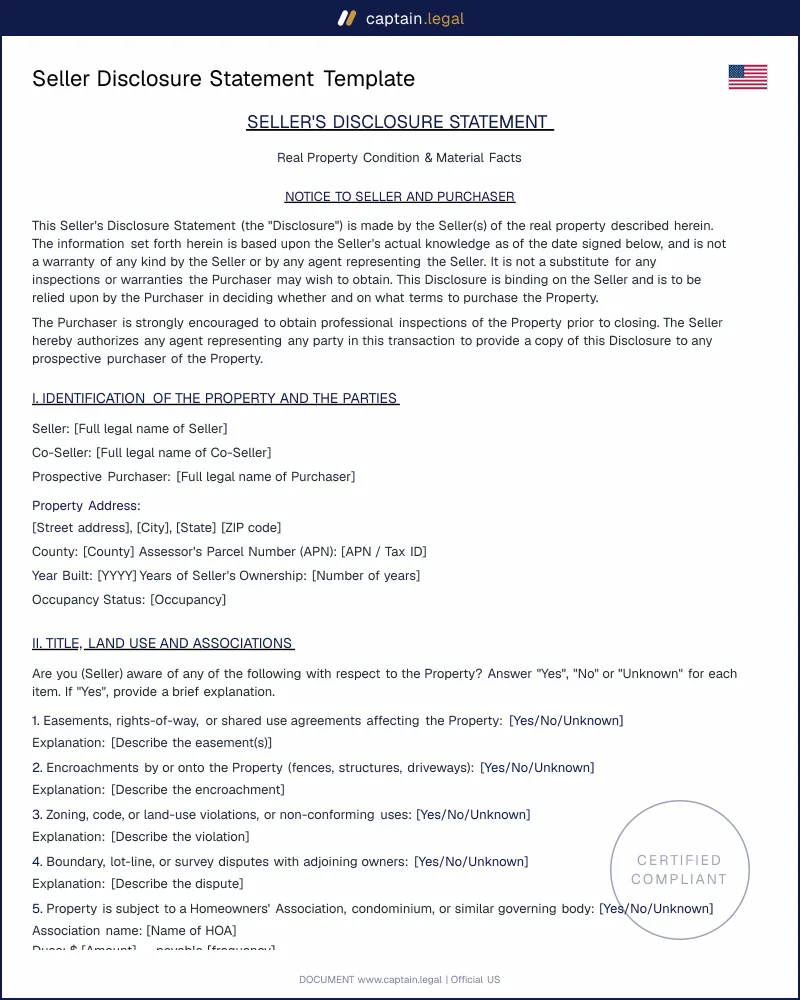
- The identification of the parties and the property opens the form with the legal description from the deed, the parcel/APN number, and the names of every owner of record. A disclosure that omits a co-owner is unenforceable against that co-owner and is the leading evidentiary problem in disputed sales. The template auto-pulls the legal description format used by the relevant county recorder.
- The structural and mechanical condition matrix covers roof, foundation, plumbing, electrical, HVAC, water heater, septic, well, and major appliances. Each row asks for current condition, known defects, and approximate age, with a free-text box for explanation. Texas §5.008 and N.Y. PCDA both require this granularity ; California's TDS uses a similar grid under §1102.6.
- The environmental hazards section addresses lead-based paint (mandatory federally for pre-1978 homes), asbestos, radon, mold, underground storage tanks, methamphetamine contamination (Utah and a dozen other states), and any history of remediation. The template auto-attaches the EPA Protect Your Family From Lead in Your Home pamphlet reference and the federal Lead Warning Statement when the construction year falls before 1978.
- The flood and natural-hazard disclosures were rewritten across multiple states after the 2020–2024 storm cycle. New York's amended PCDA now requires answers on FEMA 100-year and 500-year floodplains, federal flood-insurance obligations, prior FEMA assistance, and any active flood-insurance policy. The template surfaces those questions automatically when the property's ZIP code falls in a designated zone.
- The legal and title disclosures cover open code violations, pending litigation, easements, encroachments, mineral rights (critical in Colorado and Texas), HOA dues and assessments, and any death-on-property disclosure where state law imposes one. California Civ. Code §1710.2 requires a 3-year disclosure of any death on the property ; Alaska asks about murder or suicide ; Texas §5.008(c) expressly removes any duty to disclose deaths by natural causes, suicide, or accident unrelated to the property.
State-specific considerations
California sits at the strict-disclosure end of the spectrum. The Transfer Disclosure Statement under Cal. Civ. Code §1102 et seq. is a non-waivable, multi-page form covering structural condition, environmental hazards, neighborhood nuisances, and known litigation. Sellers must also deliver the Natural Hazard Disclosure Statement identifying earthquake fault zones, special flood hazard areas, and very high fire-hazard severity zones under Gov. Code §8589.3. The 3-year death-on-property rule under §1710.2 catches many out-of-state sellers off guard, and the buyer's remedy for an undelivered TDS is statutory rescission plus damages. Out-of-state owners selling California property frequently sign through a power of attorney template for absent or out-of-state sellers, and the attorney-in-fact carries identical liability for the disclosures.
Texas anchors its regime in Property Code §5.008, with the TREC OP-H form serving as the de facto standard. The seller's knowledge standard is subjective ("belief and knowledge"), which sounds permissive but pairs with the Deceptive Trade Practices Act (Bus. & Com. Code §17.46) to expose dishonest sellers to treble damages plus attorney fees. Section 5.008(f) gives the buyer a 7-day termination right when the notice arrives late, and the eleven statutory exemptions under §5.008(e) cover new construction, foreclosures, and transfers between co-owners. Texas has no death-disclosure obligation under §5.008(c), a notable departure from California.
Florida takes the unusual route of building its disclosure duty on a judge-made foundation. The Florida Supreme Court's 1985 decision in Johnson v. Davis, 480 So. 2d 625, holds that a seller must disclose any "facts materially affecting the value of the property" not readily observable to the buyer, regardless of any "as is" clause in the contract. The Florida Realtors Seller's Property Disclosure form is the practical implementation, but the duty itself flows from common law, which means even FSBO sellers who skip the form remain on the hook for known latent defects. Sinkhole history, prior insurance claims, and Chinese drywall are the Florida-specific items most often litigated.
New York runs the most recently overhauled regime. The amended Property Condition Disclosure Act (N.Y. Real Property Law §§460–467), effective March 20, 2024, eliminated the legendary $500 opt-out credit and expanded the statement from 48 to 56 questions, with seven new items targeting FEMA floodplain status, federal flood-insurance obligations, FEMA elevation certificates, and prior flood claims. Cooperative apartments, condominiums, and fiduciary transfers remain exempt under §461(5). Sellers who deliver a knowingly false answer face liability under the "willful failure to perform" standard of §465, and downstate practice has shifted from routine opt-out to careful, attorney-reviewed completion.
How to fill out this seller disclosure statement
You start by entering the property address and selecting the state, which sets the entire question set, the required attachments, and the deadlines. Captain.Legal's form switches to California's TDS layout when you pick CA, swaps in TREC OP-H for Texas, loads the 56-question PCDS for New York, and prepends the Florida Realtors form when you pick FL. The construction year drives the next branch : entering anything before 1978 triggers the federal Lead Warning Statement, the EPA pamphlet acknowledgement, and the 10-day buyer inspection window automatically attached to the contract.
The body of the form steps through structural systems, environmental hazards, and legal encumbrances room by room and topic by topic, with a Yes / No / Unknown answer pattern that mirrors the statutory templates. Where you answer "Yes", the form opens a free-text box and prompts you to attach any inspection report, repair invoice, or insurance claim that documents the issue. The flood section pulls FEMA flood-zone data when you allow geolocation, so the right questions surface for properties inside 100-year or 500-year floodplains.
The last step is the certification page. You sign and date, the buyer signs an acknowledgment of receipt, and the form exports as a PDF and an editable Word file. Both versions carry the state-mandated headers and the federal lead addendum where applicable, ready to attach to the purchase contract. Deliver the signed disclosure before the buyer signs the binding contract in every state that requires it ; late delivery resets the buyer's termination clock and weakens any later defense against rescission.
Common mistakes to avoid
The first and costliest mistake is treating the disclosure as a marketing document. Sellers who soft-pedal known defects, hoping the inspector will miss them, lose disclosure suits with depressing regularity. A water stain on a basement ceiling that you painted over last summer and answered "no known leaks" is the textbook Johnson v. Davis fact pattern in Florida and the textbook DTPA fraud case in Texas. Honest "Yes, repaired in March 2024, invoice attached" disclosure costs nothing at signing and immunizes you against the post-closing call from the buyer's attorney.
The second mistake is checking "Unknown" to dodge a question the seller actually does know the answer to. Courts read systematic "unknown" patterns as evasion and treat them as evidence of willful failure to perform under New York's §465 or as deceptive practice under Texas DTPA. A close cousin is failing to update the disclosure when a defect appears between signing the form and closing : every state with a written-disclosure regime imposes a duty to revise. The third common failure shows up when an LLC or trust owns the property and the form is signed by the wrong person ; signature blocks must match the recorded title exactly, which is why investors managing properties through entities typically pair this template with the matching business entity document templates for the LLC or land trust. Finally, sellers routinely forget the federal lead addendum for pre-1978 homes even when they correctly handle the state form, leaving themselves exposed to $16,000-per-violation EPA penalties on a transaction that is otherwise clean.
Frequently Asked Questions
74 verified reviews · 50 000+ downloads
- Immediate access to the document
- PDF + Word download
- Compliant with 2026 legislation
- Reviewed by lawyers
You might also like