A non-compete and non-solicitation agreement is the restrictive covenant most US employers reach for when they need to protect trade secrets, customer relationships, or specialized training they have funded. It binds an employee or contractor, during and after the engagement, from working for a direct competitor within a defined territory and from poaching the company's clients or staff. The legal landscape shifted sharply between 2024 and 2025: the FTC Non-Compete Clause Rule was set aside by the Northern District of Texas in Ryan, LLC v. FTC, and the Commission formally abandoned its appeal in September 2025. The patchwork of state law is now, more than ever, what decides whether your covenant holds.
This template is built for that reality. It pairs a non-compete clause with a non-solicitation of customers and a non-solicitation of employees, and it adjusts automatically to the state you select. It will not generate an enforceable non-compete in California, North Dakota, or Oklahoma — where the statute voids them outright — and it switches to a non-solicitation-only configuration when the chosen jurisdiction prohibits the broader restraint.
Compliant
2026 Legislation
50,000+ clients
trust us
Affordable
From $4.90 / doc
Secure payment
Instant download
Non-Compete & Non-Solicitation Agreement (US) — Enforceable Template
Secure payment
What is a non-compete and non-solicitation agreement?
A non-compete agreement is a covenant in which an employee or contractor promises that, for a defined period after the relationship ends, they will not engage in business activity that directly competes with the former employer's. The covenant typically targets three variables: the scope of restricted activity, the geographic territory, and the duration. Courts across the country share one core test: each variable must be no broader than reasonably necessary to protect a legitimate business interest — usually trade secrets, confidential information, customer goodwill, or specialized investment in the worker.
A non-solicitation agreement is the milder cousin. Rather than barring the former worker from competing at all, it forbids them from soliciting the employer's customers, prospects, or employees for a set period. The customer non-solicit protects the relational capital the employer has built ; the employee non-solicit, sometimes called an anti-raiding clause, protects against the targeted poaching of teams.
Practitioners often confuse the two with a non-disclosure agreement. The NDA protects information ; the non-compete and non-solicit protect the use of relationships and know-how once the information is out. The three documents are complementary, not interchangeable. A well-drafted employment package usually includes all three, and our non-disclosure agreement template is the natural pairing with this one. The mistake we see most often is the employer who relies on a single sweeping non-compete and discovers, at the temporary restraining order hearing, that the narrower non-solicit would have survived where the broader covenant collapses.
Legal framework
There is no single federal statute governing post-employment restrictive covenants in the United States. The closest the country came to one was the FTC Non-Compete Clause Rule of April 2024, which would have voided most existing non-competes and barred new ones nationwide. The rule never took effect: the Northern District of Texas set it aside with nationwide vacatur in Ryan, LLC v. FTC on August 20, 2024, and on September 5, 2025 the Commission voted 3-1 to dismiss its Fifth Circuit appeal and accede to that vacatur. The Commission's enforcement priorities under the new administration remain focused on case-by-case challenges to abusive covenants, but the blanket federal ban is no longer on the table. What this means in practice : the question of enforceability now turns almost entirely on the law of the state whose law governs the agreement.
State law sorts into three camps. The first is the outright ban : California Business and Professions Code §16600 voids every contract that restrains a person from engaging in a lawful profession ; North Dakota Century Code §9-08-06 mirrors that approach ; Oklahoma prohibits employee non-competes while allowing narrow customer non-solicits ; and Minnesota Statutes §181.988, in force since July 1, 2023, voids most covenants entered into after that date. California raised the stakes further with SB 699, codified at §16600.5, which makes out-of-state non-competes unenforceable against any California worker regardless of where they were signed, and gives employees a private right of action with attorney's fees. If you have a workforce that crosses into California, assume any non-compete signed elsewhere is exposed to challenge under §16600.5.
The second camp is the wage-threshold regime : Illinois Freedom to Work Act sets the floor at $75,000 in annual earnings ; Washington uses an annually-indexed threshold ; Colorado, Maine, Maryland, New Hampshire, Oregon, Rhode Island, Virginia, and D.C. all have variations of the same idea. Below the threshold the covenant is void. Above it, the standard reasonableness test still applies.
The third camp is the reasonableness regime that still governs most states, including Texas, Florida, New York, Georgia, and Pennsylvania. Courts in these states will enforce a covenant supported by valid consideration, narrowly tailored as to scope, geography, and duration, and tied to a legitimate business interest. The Cornell Legal Information Institute summary of non-compete enforceability principles offers a clean overview of the doctrine and the leading case, Karpinski v. Ingrasci, that still anchors the reasonableness test in most jurisdictions. We summarize the leading state rules in detail in the employment documents library on Captain.Legal.
When do you need this document?
The most common trigger is the hiring of a key employee with access to confidential information — a salesperson with a book of business, an engineer working on proprietary code, a senior manager privy to pricing strategy. In each of these cases, what the employer is really protecting is not the person but the position: the relationship the salesperson will build, the architecture the engineer will see, the pricing model the manager will internalize. A covenant signed at the start of the relationship, with the offer letter still on the table, is the cleanest scenario. Consideration is the new job itself, which courts uniformly accept.
The second trigger is the promotion or material change of role of an existing employee. This is where most employers get tripped up. In many states, continued at-will employment alone is not adequate consideration for a new restrictive covenant imposed mid-stream. Texas, Illinois, and Pennsylvania have all generated case law on this point. The fix is straightforward : pair the new covenant with a meaningful benefit — a promotion, a raise, a stock grant, a signing bonus — and document the link in the recitals.
The third use case is the sale of a business or a significant equity event. Here the law is far more permissive. Even California, the most hostile state to employee non-competes, allows them under Business and Professions Code §16601 in the context of the sale of goodwill. The rationale is that the seller is being paid for the goodwill they are agreeing not to compete with, which is a different bargain from an employee covenant.
The fourth situation is the engagement of an independent contractor with deep access to operations. Many states extend non-compete and non-solicitation restrictions to contractors, but the consideration analysis is different and the misclassification risk lurks behind every drafting choice. One edge case worth flagging : physicians, attorneys, and certain licensed professionals are governed by profession-specific rules that often render non-competes void as a matter of professional ethics. Tennessee, Massachusetts, and several others restrict physician covenants by statute.
Key clauses included in our template
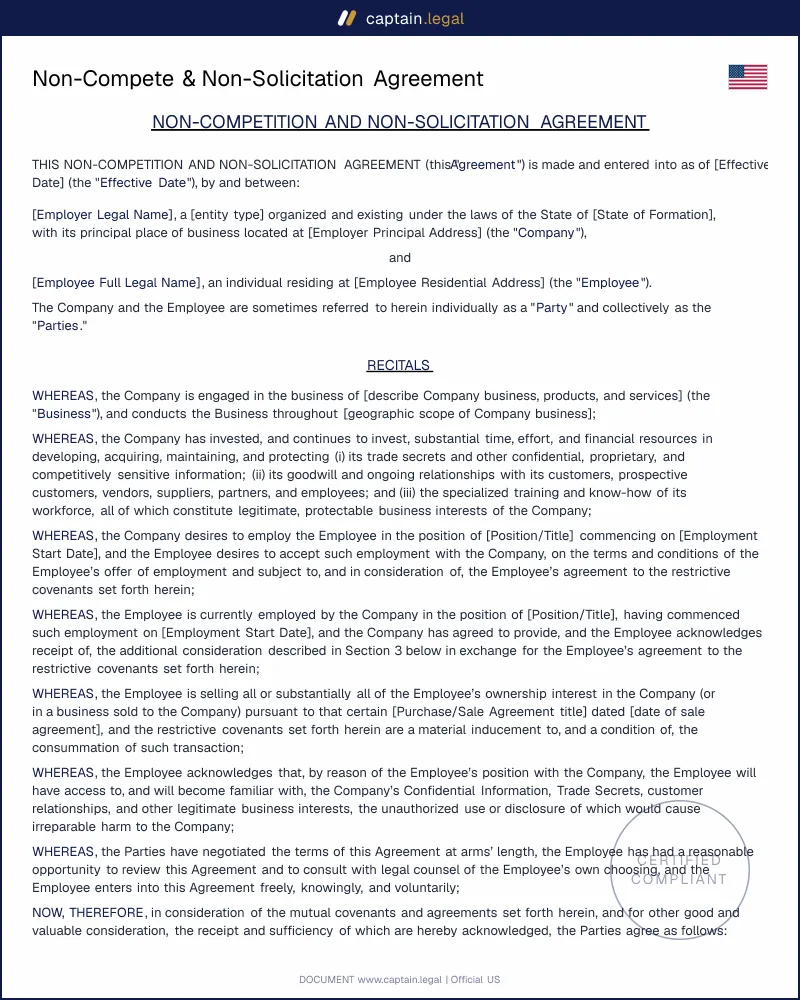
The identification of the parties and recitals spells out the employer entity, the employee or contractor, the date the relationship began, and the consideration being exchanged for the covenants. Recitals matter more than most drafters think : they are the document's contemporaneous explanation of why the restraint is reasonable, and courts read them when stress-testing the covenant later.
The non-compete clause is drafted with three explicit dials: restricted activity, geographic territory, and duration. The template defaults to a 12-month restriction within a defined market, narrowed to the activities the employee actually performed. In states with statutory caps — Massachusetts limits non-competes to 12 months under G.L. c. 149, §24L — the template enforces the cap automatically. Do not draft beyond the statutory ceiling : in states that follow strict construction, the entire covenant falls rather than being judicially reformed.
The non-solicitation of customers covers both clients and active prospects the employee had material contact with during the last 12 to 24 months of the engagement. This is the narrowly tailored approach most courts now expect after a decade of decisions striking down blanket customer non-solicits.
The non-solicitation of employees prohibits direct or indirect recruiting of the employer's workforce. In California, post-AMN Healthcare v. Aya Healthcare (2018), this clause is presumptively void as applied to employees whose profession is recruiting itself, and the template removes it for California-governed agreements.
The definition of confidential information and trade secrets ties the restrictive covenants to a legitimate business interest, which is the touchstone of enforceability in every reasonableness-test state. Without this link the covenant reads as a naked restraint on competition and is far easier to attack.
The tolling, savings, and choice-of-law clauses keep the covenant alive during a breach period and identify the governing law. The choice-of-law provision is drafted carefully because §16600.5 in California, and similar statutes elsewhere, neutralize out-of-state choice-of-law clauses against in-state workers.
The remedies and attorney's fees clause gives the employer access to injunctive relief and, where the state permits, recovery of enforcement costs. Several states, including Illinois and Washington, allow employees to recover fees if the employer overreaches, so the clause is bilateral by design.
State-specific considerations
California, North Dakota, and Oklahoma. The template will not produce an enforceable employee non-compete in any of these three states ; in California it falls under Business and Professions Code §16600, in North Dakota under N.D.C.C. §9-08-06, and in Oklahoma under the state's general prohibition on restraints of trade. For all three jurisdictions the output is a non-solicitation-only configuration. California is the most aggressive of the three : Business and Professions Code §16600.5, in force since January 1, 2024, voids non-competes signed outside the state when applied to California workers and creates a private right of action with statutory attorney's fees. AMN Healthcare v. Aya Healthcare Services further narrows employee non-solicits in California, and the template flags this risk in the output.
Texas. Texas enforces non-competes under the Covenants Not to Compete Act (Tex. Bus. & Com. Code §§15.50–15.52) provided the covenant is ancillary to an otherwise enforceable agreement and reasonable as to time, geography, and scope. The Texas Supreme Court's decision in Marsh USA Inc. v. Cook made stock grants and similar awards valid consideration, which is the most common drafting hook. Texas courts will reform an overbroad covenant rather than void it, which gives drafters slightly more room than in strict-construction states.
Florida. Florida Statutes §542.335 is one of the most employer-friendly frameworks in the country : it presumes a six-month restriction reasonable, allows up to two years for former employees, and treats customer relationships and goodwill as legitimate business interests by statute. The state explicitly forbids courts from considering individualized harm to the employee, which is unusual and well worth noting in the choice-of-law analysis. The new CHOICE Act, effective July 2025, adds garden-leave-style provisions for highly compensated employees.
New York. New York applies the BDO Seidman v. Hirshberg (1999) common-law test, which weighs employer interest, employee hardship, and public harm. New York courts are skeptical of geographic scopes broader than the employer's actual market and routinely strike covenants that read as boilerplate. Governor Hochul vetoed a near-total ban in late 2023, but legislative momentum continues, so drafters working in New York should monitor the calendar.
Massachusetts. The Massachusetts Noncompetition Agreement Act (G.L. c. 149, §24L) imposes the most procedurally demanding regime in the country : a ten-business-day advance notice before signing, an express right to counsel, mandatory garden leave at 50% of base pay or other mutually agreed consideration, and a hard 12-month duration cap. The template generates the Section 24L notice and the garden leave election automatically when Massachusetts is the chosen governing law.
Illinois. The Illinois Freedom to Work Act (820 ILCS 90/) voids non-competes for employees earning $75,000 or less and non-solicits for those earning $45,000 or less, with thresholds that index over time. The Act also imposes a 14-day notice requirement and an express right to counsel.
For any other state, the template applies the local reasonableness test, references the controlling statute where one exists, and flags any wage threshold the employer must satisfy. Captain.Legal also maintains HR documentation templates across the entire employee lifecycle for the moments when a covenant alone is not the right tool.
How to fill out this non-compete and non-solicitation agreement
You start by identifying the governing state, which is the input that drives every downstream decision in the template. The form then asks for the parties' details, the employee's role and access to confidential information, and the consideration being exchanged. If you are using the agreement at hire, the offer of employment is automatically referenced as consideration. If you are using it mid-stream with an existing employee, the form prompts you for the additional benefit — a raise, promotion, bonus, or equity grant — and inserts the appropriate recital so the consideration is documented on the face of the agreement.
You then set the three dials of the restraint : restricted activity, geographic territory, and duration. The template suggests defaults that align with prevailing case law in the chosen state, and warns you when an input exceeds a statutory or judicially recognized ceiling. For Massachusetts, the form automatically generates the Section 24L advance-notice package and the garden leave terms. For Illinois, it inserts the 14-day notice and the right-to-counsel disclosure. For California, North Dakota, and Oklahoma, the non-compete is removed entirely and the document is reconfigured as a non-solicitation agreement.
Finally, the form generates the choice-of-law, remedies, and severability provisions, and produces the final document in Word and PDF. Signature blocks are formatted for wet ink or e-signature workflows, and an internal compliance memo summarizes the key inputs for your HR file. The whole sequence takes the same time as drafting a single clause from scratch — and the full employment document set is available in our US catalog for the agreements you will need alongside it.
Common mistakes to avoid
The first and most expensive mistake is the overbroad geographic scope. A worldwide or nationwide non-compete for a regional sales role reads to a judge as a punitive measure, not a protective one, and it invites the court to void the entire covenant in strict-construction states like Georgia or Wisconsin. The fix is to tie the territory to the geography where the employee actually generated business or had material customer contact. The second is the mid-stream covenant without fresh consideration. Employers slide a non-compete in front of a tenured employee and assume continued employment is enough ; in roughly half the states that assumption is wrong, and the covenant collapses for want of consideration the moment it is tested.
The third mistake is ignoring the choice-of-law trap. A New York choice-of-law clause does not save a covenant against a California-resident worker, because §16600.5 explicitly neutralizes the workaround. The fourth is the catch-all definition of restricted activity — "any business that competes with the Company" — which courts now routinely strike as unreasonably broad. Modern drafting names the specific lines of business, services, or products at stake. The fifth, and the one most likely to bite a fast-growing company, is failing to update the territory when the business expands. An agreement signed when the employer operated in three states does not stretch to cover the twelve states the company has since entered, and the original geographic scope is what the court will look at.
Frequently Asked Questions
16 verified reviews · 50 000+ downloads
- Immediate access to the document
- PDF + Word download
- Compliant with 2026 legislation
- Reviewed by lawyers
You might also like