A Residential Lease Agreement is one of the most searched and downloaded legal documents in the United States, and for good reason: it is the binding contract that governs the relationship between a landlord and a tenant for the rental of a home, apartment, condo, or any residential dwelling. Whether you are a first-time landlord in Los Angeles, a property manager in Houston, an investor in Miami, or a tenant signing your first lease in New York City, understanding what makes a lease legally valid in your state is essential. This guide explains everything you need to know about a U.S. residential lease, with a deep focus on the four most active rental markets in the country: California, Texas, Florida, and New York.
Compliant
2026 Legislation
50,000+ clients
trust us
Affordable
From $4.90 / doc
Secure payment
Instant download
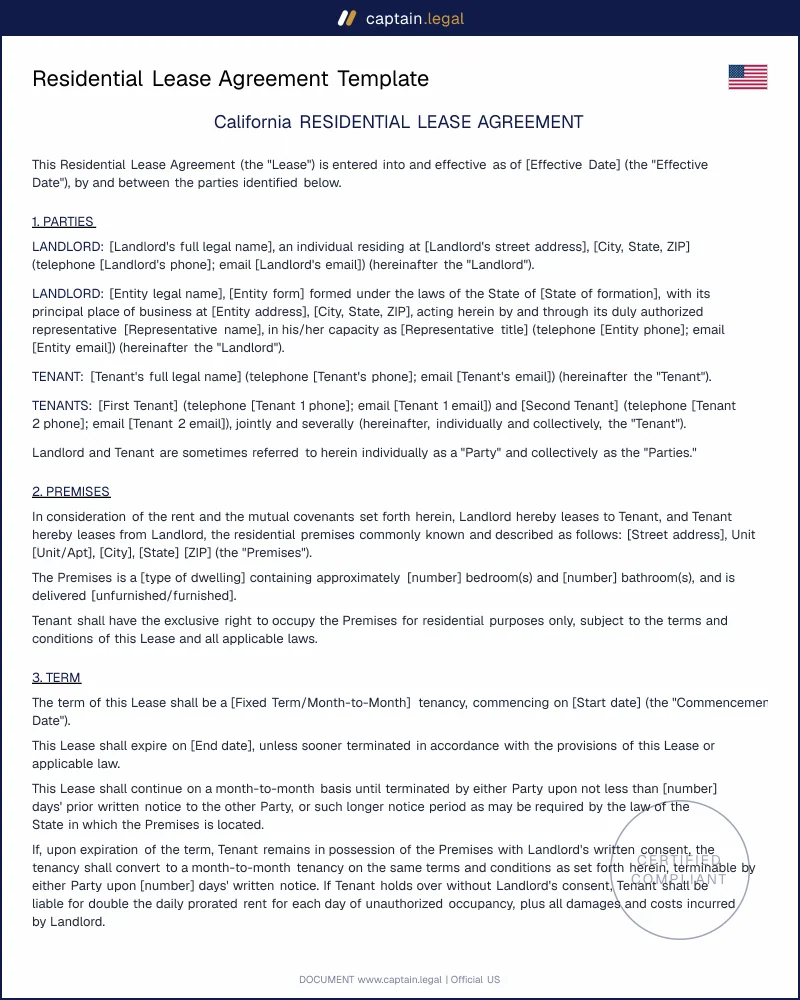
Residential Lease Agreement Template - PDF & Word Download
Secure payment
What Is a Residential Lease Agreement
A Residential Lease Agreement — sometimes called a rental agreement, rental contract, or simply a "lease" — is a legally enforceable document that sets out the terms under which a tenant rents a residential property from a landlord. Unlike a commercial lease, it is governed primarily by state landlord-tenant law, which means the same template cannot be used identically in every state. While federal law imposes a few baseline requirements (such as fair housing protections and the lead-based paint disclosure for properties built before 1978), the bulk of the rules — security deposits, notice periods, late fees, eviction process — are set at the state level.
A standard residential lease typically covers the identification of the parties (landlord and tenant), the property address and description, the lease term (fixed-term or month-to-month), the monthly rent amount and due date, security deposit terms, utilities and maintenance responsibilities, rules on pets, smoking, subletting, and grounds for termination. A well-drafted lease protects both parties: it gives landlords legal recourse if rent goes unpaid and gives tenants clear rights regarding habitability, privacy, and the return of their deposit.
You can browse a full library of real estate legal documents tailored for U.S. landlords and tenants, including leases, move-in inspection reports, and rent receipts.
Why a State-Specific Lease Matters
Using a generic "one-size-fits-all" lease found online is one of the most common — and costly — mistakes landlords make. State law overrides any contractual clause that conflicts with it, which means a clause that is perfectly enforceable in Texas may be void in California. Examples of state-level differences include:
- Maximum security deposit allowed
- Number of days to return the deposit after move-out
- Required disclosures (mold, bedbugs, flood zones, lead paint, etc.)
- Notice periods for entry, rent increase, or termination
- Late fee caps and grace periods
- Rent control or rent stabilization rules
For these reasons, a Residential Lease Agreement should always be drafted with the specific state — and sometimes the specific city — in mind. Below is a state-by-state breakdown for the four largest rental markets in the U.S.
California Residential Lease Agreement
California is one of the most tenant-protective states in the country. The legal framework is built on the California Civil Code, the Tenant Protection Act of 2019 (AB 1482), and a growing body of local rent-control ordinances in cities like Los Angeles, San Francisco, Oakland, and San Jose.
Key features of a California residential lease include:
- Security deposit limit: Capped at one month's rent for most rentals (a major change under AB 12, effective July 1, 2024). Small landlords with two or fewer properties may charge up to two months.
- Deposit return: Must be returned within 21 days after the tenant vacates, with an itemized statement of any deductions.
- Statewide rent cap: Under AB 1482, annual rent increases are limited to 5% plus local CPI, capped at 10%, for most multi-family properties more than 15 years old.
- Just cause eviction: Landlords must state a legally valid reason to terminate a tenancy after 12 months of occupancy.
- Mandatory disclosures: Lead-based paint (federal), Megan's Law database notice, mold, bedbugs, flood hazard, demolition, and — in some counties — pest control history.
- Notice of entry: 24 hours' written notice in most cases.
Cities with their own rent-stabilization rules (LA, SF, Berkeley, Santa Monica, West Hollywood, etc.) may impose stricter limits than state law. A California lease should always reference both state and local rules.
Texas Residential Lease Agreement
Texas is widely considered one of the more landlord-friendly states. The governing law is Chapter 92 of the Texas Property Code, supplemented by the Texas Apartment Association's widely used standard form. Texas has no statewide rent control — in fact, state law explicitly prohibits cities from adopting it.
Key features of a Texas residential lease include:
- Security deposit: No statutory maximum. Whatever amount is agreed in the lease is legal.
- Deposit return: Must be returned within 30 days after the tenant surrenders the property and provides a forwarding address.
- Late fees: Allowed if "reasonable" (a safe-harbor rule generally treats 12% of monthly rent for properties with four or fewer units, and 10% for larger properties, as reasonable).
- Notice to vacate: For nonpayment of rent, the landlord must give a 3-day notice to vacate before filing for eviction (unless the lease specifies a shorter or longer period).
- Mandatory disclosures: Lead-based paint (federal), name and address of the owner or property manager, parking rules for multi-unit buildings, and certain flood disclosures (required since 2022 for properties in 100-year floodplains).
- Right of entry: Texas law does not specify a notice period — the lease itself controls. Most landlords include 24 hours as a contractual standard.
Texas leases are often longer and more detailed than in other states because so many rules are determined by the contract itself rather than by statute.
Florida Residential Lease Agreement
Florida is governed by the Florida Residential Landlord and Tenant Act (Chapter 83, Part II of the Florida Statutes). Like Texas, Florida is generally considered landlord-friendly, with no statewide rent control and relatively few mandatory disclosures. However, hurricane risk and a heavy presence of homeowners' associations (HOAs) make Florida leases unique.
Key features of a Florida residential lease include:
- Security deposit: No statutory cap.
- Deposit return: Must be returned within 15 days if no deductions are claimed, or within 30 days if the landlord intends to make a claim against the deposit (with written notice by certified mail).
- Three-day notice: For nonpayment of rent, the landlord must give a 3-day notice (excluding weekends and legal holidays) before filing for eviction.
- Mandatory disclosures: Lead-based paint (federal), radon gas disclosure (Florida-specific), and identity of the landlord or authorized agent. Properties governed by an HOA or condo association must include the relevant rules.
- Notice of entry: At least 12 hours' notice is required for routine maintenance access.
- Rent grace period: Florida law does not require one, but most leases include 3–5 days as a standard.
Florida law also includes specific provisions for early termination by active-duty service members under both federal SCRA and Florida-specific statutes.
New York Residential Lease Agreement
New York — and especially New York City — has one of the most complex landlord-tenant frameworks in the country. The Housing Stability and Tenant Protection Act of 2019 (HSTPA) dramatically expanded tenant rights statewide. In NYC, additional layers of rent control and rent stabilization apply to roughly half of all rental units.
Key features of a New York residential lease include:
- Security deposit limit: Capped at one month's rent statewide (HSTPA, 2019).
- Deposit return: Must be returned within 14 days of move-out, with an itemized statement of any deductions.
- Late fees: Capped at the lesser of 5% of monthly rent or $50, and only after a 5-day grace period.
- Application fees: Capped at $20 statewide.
- Rent increase notice: For tenants who have lived in a unit for 1–2 years, the landlord must give 60 days' notice before raising rent more than 5% or refusing to renew. For tenants of 2+ years, the notice extends to 90 days.
- Mandatory disclosures: Lead-based paint (federal), bedbug history (NYC), sprinkler system, window guard notice (NYC, for households with children under 10), and indoor allergen hazards (NYC).
- Rent stabilization: Approximately one million NYC apartments are rent-stabilized and subject to annual increase limits set by the Rent Guidelines Board.
A New York lease must be careful to comply with both state law and NYC-specific rules, as violations can result in significant penalties.
Federal Disclosures That Apply to All States
Regardless of which state you are in, federal law requires every residential lease for a property built before 1978 to include the Lead-Based Paint Disclosure under the Residential Lead-Based Paint Hazard Reduction Act. The landlord must provide the EPA-approved pamphlet and disclose any known lead hazards. You can find the official guidance and required forms on the HUD lead-based paint disclosure page.
Other federal protections — such as the Fair Housing Act (prohibiting discrimination based on race, color, national origin, religion, sex, familial status, or disability) and the Servicemembers Civil Relief Act (SCRA) — apply uniformly across all states.
What to Include in a Solid Residential Lease
Whether you are renting out a single-family home in Dallas or a studio in Brooklyn, every residential lease should include the following sections:
- Identification of all parties (landlord, tenants, occupants)
- Full property address and description
- Lease term and start/end dates
- Monthly rent, due date, payment method, and accepted forms of payment
- Security deposit amount, holding rules, and conditions for return
- Late fees and grace period
- Utilities and services (who pays for what)
- Maintenance and repair responsibilities
- Pet policy and pet deposit, if any
- Rules on smoking, subletting, and short-term rentals
- Right of entry and notice requirements
- Default and termination clauses
- State-mandated disclosures
- Signatures of all parties
For first-time landlords, drafting a compliant lease can feel overwhelming. Captain.Legal lets you generate a state-specific Residential Lease Agreement in under five minutes — answer a few simple questions and download a ready-to-sign PDF and editable Word file. Browse the full catalog of legal documents to find the exact template you need.
Common Mistakes to Avoid
Even seasoned landlords make avoidable errors. The most frequent ones include using outdated templates that no longer reflect current state law (especially after California's AB 12 and New York's HSTPA), forgetting state-specific disclosures, charging illegal late fees or excessive deposits, and skipping a written move-in inspection. Another classic mistake is letting a tenant move in without a signed lease — verbal agreements are technically valid in most states for short terms but are extremely difficult to enforce.
Tenants, on the other hand, should never sign a lease without reading it in full. Pay particular attention to early-termination clauses, automatic renewal provisions, and rules on guests and parking — these are the clauses most often disputed in housing court.
Why Use a Captain.Legal Template
Drafting a lease from scratch — or copying one from the internet — exposes you to legal risk and wasted time. With Captain.Legal, every Residential Lease Agreement is:
- Reviewed by lawyers and updated to reflect current 2026 legislation
- State-specific, with clauses tailored to California, Texas, Florida, and New York rules
- Generated in minutes through a simple guided questionnaire
- Downloadable instantly in PDF (ready to sign) and Word (fully editable) formats
- Yours for life — no subscription, no hidden fees
If you also need related documents — such as a Power of Attorney to allow a property manager to sign on your behalf, or other personal legal documents — you'll find them in the same place. Landlords managing properties through a small business may also want to explore the business documents catalog for LLC operating agreements and related contracts. And if you employ an on-site superintendent or leasing assistant, you can issue a compliant disciplinary notice using an Employee Warning Letter whenever needed.
Frequently Asked Questions
61 verified reviews · 50 000+ downloads
- Immediate access to the document
- PDF + Word download
- Compliant with 2026 legislation
- Reviewed by lawyers
You might also like