A Month-to-Month Rental Agreement is one of the most flexible and widely used housing contracts in the United States. Unlike a traditional fixed-term lease that locks both parties in for six or twelve months, a month-to-month agreement renews automatically every 30 days, giving landlords and tenants the freedom to end or modify the arrangement with proper notice. This format has become especially popular among small landlords, accidental landlords, snowbirds, traveling professionals, students, and anyone whose housing needs may change on short notice. Whether you own a single rental property in Phoenix, manage a duplex in Atlanta, or rent out a room in your home in Austin, understanding how a month-to-month rental works is essential to protect your rights and avoid costly mistakes.
Compliant
2026 Legislation
50,000+ clients
trust us
Affordable
From $4.90 / doc
Secure payment
Instant download
Month-to-Month Rental Agreement Template | PDF & Word
Secure payment
What Is a Month-to-Month Rental Agreement
A Month-to-Month Rental Agreement — sometimes called a periodic tenancy, rolling lease, or simply a "30-day lease" — is a legally binding contract between a landlord and a tenant for a residential property that automatically renews every month until either party gives notice to terminate. The contract has no fixed end date. Each new month is technically a new term that begins the moment rent is paid and accepted.
Despite its short renewal cycle, a month-to-month agreement is just as enforceable as a one-year lease. The tenant is bound by all the standard obligations — paying rent on time, maintaining the property, following community rules — and the landlord is bound by the same duties of habitability, privacy, and non-discrimination that apply to any residential tenancy under federal and state law.
You can browse the full library of real estate legal documents for U.S. landlords and tenants, including month-to-month templates, fixed-term leases, move-in inspection reports, and rent receipts.
Why Month-to-Month Rentals Are So Popular
The flexibility of a month-to-month rental makes it the preferred choice for several types of landlords and tenants. For small landlords, especially those renting out a single property or a portion of their primary residence, it removes the long-term commitment of a 12-month lease and makes it easier to adjust rent, change tenants, or take the property back for personal use. For tenants, it provides freedom to relocate quickly for a new job, a relationship change, or simply because they prefer not to be locked in.
Common scenarios where a month-to-month agreement makes sense include:
- A landlord testing a new tenant before offering a full lease
- A homeowner renting out an in-law unit or basement apartment
- A property owner planning to sell within the next year
- A tenant relocating temporarily for work or family reasons
- A traveling nurse, contractor, or remote professional in transition
- A retired snowbird splitting time between two states
- An older fixed-term lease that has rolled over after expiration
In many states, when a fixed-term lease ends and the tenant continues paying rent without signing a new contract, the tenancy automatically converts into a month-to-month agreement by default. This is called a "holdover tenancy" and is governed by the same rules as an originally drafted month-to-month lease.
How a Month-to-Month Agreement Differs From a Fixed-Term Lease
The two forms of residential tenancy share most clauses — rent amount, security deposit, maintenance duties, pet rules — but differ in three critical areas: duration, termination, and rent changes.
Duration. A fixed-term lease has a defined start and end date (typically 12 months). A month-to-month agreement has a start date but no end date — it continues indefinitely until terminated.
Termination. Ending a fixed-term lease before its end date usually requires a valid legal reason or an early-termination fee. Ending a month-to-month agreement only requires written notice — typically 30 days, but longer in some tenant-protective states.
Rent changes. Under a fixed-term lease, rent is locked in for the entire term. Under a month-to-month, the landlord can raise the rent by giving proper written notice (with limits set by state and local rent-control laws). This flexibility is one of the main reasons landlords in volatile markets choose month-to-month over a one-year commitment.
If you need a more permanent arrangement instead, you can also generate a state-specific Residential Lease Agreement from the same catalog of legal documents.
Key Clauses Every Month-to-Month Agreement Should Contain
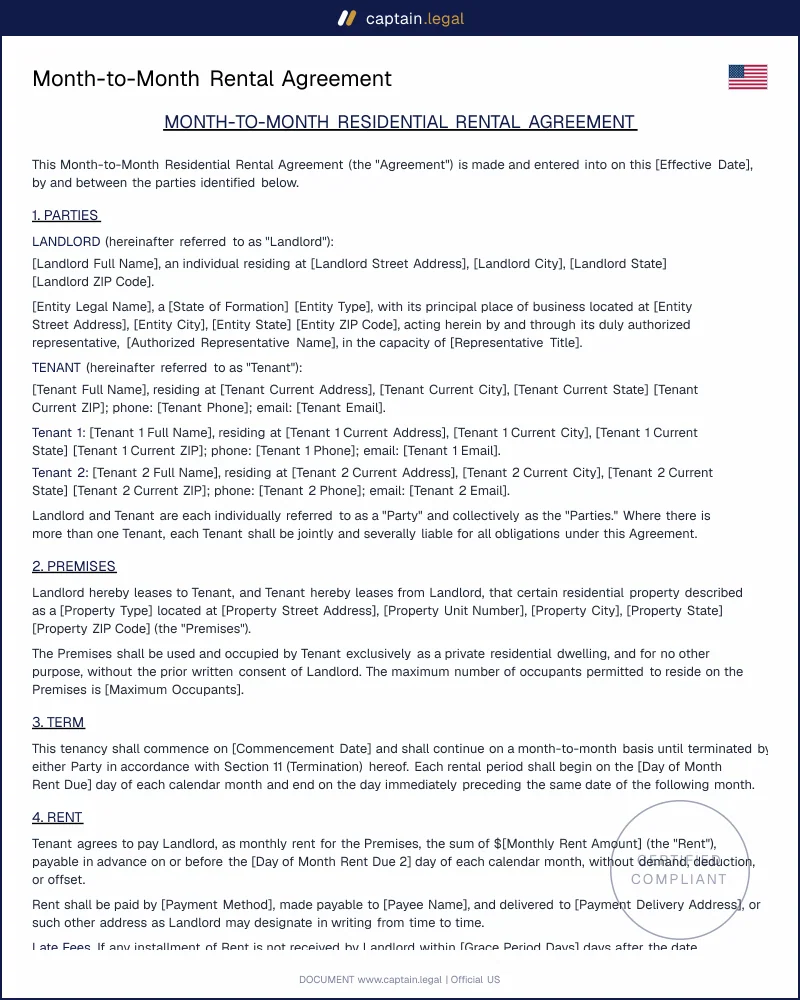
A solid month-to-month rental agreement is short by design but should never be incomplete. The most important clauses include:
- Identification of the parties. Full legal names of the landlord (or property management company) and all adult tenants who will occupy the unit.
- Property description. Full address, unit number, and a description of any included parking, storage, or shared areas.
- Term and renewal. A clear statement that the tenancy begins on a specific date and renews monthly until terminated by either party with proper notice.
- Rent amount, due date, and payment method. Most agreements set rent due on the 1st of each month, with accepted methods (ACH, check, online portal, etc.) listed explicitly.
- Security deposit. Amount, holding rules, conditions for return, and the timeline required by state law.
- Late fees and grace period. State-specific caps apply — for example, New York limits late fees to the lesser of 5% of rent or $50, while many other states allow "reasonable" fees.
- Utilities and services. Clear allocation of who pays for electricity, gas, water, internet, trash, and lawn care.
- Maintenance and repairs. Tenant responsibility for minor upkeep; landlord responsibility for habitability and major systems.
- Pet policy. Whether pets are allowed, breed/weight restrictions, and any additional pet deposit or monthly pet rent.
- Smoking, subletting, and short-term rental rules. Many landlords explicitly prohibit Airbnb-style subletting.
- Right of entry. State-mandated notice (commonly 24 hours) before the landlord can enter for inspections or repairs.
- Termination notice requirement. The number of days each party must give to end the tenancy.
- Mandatory disclosures. Lead-based paint (federal, for properties built before 1978), plus any state-specific disclosures (mold, bedbugs, flood zone, radon, etc.).
- Signatures. All adult occupants and the landlord, dated.
For first-time landlords, drafting these clauses correctly can be intimidating. Captain.Legal's smart generator walks you through each section in plain English and produces a fully compliant document in under five minutes.
Notice Requirements: How to End a Month-to-Month Tenancy
The most common question both landlords and tenants ask is: How much notice do I need to give? The answer depends on the state and, sometimes, on how long the tenant has lived in the unit.
Here is a snapshot of notice requirements in major U.S. states:
- California. 30 days if the tenant has lived there less than one year; 60 days if the tenant has lived there one year or longer. The state's Tenant Protection Act (AB 1482) also imposes "just cause" rules after 12 months of occupancy, meaning the landlord must state a legally valid reason to terminate.
- Texas. 30 days, unless the lease specifies a different notice period (Texas allows the contract to set the rule).
- Florida. 15 days' notice from either party — one of the shortest periods in the country.
- New York. 30 days for tenancies under one year; 60 days for tenancies of one to two years; 90 days for tenancies of two years or more. Strictest in the country.
- Illinois. 30 days for unfurnished residential rentals; Chicago has additional ordinance requirements.
- Georgia. Landlord must give 60 days; tenant must give 30 days.
- Washington State. 20 days for the tenant; landlord must provide written cause and longer notice depending on the situation.
In most states, the notice must be in writing, delivered in a verifiable manner (certified mail, hand delivery with witness, or as the lease specifies), and timed so that the termination falls at the end of a rental period.
A few states also require landlords to provide a "just cause" reason for non-renewal — most notably California, New Jersey, Oregon, Washington, and parts of New York. In these states, simply not wanting to renew the tenancy is not enough.
Rent Increases on a Month-to-Month Agreement
One of the biggest advantages of a month-to-month rental for landlords is the ability to adjust rent as market conditions change. However, rent increases are not unlimited. Each state — and many cities — sets specific rules.
In most states without rent control (such as Texas, Florida, Georgia, Tennessee, North Carolina, and Arizona), a landlord can raise rent by any amount as long as proper written notice is given (typically 30 days). In rent-controlled jurisdictions, increases are capped:
- California (AB 1482): annual increases capped at 5% plus local CPI, or 10% maximum, for most units more than 15 years old.
- Oregon: annual increases capped at 7% plus CPI, statewide.
- New York City: rent-stabilized units are subject to annual increase limits set by the Rent Guidelines Board.
- St. Paul, MN: rent increases capped at 3% per year.
Even where there is no statutory cap, landlords cannot use rent increases as a form of retaliation or discrimination — both are illegal under federal and state law.
Federal Rules That Apply to All Month-to-Month Rentals
Regardless of which state you are in, three federal rules always apply:
- Fair Housing Act. Landlords cannot refuse to rent or terminate a tenancy based on race, color, national origin, religion, sex, familial status, or disability.
- Lead-Based Paint Disclosure. Required for any property built before 1978. The landlord must provide the EPA-approved pamphlet and disclose any known lead hazards. You can find official guidance on the HUD tenant rights page.
- Servicemembers Civil Relief Act (SCRA). Active-duty military tenants can terminate any residential lease — including month-to-month — early without penalty when receiving qualifying orders.
Pros and Cons for Landlords
Advantages. Month-to-month rentals give landlords maximum flexibility. You can adjust rent quickly, end a problematic tenancy without waiting for a lease to expire, and reclaim the property for personal use, sale, or major renovation. They are also ideal for transitional situations — between long-term tenants, while preparing a property for sale, or while testing a new tenant before offering a longer lease.
Disadvantages. The tenant can leave on short notice, which means more turnover, more vacancy risk, and more time spent screening new applicants. Marketing and cleaning costs add up quickly if turnover is frequent. Some lenders and insurers also prefer fixed-term leases because they provide more predictable income.
Pros and Cons for Tenants
Advantages. Tenants enjoy the same flexibility — the freedom to relocate for a new job, move in with a partner, or upgrade to a better unit without paying an early-termination fee. Month-to-month is also ideal for newcomers to a city who want to explore neighborhoods before committing to a 12-month lease.
Disadvantages. The landlord can also end the tenancy on short notice, raise the rent more frequently, or change the rules. In tight rental markets, this lack of stability can be stressful. Some landlords charge higher monthly rent for month-to-month tenants to offset turnover risk — typically 5–15% more than the equivalent annual lease.
Common Mistakes to Avoid
Even experienced landlords make avoidable mistakes with month-to-month agreements. The most common include:
- Using a generic template that doesn't comply with state notice requirements or rent-control caps.
- Forgetting state-mandated disclosures, especially lead-based paint for older properties.
- Giving improper notice — verbal notice is invalid in most states, and written notice must follow specific delivery rules.
- Ignoring "just cause" rules in California, Oregon, and other tenant-protective states.
- Charging illegal late fees that exceed the state cap.
- Using self-help eviction tactics like changing locks, shutting off utilities, or removing belongings — illegal everywhere and exposing the landlord to significant damages.
- Failing to document the move-in condition — without a signed inspection report, security deposit disputes become very difficult to win.
Tenants should also avoid signing without reading. Pay particular attention to automatic renewal language, rules on guests and parking, and the precise notice period required for termination.
Why Use a Captain.Legal Month-to-Month Template
Drafting a month-to-month rental from scratch — or downloading a free template of unknown origin — is risky. State law evolves quickly, and an outdated clause can cost you thousands in court. With Captain.Legal, every Month-to-Month Rental Agreement is:
- Reviewed by lawyers and updated to reflect current 2026 legislation
- State-specific, with adjusted notice periods, deposit caps, and required disclosures
- Generated in minutes through a guided questionnaire — no legal jargon
- Downloadable instantly in PDF (ready to sign) and Word (fully editable) formats
- Yours for life — no subscription, no renewal fees
If you need other documents alongside your rental, you'll find them in the same place — including a Power of Attorney to allow a property manager to sign on your behalf, and a wide range of personal legal documents for everyday legal needs. Landlords managing properties through an LLC or small business can browse the business documents catalog for operating agreements and contracts. And if you employ an on-site superintendent or leasing assistant, you can issue a formal disciplinary notice using an Employee Warning Letter when the situation calls for it.
Frequently Asked Questions
51 verified reviews · 50 000+ downloads
- Immediate access to the document
- PDF + Word download
- Compliant with 2026 legislation
- Reviewed by lawyers
You might also like