A living will, also called an advance directive in most states, is the written instruction you leave behind so that doctors, hospitals, and family members know which life-sustaining treatments you accept or refuse if you can no longer speak for yourself. It is the cornerstone of any serious estate plan, sitting alongside a healthcare power of attorney and a last will and testament. Unlike a last will, which deals with property after death, a living will speaks while you are still alive but unable to communicate, typically after a stroke, an irreversible coma, an end-stage condition, or advanced dementia.
This page explains what a valid living will looks like under U.S. law, which statutes apply in your state, the clauses our template covers, and the mistakes that send otherwise well-drafted directives back to a hospital ethics committee.
Compliant
2026 Legislation
50,000+ clients
trust us
Affordable
From $4.90 / doc
Secure payment
Instant download
Living Will & Advance Directive Template | Word & PDF Download
Secure payment
What is a living will and how is it different from an advance directive
A living will is a written declaration of medical preferences, executed by a competent adult, that becomes operative only after a physician certifies that the patient has lost decision-making capacity due to a qualifying condition. The document instructs healthcare providers about specific interventions: cardiopulmonary resuscitation, mechanical ventilation, artificial nutrition and hydration, dialysis, antibiotics in terminal illness, and palliative sedation. It does not name a person; it names treatments, accepted or refused.
The advance directive is the broader umbrella. In federal regulation under 38 C.F.R. §17.32, the term covers four categories: the durable power of attorney for healthcare, the living will, the mental-health directive, and any state-authorized variant. In daily practice, California and Florida publish a single combined form that includes both the living will provisions and the appointment of a healthcare agent, and they call the whole instrument an Advance Health Care Directive. Texas and New York keep the documents separate: a Directive to Physicians and Family or Surrogates on one side, a Medical Power of Attorney or Health Care Proxy on the other. The terminology you use must match the state where the document will be presented, because hospitals routinely reject forms whose headings do not track local statutory language. Our personal legal documents builder detects your state and adjusts the form, the title, and the witnessing block accordingly, so the file you download already speaks the right legal dialect.
Legal framework
The Patient Self-Determination Act of 1990 (codified at 42 U.S.C. §1395cc(f)) is the federal cornerstone. It requires every Medicare- and Medicaid-funded hospital, nursing home, hospice, and home-health agency to ask each adult patient at admission whether they have an advance directive, to provide written information about state law, and to document the answer in the chart. The Act does not create a national form ; it forces compliance machinery on the providers and leaves the substantive rules to the states.
State law is where the substance lives. California has consolidated its regime in California Probate Code §§4670 to 4743, with the statutory form set out at §4701 and capacity determination governed by §4695 (the supervising healthcare provider makes the call). Florida runs Florida Statutes Chapter 765, with §765.302 requiring two adult witnesses and §765.306 requiring confirmation by the attending physician plus a consulting physician before the directive controls care. Texas uses the Texas Advance Directives Act at Texas Health and Safety Code Chapter 166, and §166.032 prescribes the statutory living-will language and the two-witness rule, one of whom cannot be a treating provider, a relative, or someone entitled to inherit. New York has no standalone living-will statute ; instead, N.Y. Public Health Law §2981 governs the Health Care Proxy, and 10 NYCRR §400.21 recognizes living wills as evidence of patient wishes that the proxy must follow. Seven states, including Alaska, Delaware, Hawaii, Maine, Mississippi, New Mexico, and Wyoming, have adopted the Uniform Health-Care Decisions Act of 1993 with local variations, which is the closest the country comes to a unified text.
A reliable starting point for cross-state research is the Cornell Legal Information Institute summary of advance directive law, which collects definitions, federal regulations, and state regulatory citations in one place. Statutes change every legislative session, so the form you executed five years ago may have witnessing rules that no longer satisfy current code. The template walks you through the requirements in force at the time of generation, and our child travel consent form follows the same state-specific approach for parents who want to coordinate their estate planning and their family logistics in one place.
When do you need this document
The most common moment is the diagnosis of a serious chronic illness: cancer, advanced heart failure, ALS, early-stage dementia. The patient is still competent, the prognosis is sobering, and the family wants written certainty about ventilator use, feeding tubes, and resuscitation before the next hospitalization. Specialists will frequently ask whether a directive is on file before scheduling major surgery, because anesthesia plus advanced age multiplies the risk of intraoperative cardiac arrest. A blank chart at that point pushes the decision onto the spouse or the eldest child, often in a hallway, often at 2 a.m.
The second trigger is the routine estate-planning consultation, usually paired with a last will and a healthcare power of attorney. Adults in their fifties and sixties draft the three documents together because they reinforce each other: the living will tells the doctors what you want, the healthcare proxy names the human being who speaks for you, and the financial power of attorney covers banking and bills while you are incapacitated. Our power of attorney template is designed to dovetail with this living will so the appointed agent and the healthcare wishes match.
Two edge cases recur in practice. First, young adults heading to college : once a child turns 18, parents lose default authority to receive medical information or make decisions, and a brief living will plus a HIPAA release prevents the Schiavo-style standoffs that follow a serious accident. Second, interstate retirees who split the year between two homes : a Florida directive may not be honored in New York, or only partially, and the safer route is to execute a directive that satisfies both states.
Key clauses included in our template
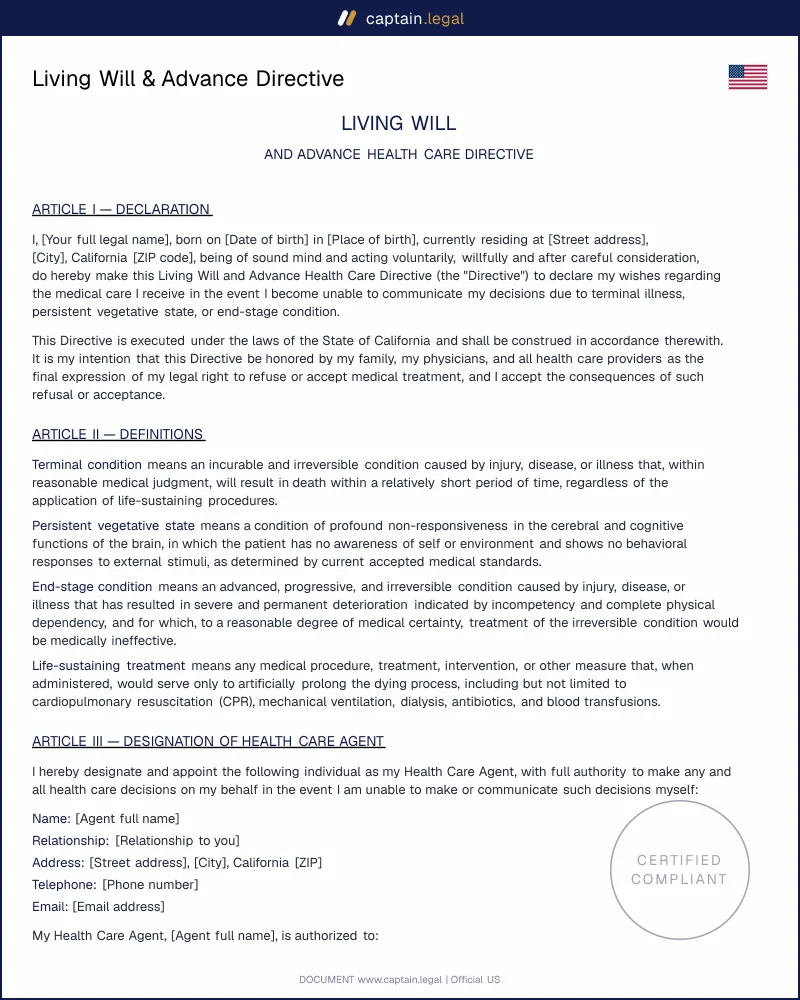
The clauses below are present in every state version of the template, with the wording adjusted to match the statutory language of the jurisdiction you select.
- The declaration of capacity and voluntariness opens the document and confirms that the principal is at least 18, of sound mind, and acting without coercion. This recital matters because it forecloses the most common attack on a living will, which is the family member arguing after the fact that the patient was confused or pressured. The clause is drafted to track §765.302 Florida Statutes, §166.032 Texas Health and Safety Code, or the equivalent in your state.
- The end-of-life treatment instructions are the heart of the document. They list specific interventions, including cardiopulmonary resuscitation, mechanical ventilation, artificial nutrition and hydration, dialysis, surgery, and antibiotics, and let you accept or refuse each one independently. Vague phrasing like "no extraordinary measures" is replaced by the precise terms used in California Probate Code §4701, because hospital ethics committees read the words on the page, not the intent behind them.
- The qualifying conditions clause defines when the directive activates: terminal illness, end-stage condition, irreversible unconsciousness, or persistent vegetative state, with the certification mechanism set by your state. In Florida this means two physicians ; in California, the supervising healthcare provider alone.
- The pregnancy provision is included because seven states, including Texas and Arkansas, automatically suspend the living will if the patient is pregnant and the fetus could reach live birth with continued treatment. Our template lets you accept or override the default, where state law allows the override.
- The organ donation declaration integrates the Uniform Anatomical Gift Act election so a single signed page covers both end-of-life care and post-mortem donation, eliminating the conflict that arises when families discover two contradictory documents.
- The HIPAA release language authorizes named individuals to receive medical information, which prevents the agent under your healthcare proxy from being stonewalled by hospital privacy officers at the very moment they need to act.
- The revocation clause sets out how to cancel or amend the directive, in writing, orally, or by physical destruction, and confirms that revocation takes effect once communicated to the attending physician.
State-specific considerations
California uses the combined Advance Health Care Directive under Probate Code §4701. Two adult witnesses or a notary public are required, but not both, and at least one witness cannot be a relative, an heir, or the appointed healthcare agent. Probate Code §4695 gives capacity determination to the supervising healthcare provider, which means the directive can engage faster than in Florida, where two physicians must concur. Patients in skilled nursing facilities face an additional layer : a patient advocate or ombudsman must witness the signing, a safeguard introduced after a series of contested cases involving cognitively impaired residents.
Texas runs the most protective witnessing regime of the four states. Health and Safety Code §166.032 requires two witnesses, and one of them cannot be related to the patient by blood or marriage, cannot be entitled to any portion of the estate, cannot be the attending physician or an employee of the physician or facility, and cannot have a claim against the estate. Out-of-hospital DNR orders are governed by a separate statute, §166.081 et seq., and require their own form ; the living will alone does not bind paramedics responding to a 911 call. Texas also publishes a statutory Directive to Physicians at §166.033 whose language must be substantially followed.
Florida sits between the two. §765.302 requires only two adult witnesses, no notary, and one witness cannot be the spouse or a blood relative. The activation threshold is stricter : §765.306 requires the attending physician plus a second consulting physician to certify that the patient has a terminal condition, end-stage condition, or persistent vegetative state before the directive controls. Florida also maintains an electronic registry through the Agency for Health Care Administration, although registration is voluntary and a non-registered directive remains fully valid.
New York is the outlier. There is no standalone living-will statute ; the binding instrument is the Health Care Proxy under Public Health Law §2981, which names an agent who must follow the patient's known wishes. A written living-will document is admissible under 10 NYCRR §400.21 as evidence of those wishes, and New York courts have repeatedly held that clear and convincing evidence of a patient's preference, whether oral or written, controls treatment decisions. The practical advice in New York is to execute both: a healthcare proxy to name the agent, and a written living will to give that agent specific instructions in writing.
How to fill out this living will
The questionnaire opens with the state where you reside or expect to receive treatment, because every downstream question depends on it. From there, you confirm your full legal name, date of birth, and address, and the form pre-populates the witnessing block with the rules in force in that state, two witnesses for Florida, two witnesses with no-relative restriction for Texas, two witnesses or a notary for California, and so on. You then move through the treatment menu, where each intervention appears on its own line with a plain-English description and the choice to accept, refuse, or defer to my agent. The interface flags incompatible combinations, for example refusing artificial nutrition while accepting indefinite ventilation, and lets you confirm or revisit the choice.
The next stage handles the optional appointment of a healthcare agent, with the same question structure as our business legal document templates for proxy designations, and pulls in the contact details of a primary agent and one or two successors. You finish with the pregnancy clause where state law lets you choose, the organ donation election, and the HIPAA release. Once the form is generated, you download a Word and a PDF copy and execute it before the witnesses or the notary required in your state.
Common mistakes to avoid
The first mistake is using a generic national form downloaded from a search-engine result. Hospitals look at the heading and the witnessing block, and a Five Wishes booklet that lacks the specific recital required by Texas §166.032 will be set aside while the family fights in the hallway. The second is asking a relative or a beneficiary under the will to act as witness, which is invalid in Texas, Florida, and California, and which voids the document where the law treats the witness as disqualified. The third is forgetting the out-of-hospital DNR: a living will is not a paramedic instruction, and EMS personnel arriving at a home address are required to begin resuscitation unless a state-issued out-of-hospital DNR or POLST form is visible.
A fourth recurring error is leaving the document in a safe-deposit box. The directive is useless if it cannot be produced within the first hour of a hospital admission, and our template prompts you to file copies with your primary care physician, your healthcare agent, and the hospital you are most likely to use. Finally, treating the living will as a one-and-done : marriage, divorce, the death of an agent, a move to a new state, or a new diagnosis are all reasons to redo the document. A directive executed in 2014 naming a now-divorced spouse as agent will create exactly the conflict it was designed to prevent. Couples who maintain a residential lease agreement template across two states should review their advance directives at the same cadence as their housing paperwork.
Frequently Asked Questions
21 verified reviews · 50 000+ downloads
- Immediate access to the document
- PDF + Word download
- Compliant with 2026 legislation
- Reviewed by lawyers
You might also like