Corporate bylaws are the internal rulebook of a US corporation, the document that turns a freshly chartered entity into a functioning organization with directors, officers, meetings, and decision-making procedures. Banks open accounts on the strength of them. Investors review them before wiring a single dollar. The IRS asks for them when a corporation applies for §501(c)(3) status. Corporate bylaws sit just below the articles of incorporation in the legal hierarchy, and just above board resolutions, which means every governance dispute eventually traces back to their wording. This page walks you through what they contain, what state law actually requires, and how to draft a set that holds up when a deal, an audit, or a lawsuit puts them under a microscope.
Compliant
2026 Legislation
50,000+ clients
trust us
Affordable
From $4.90 / doc
Secure payment
Instant download
Corporate Bylaws Template — Word & PDF
Secure payment
What is a corporate bylaws document?
A corporate bylaws document is the internal governance contract of a corporation, adopted right after incorporation and binding on the entity, its directors, its officers, and its shareholders. Where the articles of incorporation tell the state who you are and what shares you can issue, the bylaws tell the company how it will actually be run on a Tuesday morning : who calls a board meeting, how many directors form a quorum, when the annual shareholder meeting takes place, who can sign a bank resolution, what happens if a director dies mid-term. The Cornell Legal Information Institute defines them as the rules adopted by a corporation to regulate its internal management and operations, and that operational dimension is precisely what distinguishes them from the charter on file with the Secretary of State.
A common confusion : bylaws are not the same as a shareholders' agreement and not the same as articles of incorporation. The articles are public, short, and amended only with state filings. The shareholders' agreement is a private contract among investors that regulates voting blocks, drag-along rights, and exit mechanics. The bylaws sit in between, governing the company itself rather than relationships among shareholders. You need all three on a serious cap table, and lenders or due-diligence counsel will ask for each separately. If you have already filed your charter, the next step is to pair it with a clean set of bylaws and, when relevant, an articles of incorporation template aligned with your state filing.
Legal framework
Corporate law in the United States is state law, not federal law, which means there is no single national bylaws statute. Roughly thirty-five states have adopted some version of the Model Business Corporation Act (MBCA) drafted by the American Bar Association ; the remaining states, including the heavyweights of corporate practice, run their own statutes. Delaware governs more public companies and venture-backed startups than any other jurisdiction through its General Corporation Law (DGCL), codified at Title 8 of the Delaware Code. California operates under the General Corporation Law at §§ 100 et seq. of the Corporations Code. New York applies the Business Corporation Law (BCL), Texas the Business Organizations Code, and Florida the Business Corporation Act at Chapter 607 of the Florida Statutes.
The provision practitioners cite most often is § 109 of the DGCL, which authorizes the board or the stockholders to adopt, amend, or repeal bylaws and sets the outer limit of their content : a bylaw may address any matter relating to the business of the corporation, the conduct of its affairs, or the rights and powers of its constituents, provided it does not conflict with the certificate of incorporation or with statute. The Delaware Supreme Court in Crown Emak Partners v. Kurz and ATP Tour v. Deutscher Tennis Bund confirmed that a bylaw inconsistent with the DGCL is void per § 109(b), while bylaws consistent with statute carry a strong presumption of validity. The MBCA reaches the same result through § 2.06, which requires every corporation to adopt initial bylaws and grants the board ongoing amendment authority subject to shareholder override.
Bylaws need not be filed with the state, and they need not be notarized. They must, however, be adopted formally, usually at the organizational meeting of the incorporator or the initial board, and signed records of that adoption belong in the corporate minute book. The IRS expects a copy when reviewing a Form 1023 for tax-exempt status, and any institutional lender will request one before issuing a credit facility. For background on the broader statutory landscape and the doctrine governing scope and validity, see the Cornell Legal Information Institute entry on corporate bylaws and internal governance documents.
When do you need this document?
The most obvious moment is the first week of life of a new C-Corp or S-Corp. Right after the Secretary of State stamps the articles, the incorporator or the initial directors hold an organizational meeting to elect officers, issue founder shares, open the bank account, and adopt the bylaws. Skip that step and the corporation is technically operating without an internal rulebook ; banks and registered agents will notice, and so will any acquirer doing diligence two years later. A second, equally common trigger is the first outside investment. Angel investors and seed funds almost always require a clean set of bylaws as part of the closing checklist, alongside a stock purchase agreement and updated charter. Without them, the round simply does not close.
Existing corporations need to revisit their bylaws after any structural change. Adding a new class of stock, expanding the board from three to five directors, creating an audit or compensation committee, moving from in-person to written-consent shareholder actions : each of these requires an amendment, and pretending the old bylaws still cover the new structure is a recipe for a void resolution down the line. Nonprofit corporations seeking §501(c)(3) exemption have their own deadline : the IRS will not process Form 1023 without a copy of adopted bylaws.
One edge case worth flagging : professional corporations in regulated fields such as medicine or law often face additional bylaw requirements imposed by the relevant state licensing board, including limits on who can serve as a director or officer. Generic templates are rarely sufficient there. If your corporation is professional, layered, or planning to raise capital, treat the bylaws as a living document, not a one-time formality.
Key clauses included in our template
The template generated on Captain.Legal mirrors the structure recognized by every US state corporation statute, so the document reads naturally to bankers, auditors, and outside counsel. The drafting choices below reflect the standards practitioners use when a corporation is expected to scale, raise outside capital, or eventually be acquired.
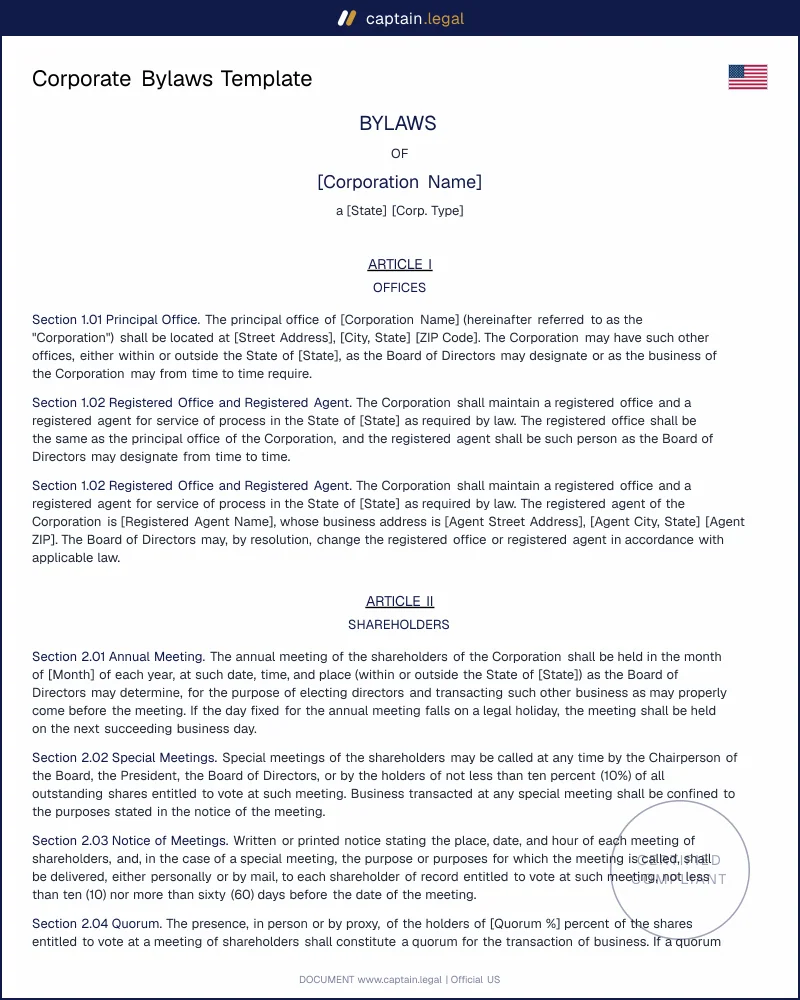
- The identification of the corporation opens the document with the exact name on file with the Secretary of State, the state of incorporation, the principal office, and the registered agent. Mismatches between the bylaws and the articles of incorporation are the most common diligence finding in M&A red flag reports ; we pull the corporate name and state directly from your inputs to keep the two in sync.
- The shareholders' meetings clause sets the date of the annual meeting, the rules for special meetings, the notice period (typically ten to sixty days under most state statutes including § 222 DGCL), and the quorum threshold, usually a majority of voting shares. We also include written-consent provisions, which let closely held corporations act without a physical meeting when permitted by § 228 DGCL or its state equivalent.
- The board of directors clause fixes the size of the board, the term of office, the procedure for filling vacancies, and the rules for removal. Most corporations elect to allow board action by unanimous written consent, which is the operational backbone of a small startup whose directors are scattered across time zones. We also include the fiduciary duty recital that anchors directors to their duty of care and duty of loyalty.
- The officers clause lists the required positions (president or chief executive officer, secretary, treasurer or chief financial officer) and any optional ones the corporation wants in place. Each officer's authority to bind the corporation, sign checks, or execute contracts is spelled out explicitly, which banks rely on when issuing signature cards.
- The indemnification and insurance clause is the provision that founders most often regret leaving thin. We draft it to the maximum extent permitted under state law, including advancement of expenses pending litigation outcome, because D&O insurance underwriters expect that language as a baseline.
- The amendment clause specifies the vote required to change the bylaws and whether the power rests with the board, the shareholders, or both, defaulting to the dual structure recognized in § 109 DGCL.
State-specific considerations
Delaware is the default choice for venture-backed corporations and any company contemplating an eventual public offering. The DGCL gives the board broad authority to adopt and amend bylaws under § 109, while reserving residual amendment power to the stockholders once the corporation has issued stock. Delaware courts apply a presumption of validity to adopted bylaws, but they will void any provision that conflicts with the certificate of incorporation or with the DGCL itself, as the Court of Chancery confirmed in Boilermakers Local 154 Retirement Fund v. Chevron Corp. Forum selection bylaws designating the Court of Chancery as the exclusive venue for internal corporate claims are now standard and were upheld by the same court.
California corporations operate under the General Corporation Law at §§ 100 et seq. of the California Corporations Code. The state requires the bylaws to set the number of directors, or to provide a method for fixing it, and to address shareholder inspection rights under § 1601. California also imposes director residency disclosures and unique cumulative voting defaults under § 708 unless the bylaws expressly opt out, which is a frequent oversight in templates downloaded from generic sites.
Texas corporations are governed by the Business Organizations Code, with bylaws addressed primarily at § 21.057. Texas allows substantial flexibility in board structure and committee delegation, but the state expects the bylaws to specify the procedure for shareholder meetings and the conditions under which action by written consent is permitted. Texas also recognizes the for-profit benefit corporation form, which carries additional bylaw requirements around the corporation's stated public benefit.
New York applies the Business Corporation Law (BCL), with bylaw authority at § 601. The state requires explicit treatment of the powers and duties of officers, the manner of election, and the indemnification of directors and officers under BCL § 722. New York is also one of the jurisdictions where shareholder approval of certain bylaw amendments cannot be delegated entirely to the board, a point worth confirming before adopting language drawn from a Delaware-flavored template.
Florida corporations follow Chapter 607 of the Florida Statutes. The state's bylaw provisions, particularly § 607.0206, allow the board to adopt and amend bylaws unless the articles reserve that power exclusively to shareholders. Florida is increasingly common as the state of incorporation for closely held businesses headquartered in the southeast, and its statutory defaults align reasonably well with the MBCA, simplifying conversion if the company later redomesticates to Delaware.
How to fill out this corporate bylaws document
You start by selecting the state of incorporation, since the bylaws will reference the correct statute throughout the document. From there, the form pulls the corporate name, registered office, and registered agent details, which it cross-checks against the format required for your state. The next block of questions covers the board of directors: how many seats, whether the size is fixed or a range, and whether the board may act by unanimous written consent. We default to ranges of three to seven for venture-backed corporations and a fixed size for closely held entities, but you can override either default in a single click.
The officer block asks you to confirm the required positions, choose any optional officers, and identify the initial slate. The shareholder meeting block sets the annual meeting date or window, the notice period within statutory bounds, the quorum threshold, and whether shareholders may act by written consent or remote communication. Finally, the amendment and indemnification blocks ask whether you want the board, the shareholders, or both to hold amendment power, and whether you want indemnification drafted to the maximum extent permitted under your state. The output is a Word file you can edit and a PDF you can sign, both ready to drop into the minute book and to share with your bank or your investors. If you are setting up the company end-to-end, generate the bylaws in parallel with the articles and consider an early LLC operating agreement template if you are still choosing between a corporation and a limited liability company.
Common mistakes to avoid
The first mistake is never adopting the bylaws formally. Founders sometimes draft a document, save it to a Google Drive, and consider the matter closed. State law and most banks expect adoption by signed resolution at the organizational meeting, with the executed copy in the minute book. A bylaw that exists only as a draft has no governance weight, and a director who acts on it is acting on a void resolution. The second mistake is inconsistency with the articles of incorporation. If the charter authorizes a five-member board and the bylaws set a three-member board, every action taken by the smaller body is open to challenge. The two documents must be reconciled at adoption and at every amendment.
A third recurring problem is stale notice and quorum provisions that no longer match how the company actually operates. A startup with five investors scattered across three continents cannot run on a ten-day mailed notice rule designed for a 1985 manufacturing corporation ; remote-meeting and electronic-notice provisions need to be drafted in deliberately, not assumed. Fourth, founders frequently underestimate the indemnification clause. Leaving it at the statutory minimum, or worse, omitting advancement of expenses, makes the D&O insurance line item more expensive and exposes directors personally during litigation. Finally, watch out for template drift across rounds: each financing should trigger a review of the bylaws, not just the charter and the stock purchase agreement, because the protective provisions investors negotiate often need to be mirrored at the bylaw level to be enforceable in practice.
Frequently Asked Questions
30 verified reviews · 50 000+ downloads
- Immediate access to the document
- PDF + Word download
- Compliant with 2026 legislation
- Reviewed by lawyers
You might also like