Filing Articles of Incorporation is the moment a business stops being an idea and becomes a legal person. The document creates a for-profit corporation under state law, separates the founders' personal assets from the company's liabilities, and triggers federal tax recognition once the IRS receives Form SS-4 and an EIN is issued. Every U.S. state requires this filing before a corporation can issue stock, open a corporate bank account, sign commercial leases, or hire its first W-2 employee.
The articles are short by design. They are not a business plan, not a shareholders' agreement, and not bylaws. They are the public charter filed with the Secretary of State (or Department of State in New York) and the only document that legally brings the entity into existence. Captain.Legal generates a state-tailored draft you can sign, mail or e-file, and use to open your EIN application the same week.
Compliant
2026 Legislation
50,000+ clients
trust us
Affordable
From $4.90 / doc
Secure payment
Instant download
Articles of Incorporation Template — Word & PDF
Secure payment
What is a corporate articles of incorporation document?
The Articles of Incorporation, also called the Certificate of Incorporation in New York and Delaware or the Certificate of Formation in Texas, are the founding charter of a stock corporation. The document is filed with the state's business registry and, once stamped, becomes the corporation's birth certificate. Every C-corp and S-corp in the United States starts here. So does every nonprofit corporation, though the statutory references and required clauses differ from those used for a for-profit entity.
The articles must be carefully distinguished from three documents people often confuse with them. The bylaws are an internal governance document, never filed with the state, that fixes how meetings are called, how directors are elected, and how officers are removed. The shareholders' agreement is a private contract between owners that addresses transfer restrictions, drag-along rights, and exit mechanics. The operating agreement is for limited liability companies and has no equivalent in a corporation. Captain.Legal hosts each of these as separate templates inside the same family of business document templates, and most founders end up needing two or three of them in the first ninety days. The articles come first because nothing else has legal effect until the corporation exists.
A second misconception worth correcting: filing the articles does not, by itself, create an S-corporation. The S-corp is a federal tax election made on IRS Form 2553 after the entity exists. The state knows nothing about whether the company is taxed as a C-corp or S-corp; it only knows the corporation has been formed.
Legal framework
Corporate formation is a state matter. There is no federal incorporation statute. Each state operates its own corporations code, and a founder must file under the law of the state where the corporation is organized, even if the business will operate elsewhere. The legal architecture is remarkably consistent across states because almost every modern statute was drawn from the Model Business Corporation Act drafted by the American Bar Association. The Model Act has been adopted, in some form, by more than thirty jurisdictions, which is why the Texas Certificate of Formation, the Florida Articles of Incorporation and the New York Certificate of Incorporation share a near-identical core.
The mandatory contents of the document are fixed by statute and rarely deferred to the founders' creativity. §200 of the California Corporations Code and §202 require the corporate name, the purpose statement, the agent for service of process, the authorized share count and the signature of each incorporator. §402 of the New York Business Corporation Law mirrors this list and adds a designation of the Secretary of State as agent. §607.0202 of the Florida Business Corporation Act uses the same skeleton with a Florida-specific registered office requirement. §3.005 and §3.007 of the Texas Business Organizations Code impose substantially identical content for the Texas Certificate of Formation. The drafting freedom comes in the optional clauses, particularly the limitation of director liability authorized by BCL §402(b) in New York and Cal. Corp. Code §204(a)(10) in California. Founders who skip these optional clauses give up valuable protection at no cost.
Recent regulatory layers sit on top of the state filing. The federal Corporate Transparency Act, enforced by FinCEN, requires most newly formed corporations to file a Beneficial Ownership Information report shortly after incorporation. The Cornell Legal Information Institute maintains a reference summary of state corporation formation rules and the Model Business Corporation Act that tracks the statutory citations used in every U.S. jurisdiction. Filing the articles without preparing the BOI report and the EIN application is the single most common mistake made by first-time incorporators.
When do you need this document?
The most common trigger is the first external commitment a founding team is about to make. The day a co-founder is brought in with an equity promise, the day a serious lease is signed, the day a SAFE or convertible note lands in the inbox: each of these is a signal that the corporation must already exist on paper, because none of these documents can be properly executed by an unincorporated group. Investors do not write checks to a person; they wire to a Delaware or California C-corp with a stamped charter. Landlords increasingly refuse to sign leases naming individuals when the tenant is supposed to be a business.
Hiring is the second classic trigger. Once a founding team plans to issue W-2 paychecks, the IRS expects an EIN, and the EIN expects an entity. Issuing 1099s as a sole proprietor is fine until the moment a contractor needs to be re-classified as an employee, at which point the corporation should already be in place. The third scenario covers founders converting an existing partnership or sole proprietorship into a corporation to limit liability before a product launch; in that case the partnership agreement template is dissolved or assigned, and the articles become the new governing charter.
Two edge cases deserve a flag. Founders preparing to raise on a Reg D 506(b) round will need a Delaware C-corp before the first investor signs, even if the team lives in California, because most institutional investors refuse to sign anything else. And nonprofit founders need a parallel document, the nonprofit articles of incorporation, that includes specific §501(c)(3) language without which the IRS will deny tax-exempt status, no matter how charitable the mission.
Key clauses included in our template
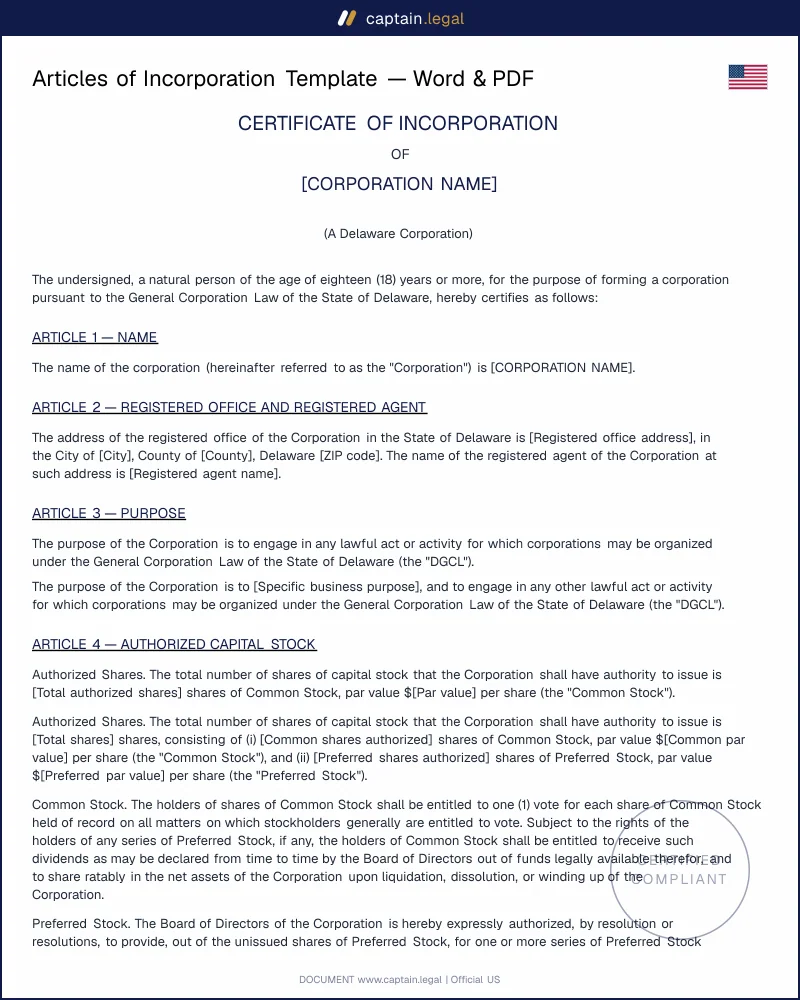
- The corporate name must satisfy state distinguishability rules and include a corporate designator. Cal. Corp. Code §202 and NY BCL §301 require the name to end in Corporation, Incorporated, Limited or an approved abbreviation. The template runs an availability check against the relevant Secretary of State database before the document is finalized, which avoids the rejection letter that costs every founder a week of delay.
- The purpose clause is drafted to the broad statutory language permitted by every modern code: "to engage in any lawful act or activity for which a corporation may be organized". Narrow purpose statements survived in older filings but no longer offer any benefit, and they create unnecessary amendment costs the first time the business pivots.
- The authorized shares clause sets the ceiling on how much equity the corporation can ever issue. The template uses a 10,000,000-share authorization with a $0.0001 par value, which is the working standard for venture-backed startups and has been validated by every major Silicon Valley firm. Founders building a small family corporation can drop the count without affecting validity.
- The registered agent designation names the person or service authorized to receive lawsuits and official notices on behalf of the corporation. The agent must have a physical address in the state of incorporation. Fla. Stat. §607.0501 requires a written acceptance from the agent, attached or filed concurrently with the articles, and Florida rejects filings that omit it.
- The director liability limitation invokes the protective provision authorized by NY BCL §402(b), Cal. Corp. Code §204(a)(10) and equivalent provisions elsewhere. The clause shields directors from personal damages in monetary suits, except in cases of bad faith, intentional misconduct, or self-dealing. Skipping it leaves directors exposed for ordinary business judgment errors.
- The incorporator block lists the natural person or persons who sign and submit the document. The incorporator's role ends the moment the first board meeting is held, but the signature must be valid at filing or the Secretary of State will reject the document outright. Captain.Legal complements the articles with the employment contract templates and shareholder documents you will need at that first board meeting.
State-specific considerations
California is one of the more demanding jurisdictions for a first incorporation. The state requires Form ARTS-GS for general stock corporations and charges a $100 filing fee plus a $15 counter drop-off fee if the document is delivered in person. §200 of the California Corporations Code fixes the minimum content, and §1502 requires a Statement of Information (Form SI-550) to be filed within 90 days of the original articles, with a $25 fee. The most painful surprise for new founders is the $800 minimum franchise tax imposed by the California Revenue and Taxation Code §23153, owed to the Franchise Tax Board every year regardless of revenue. This minimum tax applies even in year one, with very narrow first-year exemptions, and ignoring it triggers FTB suspension of the corporation's powers within a few quarters.
Texas does not file Articles of Incorporation. It files a Certificate of Formation under §3.005 and §3.007 of the Texas Business Organizations Code, using the Secretary of State Form 201 for for-profit corporations. The state filing fee is $300, the highest among the four. Texas requires the certificate to state the aggregate number of shares and the par value (or absence of par value) under §3.007(a)(2), and to name the initial directors when the corporation is to be managed by a board. Texas also imposes a franchise tax administered by the Comptroller, with a no-tax-due threshold updated annually.
Florida is among the cheapest states to incorporate in. The Department of State, Division of Corporations charges $35 for the articles plus $35 for the registered agent designation, with a small surcharge for an electronic certificate of status. Fla. Stat. §607.0202 fixes the mandatory clauses, and §607.0501(3) requires the registered agent's written acceptance to be filed with the articles. Florida is one of the few states that demands the registered office street address match the registered agent's address; the SunBiz portal rejects mismatches automatically.
New York uses the Certificate of Incorporation under §402 of the Business Corporation Law, filed with the NYS Department of State, Division of Corporations in Albany. The filing fee is $125, and the document must designate the Secretary of State as agent for service of process under §402(a)(7). The most overlooked obligation is the Biennial Statement, owed every two years from the date of filing. Unlike LLCs, New York corporations are not subject to the publication requirement, which spares founders the four-figure newspaper fees that LLC owners face.
How to fill out this articles of incorporation document
You start by selecting the state where the corporation will be formed. From there the questionnaire adjusts to the local statute: California prompts for the ARTS-GS purpose statement, Texas asks for the par value and director count under §3.007, Florida requests the registered agent's written acceptance, and New York routes the document toward the Department of State designation under §402(a)(7). The corporate name is checked in real time against the chosen state's business registry, and a placeholder is used if you want to file a name reservation separately.
You then enter the principal office address, the registered agent details, and the authorized share structure. The template defaults to the venture-standard 10,000,000 common shares at $0.0001 par value, with a single voting class, but the form lets you switch to a multi-class structure or a no-par-value setup with one click. The next screen handles the incorporator's identity, the optional director slate, and the §402(b) or §204(a)(10) director liability limitation. A short review screen surfaces every state-specific addendum required for the chosen jurisdiction, including the Florida written acceptance and the Texas par-value disclosure. The output is delivered in Word and PDF, fully signable, ready to mail or e-file with the relevant Secretary of State portal.
Common mistakes to avoid
The first and most expensive mistake is filing in the wrong state. Founders who incorporate in their home state to save a few dollars and then try to raise venture capital are routinely asked to redomesticate to Delaware before the term sheet is signed, which costs more than the original filing would have. The second mistake is the purpose clause that is too narrow: a New York corporation organized "to operate a coffee shop" cannot legally launch a SaaS product two years later without amending the certificate, which is a $60 filing and several days of paperwork. The third recurring error is the omission of the director liability limitation, which leaves directors personally exposed for honest business judgment errors that the statute would otherwise shield.
Two further mistakes happen at the registered agent step. Founders sometimes name themselves as agent and use a residential address; the address becomes part of the public record forever, and any future move requires a paid amendment. Others list a P.O. Box, which Florida and California reject because the statute requires a physical street address. Always use a commercial registered agent service when the corporation is venture-track, and be sure the agent has signed the written acceptance Florida demands under §607.0501(3). A final error worth flagging: filing the articles before reserving the EIN. The IRS will issue an EIN to a corporation that legally exists, but most founders forget that the Beneficial Ownership Information report under the Corporate Transparency Act is now due shortly after formation, and missing the deadline carries daily federal penalties. Captain.Legal stores the executed articles alongside the rest of your personal legal documents so they remain available the day a bank, an investor or the IRS asks for them.
Frequently Asked Questions
106 verified reviews · 50 000+ downloads
- Immediate access to the document
- PDF + Word download
- Compliant with 2026 legislation
- Reviewed by lawyers
You might also like