A quit claim deed is the fastest way to move whatever ownership interest you hold in a piece of real estate to someone else, without promising that the title is clean. It is the deed of choice when trust already exists between the parties : a divorcing spouse releasing the family home, a parent adding an adult child to title, an heir clearing a sibling's name out of an estate, a settlor moving property into a revocable living trust. It does not sell the property in the open market and it does not protect the recipient against unknown liens, easements, or rival claims. What it does, very efficiently, is end the grantor's stake in the property and document the transfer in the public record.
This template is drafted to the statutory wording each US state expects on a recordable deed and adjusts automatically based on where the property sits. You complete it in a few minutes, sign before a notary, and bring it to the county recorder.
Compliant
2026 Legislation
50,000+ clients
trust us
Affordable
From $4.90 / doc
Secure payment
Instant download
Quit Claim Deed Template - PDF & Word
Secure payment
What is a quit claim deed?
A quit claim deed is a legal instrument by which a grantor releases to a grantee whatever right, title, or interest they hold in a specific parcel of real property, with no warranty of title of any kind. The Cornell Legal Information Institute summarizes the doctrine in one sentence : the grantor conveys a present interest, if any, without representing, covenanting, or warranting that the title is good. Nevada's administrative code puts it almost identically at NAC §375.100, defining the instrument as a deed operating by way of release. The grantor is not lying about owning the property ; the grantor is simply refusing to make any promise either way.
That distinction is what separates a quit claim deed from a warranty deed and from a grant deed. A warranty deed bundles the full chain of title covenants, the covenant of seisin, the covenant against encumbrances, the covenant of warranty, and gives the buyer the right to sue the seller if a defect surfaces years later. A grant deed sits in the middle, used heavily in California, with only two implied covenants. A quit claim conveys whatever the grantor has, which can be everything, a fractional share, or in rare cases nothing at all. If the grantor never actually owned the property, the grantee receives nothing, and there is no recourse on the deed itself. That is precisely why this instrument circulates almost exclusively between people who already know what they are getting.
Legal framework
Real property transfers in the United States are governed primarily by state law, with each jurisdiction setting its own statutory form, recording requirements, and tax treatment. The Statute of Frauds, codified in every state, requires that any conveyance of an interest in land be in writing and signed by the grantor. Beyond that baseline, the rules diverge sharply. California's Civil Code §1092 recognizes the quit claim form expressly ; Texas relies on the conveyance language in Property Code §5.022 and accepts a quit claim that uses the words quitclaim or release ; New York treats the instrument under Real Property Law §258 and provides a statutory short-form template in Schedule M. Pennsylvania, in 61 Pa. Code §91.164, confirms that a quit claim deed is taxable on the same basis as any other deed when an actual conveyance occurs, which matters at the recording office.
Three formal conditions are nearly universal. The deed must identify the parties and the property with enough precision to leave no doubt about what is being transferred, which in practice means a full legal description, not just a street address. The grantor must sign before a notary public, and most states require an explicit acknowledgment of identity and free will under threat of perjury. Finally, the deed must be recorded with the county recorder's office where the property is located, almost always within a defined window after execution. Recording is what gives the transfer priority against later claims under each state's race, notice, or race-notice statute. An unrecorded quit claim is valid between grantor and grantee, but a third party who later records first can defeat it.
You can read the full doctrinal entry in the Cornell Legal Information Institute summary of quitclaim deeds and the Spreckels v. Brown line of authority. Recording fees, transfer taxes, and form requirements vary by county ; some jurisdictions exempt intra-family transfers and trust funding from the real estate transfer tax, others do not. Washington's WAC §458-61A-215 is a good example of the kind of narrow exemption that applies to deeds clearing or exiting title between co-signing relatives.
When do you need this document?
The most common scenario is divorce. When a marital settlement awards the family home to one spouse, the court order divides the equity, but it does not, by itself, remove the other spouse from title. A quit claim deed signed by the exiting spouse is the document that actually closes the public record and lets the awarded spouse refinance, sell, or eventually pass the property to heirs. Most family law judgments give a strict deadline for delivery of the executed deed, often 30 to 60 days after judgment, and missing it can trigger a contempt motion.
The next most frequent use is adding or removing a family member from title. Parents add an adult child for estate-planning reasons, siblings consolidate inherited property into a single name to simplify a sale, an unmarried partner is removed from title after a separation. Each of these transfers is essentially a release, with no money changing hands, which is exactly what the quit claim form was designed to handle. Funding a revocable living trust follows the same logic : the settlor signs a quit claim from themselves as individual to themselves as trustee, and the property formally enters the trust corpus. Without that deed, the trust holds nothing real, no matter what the trust instrument says.
A handful of edge cases legitimately call for a quit claim. Clearing a cloud on title, an old recorded interest from a long-dead claimant, an unreleased lien from a paid-off lender, an heir who never disclaimed, is often handled with a quit claim from the apparent claimant in exchange for a small consideration. Correcting a typographical error in a previously recorded deed, what title professionals call a correction deed or deed of confirmation, also takes the quit claim form in most states. Never use a quit claim deed for an arm's-length sale to a stranger ; the buyer needs the warranty protection, and lenders will refuse to finance a purchase backed by a bare release.
Key clauses included in our template
- The identification of the parties lists the grantor and grantee in full legal name, with current marital status when relevant. Marital status matters because spousal homestead rights survive a deed signed by only one spouse in many states, and a quit claim that fails to address the homestead can be set aside years later. We capture this on the form so the recorder accepts the deed on first submission.
- The legal description of the property reproduces the description from the most recent recorded deed, with lot, block, subdivision, plat reference, and parcel identification number where applicable. Street addresses alone are rejected by most county recorders, and a description that fails to match the parcel of record creates a gap in the chain of title that title insurers will flag for years.
- The granting clause uses the precise statutory verbs your state requires, remise, release, and forever quitclaim in California, Texas, and New York, convey and quitclaim in others. Substituting a different verb risks a finding that the deed conveys more than intended, which in turn revives implied warranties that the grantor never agreed to.
- The statement of consideration records the value given for the transfer, which can be a nominal one dollar and other valuable consideration in family transfers, the equity awarded in a divorce decree, or zero where state law and local recording practice allow it. Some counties require a separate real estate transfer tax declaration affirming the consideration figure.
- The execution and notarial acknowledgment block matches the form prescribed by the state where the property sits, not where the grantor signs. A California acknowledgment used on a Florida deed will be returned by the Florida recorder. Our template generates the correct acknowledgment language and the correct jurat automatically.
- The return-to and recording information identifies who receives the recorded original after the county processes it, and who pays property tax going forward. Missing this block delays recording by weeks in busy counties.
State-specific considerations
California. Quit claim deeds in California are governed by Civil Code §1092, which sets out the operative language, and by Government Code §27201 on recording. The state also imposes a documentary transfer tax under Revenue and Taxation Code §11911, generally $1.10 per $1,000 of consideration, with a statutory exemption for transfers between spouses incident to dissolution of marriage and for transfers without consideration, such as gifts and trust funding. The Preliminary Change of Ownership Report must accompany the deed at recording. Counties enforce a strict PCOR requirement : a missing form means the deed is recorded but the county assessor charges a penalty.
Texas. Texas recognizes the quit claim under Property Code §5.022, but Texas case law has long treated the instrument as conveying only what the grantor owns at the moment of signing, never any after-acquired title. Diversified, Inc. v. Hall and its progeny hold that a quit claim grantee is not a bona fide purchaser and cannot rely on the protection of the recording statutes against earlier unrecorded interests. For that reason, Texas title companies routinely refuse to insure a chain of title that depends on a quit claim deed unless the grantor's interest can be independently confirmed.
Florida. Florida real property is governed by Chapter 689 of the Florida Statutes, with the quit claim form recognized at §689.02. Two witnesses are required in addition to the notary, a peculiarity that catches many out-of-state grantors by surprise. The Florida documentary stamp tax under §201.02 applies to deeds with consideration, but transfers between spouses, transfers under a divorce decree, and gift transfers without mortgage assumption are generally exempt. Homestead protections under Article X, §4 of the Florida Constitution require both spouses to sign any deed conveying homestead property, even if title is held in only one name.
New York. New York provides a statutory short form at Real Property Law §258, Schedule M, that recorders prefer over custom drafting. The state imposes a real estate transfer tax under Article 31 of the Tax Law, with the TP-584 form filed at recording, and New York City adds the Real Property Transfer Tax on top. Transfers without consideration, including most quit claims between family members, are exempt from the state tax but the TP-584 still must be filed. Recording happens in the county clerk's office, except in New York City, where the City Register handles the four downstate counties.
How to fill out this quit claim deed
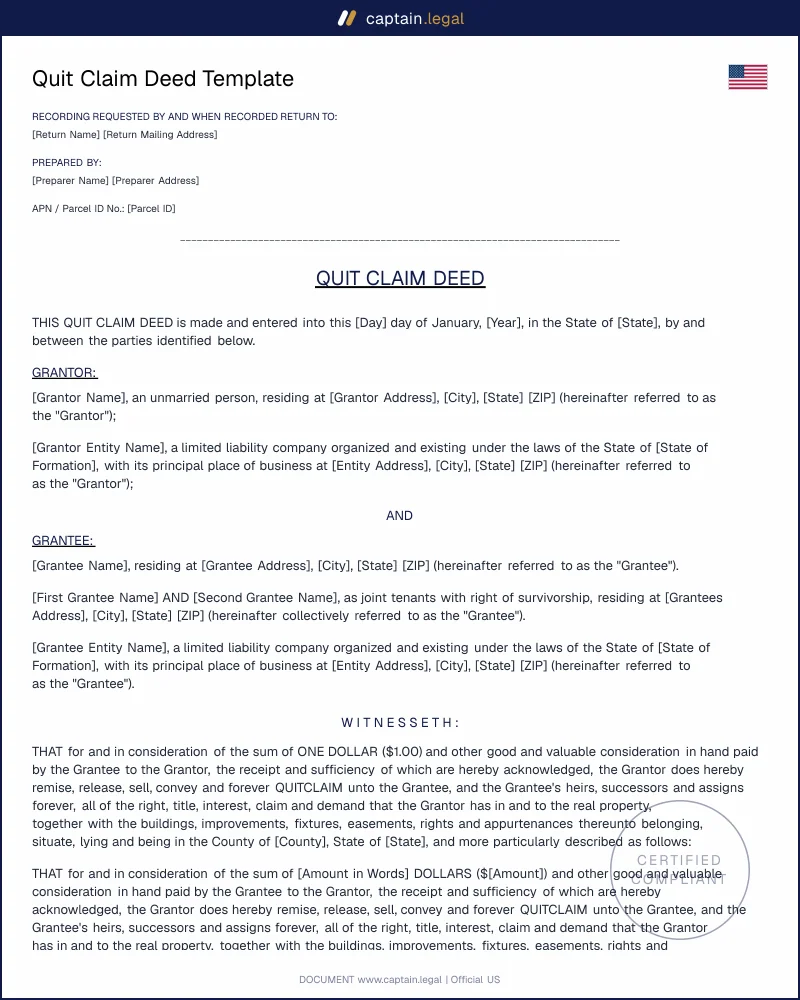
You begin by selecting the state where the property is located, which is what determines every downstream choice on the form. From there, the workflow asks for the grantor's full legal name and current marital status, the grantee's full legal name and the precise way the grantee wants title to read, as joint tenants with right of survivorship, as tenants in common, as community property, or as trustee of the [name] revocable living trust dated [date]. Getting the vesting language right at this stage prevents a future deed of correction.
Next you enter the legal description, which we recommend pulling directly from your most recent recorded deed and pasting verbatim. The form accepts both metes-and-bounds descriptions and platted descriptions and inserts the appropriate parcel identification field for your state. Consideration follows : a dollar amount when one is paid, one dollar and other valuable consideration for family transfers, or the language your court order specifies for divorce-related deeds. The system then generates the granting clause, the statement of consideration, the execution block, and the notary acknowledgment that matches the recording state, not the signing state. You download the deed in PDF and Word formats and bring it to a notary. After signature, the original goes to the county recorder along with any state-specific cover sheet, transfer tax declaration, and recording fee. The recorder returns the original deed to the address you indicated in the return-to block, typically within four to eight weeks.
Common mistakes to avoid
The single most damaging mistake is using a street address instead of the legal description. Recorders in most counties reject the deed outright, but in counties that accept it, the deed is recorded against an unidentified parcel and creates a permanent cloud on title that surfaces decades later, usually at the worst possible moment. Always copy the legal description from a recent recorded instrument, never from the property tax bill, which often abbreviates. The second recurring error is a mismatched grantor name. The deed must show the grantor exactly as that person took title on the prior deed, with any subsequent name change, marriage, divorce, or trust appointment, addressed in a recital. John Smith on the prior deed and Jonathan A. Smith on the new one will be flagged as a different person.
Notarization errors come next. A deed notarized in one state for property in another must use the acknowledgment form of the recording state, and the notary's commission must be in good standing on the date of signing. A defective acknowledgment is the most common reason a recorder rejects a deed at intake, and reissuing the document means another notary appointment, another fee, and a delay that can derail a closing or a divorce timeline. Forgetting to record is the silent fourth mistake : a quit claim deed valid between the parties does nothing against later purchasers or creditors until it appears in the public record. Finally, treating the deed as a substitute for an estate plan is a category error. A quit claim moves an interest now, but it does not avoid probate by itself, it does not name a successor, and once signed it cannot be undone without a new deed signed by the new owner. The right place for transfer-on-death planning is a revocable living trust or a recorded transfer-on-death deed, not a quit claim signed and held in a drawer.
Frequently Asked Questions
119 verified reviews · 50 000+ downloads
- Immediate access to the document
- PDF + Word download
- Compliant with 2026 legislation
- Reviewed by lawyers
You might also like