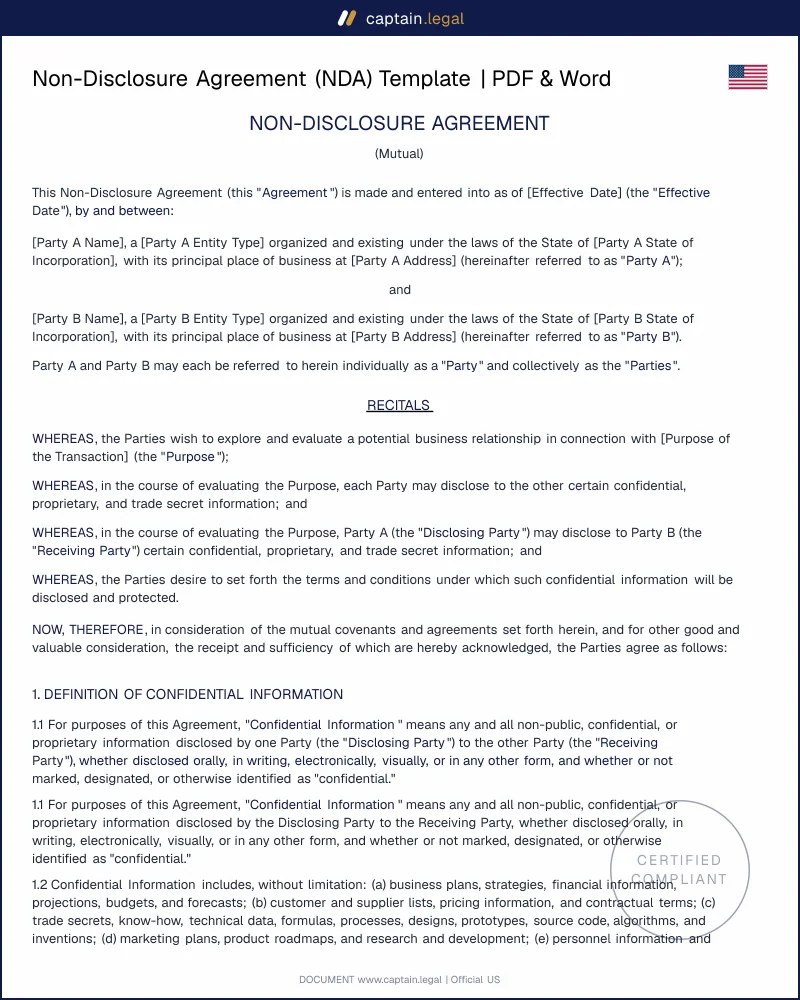
A Non-Disclosure Agreement is the contractual backbone every US company relies on the moment confidential information leaves the perimeter of its own systems. Recruiters share salary bands with finalists, founders pitch product roadmaps to investors, supply-chain teams hand specifications to manufacturers : each exchange is a controlled disclosure that needs paper before the conversation starts. This template generates a state-correct NDA in Word and PDF, with the Defend Trade Secrets Act whistleblower notice embedded, the SEC Rule 21F-17 carve-out drafted in, and the Speak Out Act compliance language included for any agreement reaching natural-person signatories. The output is built to survive the two scenarios that matter, an injunction hearing in Delaware Chancery and a motion to dismiss in the Southern District of New York.
Compliant
2026 Legislation
50,000+ clients
trust us
Affordable
From $4.90 / doc
Secure payment
Instant download
Non-Disclosure Agreement (NDA) Template | PDF & Word Download
Secure payment
What is a non-disclosure agreement?
A non-disclosure agreement, also called a confidentiality agreement or NDA, is a contract under which one or more parties commit to receive defined information solely for a stated purpose, hold it in confidence for a stated term, and accept specified remedies for unauthorized disclosure. The agreement comes in three structures : unilateral (typical in investor and recruiting contexts), mutual (both parties exchange confidential information, standard in M&A diligence), and multilateral (three or more parties, common in joint ventures).
The NDA does not stand alone. It sits at the front of the commercial documents a company signs with the same counterparty, term sheets, master services agreements, offer letters. Where a downstream contract follows, the NDA is superseded or cross-referenced. Where no further contract follows, the NDA is the only enforceable instrument protecting what was disclosed. Standalone NDAs go to litigation more often than any other commercial contract, precisely because they govern failed deals.
Legal framework
Confidentiality law in the United States rests on three layers. The first is state common law on contract enforcement, which makes any properly formed NDA enforceable under standard offer, acceptance, and consideration principles. The second is the Uniform Trade Secrets Act, adopted in 49 jurisdictions excluding New York. New York applies the older Restatement (First) of Torts §757 standard ; Texas codifies the UTSA at Tex. Civ. Prac. & Rem. Code §134A and California at Cal. Civ. Code §3426 et seq.
The third and most consequential layer is the federal Defend Trade Secrets Act of 2016 (18 U.S.C. §1836 et seq.). The DTSA allows the trade-secret owner to seek exemplary damages up to twice actual damages and attorney fees for willful misappropriation under §1836(b)(3), and it imposes a mandatory whistleblower-immunity notice under 18 U.S.C. §1833(b)(3) in every agreement governing confidential information signed with an employee, contractor, or consultant ; absence of the notice forfeits those remedies. The full statutory text appears on the Cornell Legal Information Institute page on 18 U.S.C. §1833, the cleanest source for the exact required wording.
Two recent federal interventions reshape NDA drafting. The Speak Out Act (Pub. L. 117-224, signed December 7, 2022) renders pre-dispute NDA and non-disparagement clauses unenforceable as applied to sexual harassment and assault claims. SEC Rule 21F-17 under Dodd-Frank, reinforced by the SEC's 2022 Brink's Company consent order and $400,000 civil penalty, requires a carve-out preserving the right to communicate with the SEC. The FTC's 2024 Non-Compete Clause Rule is no longer in force : the Northern District of Texas vacated it in Ryan, LLC v. FTC (Aug. 20, 2024), and the FTC withdrew its appeal on September 5, 2025. NDAs are not non-competes, but the line is policed in California and Minnesota, and the broader catalog of US business document templates routes overbroad clauses to a separate non-compete instrument where local law requires.
When do you need this document?
The trigger is the moment a party is about to share information that has commercial value precisely because it is not generally known. Five fact patterns dominate. The investor pitch comes first : founders disclose financial models, customer lists, and product roadmaps, and the NDA must be on file before the data room opens. The M&A and due-diligence track follows, where a mutual NDA precedes the letter of intent and survives a failed transaction by 2 to 5 years. Vendor engagement is the third. The fourth is the employment and consulting context, where the DTSA whistleblower notice is non-negotiable. The fifth is the strategic partnership or joint venture, where parties exchange roadmap information before signing a definitive agreement. The single worst time to negotiate an NDA is after the disclosure has happened, because the receiving party has no incentive to give back the leverage of free information.
Key clauses included in our template
The template tracks the structure used in venture, technology, and corporate practice at major US firms, with smart fields that adapt scope, term, and remedies to the transaction type and the governing law selected.
- The definition of Confidential Information uses the broad-with-carve-outs model preferred by sophisticated counterparties, with carve-outs for material already public, independently developed, lawfully received from a third party without a duty of confidence, or required by court order. The residuals clause is offered as an opt-in for technology transactions.
- The Permitted Purpose and Use Restrictions clause limits the receiving party to the business reason on the cover page, prohibits reverse engineering except where state law preserves the right (notably Cal. Civ. Code §3426.1(a)), and requires the same degree of care the receiver applies to its own confidential information of similar importance.
- The Term and Survival provisions split the obligation : confidentiality runs 3 to 5 years from disclosure for general information, while obligations applicable to trade secrets survive for as long as the information qualifies as one. Trade-secret obligations cannot lawfully be cut off by a fixed term in most jurisdictions.
- The DTSA Whistleblower Notice, the SEC Rule 21F-17 Carve-Out, and the Speak Out Act compliance carve-out appear in dedicated paragraphs drafted to the statutory wording. Without them the disclosing party loses exemplary damages and attorney fees, the agreement risks SEC enforcement, and pre-dispute terms are unenforceable against any sexual harassment claim.
- The Equitable Relief, Governing Law, and Dispute Resolution clauses close the agreement. The receiving party acknowledges that monetary damages are inadequate and consents to injunctive relief without bond. Governing law and forum default to Delaware for entity-to-entity NDAs and to the disclosing party's home state for individuals, with the personal legal forms for individual signatories library covering matching consent documents.
State-specific considerations
California is the most idiosyncratic NDA jurisdiction in the country. Bus. & Prof. Code §16600 voids any contract restraining a person from engaging in a lawful profession, and California courts read this prohibition into NDAs operating as de facto non-competes : a 2022 ruling against Google held that an internal NDA forbidding employees from speaking to potential employers crossed that line. The Silenced No More Act (SB 331, codified at Cal. Code Civ. Proc. §§1001-1002) prohibits NDA provisions that prevent disclosure of factual information about workplace harassment, discrimination, or retaliation under FEHA. NDAs limited to trade secrets remain enforceable. The matching US employment law document collection includes the offer-letter templates that pair with a California-compliant NDA.
New York has not adopted the UTSA and applies the older Restatement (First) of Torts §757 trade-secret standard, which gives plaintiffs more flexibility on what qualifies. Gen. Oblig. Law §5-336 restricts confidentiality terms in settlements of discrimination, harassment, and retaliation claims, requiring a 21-day consideration period and a 7-day revocation window. S4516, signed in 2023, voids liquidated-damages provisions in those settlement NDAs. Pre-dispute commercial NDAs remain fully enforceable.
Texas anchors its trade-secret law in the Texas Uniform Trade Secrets Act (Tex. Civ. Prac. & Rem. Code Ch. 134A), with strong injunctive relief and attorney fees for willful misappropriation. The Texas Citizens Participation Act anti-SLAPP statute adds a wrinkle : the agreement should expressly state that confidentiality enforcement is not directed at protected speech on matters of public concern.
Delaware is the chosen forum for most entity-to-entity NDAs even when neither party is incorporated there, because of Court of Chancery expertise on equitable remedies. Delaware will enforce a reasonable choice-of-law clause selecting Delaware law and a forum-selection clause designating the Court of Chancery in Wilmington. HR-driven matters where confidentiality enforcement intersects with disciplinary process pair this template with the employee warning letter template and related documents.
How to fill out this non-disclosure agreement
You start by selecting the agreement type, unilateral, mutual, or multilateral, which sets the disclosure-direction language and whether term and remedy clauses are reciprocal. The next step identifies the parties by exact legal name, jurisdiction of formation, and signatory authority, with separate flows for natural persons, LLCs, corporations, and partnerships. Entity NDAs require the signatory's title and a representation of authority ; individual NDAs trigger the DTSA whistleblower notice automatically.
You then define the Permitted Purpose in plain language, narrowly enough that the receiving party's permissible activities are unambiguous on day one. The form sets the confidentiality term (3 to 5 years for general information), preserves an indefinite obligation for trade secrets, and adds the return-or-destruction language at termination. Final steps select governing law and forum, with Delaware as the entity default and the disclosing party's home state for individuals, both overridable. The agreement exports as an editable Word file and a PDF with every federal compliance clause already embedded. Sign before disclosure, never after : a post-disclosure NDA reads to most courts as evidence of bad-faith bargaining rather than as protection.
Common mistakes to avoid
The first and most common drafting failure is omitting the DTSA whistleblower-immunity notice required by 18 U.S.C. §1833(b)(3). The penalty is silent but severe : the disclosing party retains all contract remedies but loses the exemplary damages and attorney fees that make a misappropriation suit economically viable. The SEC Rule 21F-17 carve-out is the close cousin, and its absence triggered the 2022 Brink's consent order with a $400,000 civil penalty.
The second failure is overbroad confidentiality language that crosses into restraint-of-trade territory. California will void the offending provision and frequently the entire NDA where the clause cannot be severed cleanly. Other jurisdictions tolerate broader scope but apply a reasonableness review, with Delaware and New York courts increasingly willing to blue-pencil. The third failure is a confidentiality term shorter than the trade secret's commercial life ; capping all obligations at 3 years means trade-secret protection lapses by contract long before it would lapse by law. The fourth is the missing Speak Out Act carve-out, which renders the NDA partially unenforceable against any sexual harassment claim.
Frequently Asked Questions
126 verified reviews · 50 000+ downloads
- Immediate access to the document
- PDF + Word download
- Compliant with 2026 legislation
- Reviewed by lawyers
You might also like