An eviction notice is the formal written demand a landlord serves on a tenant to leave the rental unit, either to cure a specific breach or to vacate outright. It is the mandatory first step of every lawful eviction in the United States : no court will hear an unlawful detainer action without proof that a valid notice was properly served first. The document goes by several names depending on the ground for termination, including 3-day pay-or-quit notice, cure-or-quit notice, unconditional quit notice, and 30-day or 60-day notice to vacate for month-to-month tenancies. Landlords, property managers, and small portfolio owners use it across all fifty states, and the form must track the exact statutory language of the state where the property sits.
This template is built for residential rentals governed by state landlord-tenant statutes. Commercial leases follow different rules and often a different notice structure dictated by the lease itself.
Compliant
2026 Legislation
50,000+ clients
trust us
Affordable
From $4.90 / doc
Secure payment
Instant download
Eviction Notice Template — 3-Day & 30-Day Notice to Quit
Secure payment
What is an eviction notice?
An eviction notice is a written, dated, signed demand by which a landlord starts the legal process to recover possession of a rental property. The document tells the tenant three things : the ground for termination, the time the tenant has to respond, and the consequence of inaction. Without those three elements, the notice is defective and a judge will throw out the subsequent eviction case at the first hearing, forcing the landlord to start the clock again.
The label changes with the ground. A pay-or-quit notice is used when the tenant has fallen behind on rent and gives a short window (often 3 to 14 days depending on the state) to either pay in full or surrender possession. A cure-or-quit notice addresses fixable lease violations such as unauthorized pets, undisclosed roommates, or smoking in a non-smoking unit, and grants a statutory cure period. An unconditional quit notice is reserved for serious misconduct that the law treats as non-curable : repeat lease violations, illegal activity on the premises, or substantial property damage. Finally, a notice to vacate of 30, 60, or 90 days ends a periodic tenancy without alleging fault, subject to just-cause restrictions in jurisdictions that have adopted them.
Practitioners often confuse the eviction notice with the summons and complaint that follows. The notice is purely pre-litigation : it is not filed with the court, it is not served by a process server, and it does not give the landlord any right to remove the tenant or change the locks. Self-help eviction remains illegal in every U.S. state, and a landlord who acts on the notice without a court judgment is exposed to statutory damages.
Legal framework
Eviction in the United States is governed by a stack of overlapping rules : state landlord-tenant statutes, local rent ordinances, the lease itself, federal housing regulations where applicable, and the common law of property. Most states have adopted some version of the Uniform Residential Landlord and Tenant Act (URLTA), which standardizes notice requirements, cure periods, and prohibitions on retaliation, but each state legislature has modified the model in ways that matter at the level of a single notice. The Cornell Legal Information Institute summarizes the doctrine concisely : a landlord must validly provide notice to quit before commencing with a summary process to evict the tenant , and the Cornell LII Wex entry on notice to quit is the standard starting point for cross-state research.
State statutes set the minimum notice period for each ground. California Code of Civil Procedure §1161 requires 3 days to pay or quit, Texas Property Code §24.005 requires 3 days to vacate after a default unless the lease shortens or lengthens it, Florida Statutes §83.56 prescribes 3 days for non-payment and 7 days for other violations, and New York Real Property Actions and Proceedings Law §711 now imposes a 14-day rent demand. These statutory floors cannot be waived in the lease, and any clause shortening them is void as a matter of public policy.
Form requirements are equally rigid. Most states demand the notice be in writing, signed by the landlord or the landlord's authorized agent, dated, and served by personal delivery, substituted service, or posting and mailing in that order. California Code of Civil Procedure §1162 sets out the hierarchy in detail : you cannot post-and-mail simply because it is more convenient.
Federal law adds a layer for subsidized housing. 24 CFR §982.310 governs Section 8 voucher tenancies and requires the owner to give the tenant a written notice that specifies the grounds for termination of tenancy during the term of the lease , and to deliver a copy to the public housing authority. The standard state notice period is rarely sufficient on its own when the tenant is on a Housing Choice Voucher : a landlord using our generic state template should always overlay HUD's separate requirements before serving. Captain.Legal's residential lease agreement template for U.S. landlords is drafted to flag those federal-overlay scenarios at the underwriting stage so that the eviction notice you serve later is consistent with the lease that started the relationship.
When do you need this document?
The most frequent trigger is non-payment of rent once the lease's grace period has expired. A landlord who waits two or three billing cycles to act loses leverage in court because judges read prolonged silence as tacit acceptance of late payment. Serving a pay-or-quit notice the day after the grace period ends preserves the record and forces the tenant to choose between paying and vacating, which often resolves the matter without litigation. The next most common scenario is the no-cause termination of a month-to-month tenancy. A landlord who wants to sell, move in a family member, or substantially renovate the unit serves a 30- or 60-day notice depending on the state and the length of occupancy. Several jurisdictions now restrict this option through just-cause statutes, and California's Tenant Protection Act of 2019 is the textbook example : after twelve months of occupancy, a no-cause termination requires either relocation assistance or a statutorily defined good cause.
Lease violations short of non-payment cover the rest of the spectrum. Unauthorized pets, undisclosed sublets, repeated noise complaints, or use of the unit for unpermitted commercial activity each justify a cure-or-quit notice that gives the tenant a defined window to fix the problem before the relationship ends. The cure period is set by statute and is non-negotiable, even when the lease language tries to shorten it. A landlord who serves a 5-day notice in a state requiring 10 has effectively served nothing, and the tenant's lawyer will move to dismiss at the first hearing.
Two edge cases are worth flagging. Tenants on federal Section 8 assistance trigger additional HUD requirements that override the state template, as discussed above. And landlords with month-to-month tenants who simply want to convert the relationship to a fixed-term lease should not use an eviction notice at all : the cleaner path is to negotiate a renewal using a month-to-month rental agreement template tailored to U.S. periodic tenancies and reserve the eviction notice for genuinely unresolvable situations.
Key clauses included in our template
- The identification of the parties lists every adult tenant in possession, not only the original lease signer. A notice naming "John Doe et al." has been rejected in dozens of California cases because the Tenant Protection Act requires each adult occupant to be named explicitly. Our template prompts you for every name on the lease and adds a free-text field for occupants added later.
- The statement of the ground for termination is drafted to the statutory language of your state. Vague phrasing like "lease violation" is replaced by the specific breach, with citation to the relevant lease clause and, where the state requires it, to the statute itself. Florida §83.56(2) is unforgiving on this point : a generic notice for a non-monetary breach is reversible error.
- The rent ledger and amount due, on a pay-or-quit notice, is itemized line by line for each unpaid month, broken down between base rent, late fees, and lawful add-ons such as utilities billed back to the tenant. Lump-sum demands are a recurring ground for dismissal because they prevent the tenant from tendering a partial cure.
- The deadline for cure or vacate is calculated automatically from the date of service and the state's statutory minimum, which removes the most common drafting error in DIY notices. The deadline expressed as both a number of days and a calendar date neutralizes counting disputes at the hearing.
- The service block records who served the notice, when, where, and by what method (personal, substituted, or post-and-mail), and is signed by the server. This block is the evidentiary foundation of the eviction case and judges scrutinize it more closely than the notice itself.
- The statutory notice of tenant rights is included where the state requires it, including California's relocation-assistance disclosure, Oregon's 90-day no-cause warning, and New Jersey's Anti-Eviction Act citation. Omitting this disclosure makes the notice voidable on its face in the affected jurisdictions.
State-specific considerations
California. Code of Civil Procedure §1161 sets a 3-day notice for non-payment of rent, but the count excludes weekends and judicial holidays under §1161(2), a quirk that trips up out-of-state landlords. The Tenant Protection Act of 2019 (AB 1482) adds a just-cause requirement after twelve months of continuous occupancy, and a no-cause termination after that point requires the landlord to pay one month of rent as relocation assistance. San Francisco, Oakland, Los Angeles, and Berkeley layer additional rent-control rules on top of state law, which means a notice valid under §1161 may still be void under a local ordinance.
Texas. Property Code §24.005 defaults to a 3-day notice to vacate but allows the lease to lengthen or shorten the period by express agreement, a flexibility unique among large states. The notice must be served by personal delivery or by mail to the premises, and posting on the inside of the front door is permitted only when the landlord cannot enter the unit. Texas has no statewide rent control, and the eviction process moves faster here than almost anywhere else : a non-paying tenant can be removed in three to four weeks if the paperwork is clean.
Florida. Statutes §83.56(3) prescribes a 3-day notice for non-payment, excluding Saturdays, Sundays, and legal holidays from the count, while §83.56(2) sets a 7-day cure-or-quit notice for non-monetary breaches. The notice must include the exact statutory boilerplate ; substantial compliance is not enough, and Florida appellate courts routinely reverse evictions where the notice deviates from the form set out in the statute. Hurricane-related rent moratoria occasionally suspend these deadlines and landlords should verify current emergency orders before serving.
New York. RPAPL §711(2) now requires a 14-day rent demand before commencing a non-payment proceeding, a doubling of the older 3-day rule under the Housing Stability and Tenant Protection Act of 2019. New York City adds the Rent Stabilization Code for covered units, and the notice must comply with both layers. Retaliatory eviction is statutorily presumed when adverse action follows a tenant's good-faith complaint, and Real Property Law §233-b gives the tenant a strong defense even when the procedural notice is otherwise valid.
How to fill out this eviction notice
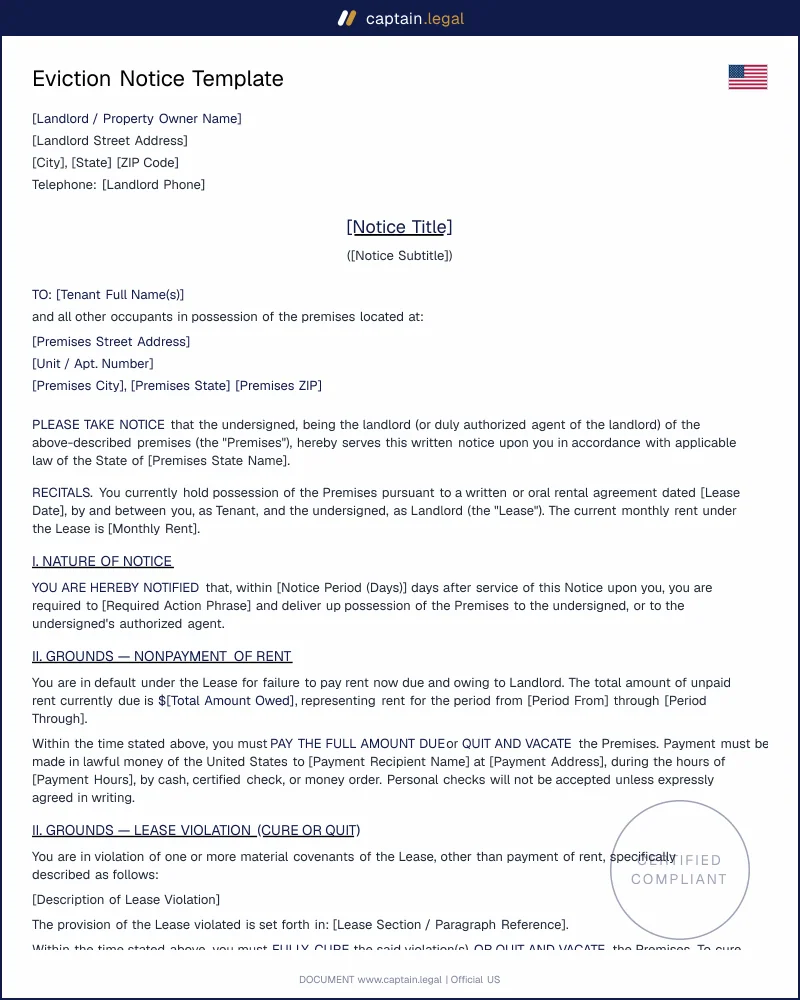
You start by selecting the state where the property is located, which sets the notice period, the form of service, and the statutory citations the document will reference. From there, the form asks for the type of notice, distinguishing between pay-or-quit, cure-or-quit, unconditional quit, and no-cause termination of a periodic tenancy. The branching logic is what separates a template from a generic Word file : selecting cure-or-quit exposes a field for the specific lease clause violated, while selecting pay-or-quit opens a rent ledger that itemizes unpaid amounts month by month.
You then enter the tenant identification, the property address, and the dates of the lease and the breach. The form pre-fills the deadline for cure or vacate based on the state's minimum and the date of service you select, and it generates the statutory disclosure language required in jurisdictions like California, Oregon, and New Jersey. The final step is the service block, where you indicate the method of delivery and the date, signed by you or your authorized agent.
The output is a Word document and a PDF, ready to print, sign, and serve. Once the notice is served, store the signed copy with proof of service alongside the underlying lease and any communications about the breach : that file is your evidence packet if the matter proceeds to court. You can manage all of these documents in the same workspace as the rest of your portfolio inside the Captain.Legal real estate dashboard for U.S. landlords.
Common mistakes to avoid
The single most damaging error is miscalculating the notice period, almost always by counting the day of service in the deadline. Most state statutes exclude the day of service from the count, and several also exclude weekends and judicial holidays. A 3-day notice served on a Friday afternoon in California is not enforceable until the following Wednesday, and a landlord who files an unlawful detainer on Tuesday is dismissed on the first appearance. The second recurring mistake is serving by the wrong method. Personal service is preferred ; substituted service requires a reasonable attempt at personal delivery first ; post-and-mail is the last resort and not a free choice. A notice slipped under the door without an attempt at personal delivery is defective in most jurisdictions, even when the tenant clearly received it.
A third mistake is the lump-sum rent demand that bundles base rent, late fees, utilities, and reimbursements into one figure on a pay-or-quit notice. The tenant has a statutory right to cure by tendering the unpaid rent, and the inability to separate rent from fees prevents the cure and gives the tenant a defense. A fourth mistake is forgetting to name every adult occupant, which leaves the unnamed tenants with possession even if the lead tenant is removed. A fifth, more subtle, is delivering the notice from a property manager who is not formally authorized in writing : courts in several states require the agent's authority to be documented before service, and the same principle applies to disciplinary documents like an employee warning letter for U.S. employers where the signing authority must be clear on the face of the document.
Frequently Asked Questions
60 verified reviews · 50 000+ downloads
- Immediate access to the document
- PDF + Word download
- Compliant with 2026 legislation
- Reviewed by lawyers
You might also like