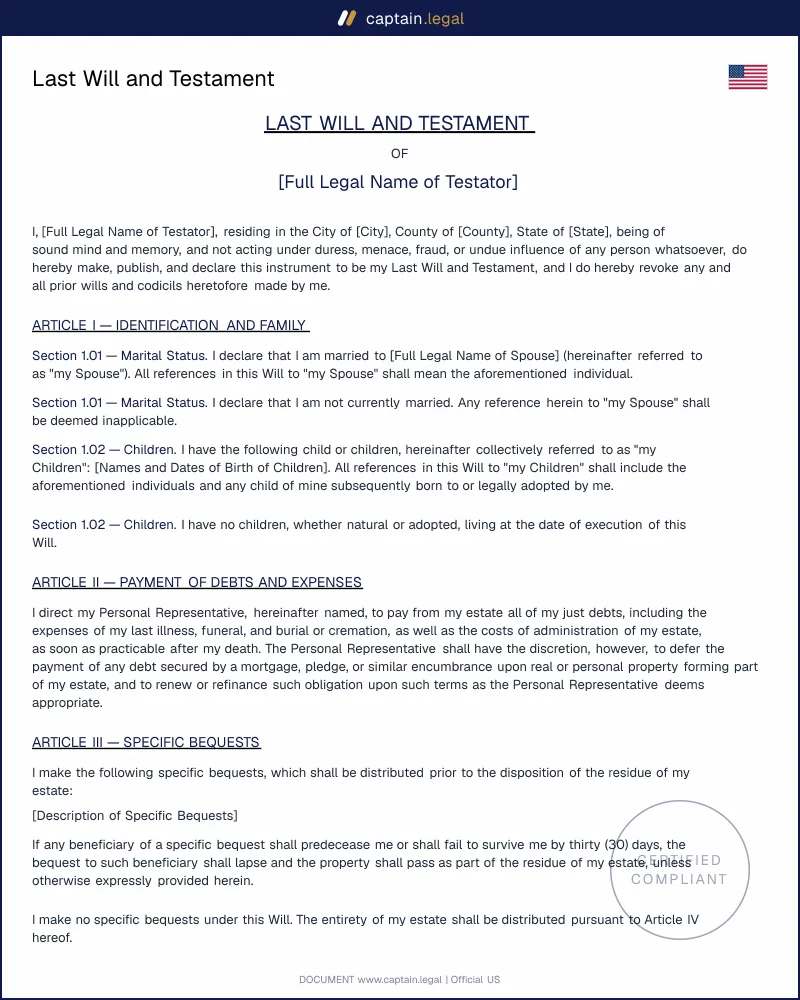
A Last Will and Testament is the foundational instrument of estate planning in the United States. It is the written, signed, and witnessed document by which a person, the testator, directs how their property will be distributed after death, who will administer the estate as executor, and who will care for any minor children. Captain.legal's online builder produces a will that complies with the formal requirements of all fifty states and the District of Columbia, with state-specific clauses inserted automatically based on the testator's domicile.
Without a valid will, the estate passes through intestate succession, meaning state law decides who inherits, in what shares, and on what timeline. That outcome rarely matches what the decedent would have chosen. A properly drafted last will and testament avoids that default, names the people who will protect the family, and accelerates the probate process by giving the court a clear roadmap.
Compliant
2026 Legislation
50,000+ clients
trust us
Affordable
From $4.90 / doc
Secure payment
Instant download
Last Will and Testament Template — All 50 States
Secure payment
What is a last will and testament?
A last will and testament is a unilateral legal act, revocable at any time during the testator's lifetime, that takes effect only at death. It is distinct from a living will (which addresses end-of-life medical decisions) and from a living trust (which transfers assets during life to avoid probate). The will speaks at the moment of death and only at that moment ; until then, the testator keeps full control of the property described in it and can rewrite, amend through a codicil, or destroy the document at will.
The instrument has four functions that matter in practice. It nominates an executor (called personal representative in many state codes) who collects the assets, pays debts and taxes, and distributes the residue. It identifies the beneficiaries by name and specifies what each receives, whether through a specific bequest (a particular item or sum), a general bequest (a dollar amount drawn from the estate), or the residuary clause that captures everything not otherwise disposed of. It nominates a guardian for minor children, which is often the single most important reason a young parent signs a will. And it can establish a testamentary trust to manage assets for a beneficiary who is too young, too inexperienced, or too vulnerable to receive a lump sum outright.
A signed will does not transfer title at death automatically. It must first be admitted to probate by the appropriate court in the county of the testator's domicile, after which the executor receives Letters Testamentary and begins administering the estate. The will sits at the center of a broader catalogue of personal legal documents for individuals and families that typically accompany it, including the power of attorney and the advance health care directive.
Legal framework
Wills in the United States are governed almost entirely by state law, which produces meaningful variation from one jurisdiction to another. The reference text most often cited as a baseline is the Uniform Probate Code (UPC), drafted by the Uniform Law Commission and adopted in whole or in substantial part by roughly nineteen states, including Alaska, Arizona, Colorado, Florida (with significant modifications), Hawaii, Idaho, Maine, Massachusetts, Michigan, Minnesota, Montana, Nebraska, New Mexico, North Dakota, Pennsylvania (partial), South Carolina, South Dakota, and Utah. States that have not enacted the UPC, such as California, Texas, and New York, follow their own probate statutes : the California Probate Code (Division 6, beginning at §6100), the Texas Estates Code (Title 2, Estates of Decedents), and the New York Estates, Powers and Trusts Law (Article 3).
Despite the patchwork, four formal requirements are nearly universal. The testator must be at least eighteen years old in most states, must possess testamentary capacity at the moment of signing (meaning the ability to understand the nature of the act, the extent of one's property, and the natural objects of one's bounty), must sign the will personally or direct another to sign in their presence, and must do so before two competent witnesses who themselves sign in the testator's presence. The witness requirement is the rule that fails most often : a will signed before a single witness, or before witnesses who are also beneficiaries, is the most common reason for a probate challenge. The Cornell Legal Information Institute summary of last will and testament execution rules sets out the baseline requirements with citations to the relevant uniform acts.
Notarization is not strictly required to make a will valid in any state, but the addition of a self-proving affidavit signed before a notary is recognized in the vast majority of jurisdictions and substantially shortens probate by removing the need to locate and depose the original witnesses years later. The Uniform Probate Code §2-503 harmless error rule allows a court to admit a defectively executed will if clear and convincing evidence shows the testator intended the document to be their will, but the doctrine is far from universal and should never be relied on as a fallback.
When do you need this document?
The most common trigger is the birth or adoption of a child. A young parent who dies without a will leaves the question of guardianship to a probate judge who has never met the family, and the court's first instinct, naming the closest blood relative, may not match the parents' wishes at all. The second most frequent driver is the purchase of a first home or any meaningful asset, because the moment a person owns property that exceeds the state's small-estate threshold, intestate succession becomes a real and costly problem for the heirs.
The third trigger is remarriage or a blended family. Intestate succession statutes were written for the nuclear family of the 1950s and produce harsh results when a surviving spouse and children from a prior marriage compete for the same estate. A will is the only instrument that lets the testator carve out specific protections, such as a life estate for the surviving spouse with the remainder passing to the children of the first marriage. The fourth is the diagnosis of a serious illness or a major surgery on the calendar, when capacity becomes a question of timing and a delay of even a few weeks may be one delay too many. The fifth is the existence of a small business, an investment portfolio, or international assets, all of which require directions intestate succession cannot supply ; users in this last category often pair the will with the corporate instruments available in the legal documents for businesses, contracts, and corporate filings section. Anyone who owns digital assets, cryptocurrency, or business interests should treat a will as a baseline document, because the Revised Uniform Fiduciary Access to Digital Assets Act (RUFADAA), now adopted in nearly every state, requires explicit testamentary language to grant an executor lawful access to the decedent's online accounts.
Key clauses included in our template
The template generated through Captain.legal includes the clauses that probate courts expect to see and that practitioners draft as a matter of course. Each is described below in plain English, but the document itself uses the formal statutory language required in the testator's state.
- The declaration and revocation clause opens the will by identifying the testator by full legal name, county and state of domicile, and date of execution, and revokes all prior wills and codicils. This single sentence prevents the most common form of probate litigation, which is the parallel admission of two competing wills signed years apart.
- The appointment of executor and successor executor names the person who will administer the estate and a backup if the first nominee predeceases or declines to serve. The clause typically waives the bond requirement under California Probate Code §8481 or its equivalent, which spares the estate the cost of a surety bond that can run into thousands of dollars.
- The guardianship clause designates a guardian of the person and, where appropriate, a separate guardian of the estate for any minor children. Probate courts retain final say over the appointment, but a clear written nomination is given strong deference under Texas Estates Code §1104.053 and parallel provisions in other states.
- The specific bequests identify particular items (a piece of jewelry, a vehicle, a named bank account) and the named beneficiary for each. The clause uses per stirpes or per capita language to handle the case where a beneficiary predeceases the testator.
- The residuary clause distributes everything not specifically given, and is the single most important provision in any will. A residuary clause that fails (because all named residuary beneficiaries have died, for example) sends the residue back through intestate succession, defeating the entire purpose of the document.
- The testamentary trust provisions set up a trust for any minor or incapacitated beneficiary, name a trustee, and define the standards for distribution (health, education, maintenance, and support, the so-called HEMS standard recognized for federal tax purposes).
- The digital assets clause grants the executor authority under RUFADAA to access email, cloud storage, social media, and cryptocurrency wallets, and lists the platforms by name where possible.
- The attestation and self-proving affidavit closes the will, with witness signatures and a notarized declaration that satisfies the self-proving requirements of the testator's state. Practitioners drafting wills for business owners often pair this clause with the equivalent corporate succession language found in the employment and HR document templates compliant with U.S. labor law catalogue.
State-specific considerations
State law shapes the will from formal execution through probate procedure, and a template that ignores those differences is no better than a generic form pulled from the internet. The five jurisdictions below illustrate the range of variation a national platform must handle.
California follows the California Probate Code, with §6110 setting the formal execution requirements (writing, signature, two witnesses present at the same time) and §6111 recognizing holographic wills entirely in the testator's handwriting without witnesses. California also enforces a strict no-contest clause regime under §21311, which allows the disinheritance of a beneficiary who challenges the will only when the challenge is brought without probable cause. California's community property rules profoundly change what a married testator can dispose of by will : a Californian can devise only their one-half interest in community property, and the surviving spouse already owns the other half outright.
Texas is governed by the Texas Estates Code, with §251.051 setting out the standard execution formalities and §251.052 recognizing holographic wills written wholly in the testator's handwriting. Texas is one of the few states that allows the executor to administer the estate as an independent executor under §401.001, meaning the estate is largely freed from court supervision once the will is admitted to probate. This Texas innovation shortens administration dramatically and is one reason the standard template names an independent executor by default unless the testator opts out.
Florida has not adopted the UPC and follows the Florida Probate Code in Title XLII, Chapters 731 to 735. Florida does not recognize holographic or nuncupative wills under §732.502(2), so an unwitnessed handwritten will signed by a Florida resident is invalid even if every other state would accept it. Florida also imposes a unique homestead protection under Article X, §4 of the Florida Constitution that restricts a testator's ability to devise the homestead away from a surviving spouse or minor child, regardless of what the will says.
New York applies the Estates, Powers and Trusts Law, with EPTL §3-2.1 setting the execution requirements, including the requirement that the testator declare the document to be their will to the witnesses (the publication requirement). New York's elective share statute under EPTL §5-1.1-A gives a surviving spouse the right to claim the greater of fifty thousand dollars or one-third of the augmented estate, and that right cannot be defeated by a contrary provision in the will. The full library of legal document templates available on Captain.Legal groups the will alongside the other instruments New York practitioners typically prepare in the same engagement.
Louisiana is the outlier. As the only civil-law jurisdiction in the United States, Louisiana follows the Louisiana Civil Code and recognizes two valid forms : the notarial testament under articles 1577 to 1580.1, and the olographic testament under article 1575, written, dated, and signed entirely by hand. Louisiana also enforces forced heirship under article 1493, which protects a portion of the estate for descendants under the age of twenty-four or those who are permanently incapacitated. A Louisiana will that ignores the forced heirship rules will be partially reformed by the probate court regardless of the testator's intent.
How to fill out this last will and testament
The flow on Captain.legal mirrors the order in which a probate attorney would interview a client. You start by selecting the state of your legal domicile, which sets the formal execution requirements, witness count, and applicable statutory citations for the rest of the document. From there, the form asks for your full legal name, date of birth, and marital status, and it tracks the names of every spouse and child whether or not they will receive a bequest, because the omission of a known heir is a question the court will eventually ask. The next screen captures the executor and the successor executor, with the option to waive bond and to authorize independent administration where the state permits it.
The form then walks through specific bequests, residuary distribution, guardianship of minor children, and testamentary trusts, in that order. Captain.legal automatically inserts the per stirpes default and the HEMS distribution standard for any trust, and it adds the digital assets clause and the self-proving affidavit unless you opt out. You can find related instruments such as a power of attorney to authorize someone to act on your behalf directly from the same dashboard, which is useful because most clients sign a will and a power of attorney at the same appointment. The final step generates the document in Word and PDF, with the witness and notary signature blocks formatted for your state, and you sign in front of two witnesses and a notary to complete execution.
Common mistakes to avoid
The most frequent mistake is the interested-witness problem. A beneficiary who also signs as a witness will, in many states, forfeit any bequest exceeding what they would have received under intestate succession. California Probate Code §6112 is the textbook example : the will is admitted, but the bequest to the witness is reduced or void. Choose witnesses who have nothing to gain from the will. The second mistake is failing to update the document after a major life event. A will signed before a divorce that names the former spouse as primary beneficiary may produce results the testator never wanted, even though most states automatically revoke pre-divorce bequests to a former spouse under statutes such as EPTL §5-1.4 in New York.
The third mistake is storing the original in a place no one can access. A photocopy is rebuttably presumed to mean the testator destroyed the original with intent to revoke, and the resulting probate fight is brutal. Store the original in a fireproof safe, with the location communicated to the executor, or with the probate clerk in states that offer pre-death deposit. The fourth is ambiguous specific bequests, such as leaving "my watch" when the testator owned three. The fifth, and the most preventable, is trying to disinherit a spouse or a minor child without using the right legal mechanism, which fails outright in every state because of elective share, community property, or homestead rules. A will is not a document you can finish in five minutes and forget for thirty years : review it after every marriage, divorce, birth, death, major purchase, and interstate move.
Frequently Asked Questions
40 verified reviews · 50 000+ downloads
- Immediate access to the document
- PDF + Word download
- Compliant with 2026 legislation
- Reviewed by lawyers
You might also like