An LLC operating agreement is the internal contract that governs how a limited liability company runs day to day, how its profits and losses are split, and what happens when a member dies, defaults, or wants out. It is signed by the members themselves, kept in the company's records, and never filed with the Secretary of State. For single-member LLCs, it documents the separation between the owner and the entity ; for multi-member LLCs, it replaces the patchwork of state default rules with terms the founders have actually negotiated. Whether you formed in Delaware, Wyoming, or your home state, this is the document a bank, a CPA, or a venture investor will ask for first when due diligence starts.
This page explains what the agreement covers, when state law makes it mandatory, and the clauses you can negotiate. Our online builder generates a Word and PDF version tailored to your state of formation in roughly five minutes.
Compliant
2026 Legislation
50,000+ clients
trust us
Affordable
From $4.90 / doc
Secure payment
Instant download
LLC Operating Agreement Template | Word & PDF
Secure payment
What is an LLC operating agreement?
An LLC operating agreement is a private contract among the members of a limited liability company, setting out the rules they agree to live by. Think of it as the constitution of the LLC : it allocates capital contributions, defines voting power, sets out how distributions are paid, and describes what triggers a buyout, a dissolution, or a transfer of membership interests. Unlike the articles of organization filed with the state, the operating agreement is an internal document. It does not appear in any public registry, and the state will not police its terms.
The distinction trips up first-time founders. The articles of organization create the LLC as a legal entity ; the operating agreement is what makes the LLC actually function as a business. A bank will rarely open a commercial account without seeing a signed agreement. The IRS will request one when reviewing partnership tax elections. Investors performing diligence will read it line by line, hunting for clauses that conflict with their term sheet.
A common misconception is that single-member LLCs do not need one. They do, and arguably more than multi-member companies. Without a written agreement, courts in many states fall back on default statutes drafted for partnerships, and the line between owner and entity blurs. That is precisely the situation that invites a piercing of the corporate veil, the doctrine that lets creditors reach a member's personal assets when the LLC looks like an extension of its owner. A signed operating agreement, paired with separate bank accounts and proper records, is the single best evidence that the entity is real. You can browse the full U.S. business document templates library for related corporate filings.
Legal framework
The governing law for an LLC is the limited liability company act of the state where the entity is formed, not the state where its members live or where the business operates. Each state has its own statute, and they vary in important ways. Delaware's Limited Liability Company Act (codified at Title 6, Chapter 18 of the Delaware Code) is the most influential, both because Delaware is the formation state of choice for venture-backed companies and because its Court of Chancery has produced decades of LLC jurisprudence. California's Revised Uniform Limited Liability Company Act (California Corporations Code §17701.01 et seq.) and New York's Limited Liability Company Law §417 take a stricter approach, especially on fiduciary duties and the rights of minority members. Texas's Business Organizations Code §101.001 et seq. is more contractarian, allowing the agreement to override most default rules.
Five states make a written operating agreement statutorily required at formation : Delaware, California, New York, Maine, and Missouri. New York pushes the requirement furthest, mandating that the agreement be adopted within ninety days of filing the articles of organization and published in two newspapers under the §206 publication requirement. The forty-five remaining states treat the agreement as optional, but every commercial lawyer in those states will draft one anyway, because state default rules almost never match what the members actually want. The Federal Corporate Transparency Act now layers a separate obligation on top of state law, requiring most LLCs to report their beneficial owners (members holding 25% or more) to FinCEN. The operating agreement is where that ownership math is recorded.
A clean overview of the doctrine, including the relationship between operating agreements and state default rules, is available in the Cornell Legal Information Institute entry on operating agreements. For founders mapping out adjacent filings, the state-compliant legal documents catalog lists each form by jurisdiction.
When do you need this document?
The cleanest trigger is formation itself. The agreement should be signed at the same meeting where the members adopt the articles of organization, before any capital is contributed and certainly before the LLC opens a bank account. Banks, including national institutions like Chase, Bank of America, and Wells Fargo, will ask for an executed copy as part of the KYC file. Without it, account opening stalls.
A second moment is when a new member joins, whether by capital contribution or by transfer of an existing interest. The original agreement almost certainly contains a transfer restriction clause that conditions admission on the unanimous (or supermajority) consent of the existing members, and a new agreement, or an amendment, has to be executed and signed. The same logic applies in reverse when a member exits : the buyout and valuation mechanics live inside the operating agreement, and trying to negotiate them after a falling-out is a textbook way to end up in court.
Investors trigger the third scenario. A seed or Series A round will require an amended and restated agreement that adds preferred units, protective provisions, and drag-along rights. The original founder-friendly agreement is replaced by one that reflects the cap table the investors paid for. Do not skip this step : a closing without an updated operating agreement leaves the new investors as economic interest holders without governance rights, which is rarely what either side intended.
Two edge cases are worth flagging. Estate planning sometimes requires a member to grant a power of attorney for an LLC member, and the operating agreement controls whether that proxy can vote member interests. Real estate holding LLCs that pool family assets need transfer restrictions tight enough to keep ownership inside the bloodline ; the agreement is the only place to write that rule.
Key clauses included in our template
- The identification of members and capital contributions lists every owner by full legal name, the dollar value (or property value) of what each contributed, and the percentage of membership interest received in exchange. This is the source of truth the IRS will use to issue K-1s at year end, so vague language like "in proportion to contributions" gets replaced with specific numbers and percentages on the schedule.
- The management structure clause elects between a member-managed and a manager-managed LLC. Member-managed is the default in most states and works for small operating businesses ; manager-managed is the right choice when passive investors want to delegate day-to-day decisions to one or two members or to an outside manager. The clause defines which decisions require a member vote and which the manager can take alone.
- The distributions and allocations clause governs both operating distributions (cash paid out during the year) and liquidating distributions (cash paid on dissolution). It also addresses how profits and losses are allocated for tax purposes, which is not always the same as the cash split. Special allocations require careful drafting under §704(b) of the Internal Revenue Code to be respected by the IRS.
- The transfer restriction and right of first refusal clause prevents a member from selling their interest to an outsider without first offering it to the other members at the same price. This is what keeps the cap table closed and the partnership functional. Combined with a buy-sell trigger on death, divorce, or bankruptcy, it gives the LLC predictable mechanics for unplanned exits.
- The dissolution and winding-up clause identifies the events that wind up the company (unanimous consent, expiration of the stated term, judicial decree) and the order in which assets are distributed. Creditors are paid first, then members in proportion to unreturned contributions, then in proportion to membership interests. Skipping this clause leaves the company at the mercy of state default rules that may force a fire-sale of assets.
For founders building a full document set around the company, the employment agreement templates for new hires cover the contracts that come right after formation.
State-specific considerations
Delaware is the formation state of choice for venture-backed LLCs and for any company anticipating outside investment. Under 6 Del. C. §18-1101, the operating agreement may eliminate fiduciary duties entirely, replacing them with the implied covenant of good faith and fair dealing. That contractual freedom is unmatched, and it explains why nearly every Series A term sheet specifies a Delaware LLC or conversion. The Delaware Court of Chancery applies the agreement as written, with minimal second-guessing, so drafting precision matters more here than anywhere else. Delaware LLCs also benefit from a streamlined certificate of formation and a flat annual franchise tax owed to the Division of Corporations.
California imposes the strictest baseline in the country through the California Revised Uniform Limited Liability Company Act. Members owe each other non-waivable fiduciary duties of loyalty and care under §17704.09, and the agreement cannot eliminate them, only narrow their application. California also requires the agreement to be in writing and treats its minimum franchise tax as due whether the LLC is profitable or dormant. Foreign LLCs doing business in California must register with the Secretary of State and pay the same tax, a trap for out-of-state founders who assume Delaware formation insulates them.
New York is the only state that pairs an operating agreement requirement with a publication requirement under Section 206 of the LLC Law. Within 120 days of formation, notice of the LLC's existence must be published in two newspapers in the county of the principal office, with proof filed with the Department of State. Failure to publish suspends the LLC's authority to bring suit in New York courts. §417 further requires the operating agreement to be adopted within ninety days of formation, in writing, and by all initial members.
Texas takes the opposite philosophical stance from California. Texas Business Organizations Code §101.052 is one of the most contractarian statutes in the country, allowing the operating agreement (called the company agreement in Texas) to modify or eliminate almost every default rule, including fiduciary duties. The state imposes no income tax on the LLC and a low franchise tax threshold, making it a popular alternative to Delaware for closely held operating businesses. The agreement controls almost entirely, so vague drafting hurts more here than in states with strong default protections.
Florida governs LLCs through the Florida Revised Limited Liability Company Act (Chapter 605, Florida Statutes). The state requires an annual report by May 1 to keep the LLC active, with a non-waivable late penalty that converts an administrative oversight into a meaningful business problem. Operating agreement provisions modifying the duty of loyalty are permitted but must be specific and reasonable under §605.0105(4). Founders who form in Florida and then expand should consult the real estate document templates when the LLC starts holding property in multiple states.
How to fill out this LLC operating agreement
You begin by selecting the state of formation, which determines the statutory framework, the citations baked into the agreement, and any state-specific clauses (publication notices for New York, franchise tax language for California and Delaware). The builder then asks for the company name as filed with the Secretary of State, the principal office address, and the registered agent details, all of which need to match the articles of organization to the letter.
The next block covers the members. You list each one by full legal name and address, the form of their capital contribution (cash, property, services), and the percentage of membership interest they receive. The form computes the contribution schedule automatically and flags any allocation that does not sum to 100%. From there, you choose between member-managed and manager-managed governance, set the threshold for ordinary decisions versus major decisions (typically a supermajority for borrowing, admitting new members, or amending the agreement), and configure the distribution policy.
The final block handles the exit mechanics : transfer restrictions, right of first refusal, buy-sell triggers, and the valuation method used when a member's interest is repurchased. The form offers three valuation options (book value, appraisal, or formula) and inserts the corresponding mechanics. Once the inputs are complete, you download the document as a Word file for further editing or a PDF signature-ready copy, both stored in your dashboard for re-download whenever a bank, lender, or investor asks for the latest version.
Common mistakes to avoid
The most expensive mistake is operating without a signed agreement at all, especially for single-member LLCs. Founders assume the state default rules are good enough until a creditor files suit and a judge starts asking why the entity has no governing documents, no separate bank account, and no member meeting minutes. The piercing-the-corporate-veil analysis lands fast in that scenario, and the limited liability the founder paid the state to create evaporates. A second frequent error is copying a generic template off the internet without adjusting for state law. A Delaware-style fiduciary waiver pasted into a California LLC is unenforceable under §17704.09(b) and may be void as a matter of public policy.
A third mistake, more subtle, is failing to update the agreement when the cap table changes. New members admitted by handshake, capital contributions made and not recorded, voting thresholds left at the original two-member configuration when the company now has six members : each gap creates an opportunity for litigation. A fourth recurring error is the mismatch between the operating agreement and the tax election. An LLC that elected S corp status with the IRS but kept partnership-style allocations in its agreement creates an immediate conflict that the IRS will resolve against the taxpayer. The fifth mistake, easy to fix and frequently overlooked, is the absence of dispute-resolution mechanics. Without a mediation-then-arbitration clause, every member disagreement becomes a candidate for state court litigation, often filed in the wrong venue.
Frequently Asked Questions
127 verified reviews · 50 000+ downloads
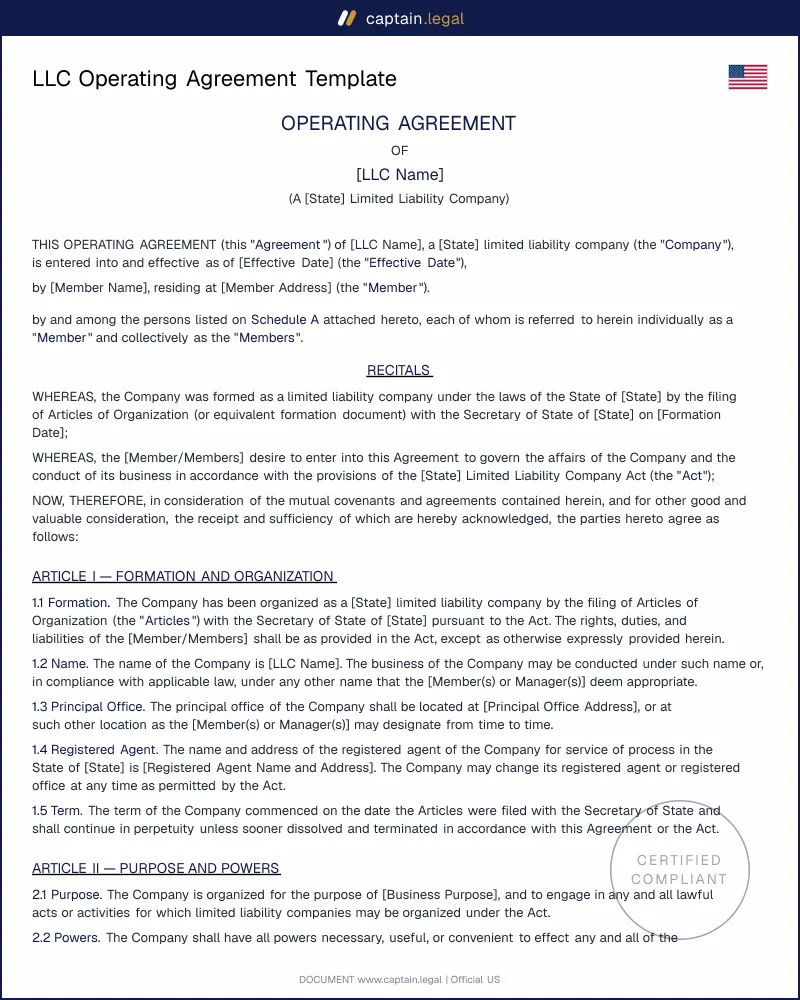
- Immediate access to the document
- PDF + Word download
- Compliant with 2026 legislation
- Reviewed by lawyers
You might also like