A nonprofit bylaws document is the internal governance constitution of a US nonprofit corporation. It spells out how the board operates, how directors and officers are elected, what counts as a quorum, how votes are taken, and how the organization will be wound down if it ever dissolves. Unlike the articles of incorporation, which are filed with the state and tell the public what the organization is, the bylaws are an internal instrument that controls how the organization actually runs. The IRS reviews them during the 501(c)(3) determination process, state attorneys general rely on them when investigating fiduciary breaches, and judges read them first when a board fight ends up in court. Good nonprofit bylaws are not a formality. They are the document every other governance decision will be measured against.
This template is drafted to align with the Model Nonprofit Corporation Act (Third Edition), the Revised Model Nonprofit Corporation Act (adopted in substance by states like California, New York, Texas, and Florida), and the IRS expectations set out in the Governance and Related Topics guidance for 501(c)(3) charities.
Compliant
2026 Legislation
50,000+ clients
trust us
Affordable
From $4.90 / doc
Secure payment
Instant download
Nonprofit Bylaws Template | Board Governance for 501(c)(3)
Secure payment
What is a nonprofit bylaws document?
A set of nonprofit bylaws is a private contract among the corporation, its directors, and its members (if any), binding everyone who accepts a board seat or officer role. The bylaws define the structure of the board, the term and qualifications of directors, how vacancies are filled, the powers and limitations of officers, the rules governing committees, and the procedure for amending the bylaws themselves. They also lock in the mechanics of decision-making: notice periods for meetings, quorum thresholds, voting rules, the use of written consent in lieu of a meeting, and the conditions under which directors may participate by remote communication. In states like Delaware and California, where nonprofit case law is heavy, the bylaws are the first document a judge will read in any dispute over authority or process.
Bylaws are often confused with two neighboring instruments. The articles of incorporation are the public charter filed with the secretary of state, containing the charitable purpose clause and the dissolution clause the IRS requires for 501(c)(3) status. A conflict-of-interest policy, by contrast, is a standalone document that disciplines insider transactions. Bylaws sit between them: broader than a single policy, narrower than the public charter, and unlike either, they govern every recurring decision the board will ever make. Most US states require nonprofit corporations to adopt bylaws even though those bylaws are not filed publicly, and the absence of bylaws is treated by the IRS as a sign of an organization that is not ready for tax-exempt status.
Legal framework
Three layers of law shape every set of US nonprofit bylaws. The first is state nonprofit corporation law, which dictates the mandatory floor: minimum number of directors, permissible board composition, fiduciary duties, indemnification limits, and the procedural mechanics for meetings and votes. California operates under the Nonprofit Corporation Law (Cal. Corp. Code §§5000–10841), New York under the Not-for-Profit Corporation Law, Texas under the Business Organizations Code Chapter 22, and Florida under Chapter 617 Florida Statutes. Most other states have adopted some version of the Model Nonprofit Corporation Act, which gives bylaws considerable drafting flexibility while imposing a baseline of duty of care and duty of loyalty. Bylaws cannot override mandatory statutory provisions, and any clause that does is unenforceable to that extent.
The second layer is federal tax law. To qualify and remain qualified under Internal Revenue Code §501(c)(3), an organization must be organized and operated exclusively for exempt purposes, with no part of its net earnings inuring to private individuals. The IRS examines bylaws when reviewing Form 1023 and Form 1023-EZ applications and may request them later during examinations. The agency's published guidance on IRS organizing documents requirements for 501(c)(3) charities confirms that organizing documents and bylaws are reviewed together to ensure the structure matches the represented activities. Bylaws should therefore mirror the purpose clause and the dissolution clause already locked into the articles of incorporation, leaving no daylight between the two instruments.
The third layer is state charitable solicitation law. Thirty-nine states require some form of registration before a nonprofit solicits donations from their residents, and several states require bylaws or governing documents to be attached to the registration. The bylaws also intersect with state public records laws when the organization holds a charitable trust or receives state funding. Drafting choices made today, especially around membership rights, indemnification, and amendment procedure, will determine how much friction the organization faces in every one of these encounters with regulators. Captain.Legal's nonprofit governance templates catalog is built to keep all three layers consistent within a single document set.
When do you need this document?
The most common trigger is incorporation. Once the articles are filed and the state issues a certificate of incorporation, the organizers have a narrow window — typically the first board meeting — to adopt bylaws, elect officers, and ratify the actions of the incorporator. Skipping this step is the single most frequent governance mistake at the front end of a nonprofit's life. Without bylaws, the board cannot lawfully conduct business, banks will refuse to open an account in the corporation's name, and the IRS will treat the Form 1023 application as incomplete. A founder who has filed articles but not adopted bylaws is, in practical terms, running an unincorporated venture under a corporate shell.
The second trigger is a 501(c)(3) application or renewal. The IRS expects the bylaws submitted with Form 1023 to contain language affirming charitable purposes, prohibiting private inurement, restricting political activity to the limits of §501(c)(3), and directing assets to another exempt organization on dissolution. Organizations adopted on a generic template that omits this language usually receive a Letter 1312 request for additional information, delaying determination by months. The third trigger is board expansion or restructuring. When a founding board of three grows into a working board of nine or twelve, when committees become standing rather than ad hoc, or when the organization moves from an all-volunteer model to one with paid staff, the original bylaws will almost always need substantive amendment. A clean amendment procedure, drafted into the original document, is what makes that transition smooth.
Two edge cases deserve mention. Fiscally sponsored projects that eventually spin out into independent 501(c)(3) entities inherit none of the sponsor's bylaws and must adopt their own from scratch. And religious organizations that elect church status under §508(c)(1)(A) still benefit from adopted bylaws even though IRS filing is not required, because state law and donor due diligence still demand them.
Key clauses included in our template
The bylaws produced by this generator cover every operative provision a US nonprofit board will rely on across its life cycle. Each clause is drafted to be legally enforceable in the state selected during the form, with the federal tax requirements layered on top.
- The purpose and tax-exemption clause restates the charitable purpose from the articles of incorporation and inserts the §501(c)(3) affirmative language the IRS reviews on Form 1023: prohibition on private inurement, limitation on lobbying activity, and a dissolution clause directing assets to another exempt organization. Without these four lines, the entire 501(c)(3) determination is at risk.
- The board composition and election clause sets the minimum and maximum number of directors, the term length, term limits (or their absence), the procedure for nomination and election, and the rules governing vacancies. It also addresses independence requirements that some state attorneys general now apply to nonprofits with significant public revenue, and it tracks the companion articles of incorporation template to keep both documents aligned.
- The meetings, notice, and quorum clause specifies how regular and special board meetings are called, the minimum notice period (typically 5 to 30 days depending on state law), what constitutes a quorum (a majority of directors then in office, unless otherwise stated), and whether participation by electronic means is permitted. Post-pandemic, the remote-meeting provisions have become the most negotiated section in the entire document.
- The voting and written consent clause establishes the default voting threshold (majority of directors present at a meeting at which a quorum is present), the elevated thresholds for specific actions (bylaw amendments, removal of a director, dissolution), and the conditions under which the board may act by unanimous written consent in lieu of a meeting as authorized by state statute.
- The officers and authority clause identifies the required officers (typically president, secretary, treasurer), their election and removal procedures, their term, their signing authority, and the limits on their ability to bind the corporation without board approval. Authority limits are where most bylaw lawsuits begin, and ambiguity here is expensive.
- The committee structure clause distinguishes standing committees (audit, governance, executive) from advisory committees and clarifies which committees may exercise delegated board authority under state law. In California and New York, only properly constituted committees of the board may bind the corporation.
- The conflict of interest, indemnification, and amendment clauses close the document. The conflict-of-interest provision tracks the IRS Appendix A sample policy, the indemnification clause matches the state nonprofit statute, and the amendment clause sets the supermajority and notice required to change the bylaws themselves.
State-specific considerations
Nonprofit corporation law is a state matter, and a clause that is enforceable in Texas may be invalid in California. The template adapts to the state selected during the form, but a few state-specific patterns are worth flagging directly.
California. Under the Nonprofit Public Benefit Corporation Law (Cal. Corp. Code §§5110 et seq.), public benefit corporations must have at least one director, but a board of fewer than three is rare in practice and discouraged by the California Attorney General's Guide for Charities. The state imposes specific restrictions on interested-director transactions under Cal. Corp. Code §5233 and requires that no more than 49% of the board may be interested persons (compensated by the corporation or related to someone compensated). Bylaws drafted for California must mirror these limits or risk invalidation of board action involving the interested directors.
Texas. The Texas Business Organizations Code §22.204 requires a minimum of three directors for a nonprofit corporation. Texas allows member and non-member nonprofit structures, and the bylaws must clearly elect one or the other; switching later requires a formal amendment under §22.102. Texas nonprofits also have unusually permissive rules on written consent without a meeting for non-member corporations, but only if the bylaws explicitly authorize it.
Florida. Florida Statutes Chapter 617 permits a single-director nonprofit, but the practical floor for IRS purposes remains three unrelated directors. Florida requires nonprofits soliciting contributions to register with the Department of Agriculture and Consumer Services under the Solicitation of Contributions Act (§496.401 et seq.), and the registration form asks for the bylaws as an attachment.
New York. The Not-for-Profit Corporation Law, substantially amended by the Nonprofit Revitalization Act of 2013, classifies nonprofits as Type A, B, C, or D corporations, each with distinct purpose restrictions. New York also imposes mandatory whistleblower and conflict-of-interest policies for nonprofits with twenty or more employees and revenues above the statutory threshold, and bylaws must integrate or cross-reference both. The state's audit committee requirements scale with annual revenue, and the bylaws should anticipate the thresholds before they are crossed. Captain.Legal's at-will employment agreement template for executive directors is often paired with the bylaws when a New York nonprofit hires its first paid staff member.
How to fill out this nonprofit bylaws document
You begin by selecting the state of incorporation, which is almost always the state where the nonprofit's principal office sits. The template then loads the correct statutory citations, minimum director count, quorum default, and amendment procedure for that jurisdiction. From there, the form walks through the operative choices in plain English: how many directors will sit on the board at launch, the term length, whether the organization will have members with voting rights or operate as a board-only corporation, and the names of the initial officers. Each answer reshapes the document in real time, so an article that does not apply to a board-only structure simply disappears rather than sitting there as orphan text.
The next stage covers meetings and voting. You set the notice period, the quorum, the default voting threshold, and any elevated thresholds for sensitive actions like removing a director or amending the bylaws themselves. The form offers tested defaults — majority of directors in office for quorum, two-thirds of directors then in office for bylaw amendment — that match most state statutes and the IRS sample bylaws attached to Publication 557. You can override any of them when the board has a specific preference. The conflict-of-interest section then incorporates the Appendix A template language from the IRS, with the option to require an annual disclosure statement from every director.
The final stage adds the dissolution clause, the indemnification provisions, and the signature block for the initial directors. The document is generated in editable Word format and signature-ready PDF, with section numbering and cross-references already in place. You can return to the form later, change a single answer, and regenerate without rebuilding the file.
Common mistakes to avoid
The most expensive mistake is copying bylaws from a generic online template that omits the §501(c)(3) language. Without the affirmative purpose, inurement, lobbying, and dissolution clauses, the IRS will not grant or maintain tax-exempt status, and the organization may be forced to amend retroactively under penalty of revocation. A close second is adopting bylaws that contradict the articles of incorporation: when the articles say "members" and the bylaws say "non-member," or when the two documents define the purpose differently, courts default to the articles, and the bylaws are read down accordingly.
A third pattern, which we see constantly in practice, is silence on remote meetings and electronic voting. State statutes vary, but in most states the default is that remote participation is not allowed unless the bylaws explicitly authorize it. A board that has been meeting on Zoom for two years under bylaws that do not mention electronic communication has technically held invalid meetings, and every vote taken at those meetings is voidable. The fix is straightforward when caught early; ruinous when caught during a dispute. The fourth mistake is failing to track compensation properly. Bylaws should require board approval for compensation paid to officers and directors and should reference the rebuttable presumption of reasonableness procedure under Treasury Regulation §53.4958-6. Without this, every payment to an insider is exposed to intermediate sanctions. The final mistake is misclassifying paid help: nonprofits that pay program staff as 1099 contractors when the relationship looks like employment expose themselves to IRS reclassification, back taxes, and penalties. A clean 1099 independent contractor agreement template used alongside the bylaws helps document the classification properly when contractor status is genuinely warranted.
Frequently Asked Questions
26 verified reviews · 50 000+ downloads
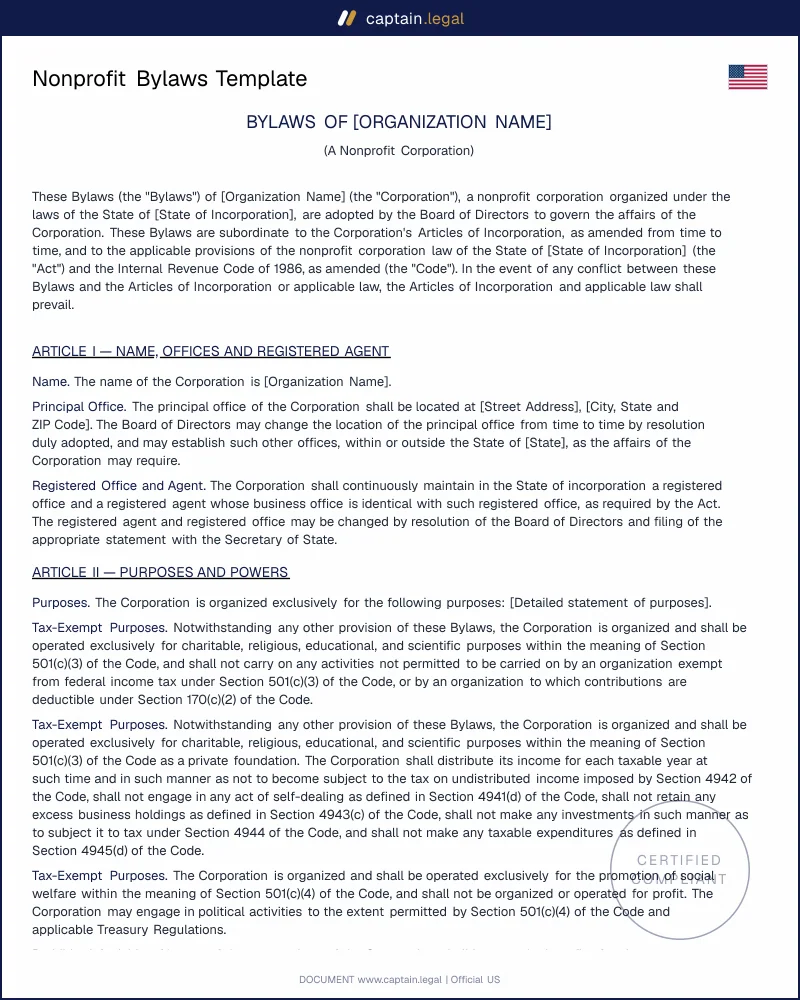
- Immediate access to the document
- PDF + Word download
- Compliant with 2026 legislation
- Reviewed by lawyers
You might also like