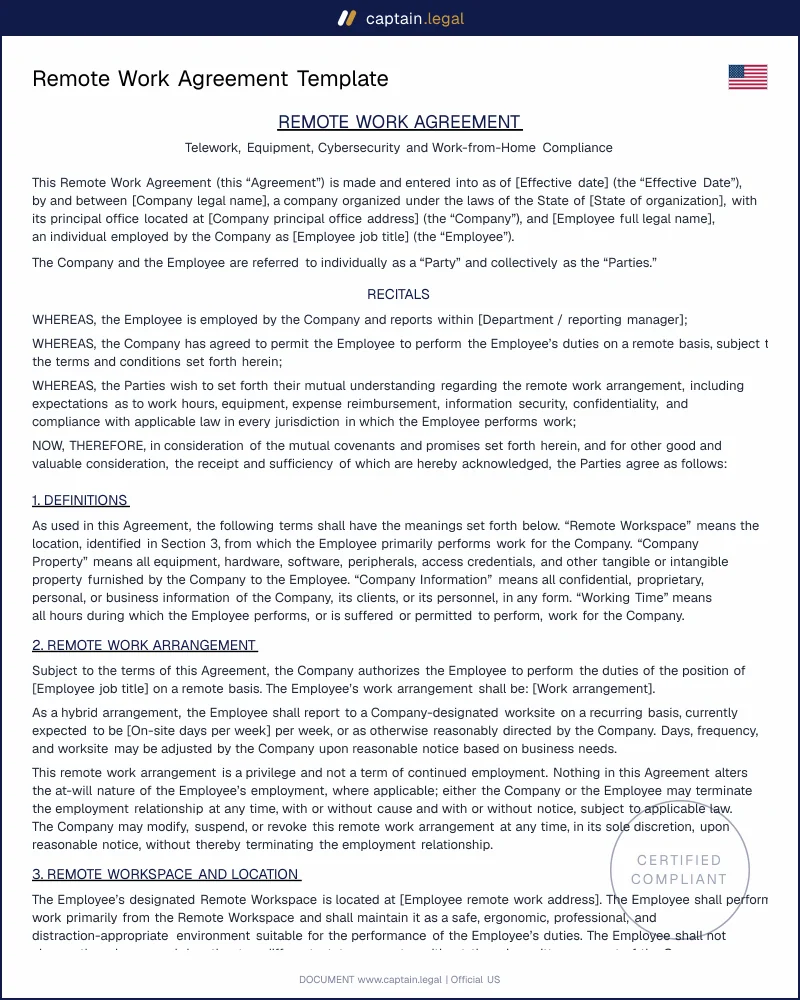
California is the most demanding jurisdiction by a wide margin. Labor Code §2802 forces reimbursement of all necessary remote-work expenses, and courts since Cochran v. Schwan's Home Service have read that to cover a reasonable share of personal phone and internet even when the employee had an unlimited plan. California also imposes daily overtime after eight hours, not just weekly overtime after forty, so the timekeeping clause has to capture daily totals. Anti-discrimination and harassment duties under the Fair Employment and Housing Act follow the employee into the virtual workspace, and the employer must keep accurate hour records regardless of location.
Texas sits at the opposite end. The state has no statute requiring expense reimbursement beyond the FLSA floor, and it follows the federal overtime standard without a daily trigger. The practical risk for a Texas employer is the remote worker who lives in a stricter state, since the governing law tends to be where the work is physically performed, not where the company is headquartered. The agreement's relocation clause is the main defense against importing California or Illinois obligations by accident.
New York requires reimbursement of expenses that would otherwise drop pay below minimum wage and enforces its own wage-notice and pay-statement rules under the Wage Theft Prevention Act, which apply to remote employees based in the state. New York City layers on additional anti-discrimination protections. Florida, like Texas, has no broad reimbursement mandate and tracks the federal standard, so the heavy lifting there is documentation and consistency rather than statutory compliance. Across every state, the safe drafting rule is to comply with whichever law is most protective of the employee, which is precisely how this template behaves when you select the work location.