An Employee Termination Letter is the written notice a US employer hands to a worker to end the employment relationship, document the legal basis for the separation, and trigger the cascade of statutory obligations that follow: final pay, COBRA election notices, return of property, and unemployment filings. It is the single document that turns an internal HR decision into a defensible paper trail, and it is read closely by plaintiffs' attorneys, unemployment hearing officers, and the EEOC if anything goes wrong later. This page covers the at-will baseline, the for-cause variant, and the layoff (reduction in force) version used in workforce restructurings. Whether you are a small business owner letting go of one administrative assistant or an HR director processing a multi-state RIF, the same drafting discipline applies.
Compliant
2026 Legislation
50,000+ clients
trust us
Affordable
From $4.90 / doc
Secure payment
Instant download
US Employee Termination Letter — At-Will, COBRA, Final Pay
Secure payment
What is an employee termination letter?
An employee termination letter is a dated written notice from the employer, addressed to a specific employee, stating that the employment relationship is ending. In US practice the letter identifies the last day worked, the separation date when applicable benefits stop, the reason for termination (or a neutral reference to at-will status), and the logistics of final pay, benefits continuation, return of company property, and post-employment obligations. It is the operative document, not a draft summary of a conversation.
The letter is not the same instrument as a separation agreement. A separation agreement is a bilateral contract under which the employer offers severance or extended benefits in exchange for a release of claims, often including a waiver under the Older Workers Benefit Protection Act for employees aged 40 and over. The termination letter, by contrast, is a unilateral notice. It can reference an attached separation agreement, but it stands on its own. Wrongful termination cases routinely turn on this distinction: an employer who treats a conversational "we're letting you go" as the operative act, and only follows up with paperwork days later, has created uncertainty about the effective separation date and the running of statutory clocks.
Legal framework
No single federal statute governs the form of a US termination letter, which is why drafting discipline matters so much. The default rule in 49 states is at-will employment: either party can end the relationship at any time, for any lawful reason or no reason at all, without advance notice. Montana is the lone exception under its Wrongful Discharge from Employment Act, Mont. Code Ann. §§ 39-2-901 et seq. At-will status does not authorize termination for an illegal reason. Title VII of the Civil Rights Act of 1964, the Age Discrimination in Employment Act, the Americans with Disabilities Act, Section 1981, and a long list of state analogues prohibit termination based on a protected characteristic. NLRA § 7 protects concerted activity, Sarbanes-Oxley § 806 protects whistleblowers, and OSHA § 11(c) protects employees who raise safety concerns. The termination letter must avoid any language that could be read to confirm a retaliatory or discriminatory motive, which is why most plaintiff-side employment lawyers read the letter first when they evaluate a case.
Three federal regimes consistently dictate what the letter must accompany. COBRA (29 U.S.C. §§ 1161–1169, applicable to employers with 20 or more employees in the prior year) requires the employer to notify the group health plan within 30 days of the qualifying event, after which the plan administrator must send the election notice to the qualified beneficiary within 14 days. The beneficiary then has 60 days to elect continuation coverage and 45 days from election to make the first premium payment. Penalties for missed COBRA notices reach $100 per day per beneficiary under IRC § 4980B and up to $110 per day under ERISA. The WARN Act (29 U.S.C. § 2101) requires 60 days of advance written notice for plant closings or mass layoffs at sites with 100 or more employees, with state mini-WARN statutes such as the New York WARN Act and the California WARN Act layering stricter triggers. USERRA protects servicemembers returning from active duty. For the authoritative federal framework, the Department of Labor Employer's Guide to COBRA continuation coverage sets out the model notices and deadlines most HR teams use as their starting point.
When do you need this document?
The textbook trigger is performance- or conduct-based termination for cause, where the employer has documented the problem through prior verbal coaching, a documented employee warning letter, and ideally a performance improvement plan. The letter states the factual basis in measured, non-inflammatory language ("failure to meet the production metrics set in the PIP dated March 4, despite the 60-day improvement window") and avoids editorial commentary. Good practitioners draft the letter assuming a future EEOC charge or unemployment hearing officer will read it line by line.
The second common trigger is economic separation: a reduction in force, position elimination, or business closure. The letter does not assign individual fault and instead references the business decision. A third scenario is end of a definite-term contract or an at-will conversion that never materialized after the probationary period documented in the at-will employment agreement signed at hire. The fourth, and most legally exposed, is immediate termination for serious misconduct: theft, harassment substantiated by investigation, workplace violence. The letter must reflect that an investigation took place and the conclusion was reached on a non-discriminatory basis, even if the wording stays general for confidentiality reasons. One edge case worth flagging: terminations that occur during or shortly after an employee has filed a workers' compensation claim, an FMLA leave request, or an internal harassment complaint carry a presumption of retaliation in many jurisdictions, and the letter should not be the only documentation of the legitimate business reason.
Key clauses included in our template
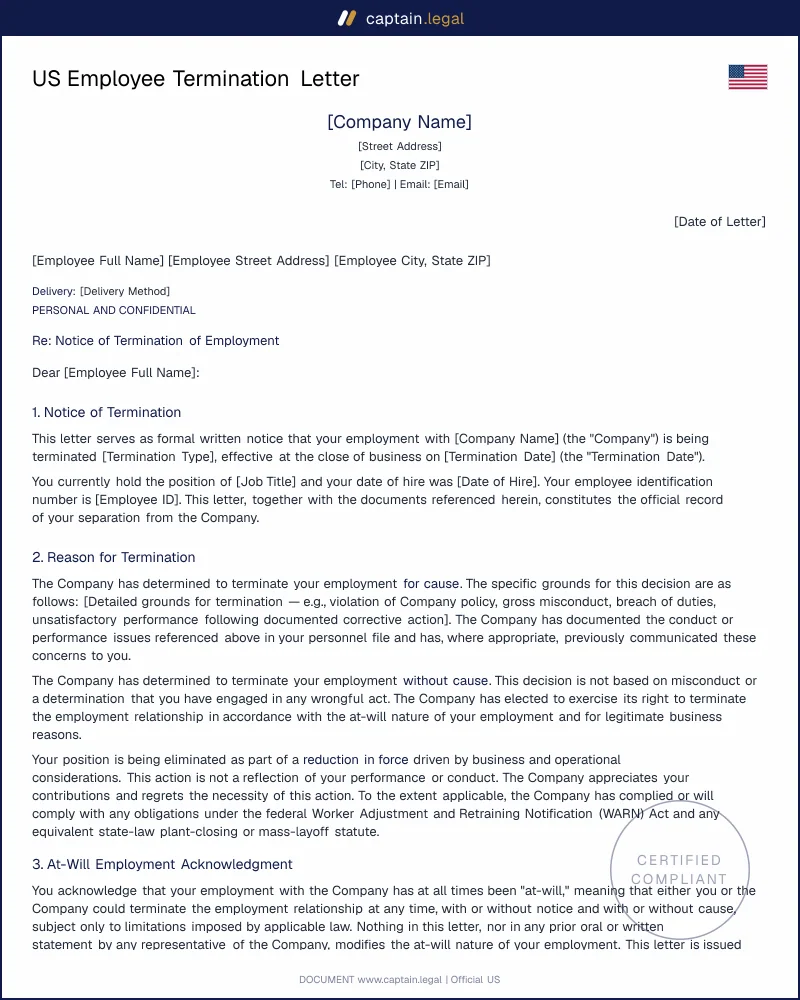
- The header and identifying information establishes legal precision: full legal name of the employer entity (not the trade name), full legal name of the employee, employee ID, hire date, and the date of the letter. Plaintiffs' counsel routinely challenge letters that name only a d/b/a or use inconsistent spellings, because any mismatch suggests sloppy process.
- The statement of termination and effective date identifies the last day worked, the separation date (which can differ if accrued PTO is paid out as continued pay), and whether the employee is on paid administrative leave between notice and effective date. Drafted in active voice, it leaves no ambiguity about when the employment ended.
- The reason for termination is calibrated to the situation. For at-will separations without cause, the letter often references the at-will status of the relationship without stating a reason, citing the offer letter signed at hire. For-cause terminations state the specific conduct or performance failure with reference to prior documentation.
- The final compensation paragraph confirms the date and method of final pay, the treatment of accrued but unused PTO under state law and company policy, the payout of any vested commissions or bonuses, and the deduction of any authorized offsets. Late or incomplete final pay triggers statutory penalties in most states.
- The benefits continuation block addresses health insurance termination, the timing of the COBRA qualifying event notice, retirement plan rollover information, and the cessation of any other benefit (life insurance, disability, FSA) on the separation date.
- The company property and post-employment obligations clause itemizes the equipment, credentials, badges, mobile devices, keys, and proprietary documents the employee must return, with the date by which return is required. It cross-references the employee's continuing confidentiality and NDA obligations, including non-solicitation, invention assignment, and any restrictive covenants that survive termination.
- The separation conditions paragraph notes whether severance or a separation agreement is being offered, the deadline to sign, and the consideration period (21 or 45 days under the OWBPA if a release of age claims is included), along with the 7-day revocation window.
State-specific considerations
California. California Labor Code § 201 requires that all wages, including accrued vacation, be paid immediately at the time of termination when the employer initiates the separation. There is no grace period and no "next payday" alternative. Failure to comply triggers waiting time penalties under Labor Code § 203, equal to the employee's daily wage for each day of delay, capped at 30 days. The employee must be paid at the place of discharge. California also requires a Notice to Employee as to Change in Relationship (DE 2320) and a For Your Benefit pamphlet, both delivered at termination. In California, handing over the letter without the final paycheck is itself a violation, regardless of how amicable the conversation was.
Texas. Under Texas Labor Code § 61.014, an employer who discharges an employee must pay the final wages within six calendar days of the discharge date. If the employee quits, payment is due on the next regularly scheduled payday. Texas law explicitly prohibits withholding the final paycheck to compel return of company property, even when the equipment is high-value or the employee has been uncooperative. The remedy for unreturned property is a civil action, not payroll withholding.
Florida. Florida has no specific final paycheck statute, so the FLSA default applies: payment by the next regularly scheduled payday. Florida is firmly at-will and does not recognize most public policy exceptions adopted in other states, which gives employers more drafting latitude but does not eliminate exposure under federal anti-discrimination statutes. Mini-WARN obligations are absent at the state level, so the federal WARN threshold of 100 employees controls. For employers building a US-wide separation library, the full catalog of US legal templates groups offer letters, warning letters, and NDAs alongside the termination letter so the documentation stays consistent across states.
New York. Under NY Labor Law § 191(3), the final paycheck is due by the next regular payday for the relevant pay period. New York's Wage Theft Prevention Act (Labor Law § 195) requires a written final wage statement, and the New York WARN Act (Labor Law § 860-b) is significantly stricter than its federal counterpart: it applies to employers with 50 or more employees and requires 90 days of advance notice rather than 60. New York City employers in the fast food sector face additional just-cause termination requirements under the Fair Workweek Law, which can effectively require a documented progressive discipline record before termination is lawful.
How to fill out this employee termination letter
You begin in our editor by selecting the state where the employee primarily works, because that single choice drives the timing of final pay, the statutory references in the letter, and any state-specific notices that must accompany it. From there you indicate the type of separation: at-will without cause, for-cause performance, for-cause misconduct, or economic (RIF). The template adjusts the reason paragraph and the tone accordingly, so a performance termination reads differently from a position elimination, even though the structural skeleton stays the same.
You then enter the identifying details: employer legal name, employee full name and position, hire date, last day worked, and separation date. The form asks for the final pay specifics (amount, method, PTO payout policy) and surfaces the relevant state statute so you can confirm compliance before you print. For COBRA, the template asks whether your group health plan covers 20 or more employees, and if so, it inserts the qualifying event language and reminds you to coordinate with the plan administrator within 30 days. The last screen handles return of property and any separation agreement reference, and indicates whether the employee was 40 or older, which triggers the OWBPA consideration period. The output is a Word file you can edit further and a PDF ready for hand delivery or certified mail.
Common mistakes to avoid
The most damaging mistake is stating a reason for termination that contradicts the employer's documented record, or that uses subjective language a hearing officer can read as pretext. "Not a good cultural fit" sounds harmless in a conference room and devastating in a deposition. The fix is to draft the reason narrowly, anchored to documented facts: specific dated incidents, prior warnings on file, measurable performance metrics. A second mistake is the inconsistent effective date: the conversation happens Tuesday, the letter is dated Friday, the final paycheck is processed the following Monday, and the COBRA notice goes out two weeks later. Every date drives a different statutory clock, and inconsistency between them is the single most reliable way to lose a wage claim.
A third frequent error is treating the termination letter as a chance to vent or to "explain" the decision in detail. Every sentence beyond the minimum factual statement is a sentence a plaintiffs' lawyer can use. The letter is a legal instrument, not a feedback session. The fourth mistake is forgetting that company property cannot be leveraged against final pay in most states, including Texas and California explicitly, so the letter should request return without conditioning the final paycheck on it. A fifth, often fatal, mistake is delivering the letter without verifying that any restrictive covenants survive termination and have been clearly reaffirmed in writing. Once the relationship is over, the employee's incentive to honor those obligations drops sharply, and the only leverage left is the letter and the underlying agreements.
Frequently Asked Questions
33 verified reviews · 50 000+ downloads
- Immediate access to the document
- PDF + Word download
- Compliant with 2026 legislation
- Reviewed by lawyers
You might also like