A shareholder agreement is the private contract that sits behind every well-run C-Corp and S-Corp once the cap table has more than one name on it. It governs how shares move, how the board gets elected, how disputes get resolved, and what happens when a co-founder leaves, dies, or simply wants out. The corporate bylaws set the procedural skeleton of the company ; the shareholder agreement is where the real economic and political deal among the owners lives, with every preemptive right, drag-along, tag-along, and deadlock mechanic spelled out before the relationship is tested.
This template is drafted for U.S. corporations formed under any state corporation law, with default language tuned to Delaware General Corporation Law practice and S-Corp eligibility constraints under IRC §1361. It covers preemptive rights, drag-along, tag-along, rights of first refusal, board composition, and deadlock resolution, with optional clauses for founders' vesting, transfer restrictions on death or divorce, and information rights for minority holders.
Compliant
2026 Legislation
50,000+ clients
trust us
Affordable
From $4.90 / doc
Secure payment
Instant download
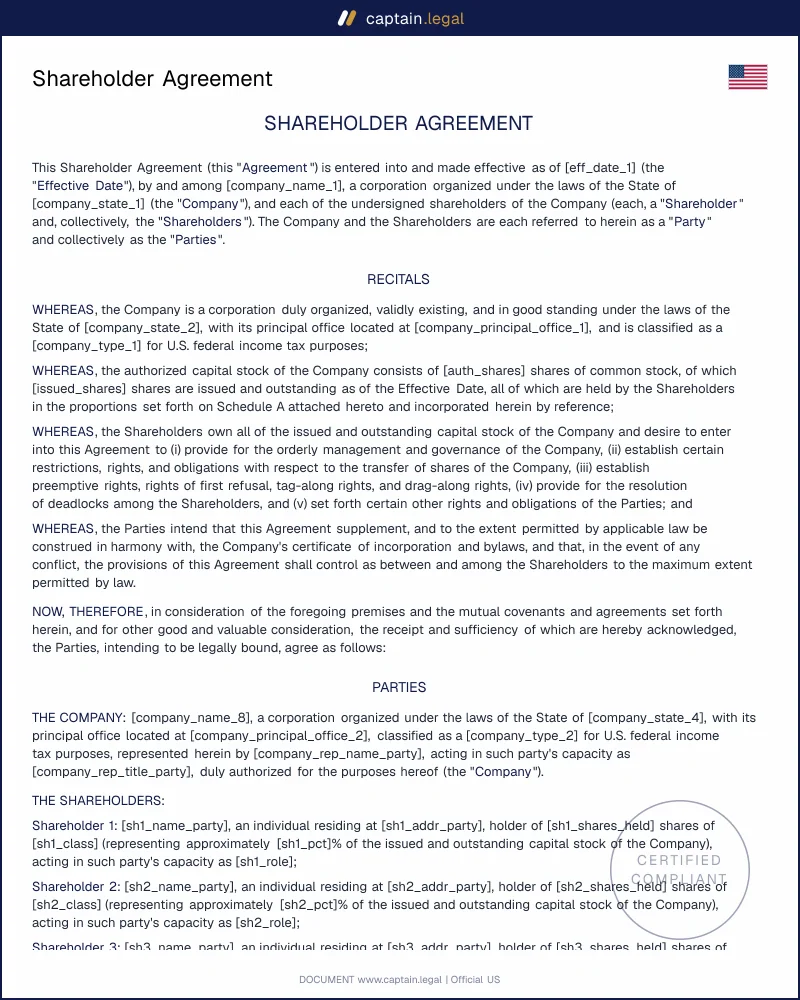
Shareholder Agreement (Stockholders' Agreement) — All 50 States
Secure payment
Legal framework
Shareholder agreements draw their enforceability from two sources : general contract law of the chosen governing-law state, and the corporation statute of the state of incorporation. For most U.S. private companies that means Delaware, California, New York, or Texas corporate codes, plus a contractual choice-of-law clause that ordinarily picks the same jurisdiction or Delaware. The Delaware framework is the most developed and the most cited, which is why even non-Delaware corporations often draft their shareholder agreement to a Delaware standard.
The statutory anchor in Delaware is 8 Del. C. §218, which expressly validates voting agreements among two or more stockholders in writing and signed. Specific enforcement of these voting provisions is well established in Delaware case law, including specific performance of agreed board nominations. Beyond §218, the DGCL leaves wide latitude for private ordering on transfer restrictions under §202, on classes and series of stock under §151, and on stockholder action by written consent under §228. The 2024 amendments to the DGCL further codified the validity of stockholder agreements that allocate governance rights to specific holders, settling questions raised by the West Palm Beach Firefighters' Pension Fund v. Moelis & Co. decision earlier that year. For a clean overview of the statutory text, see the Cornell Legal Information Institute summary of Delaware voting trusts and voting agreements.
For S-Corps the analysis carries an extra constraint. IRC §1361(b) limits an S-Corp to 100 eligible shareholders, only one class of stock, and only U.S. individuals, certain trusts, and a narrow list of permitted entities. A shareholder agreement that creates economic preferences, liquidation waterfalls, or non-pro-rata distributions can inadvertently terminate the S election, because the IRS will treat the agreement as creating a second class of stock under Treas. Reg. §1.1361-1(l). Drafting for an S-Corp therefore requires careful neutrality on economic rights, while still allowing governance and transfer-restriction provisions that do not touch distributions or liquidation proceeds. C-Corp drafters have no equivalent constraint and routinely include preferred-style economic terms when the cap table justifies them. The choice between a C-Corp and an S-Corp structure should be made before the shareholder agreement is finalized, in coordination with the articles of incorporation filed in your state and the chosen tax election.
When do you need this document?
The most common trigger is the moment a corporation has more than one shareholder and the founders have decided not to operate as an LLC. The day the second stock certificate is issued is the day the agreement should already be signed. Waiting until the first dispute is the textbook mistake. Once a co-founder feels squeezed out, every proposed clause looks like a trap, and the conversation that should have taken an afternoon takes six months and a mediator. Sign while everyone still likes each other.
The second trigger is bringing in outside capital, even at a small scale. Angel investors, friends-and-family rounds, and SAFEs that later convert into common or preferred stock all create new owners with new expectations. A shareholder agreement gives the existing holders a framework to absorb new equity without losing control of board composition or transfer mechanics. Most professional investors will insist on one anyway as a closing condition, and they will prefer the company-side template to a heavily negotiated investor draft.
The third trigger is succession planning. Closely-held corporations frequently include life-event clauses : buy-sell mechanics on death, disability, divorce, bankruptcy, or termination of employment are standard in private-company practice. A surviving spouse who inherits 30 % of the voting stock can paralyze a working business overnight if no buyout right exists. The shareholder agreement is where that contingency gets handled, often paired with key-person life insurance to fund the buyout.
One edge case worth flagging : single-shareholder S-Corps that plan to bring in an employee on equity. The moment the second shareholder appears, IRC §1361 eligibility tests apply, and an undocumented oral arrangement risks both the S election and the corporate-veil protection. Draft and sign before the stock certificate is issued, not after.
Key clauses included in our template
- Preemptive rights give existing shareholders the right to maintain their percentage ownership by participating pro-rata in any new issuance of stock. The template offers two variants : a full preemptive right covering all new issuances, and a narrower right that excludes equity compensation pools, stock splits, and recapitalizations. Without this clause, the board can dilute a 25 % holder down to 10 % in a single financing round, lawfully.
- Right of first refusal (ROFR) requires a shareholder who receives a bona fide third-party offer to first offer the same shares, on the same terms, to the other shareholders or to the corporation. The template runs a clean 30-day notice window and addresses partial-acceptance scenarios, which is where most poorly drafted ROFRs fall apart in litigation.
- Tag-along rights protect minority holders when a majority shareholder sells to a third party. The minority can "tag" onto the sale on the same per-share economics, avoiding the worst-case scenario of being left as a minority partner with an unknown buyer. The template fixes the tag percentage to the proportion of the majority's stake being sold, which is the market-standard formula.
- Drag-along rights are the mirror image. They let a defined majority (typically holders of at least 66.67 % or 75 % of voting stock) compel every other shareholder to sell in a qualifying transaction, eliminating the holdout problem in an M&A exit. Delaware courts have upheld carefully drafted drag-alongs including waivers of statutory appraisal rights under §262, following Manti Holdings v. Authentix Acquisition Co. in 2021.
- Board composition and voting agreement allocates board seats by reference to shareholding thresholds and obligates the signatories to vote their shares accordingly at every election. The template includes a removal-and-replacement mechanic so a designating shareholder can swap out a director without convening a full election.
- Deadlock resolution covers the 50/50 and the supermajority-blocked scenarios. The template offers three escalation tiers : mandatory mediation, a buy-sell shotgun (Texas shootout) clause, and a Russian roulette mechanic as the final fallback. Each is drafted to be enforceable under standard contract principles in Delaware and New York.
- Transfer restrictions and permitted transfers carve out estate-planning trusts, controlled affiliates, and family transfers from the general transfer prohibition, while keeping arms-length sales subject to ROFR and tag-along. The legend is drafted to satisfy the conspicuous-notice requirement of DGCL §202(a).
- Confidentiality and non-solicitation bind the shareholders in their personal capacity, supplementing any non-disclosure agreement signed in a commercial context. The non-solicit is drafted to two years, the duration that survives review in most U.S. jurisdictions.
State-specific considerations
Delaware is the default reference for shareholder-agreement drafting whether or not the corporation is incorporated there. The DGCL §218 validates voting agreements, §202 validates transfer restrictions, and the 2024 statutory amendments codified board-composition and consent rights granted directly to shareholders. The Court of Chancery enforces drag-along and appraisal-waiver provisions when the original agreement was negotiated by sophisticated parties with counsel. Drafting to a Delaware standard does not require Delaware incorporation, but it does require a Delaware choice-of-law clause to access this body of case law on enforcement disputes.
California corporations face a distinctive overlay. The California General Corporation Law §706 permits voting agreements and §204(a)(5) permits transfer restrictions, but California's strong public policy against employee non-competes under Bus. & Prof. Code §16600 reaches into shareholder agreements when the restricted shareholder is also an employee. A non-solicit clause that survives in Delaware may be void in California if it is read as a disguised non-compete. The template flags this and offers a California-specific non-solicit variant tied to trade-secret protection under the Uniform Trade Secrets Act.
Texas practice under the Texas Business Organizations Code §21.210 through §21.213 expressly validates shareholder agreements that alter the default governance rules, including agreements that eliminate the board entirely and place management in the shareholders. The Texas drag-along is enforceable as a specific-performance remedy under Tex. Bus. Orgs. Code §21.213(b). One drafting trap : Texas does not recognize the broad-form fiduciary-duty waivers that Delaware permits, so a shareholder agreement governed by Texas law should keep duty modifications narrow and tied to specific transactions.
New York corporations operate under N.Y. Bus. Corp. Law §620(b), which permits shareholder agreements to restrict board discretion but requires unanimous shareholder consent and a notation on each stock certificate. The unanimity rule is the trap. A 90 % shareholder agreement that purports to restrict board action in New York is unenforceable as to the non-signing 10 %, and case law has voided board decisions taken under such agreements. Plan for unanimity at the front end or restructure the restriction as a voting agreement under §620(a), which has no unanimity requirement.
Florida under the Florida Business Corporation Act §607.0732 takes a more permissive approach modeled on the MBCA, allowing shareholder agreements signed by all shareholders to govern almost any aspect of corporate affairs, including the elimination of the board. Florida courts have enforced these agreements aggressively even in close-corporation disputes, making the document particularly valuable for family-owned Florida corporations.
Common mistakes to avoid
The first mistake is treating the shareholder agreement as boilerplate. A template signed without reading is worse than no template at all, because it creates rights and obligations the parties did not actually negotiate. Walk through every defined threshold (drag-along percentage, ROFR window, deadlock trigger) with the other shareholders before signing, and document the rationale for each in a side memo. The second mistake is mismatching the governing law to the state of incorporation without thinking. A Texas corporation governed by Delaware law works, but the interaction between DGCL default rules and the Texas filing requirements creates enforcement friction that most founders did not anticipate.
The third mistake is forgetting the stock certificate legend. DGCL §202(a) and equivalent statutes in most states require transfer restrictions to be noted conspicuously on the certificate or in the book-entry record for the restriction to bind a transferee who took without actual notice. A perfectly drafted ROFR that does not appear on the certificate is enforceable against the seller but not against an arms-length buyer. The template generates the legend text ; it still needs to be physically added to the certificates. The fourth, particularly damaging, mistake on S-Corps is including any economic preference that the IRS will read as creating a second class of stock : disproportionate distributions, liquidation preferences, or capital-account adjustments. An invalid S election triggers retroactive C-Corp tax treatment and personal liability for the shareholders who relied on the pass-through. The fifth mistake is signing without spousal consent in community-property states. A shareholder in California, Texas, Arizona, or Washington who signs a transfer restriction without the spouse's joinder may find the restriction unenforceable as to the community half of the shares.
Frequently Asked Questions
30 verified reviews · 50 000+ downloads
- Immediate access to the document
- PDF + Word download
- Compliant with 2026 legislation
- Reviewed by lawyers
You might also like