A properly drafted Independent Contractor Agreement is the single most effective document a US business can use to defend the 1099 classification of a worker against an IRS audit, a Department of Labor investigation, or a private misclassification lawsuit. The agreement is not just paperwork. It is the written record of an arms-length relationship between a hiring company and a self-employed contractor, and it is the first exhibit every plaintiff's lawyer subpoenas when a freelancer files a wage-and-hour claim. The document sets the scope of work, the payment structure, the ownership of intellectual property, the confidentiality regime, and the explicit acknowledgement that the contractor is not an employee. Get any of those wrong and the entire 1099 arrangement is exposed.
This page walks through what a US-compliant independent contractor agreement must cover in 2026, how it interacts with the IRS common-law test and the FLSA economic-realities test, and where the state-by-state landscape (especially California's ABC test) imposes additional constraints. It is written for founders, operators, and small-business owners who hire freelancers, consultants, and 1099 workers and who need a contract that holds up under audit.
Compliant
2026 Legislation
50,000+ clients
trust us
Affordable
From $4.90 / doc
Secure payment
Instant download
Freelance Contractor Agreement Template | 1099, IP, NDA Ready
Secure payment
What is an independent contractor agreement?
An independent contractor agreement, sometimes called a freelance agreement, a consulting agreement, or simply a 1099 contract, is a written contract between a business (the client or hiring party) and a self-employed worker (the contractor) that defines the services to be performed, the compensation, and the terms under which the contractor operates as an independent business rather than as an employee. The contract is the centerpiece of the 1099 relationship, named after the Form 1099-NEC the client must file with the IRS when total payments to the contractor reach $600 or more in a calendar year.
The agreement is fundamentally different from an employment contract. An employee works under the direction and control of the employer, receives a W-2, has payroll taxes withheld, and is covered by the Fair Labor Standards Act, workers' compensation, and unemployment insurance. A contractor controls the means and methods of the work, invoices the client, pays self-employment tax under §1401 of the Internal Revenue Code, supplies their own tools, and bears the risk of profit or loss. The written agreement is the document that memorializes those distinctions and is read closely by the IRS, the Department of Labor, and state labor commissioners when classification is challenged. A handshake or an email exchange is not enough. Without a signed agreement, the burden of proving independent-contractor status shifts almost entirely onto the hiring party, and the default presumption in most jurisdictions today is that the worker is an employee.
Legal framework
No single federal statute governs the independent-contractor relationship in the United States. Classification is determined by a layered framework that combines tax law, wage-and-hour law, anti-discrimination statutes, and state-specific tests, and the Independent Contractor Agreement must be drafted with all of them in mind.
The starting point is the Internal Revenue Service common-law test, codified in Treas. Reg. §31.3121(d)-1(c)(2) and developed through Revenue Ruling 87-41 into the well-known twenty-factor test. The IRS groups those factors into three categories: behavioral control (who decides how the work is done), financial control (who bears the economic risk and supplies the tools), and the type of relationship (written contract, permanence, employee-type benefits). The agency uses this framework to decide whether a worker should have received a Form W-2 instead of a Form 1099-NEC, and it is the basis for the Form SS-8 determination procedure available to either party. Captain.Legal's broader library of US business and incorporation templates is designed so the contractor agreement aligns with the corporate-structure documents a founder typically signs at the same stage.
The second federal layer is the Fair Labor Standards Act and its economic-realities test, applied by the Department of Labor and the federal courts. The economic-realities analysis asks whether the worker is, as a matter of economic reality, in business for themselves or dependent on the hiring entity for work. Two factors carry the most weight under the framework the DOL is currently moving toward: the nature and degree of control over the work and the worker's opportunity for profit or loss. Three secondary factors round out the test: the skill required, the permanence of the relationship, and whether the work is part of an integrated unit of production. The 2024 DOL rule and the proposed 2026 rescission have created some regulatory turbulence, but the underlying economic-realities case law from the federal circuit courts has been stable for decades and is what judges actually apply. The Cornell Legal Information Institute maintains a useful summary of the FLSA economic-realities test and the underlying Supreme Court precedent, which is the most authoritative free reference on the topic.
A third layer sits at the state level and is increasingly decisive. California, Massachusetts, and New Jersey apply the ABC test, under which a worker is presumed to be an employee unless the hiring party proves all three prongs: (A) the worker is free from control, (B) the work is outside the usual course of the hiring business, and (C) the worker is engaged in an independently established trade. The B prong is the one that defeats most California 1099 arrangements, and it was codified in California Labor Code §2775 by AB 5 in 2019. New York, Illinois, and a growing list of states apply hybrid tests. Several states also impose written-contract requirements above a payment threshold (New York Freelance Isn't Free Act, Illinois Freelance Worker Protection Act, Los Angeles Freelance Worker Protection Ordinance), each of which dictates specific terms the agreement must include.
When do you need this document?
The single most common trigger is hiring a freelancer or consultant for a discrete project : a developer building a feature, a designer producing a brand identity, a marketer running a campaign, a fractional CFO closing the books. Any time a US business pays an individual or a single-member LLC $600 or more in a calendar year for services, the engagement should rest on a written contractor agreement, regardless of how informal the working relationship feels. The $600 threshold is the IRS reporting floor for Form 1099-NEC, and the absence of a written contract at audit time is read as evidence that the parties never seriously addressed classification.
The second scenario is the conversion of an existing relationship, often when a former employee comes back to do project work or when a long-term freelancer is finally formalized. Conversions are the highest-risk fact pattern because the worker has historical ties to the company, may still use the same email address or office, and is statistically likely to be reclassified by a labor commissioner. The agreement must explicitly reset the relationship, document the contractor's other clients, and confirm the new lack of control over hours and methods. The third common trigger is the engagement of an offshore or remote contractor, where the agreement must address tax residency, W-8BEN certification for non-US persons, sanctions compliance, and the governing-law clause that determines which courts will hear a dispute.
Edge cases worth flagging include staffing-agency arrangements (where a joint-employment theory may pull the end client into liability), platform workers delivered through a marketplace (where the ABC test has produced very different outcomes in Dynamex and the Prop 22 aftermath), and startup advisors who receive equity rather than cash, in which case the contractor agreement must be paired with a separate advisor stock-option grant. For founders who anticipate complex IP creation by contractors, the document should ideally be reviewed alongside the LLC operating agreement that governs ownership of the underlying business so that the chain of title to the work product is unbroken.
Key clauses included in our template
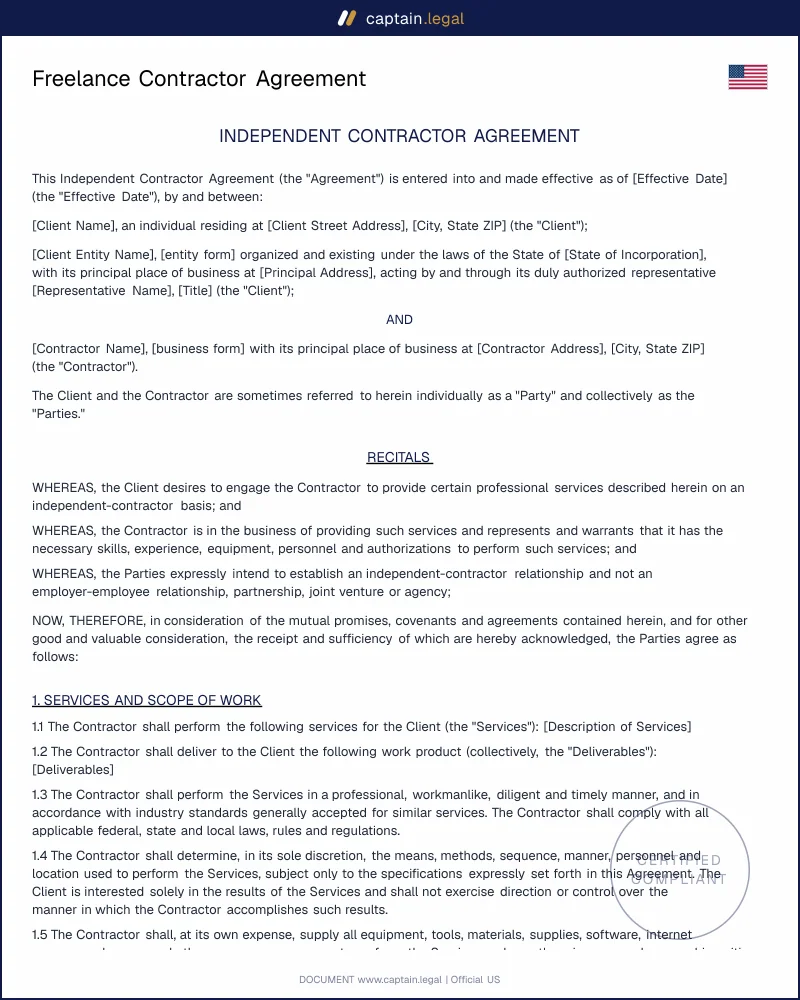
The Captain.Legal Independent Contractor Agreement is drafted to the standard of a top-tier US firm and contains every clause a sophisticated client would expect to see. The structure tracks the IRS classification factors so that each provision affirmatively supports the 1099 status of the worker.
- The identification of the parties and the recital of independent-business status opens the agreement and is more substantive than it looks. The contractor is identified by legal name, business entity if any, tax-ID type (EIN or SSN), and business address, and the recitals affirmatively state that the contractor operates an independent trade, holds itself out to the public, and serves other clients. Courts look at recitals when the operative provisions are ambiguous, and a precise recital block is the first line of defense in a misclassification claim.
- The scope of work is captured either in the body of the agreement or, more commonly, in a Statement of Work exhibit that can be amended without rewriting the master contract. Captain.Legal's template uses the MSA + SOW architecture familiar from enterprise services contracts, which means a founder can sign a contractor once and then issue successive SOWs for new projects without renegotiating boilerplate.
- The compensation and payment terms specify the fee structure (fixed fee, hourly rate with a cap, milestone-based, or retainer), the invoicing cadence, the net-30 or net-15 payment window, the late-fee mechanism, and the absence of withholding. The clause also states that the contractor is responsible for self-employment tax and estimated quarterly payments under §6654 of the Internal Revenue Code, which is the contractual mirror of the 1099-NEC relationship.
- The intellectual-property assignment is the most negotiated clause in any well-drafted contractor agreement. The template uses a hybrid work-made-for-hire plus present assignment construction : the work is deemed a work made for hire under §101 of the Copyright Act to the extent that doctrine applies, and to the extent it does not, the contractor presently assigns all right, title, and interest to the client. This double-barrel approach closes the well-known §101 gap for software, where most code does not qualify as work made for hire because it is not one of the nine enumerated categories.
- The confidentiality and restrictive-covenant block protects client data, trade secrets, and customer lists, with a survival period calibrated to the type of information. The non-compete portion is drafted to be enforceable only in states where post-engagement restrictions are still permitted (the FTC non-compete ban is enjoined as of 2026, but state-level limits in California, Minnesota, Oklahoma, and North Dakota still apply). For richer protection, the agreement is often paired with the Captain.Legal non-disclosure agreement template signed at the kickoff of a sensitive project.
- The independent-contractor representations and indemnities are the crown jewel of the document. The contractor represents that they control their own schedule, supply their own tools, can hire subcontractors, are not entitled to employee benefits, and will defend and indemnify the client against any misclassification claim brought by the contractor's own subcontractors or by a tax authority on the contractor's behalf. Termination, governing law, and dispute resolution clauses close the agreement.
State-specific considerations
Worker classification is the area of US law where federal and state rules diverge most sharply, and a one-size-fits-all template is a liability. Captain.Legal's Independent Contractor Agreement adjusts its substantive clauses based on the governing-law state selected at the start of the questionnaire.
California is the most aggressive jurisdiction. California Labor Code §2775, codified from AB 5 in 2019 after the Dynamex Operations West v. Superior Court decision, applies the ABC test by default, and the B prong (work performed outside the usual course of the hiring business) defeats most freelance arrangements with a tech company that hires developers, a marketing agency that hires copywriters, or a media company that hires journalists. AB 2257 added more than 100 occupational exemptions (lawyers, doctors, real-estate agents, accountants, freelance writers under a 35-submission ceiling), each with their own business-to-business prerequisites. A California-governed agreement must contain the §2775 B-prong recital, document the contractor's separate business entity, and reference applicable exemptions by statute.
Texas sits at the opposite end. The state generally follows the common-law right-to-control test developed by the Texas Workforce Commission, applies it through Form C-8 determinations, and has no ABC-style presumption. A Texas-governed agreement focuses on documenting control, profit-and-loss risk, and the contractor's general liability and workers'-compensation coverage. The single Texas trap is the construction industry, where Texas Labor Code §406.144 presumes employment unless a written agreement and a specific certificate are filed with the Division of Workers' Compensation.
Florida also follows a common-law approach under Florida Statutes §440.02(15)(d) for workers' compensation purposes, with a ten-factor test that mirrors the IRS framework. The trap in Florida is the construction industry exemption, which requires the contractor to file with the Division of Workers' Compensation to be excluded from coverage. Florida agreements should reference §440.02(15)(d)(1) explicitly when the work is in a covered trade.
New York applies a common-law control test for most purposes but has layered the Freelance Isn't Free Act (now statewide under General Business Law §1410-1415, effective August 28, 2024) on top. The act requires a written contract for any independent-contractor engagement of $800 or more (single project or aggregated over 120 days), payment within the contracted period (or within 30 days of completion if silent), and exposes the client to double damages plus attorneys' fees for violation. A New York-governed Captain.Legal agreement automatically inserts the FIFA required terms : itemized services, rate and method of compensation, payment date or mechanism, and the contractor's address and the client's address.
Other states impose targeted layers. Illinois enforces the Illinois Freelance Worker Protection Act (effective July 1, 2024) along the same lines as New York. Massachusetts applies a strict ABC test under M.G.L. c. 149 §148B that is even harder to satisfy than California's because the B prong has no statutory exemptions. New Jersey applies N.J.S.A. 43:21-19(i)(6) with similar rigor. Each of these states is handled by the Captain.Legal generator at the governing-law step.
How to fill out this independent contractor agreement
The Captain.Legal flow is built so a non-lawyer founder can produce a defensible agreement in roughly ten minutes. You begin by selecting the governing-law state, which is the single most important decision because it drives the ABC test logic, the FIFA-style required terms, and the enforceability of the restrictive covenants. From there, the form asks for the legal name of the client (typically an LLC or corporation), the legal name and tax-ID type of the contractor, and whether the contractor is a US person or a foreign entity that will require a Form W-8BEN on file rather than a Form W-9.
The questionnaire then moves into the substance of the engagement. You describe the services in plain language, the deliverables and acceptance criteria, the start date and the term (fixed end date, project completion, or evergreen with a thirty-day termination for convenience), and the compensation structure. The template handles fixed fees, hourly billing with caps, milestone-based payment, and retainers, and it inserts the right net-X invoicing language for the state you selected. For sensitive engagements you can opt in to extended confidentiality survival periods, non-solicitation of clients and employees, and a liquidated-damages schedule for IP leakage. The final block addresses dispute resolution (litigation in a specified venue or AAA commercial arbitration), governing law, and the integration and amendment clauses.
Once the questions are answered, the agreement is generated as a single PDF and an editable Word file, with the Statement of Work as a separate exhibit and a signature block that supports DocuSign and other electronic-signature platforms under the E-SIGN Act and UETA. The two files are ready to send to the contractor for countersignature.
Common mistakes to avoid
The mistake we see most often is the copy-paste of a template found online that does not match the governing-law state. A California agreement using a Texas-style right-to-control recital is worse than no agreement at all, because it signals to a labor commissioner that the parties never seriously considered the ABC test. The second recurring error is the omission of a present-assignment clause for intellectual property, on the assumption that the work-made-for-hire doctrine alone covers the work. It does not for most software code, most architectural plans, and most marketing materials that fall outside the nine §101 categories, and the client ends up with an irrevocable license at best rather than ownership. This single drafting gap is the most common cause of failed acquisitions during diligence, when the buyer's counsel discovers that key code was never properly assigned.
The third error is the inclusion of employee-style provisions in a contractor agreement : paid time off, benefits eligibility, mandatory training hours, fixed daily schedules, performance reviews on the company's Workday instance. Each of those provisions is treated by the IRS and the DOL as evidence of an employer-employee relationship, and a single offending clause can outweigh the rest of the agreement. The fourth mistake is payment without a Form W-9 on file for US persons, which exposes the client to backup withholding at 24% under §3406 of the Internal Revenue Code and creates a Form 1099-NEC filing nightmare at year-end. The fifth, and most expensive, is the failure to update the contract when the engagement materially changes, for example when a project-based freelancer drifts into a full-time-equivalent role without a corresponding conversion to W-2 status. Periodic recertification of contractor relationships, paired with a calendar reminder to issue fresh SOWs, is the discipline that separates a clean 1099 program from one waiting for an audit notice.
Frequently Asked Questions
30 verified reviews · 50 000+ downloads
- Immediate access to the document
- PDF + Word download
- Compliant with 2026 legislation
- Reviewed by lawyers
You might also like