Create my document
Login

Choose country

FranceBelgiqueEspañaUnited StatesUnited KingdomالمغربDeutschlandItalia
Employment

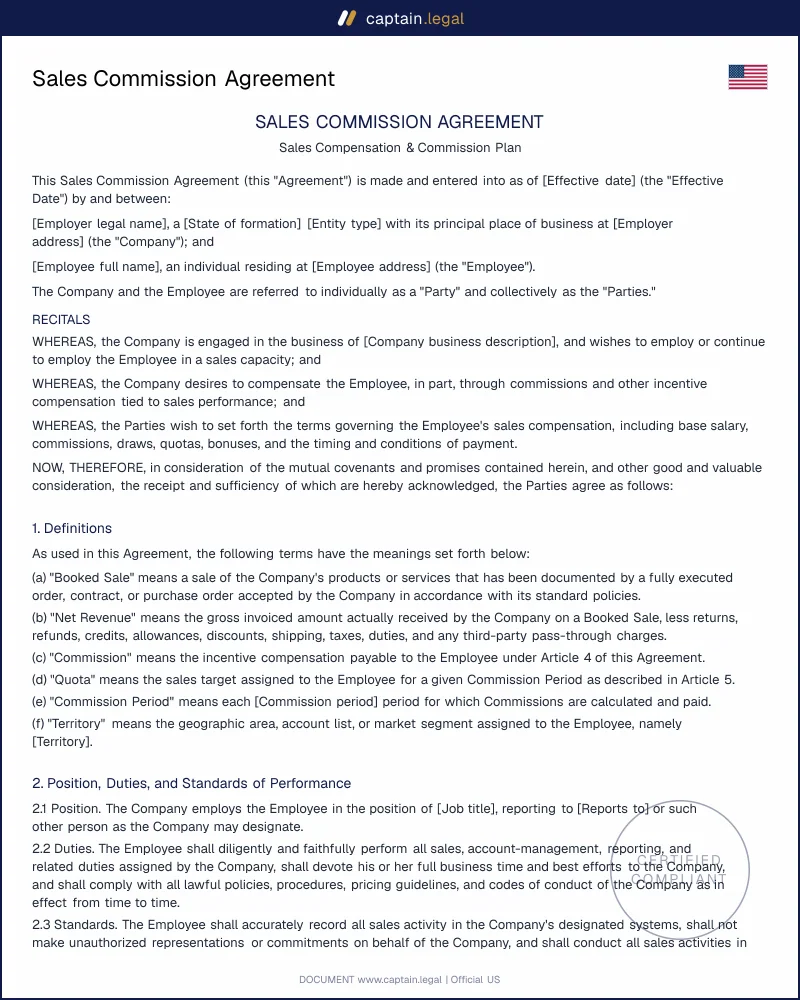
Commission Agreement for Sales Employees (US Template)

Set clear commission rates, quotas and payment schedules with a compliant sales compensation agreement. §2751-ready, signed and downloadable in Word & PDF.
4.8/522 reviews50 000+ downloadsInstant download
Share

A commission agreement for sales employees is the written instrument that fixes how a salesperson earns variable pay: the commission rate, the bonus triggers, the quotas, and the exact dates money lands in the bank account. Without it, every closed deal becomes a potential argument. This sales compensation agreement spells out what counts as a "sale," when a commission is earned versus merely credited, and what happens to pending deals when the rep resigns or gets fired. It is the single document that separates a clean payroll run from a wage claim, and in several states an employer who pays commissions without one is already breaking the law.

The agreement works for inside sales reps, field account executives, regional managers, and any role where part of the paycheck moves with revenue. It pairs naturally with an at-will employment contract for US employers and a standard US offer letter covering salary and start date, filling the one gap those documents leave open: the math behind the variable pay.

Compliant

2026 Legislation

50,000+ clients

trust us

Affordable

From $4.90 / doc

Secure payment

Instant download

Commission Agreement for Sales Employees (US Template)

Secure payment · No subscription

Fill in the template

What is a commission agreement for sales employees?

A commission agreement is a contract that ties a portion of an employee's compensation to sales performance, defining the commission structure, the quota or threshold that unlocks payment, and the payment schedule that governs when earned amounts are disbursed. It sits on top of base salary rather than replacing it for most W-2 roles, because federal and state wage law still require a floor. The document answers the questions that verbal promises never quite cover: Is commission paid on booking, on invoice, or on cash collected? Does a deal that closes after the rep leaves still pay out? What happens to a chargeback when a customer cancels?

People often confuse this with a bonus plan, and the distinction matters legally. A true commission varies proportionally with the value or number of units sold, while a discretionary bonus sits at the employer's option and follows different rules. California's statute, for instance, expressly carves short-term productivity bonuses and most profit-sharing plans out of the commission definition. Drafting the agreement as a commission plan when the pay is really discretionary, or vice versa, creates the kind of mismatch that surfaces later in a Labor Commissioner hearing. The cleanest agreements name the compensation type honestly and then build the calculation to match. A sales rep reading the document should be able to compute their own check; if they cannot, the plan is too vague to defend.

2

When do you need this document?

The most common trigger is the first commissioned hire, the moment a startup or small business moves from paying flat salaries to paying for performance. That first plan sets a precedent every later rep will point to, so getting the earned-versus-credited language right early saves years of cleanup. The second trigger is a plan change: raising a quota, lowering a rate, adding an accelerator, or capping payouts. Changes made by email or in a sales kickoff slide deck are exactly what produced the IBM litigation, where reps argued they were promised uncapped commissions and then saw credits reversed. A signed amendment to the written agreement closes that exposure.

You also need the document whenever commission structures get complicated: tiered rates, team-split deals, multi-year contracts paid on annual recurring revenue, or clawbacks for canceled accounts. The more moving parts, the more a verbal understanding falls apart. Two edge cases legitimately call for extra care. The first is the rep who closes a large deal and then resigns before the customer pays. Whether that commission is owed turns entirely on the plan's definition of "earned," and silence almost always favors the employee in court. The second is the manager who earns an override on a team's sales. Override math is its own clause, because it layers a second commission on the same revenue, and a plan that forgets to define the override base creates double-counting fights at year-end. Companies pairing commissioned roles with restrictive covenants should also review their non-compete and non-solicitation agreement for US employers, since a departing rep with a client book is precisely the situation those clauses are built for.

3

Key clauses included in our template

  • The compensation structure clause defines base salary, commission rate, and any tiers or accelerators in plain numbers a rep can actually calculate. It separates earned commission from projected pipeline, because that single definition decides who wins a post-termination dispute. The clause also states the basis (booking, invoice, or collected revenue) so there is no argument about which event triggers the pay.
  • The quota and threshold clause sets the sales target that must be met before commissions or accelerators apply, along with the measurement period (monthly, quarterly, annual). It specifies how a shortfall is treated and whether quotas reset, which prevents the recurring fight over whether last quarter's miss carries forward.
  • The payment schedule clause ties commission disbursement to specific dates and payroll cycles, satisfying state timing rules. It addresses the lag between a closed sale and a paid commission, and confirms that earned amounts are paid on the next regular payroll after they vest.
  • The clawback and chargeback clause governs what happens when a customer cancels, refunds, or fails to pay. It defines the recovery window and the cap on clawbacks, language that several states scrutinize closely because an aggressive clawback can effectively claw back earned wages.
  • The post-termination clause is the one most plans omit and most lawsuits target. It states whether deals in the pipeline at separation pay out, and on what timeline, removing the ambiguity that §2751 and similar statutes resolve against silent employers.
4

State-specific considerations

California runs the strictest regime in the country. Under §2751 California Labor Code, any commission arrangement for services performed in the state must be a written contract that explains the computation and payment method, must be signed, and the employer must keep a signed receipt from the employee. There is no verbal-agreement exception. Earned commissions are wages under the Labor Code, so withholding them after termination can trigger §203 waiting-time penalties of up to thirty days of pay. The state also reads its narrow exemptions strictly, so an inside rep classified as exempt purely because of commission income is a frequent audit target.

New York treats commission salespersons as a protected category under Labor Law §191 and §191-c. Employers must furnish a written agreement describing how wages, salary, drawing accounts, commissions, and other compensation are calculated, and disputed earned commissions are presumed owed unless the written terms say otherwise. New York courts construe gaps against the drafting employer, which makes a precise earned-commission definition essential rather than optional.

Texas has no statute forcing commission plans into writing, so the agreement is governed by ordinary contract principles and the Texas Payday Law. That freedom is a trap: without a written plan defining "earned," the Texas Workforce Commission and courts will enforce whatever the parties' conduct and any writing suggest, often unpredictably. A clear written agreement is the employer's only real protection here.

Florida likewise imposes no specific commission-writing statute and follows general contract law, but Florida courts routinely enforce written commission terms exactly as drafted, including post-termination forfeiture clauses, provided the language is unambiguous. A vague Florida plan, by contrast, tends to be read in the employee's favor. The practical takeaway across all four states is identical: the written agreement, not the state, is what protects you, and a US employee termination letter that addresses final pay should always reconcile with the commission plan's payout terms at separation.

5

How to fill out this commission agreement

You start by entering the parties: the employing company and the sales employee, with the state where services are primarily performed, because that selection drives which wage rules the document flags. From there the form asks for the compensation backbone, the base salary if any, the commission rate or tier table, and whether commissions are calculated on bookings, invoiced amounts, or collected revenue. You then set the quota and the measurement period, and decide whether accelerators kick in above target.

Next you define the payment schedule, choosing the payroll cycle on which earned commissions are paid and the lag between a closed sale and disbursement. The clawback section lets you set a recovery window for canceled or unpaid deals and a cap on how much can be reclaimed. The post-termination section is where you make the decision that matters most, whether pipeline deals pay out after the rep leaves and on what timeline, so the document never goes silent on that point. Once the fields are complete, you download the agreement in Word and PDF, sign it, and have the employee sign both the agreement and the receipt. Employers building a full hiring packet often complete the commission plan alongside other US employment templates in the same category so the documents reference each other cleanly.

6

Common mistakes to avoid

The mistake that produces the most litigation is leaving "earned" undefined. When a plan never states whether a commission vests at booking, at invoice, or at cash collection, a rep who closes a deal and then departs will argue the commission was already earned, and a silent contract hands them the advantage. A close second is changing the plan informally. Announcing a new quota in a sales meeting or a quarterly email, without a signed amendment, leaves the old written terms controlling and exposes the employer to exactly the bait-and-switch claims that have produced large settlements. Aggressive clawbacks are the third trap: a clause that recovers commissions long after they were paid can be treated as an unlawful deduction from wages in several states, turning a recovery clause into a penalty against the employer.

Two further errors recur in practice. Employers frequently misclassify commissioned inside reps as overtime-exempt, assuming the commission alone qualifies them, when the FLSA exemptions are narrow and a misclassified rep generates back-pay liability. And many businesses use one generic plan across every state, ignoring that California and New York demand specific written terms while Texas and Florida enforce whatever the contract says. A single template stretched across all fifty states without state-aware language is how a compliant-looking document becomes the centerpiece of a wage claim. The fix in every case is the same: define the math, sign the changes, and match the plan to the state.

Key takeaways

Deal definition

Put the commission math in writing

This agreement should spell out what counts as a sale and when a commission is earned versus merely credited. It also needs the triggers (quota or threshold), the rate, and the payment schedule so the rep can calculate a paycheck without guessing. If those basics are vague, every closed deal can turn into a dispute about booking vs invoicing vs cash collected.

State compliance

California requires a signed written plan

State wage laws drive many commission disputes, and California is especially strict. Under California Labor Code Section 2751, employers paying commissions for services performed in the state must have a written agreement that explains how commissions are computed and paid, provide the employee a signed copy, and obtain a signed acknowledgment. Skipping the paperwork can mean noncompliance even if you pay on time.

Wage risk

Commissions do not erase wage laws

A commission plan sits on top of wage-and-hour rules, not outside them. The Fair Labor Standards Act still requires minimum wage and may require overtime, and being paid on commission does not automatically make someone overtime-exempt. The outside sales and Section 7(i) retail commission exemptions are narrow. Misclassifying an inside rep can create overtime liability regardless of what the plan says.

Frequently Asked Questions

Yes. A commission agreement is a binding contract once both the employer and the sales employee sign it and consideration exists, which is satisfied by the employment relationship and the promised pay. To hold up, the document must clearly state the commission rate, how commissions are computed, the quota, and the payment timing. In states like California under §2751, the writing is not just advisable but legally required, and an unsigned or vague plan can be read against the employer. The template produces an enforceable agreement provided you complete the calculation fields honestly and both parties sign, along with the employee receipt where the state requires one.

In several states, yes, and even where it is optional, writing is the only real protection. California Labor Code §2751 mandates a signed written commission agreement for any employee performing services in the state, and New York Labor Law §191 requires a written description of how commissions are calculated for commission salespersons. Texas and Florida have no such statute, but their courts enforce written terms as drafted and treat verbal arrangements as guesswork. A written plan that defines when commissions are earned is what keeps a closed-deal dispute out of court, so writing is the practical standard nationwide regardless of whether a specific statute compels it.

You receive the commission agreement in both Word and PDF formats. The Word file lets you edit clauses, adjust the commission rate or quota table, and track changes if your team negotiates the terms internally before signing. The PDF is the clean, print-ready version you use for signature and for storing the executed copy in your personnel files. Keeping the signed PDF together with the employee's signed receipt is the record that satisfies state writing-and-receipt requirements, so most employers archive both files in the same folder for each commissioned hire.

That depends on your plan's definition of "earned" and on state timing rules, which is why the payment-schedule clause matters so much. Commissions are typically paid on the next regular payroll after they vest under the agreement's terms, whether that vesting point is booking, invoicing, or cash collection. State law sets outer limits: many states treat earned commissions as wages that must be paid promptly, and California can impose waiting-time penalties for late payment after termination. The agreement should state the disbursement cycle explicitly so neither side guesses, and the vesting trigger should be unambiguous enough that a rep can predict the date.

Only if the written agreement says so. This is the single biggest source of commission litigation. If the plan defines a commission as earned at booking and you booked the deal before resigning, you generally have a strong claim. If the plan is silent or requires you to be employed on the payout date, the answer flips. Courts in employee-friendly states tend to resolve genuine ambiguity in the worker's favor, but the cleanest outcome is a post-termination clause that states plainly whether pipeline deals pay out and on what schedule. Read that clause before signing, because it controls your last paycheck.

An employer can change a commission plan going forward, but generally not retroactively, and changes should be documented with a signed amendment rather than an email or a meeting announcement. Commissions you already earned under the prior plan are usually protected as wages, so a mid-quarter rate cut cannot lawfully reach back to claw them away. The IBM litigation turned on exactly this point, where reps alleged the company reversed sales credits after promising no cap. A signed amendment that takes effect on a clear date keeps prospective changes enforceable while protecting commissions that have already vested.

A commission varies proportionally with the value or number of units sold, while a bonus is usually a discretionary or fixed reward that does not scale directly with each sale. The distinction is not cosmetic. Some state statutes apply only to commissions, and California's law expressly excludes short-term productivity bonuses and most profit-sharing from the commission definition. Labeling discretionary pay as a commission, or treating a true commission as a bonus, creates a compliance mismatch. The agreement asks you to name the compensation type accurately so the calculation, the timing, and the legal obligations all line up with what you are actually paying.

The template is built for W-2 sales employees, where wage law, overtime exemptions, and state commission statutes apply. Independent contractors operate under a different framework, governed by the contractor agreement and general contract law rather than employee wage protections. If you pay commissions to a 1099 salesperson, the commission math and payment terms can be similar, but the surrounding obligations differ, and misclassifying a contractor as a way to dodge commission-wage rules is a serious risk. For a contractor relationship, a dedicated services contract is the better starting point, with the commission terms folded into its payment section.

4.8/5

22 verified reviews · 50 000+ downloads

Commission Agreement for Sales Employees (US Template)
  • Immediate access to the document
  • PDF + Word download
  • Compliant with 2026 legislation
  • Reviewed by lawyers
Fill in the template
Secure payment · No subscription
Updated on May 29, 2026

You might also like

Remote Work Agreement Template
Internship Agreement Template