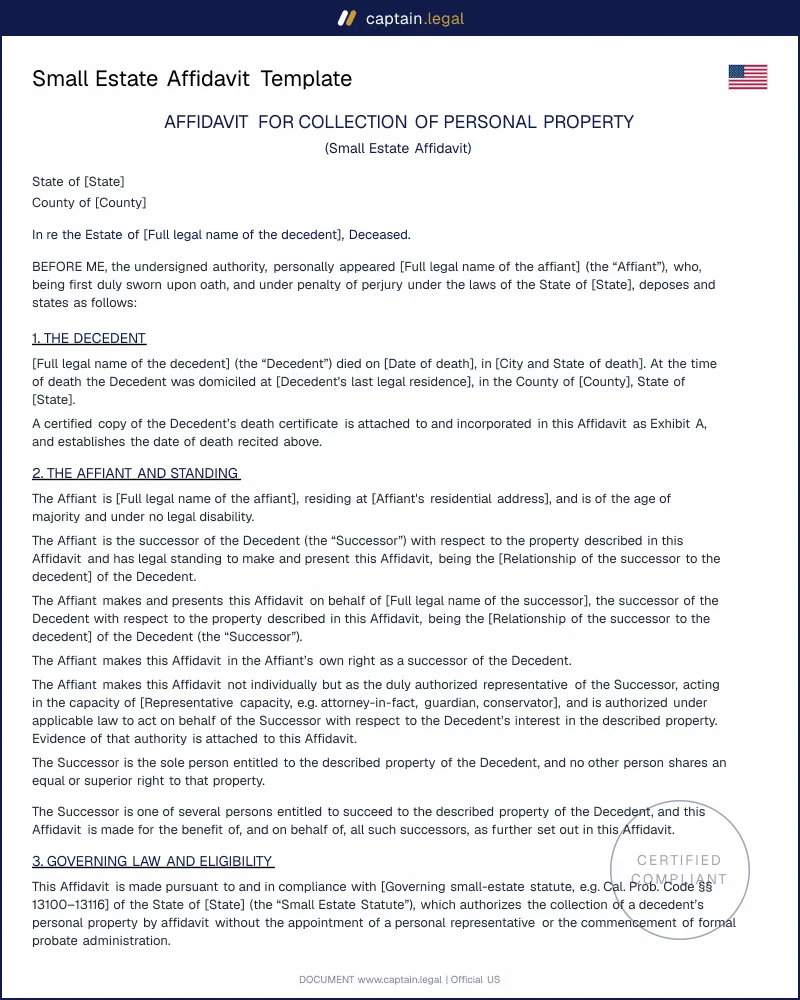
California sets one of the highest thresholds in the country. Under §13100 of the Probate Code, an heir may collect personal property up to $208,850 for deaths on or after April 1, 2025, a figure that climbs to $239,700 for deaths on or after April 1, 2026 under the inflation mechanism in §890. The affidavit cannot be presented until 40 days have passed since the death, and it may not be used if a probate case is pending. California treats real property separately, so a house cannot ride along on the personal-property affidavit; a distinct procedure under §13200 handles real property of small value, and a primary residence can move through a separate petition without counting against the personal-property cap.
Texas runs a more restrictive regime. Chapter 205 of the Texas Estates Code permits a small estate affidavit only when the decedent died intestate, meaning without a will, and caps the estate at $75,000 after excluding the homestead and exempt property. Texas is unusual in requiring the affidavit to be filed with the court and approved by a judge before it operates, and the estate's non-exempt assets must exceed its non-exempt debts. At least 30 days must pass after death. A qualifying homestead can transfer under the affidavit only in narrow circumstances involving a surviving spouse or minor children.
Florida does not use a self-executed affidavit for most estates. It runs summary administration under F.S. §735.201, a streamlined court process ending in a judge's order that banks and title companies accept readily. The threshold historically sat at $75,000 of non-exempt assets, but CS/HB 1337, signed April 29, 2026, doubles it to $150,000 effective July 1, 2026. An estate also qualifies regardless of value if the decedent has been dead more than two years. Florida homestead property is excluded from the calculation under the state constitution.
New York offers voluntary administration under Article 13 of the Surrogate's Court Procedure Act, available when the decedent left personal property with a gross value of $50,000 or less, exclusive of property set off to the family. A voluntary administrator is appointed through the Surrogate's Court, and the procedure works whether or not the decedent left a will. Because thresholds and mechanics diverge this sharply, always confirm the current figure for the state of the decedent's residence before drafting, and note that the state where the assets sit, not where the heir lives, usually controls.