Employment

Bonus Plan Template | 29 CFR 778.211 & 409A Ready

Employee bonus plan drafted to FLSA 29 CFR 778.211, IRC 409A timing and SEC Rule 10D-1 clawbacks. State-aware for CA, NY, MA, IL and TX. Word and PDF.
4.5/510 reviews50 000+ downloadsInstant download
Share

An employee bonus plan is the written instrument that tells your workforce how extra compensation is decided, measured and paid, and tells a court how much discretion you actually kept. Employers use it for annual performance awards, retention and signing bonuses, profit-sharing pools and spot recognition payments in all 50 states. The document earns its keep in two moments: when someone resigns three weeks before the payout date and demands the money anyway, and when a wage-and-hour auditor asks whether the bonus belonged in overtime pay. A plan with clean eligibility conditions, honest discretion language and a workable clawback mechanism keeps both problems small. A manager email promising a bonus "if the year goes well" does the opposite.

Compliant

2026 Legislation

50,000+ clients

trust us

Affordable

From $4.90 / doc

Secure payment

Instant download

Bonus Plan Template | 29 CFR 778.211 & 409A Ready

Secure payment

Fill in the template

What is an employee bonus and incentive compensation plan?

An employee bonus plan is a unilateral compensation document adopted by the employer and communicated to participants, setting the eligibility pool, the performance metrics, the measurement period, the payment date and the conditions that must still be satisfied when payment falls due. It is not a negotiated contract, but courts treat it as one the moment its terms are definite enough to rely on. Everything turns on a distinction most employers get wrong: whether the bonus is discretionary or nondiscretionary. Under 29 CFR 778.211(b), a bonus is discretionary only if the employer keeps control over both the fact of payment and the amount until a time quite close to the end of the measurement period. Announce in January that a bonus will be paid in December and you have abandoned that discretion, whatever the plan calls itself. Section 778.211(d) is blunt on the point: labels do not decide the question.

The document sits between two neighbors that people confuse with it. A commission arrangement ties pay to a formula on individual sales and counts as earned wages in most states well before payday, which is why it belongs in a separate sales commission agreement with quota and payment schedule terms. Equity awards run on a different track entirely, with vesting schedules and tax elections a cash bonus never touches. Mixing the three in one document is the fastest way to lose the discretion you drafted for.

2

When do you need this document?

The most common trigger is scale. A company with a dozen employees can improvise; a company with sixty cannot, because one manager has promised a bonus "if things go well", a second has told his team the company does not pay bonuses, and payroll is guessing. A written plan applies one set of conditions consistently, which also answers the discrimination argument that surfaces whenever payouts vary and nobody can explain why.

Retention situations come next. When a business is being sold, when a key engineer has an offer in hand, or when a plant closure is eighteen months out, employers buy time with a retention bonus conditioned on service through a stated date. That condition is the whole product, and it has to read as a condition of earning rather than a forfeiture of something already earned. Signing bonuses with a repayment obligation follow the same logic in reverse, with the trigger and the pro-rata formula settled before the first day of work.

Profit-sharing pools, annual incentives tied to revenue or EBITDA, and spot awards for project delivery belong here too. Two edge cases deserve attention. A mixed exempt and nonexempt population is the first: the same award that is simply a payment for your salaried managers triggers a retroactive overtime recalculation for your hourly staff, and that recalculation is owed even if the bonus was generous. The second is cash paired with equity, where the two instruments stay separate and cross-referenced, since an employee stock option plan built for ISO and NSO grants answers to tax and securities rules that have nothing to do with wage law.

3

Key clauses included in our template

  • The eligibility and participation clause identifies participants by class rather than by name, sets a minimum service period, and states what happens to employees hired or promoted mid-cycle. Employees on FMLA, military or state paid leave get a pro-rata service formula rather than exclusion, which keeps the plan clear of 29 CFR 825.215(c).
  • The discretion and no-entitlement language is drafted to the standard of 29 CFR 778.211, reserving the right to decide both whether an award is made and how much, with no contractual right arising until the company declares it. Where the plan is deliberately formulaic, the template switches to nondiscretionary drafting instead of pretending. A plan cannot be both.
  • The performance metrics schedule ties awards to defined, auditable measures with stated weightings, thresholds and caps, and names the officer who certifies results. Vague standards such as "satisfactory performance" give way to the actual measure, so the plan survives a fight over what the employee was told.
  • The active employment condition requires the participant to be employed and not under notice on the payment date, with carve-outs for death, disability and retirement. The clause is framed as a condition of earning, following the reasoning of Schachter v. Citigroup (2009), rather than as a deduction from wages already accrued.
  • The clawback and recoupment provision covers restatement of the results an award was based on, misconduct found within a stated look-back window, and breach of restrictive covenants. Listed issuers get Rule 10D-1 recovery language; private employers get a contractual version with a repayment mechanism that avoids payroll deduction.
  • The regular rate and payroll treatment clause records whether the award is discretionary or nondiscretionary for FLSA purposes and commits the employer to the 778.209 recomputation where it applies, so payroll and HR work from one document.
4

State-specific considerations

California treats bonuses as wages under Labor Code 200 once earned, and Labor Code 201 and 202 require earned wages at termination or within seventy-two hours of a resignation without notice. The workable route is the one blessed in Schachter v. Citigroup, 47 Cal.4th 610 (2009): if the plan makes continued employment a condition of earning, nothing is earned at separation and nothing is forfeited. What California will not tolerate is recovery of money already paid, since Labor Code 221 bars an employer from collecting back wages.

New York starts from Labor Law 190(1), which defines wages as earnings for labor or services rendered. In Truelove v. Northeast Capital & Advisory, 95 N.Y.2d 220 (2000), the Court of Appeals held that a bonus drawn from a discretionary pool and contingent on the firm's overall financial success falls outside that definition, so conditioning installments on continued employment did not breach Labor Law 193. An award tied tightly to individual production, by contrast, looks like wages, and the deduction rules then apply in full.

Massachusetts is the most punitive jurisdiction here, because the Wage Act, G.L. c. 149, s. 148, carries mandatory treble damages and attorney fees. The Supreme Judicial Court held in Nunez v. Syncsort Inc. (2025) that a retention bonus is contingent compensation rather than wages, following Weems v. Citigroup, 453 Mass. 147 (2009). Commissions definitely determined and due remain wages, so the line between a bonus and a commission deserves real attention in Massachusetts.

Illinois regulates bonuses by rule. 56 Ill. Adm. Code 300.500 makes an earned bonus part of final compensation under the Illinois Wage Payment and Collection Act, 820 ILCS 115/1, and treats a bonus as discretionary only where the earning terms are indefinite, such as a positive evaluation of performance, rather than objective factors like length of service or attendance. A departing employee keeps a proportionate share of a length-of-service bonus whatever the payout-date clause says, where the separation came by mutual consent or through no fault of the employee.

Texas applies the Payday Law, Labor Code chapter 61, which enforces the agreement the parties actually made and defines wages to include compensation payable under a written agreement. The Texas Workforce Commission will honor a clearly worded active employment condition, and will just as readily order payment of a formulaic bonus the employer withheld.

5

How to fill out this employee bonus plan

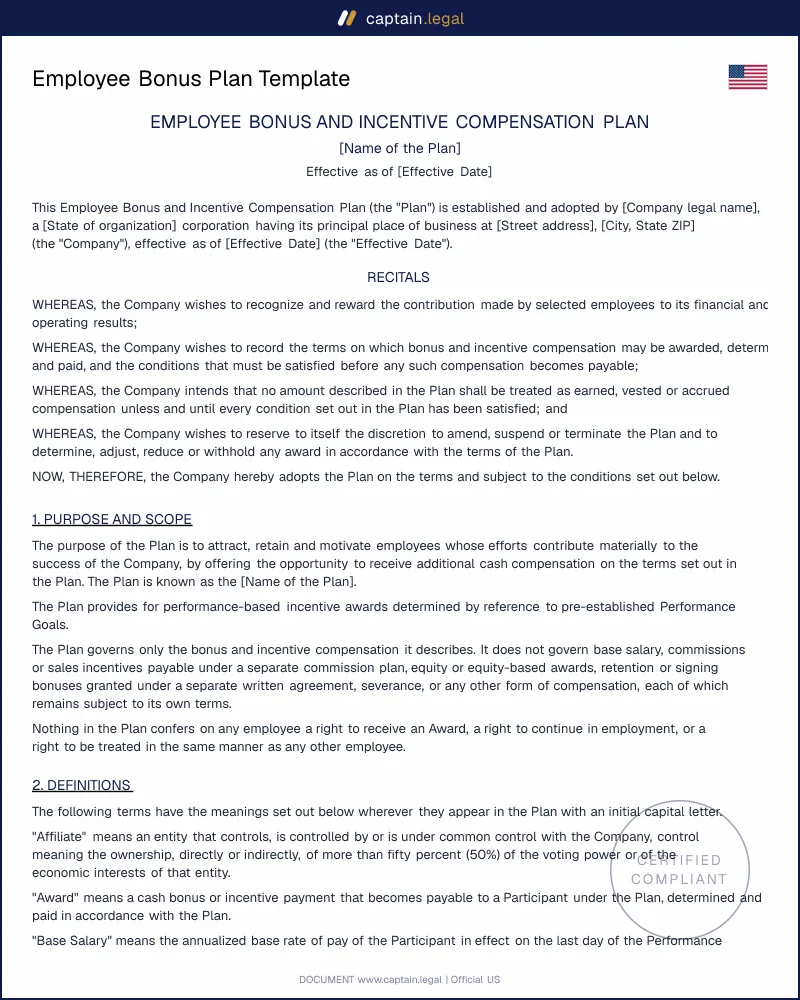
You begin by choosing the plan type, because that choice drives the rest of the form. A discretionary annual bonus produces reservation-of-rights language and no metric schedule; a performance or retention plan opens the metric fields and the vesting date. From there you identify the participating group, the plan year and the payment date, and the form checks that date against the 409A short-term deferral window and flags it if the payout falls outside.

The next block covers the money mechanics: target award as a percentage of base salary or a fixed sum, threshold and maximum payout, weighting between company and individual measures, and the proration rule for mid-year hires and leaves. You then set the separation treatment, choosing whether the award is forfeited on resignation, on termination for cause, or both, with death and disability carve-outs added by default.

The clawback module asks whether your company is exchange-listed. If it is, the form inserts Rule 10D-1 recovery language and the three-year restatement look-back; if not, you get a contractual recoupment clause with a defined repayment period. Last, you select the governing state, and the plan adjusts its earning and forfeiture wording accordingly. The finished document downloads in Word and PDF, ready for officer approval alongside the rest of your US employment documents and HR policy templates.

6

Common mistakes to avoid

The mistake that costs the most is running a formulaic plan and calling it discretionary. An employer who publishes targets in January, tells the team the payout formula, then labels the result a discretionary bonus has abandoned discretion under 778.211(b) and owes retroactive overtime on every bonus dollar allocated to a nonexempt employee's overtime weeks. Back wages, an equal sum in liquidated damages and a two or three year look-back all follow from a drafting choice nobody thought about. The second mistake is the forfeiture clause written as a forfeiture. Saying that an employee who resigns forfeits an earned bonus invites a wage claim in California, Illinois and every state with a comparable statute; saying that continued employment is a condition of earning produces the opposite result on identical facts.

Three more recur. Employers take clawbacks out of a final paycheck, which is unlawful in most states and is better handled by pairing the plan with a proper final paycheck and offboarding checklist for US employers. Managers make side promises that contradict the plan, so the document needs an integration clause and the managers need to be told. And plans go stale after an acquisition or a metric change, leaving two versions in circulation. Amend in writing, prospectively, before the plan year opens.

Key takeaways

DISCRETION

Your labels do not control discretion

Whether a bonus is discretionary or nondiscretionary turns on when you lock in the fact and amount of payment, not what you call it. Under 29 CFR 778.211, you only keep discretion if both are decided close to the end of the measurement period. Announce in January that a bonus will be paid in December and you likely gave up discretion, even if the plan says otherwise.

OVERTIME

Nondiscretionary bonuses can raise overtime

For nonexempt employees, most announced-in-advance bonuses belong in the regular rate used to calculate overtime, with only limited exclusions under the FLSA framework. If a nondiscretionary bonus covers multiple workweeks, 29 CFR 778.209 requires allocating it back over the measurement period and recomputing overtime for each week over 40 hours. A percentage-of-earnings bonus can avoid recalculation under 29 CFR 778.210.

TIMING

Late payments can trigger 409A issues

Bonus timing is not just an HR preference; it can create federal tax exposure. If payment occurs later than the 15th day of the third month after the end of the year in which the right to payment vests, it can fall outside the short-term deferral exception in Treas. Reg. 1.409A-1(b)(4). That can convert the arrangement into deferred compensation under IRC 409A and push penalty tax risk onto the employee.

Frequently Asked Questions

Yes, and that is the point. Once you adopt the plan and communicate it, participants can enforce its terms, which is why the discretion language, the eligibility conditions and the payment date are drafted with care. A discretionary award creates no entitlement until the company declares it; a performance award creates one as soon as the stated conditions are met. The document is built to 29 CFR 778.211 and to the wage payment statute of the state you select, and adopting it by written officer consent gives you a clean record of the effective date.

Only nondiscretionary ones, and the test is stricter than most employers expect. If you promised the bonus in advance, tied it to attendance, production, quality or retention, or created any expectation of regular payment, it enters the regular rate under 29 U.S.C. 207(e). You then apportion it across the weeks it covers and recompute overtime for each week over forty hours, under 29 CFR 778.209. Exempt employees are unaffected.

In most states yes, provided the plan treats the condition as part of earning the award rather than a forfeiture of something already earned. That distinction decided Schachter v. Citigroup in California and Truelove in New York. Illinois is the exception for length-of-service bonuses, where 56 Ill. Adm. Code 300.500 gives a departing employee a proportionate share whatever the clause says, when the separation was not the employee's fault. The template applies the state wording and adds death, disability and retirement carve-outs.

Word and PDF. The Word file is the working version for your counsel or compensation committee, since metrics, weightings and payout tables change from one plan year to the next. The PDF goes to participants and into the file with the signed acknowledgment page. If you also need an acknowledgment form or an amendment notice, you can build them from the same account through the full catalog of US legal document templates.

Two clocks run. Your state wage payment statute governs the deadline once the bonus is earned and due, which in most states means the next regular payday after the amount becomes calculable. The federal clock bites harder: pay by the fifteenth day of the third month after the end of the year in which the right vests and the award stays inside the short-term deferral exception of Treas. Reg. 1.409A-1(b)(4). Miss that window without a compliant deferral election and IRC 409A applies, with penalty tax charged to the employee.

If your company is listed on the NYSE or Nasdaq you must, in the circumstances covered by Exchange Act Rule 10D-1: incentive compensation received by executive officers in the three fiscal years before a required restatement. Private employers rely on the contractual clawback in the plan, enforceable where the trigger is defined and the employee agreed in advance. The method matters more than the right: recovery by payroll deduction violates California Labor Code 221 and comparable provisions elsewhere, so the plan creates a repayment obligation enforceable as a debt.

4.5/5

10 verified reviews · 50 000+ downloads

Bonus Plan Template | 29 CFR 778.211 & 409A Ready
  • Immediate access to the document
  • PDF + Word download
  • Compliant with 2026 legislation
  • Reviewed by lawyers
Fill in the template
Secure payment
Updated on September 5, 2026

You might also like

Job Application Form
Performance Improvement Plan
Employee Bonus Plan Template | Word & PDF, 50 States