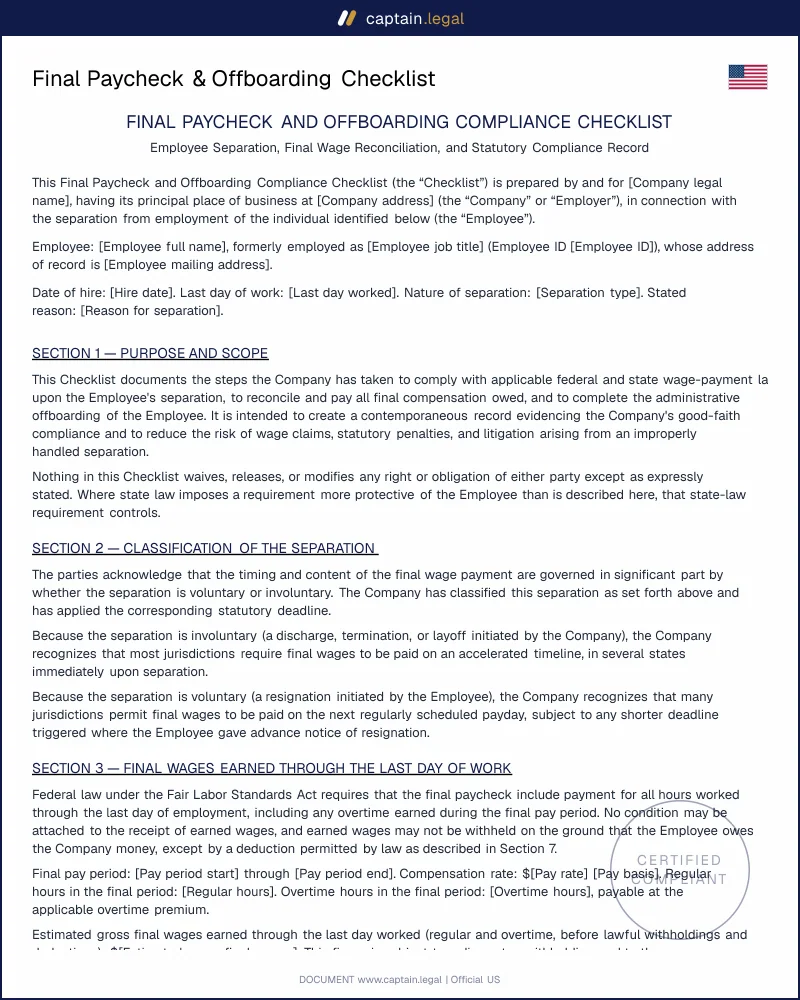
California is the strictest jurisdiction in the country on final pay. An employee fired or laid off must be paid all wages immediately at the time of termination, and an employee who quits without notice must be paid within 72 hours under Labor Code §201 and §202. Accrued, unused vacation counts as earned wages and must be cashed out, though accrued sick leave does not. Waiting-time penalties under §203 run up to thirty days of the employee's daily wage for late payment, which makes California the place where a disorganized offboarding gets expensive fastest. Your checklist should treat the California termination meeting and the paycheck as a single event.
Texas runs on a cleaner timeline but with a sharp trap. Under the Texas Payday Law, an involuntarily terminated employee must be paid within six calendar days, while an employee who quits is paid by the next regular payday. The Texas Workforce Commission has been explicit that an employer cannot hold a final paycheck hostage over unreturned equipment; the lawful route is a deduction only with written authorization or a separate civil claim. Vacation payout in Texas follows your written policy rather than statute, so the checklist should pull the relevant PTO policy language rather than assume a cash-out.
Florida has no state final-pay statute at all, which surprises employers expecting a deadline. Final wages default to the next regular payday for both resignations and terminations, following federal Wage and Hour Division guidance. The absence of a state rule is not a license to delay, because unpaid earned wages still support a civil claim, but it does mean Florida employers should anchor their checklist to the payroll calendar rather than to the termination date.
New York keeps the rule simple: final wages are due by the next regular payday regardless of whether the employee quit or was fired, under Labor Law §191. The wrinkle is pay-frequency classification, since a "manual worker" may be entitled to a shorter pay cycle than the standard rule, and an unpaid commission structure must be honored according to the written agreement. New York employers should confirm the worker's classification in the checklist before defaulting to the next-payday assumption.