A founders' agreement is the contract that turns a shared idea into an actual company before the lawyers, the bank, and the cap table get involved. In one document, two or more co-founders write down who owns what percentage, what each person is on the hook to deliver, how decisions get made when nobody can agree, what happens to the equity if someone walks away in six months, and who owns the code, the brand, and the customer list. Investors will ask for it during the first call of any priced round, and most term sheets are conditioned on the team having one signed. If you are launching a US startup with at least one co-founder, this is the document you sign on day zero, not day three hundred.
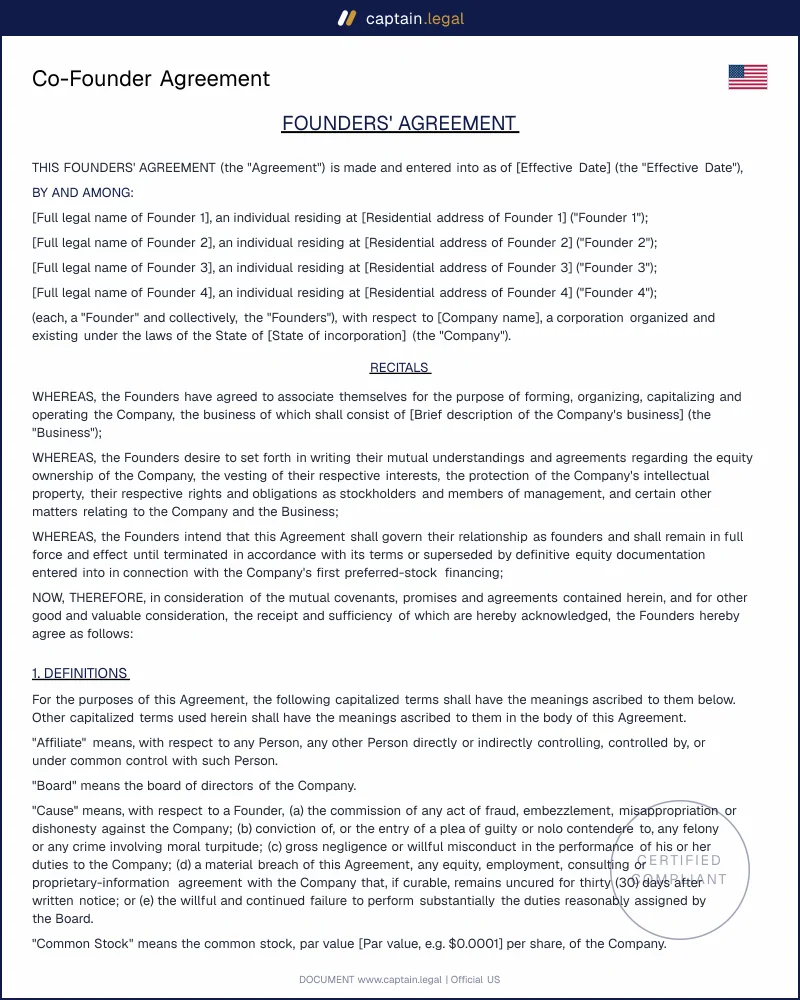
The founders' agreement template below is drafted for Delaware C-Corps and state-formed LLCs alike, with the standard market terms used by Silicon Valley counsel: four-year vesting with a one-year cliff, broad IP assignment back to the company, dispute resolution mechanics, and clean exit provisions for the co-founder who leaves first.
Compliant
2026 Legislation
50,000+ clients
trust us
Affordable
From $4.90 / doc
Secure payment
Instant download
Co-Founder Agreement Template — Equity, Vesting, IP (US)
Secure payment
What is a founders' agreement?
A founders' agreement is a binding contract executed between the original founders of a US startup, typically before incorporation or in the first days after the certificate of incorporation is filed. It records the four things that destroy more early-stage companies than competition ever does : the equity split, the vesting schedule, the assignment of intellectual property to the entity, and the rules for separation when one founder leaves.
The document is sometimes called a co-founder agreement, a founders' collaboration agreement, or, in a more limited form, a founders' stock purchase agreement (the FSPA, which is the share-issuance instrument that operationalizes the vesting schedule). The agreement we provide is the broader governance document, which is then implemented through restricted stock purchase agreements and IP assignment agreements signed at closing.
It is not the same thing as your LLC operating agreement template or your corporate bylaws. The operating agreement and the bylaws govern the company, its members, its board, and its officers. The founders' agreement governs the founders themselves : the human beings sitting in a room together, deciding who gets 50 and who gets 30 and what happens when one of them stops showing up. Sign the founders' agreement before the operating agreement or bylaws are finalized, because the equity numbers and vesting terms in this document feed directly into the cap table that the formation documents will memorialize.
Legal framework
US founders' agreements sit on top of state corporate or LLC law, federal tax rules, and federal IP statutes. There is no single "founders' agreement act" anywhere in the country. What makes the contract enforceable, and what makes it actually work in practice, is the way it interacts with the Delaware General Corporation Law (most venture-backed startups), the California Corporations Code (for California-formed entities), and the LLC statutes of the state of formation when the entity is an LLC rather than a corporation.
Vesting and repurchase rights are typically implemented through a restricted stock purchase agreement governed by §202 of the Delaware General Corporation Law, which permits the corporation to impose transfer restrictions on its own shares. The vesting schedule itself, the four-year ramp with a one-year cliff, is market practice rather than statutory law, but it is reinforced by tax considerations under §83(b) of the Internal Revenue Code : a founder who fails to file an 83(b) election within thirty days of share issuance can owe ordinary-income tax every time a tranche of shares vests, on the spread between strike price and then-current fair market value. That one mistake has cost individual founders six- and seven-figure tax bills. The election itself is one page ; the deadline is non-negotiable.
Intellectual property assignment runs on a different track. Under 17 U.S.C. §201 and federal patent law, work created by a person before incorporation belongs to that person until it is assigned in writing. The founders' agreement contains the present-tense assignment language that moves all pre-formation IP into the new entity. For an authoritative summary of how restricted stock and corporate transfer restrictions operate under Delaware law, the Cornell Legal Information Institute overview of Delaware corporate law is the standard reference. Non-compete provisions, by contrast, are governed by state law and vary sharply : California Business and Professions Code §16600 voids most post-termination non-competes outright, while Delaware enforces reasonable ones. The FTC's 2024 attempt to ban non-competes nationwide was enjoined by a Texas federal court in Ryan LLC v. FTC, leaving the patchwork intact.
When do you need this document?
The trigger is incorporation, or the conversation that precedes it. The moment two or more people agree they are building something together, the founders' agreement should be on the table. Most startup litigation that lands in Delaware Chancery Court traces back to founders who skipped this step and tried to reconstruct the deal from text messages eighteen months later. By then, the company has revenue, the equity split has become a fight, and a judge is being asked to interpret an exchange that includes the phrase "lol fine whatever."
The second trigger is the first outside money. Friends-and-family checks, angel investments, a SAFE, a priced seed round : any capital from a third party will surface the question of who actually owns what. Investors run diligence on the cap table before they wire, and a missing founders' agreement is the kind of finding that delays a closing by weeks while a Wilson Sonsini associate drafts the missing paperwork at a premium. The day a term sheet arrives is the wrong day to start negotiating vesting with your co-founder.
The third scenario is a team change. A co-founder leaves, a new one joins, or someone's role shifts from full-time CTO to part-time advisor. Each of these events has to map onto the document. Without it, the departing founder walks with all their unvested shares, the joining founder negotiates from a position of leverage you did not anticipate, and the demoted founder keeps voting rights that no longer match contribution.
The edge case worth flagging is the solo founder who later brings on a co-founder after incorporation. The founders' agreement still applies, but it has to be drafted to retroactively assign pre-existing IP that the original founder created. Skipping that step leaves the company exposed to a future IP claim from its own founder, which is a diligence-killer at Series A.
Key clauses included in our template
The template is built around the six clauses that determine whether the agreement actually holds up when it is needed. Each is drafted to current US market practice and is editable in Word so you can adjust the numbers to your deal.
The equity split and share issuance section identifies each founder, the number of shares issued, the purchase price per share (typically $0.0001 par value for a Delaware C-Corp), and the resulting ownership percentage on a fully diluted basis. The clause references the restricted stock purchase agreement that each founder will sign concurrently and includes the 83(b) election reminder with the thirty-day federal deadline written into the document itself.
The vesting schedule locks each founder's shares to a four-year ramp with a one-year cliff. No shares vest in the first twelve months ; on the cliff date, twenty-five percent of the allocated shares vest in a single block ; the remaining seventy-five percent vests in equal monthly installments over the following thirty-six months. Acceleration triggers (single-trigger and double-trigger on a change of control) are drafted as optional, because the right answer depends on whether you expect to raise institutional capital.
The intellectual property assignment is a present-tense assignment of every piece of IP each founder has created relating to the business : code, designs, brand assets, customer lists, trade secrets, and any patent applications. The clause covers both pre-formation IP (the work done before the entity existed) and post-formation IP (anything created while the founder is engaged with the company). It includes a waiver of moral rights and a power-of-attorney for the company to file IP registrations on the founder's behalf.
The roles and responsibilities section names each founder's title, primary functional area, and full-time or part-time commitment. It is short on purpose : the goal is to record who was supposed to do what, so that a future "they never did the work" argument has a baseline.
The decision-making and deadlock clause lists the matters that require unanimous founder consent (issuing new equity, selling the company, taking on debt above a threshold, changing the business model) and the mediation-then-arbitration path for resolving disputes. The default forum is the Delaware Court of Chancery for entity-formed Delaware companies, with American Arbitration Association rules as the fallback.
The departure and repurchase clause defines what happens when a founder leaves voluntarily, is terminated for cause, or is terminated without cause. The company's right to repurchase unvested shares at original purchase price is the standard mechanism, and the cause definition is drafted narrowly enough to survive the inevitable "I was not fired for cause" argument that follows every contested exit.
State-specific considerations
US founders' agreements are governed by the law of the state of formation of the entity, not the state where the founders happen to live. Choice of formation is therefore the first strategic decision the agreement reflects.
Delaware is the default for any startup planning to raise venture capital, and the founders' agreement template defaults to Delaware governing law for that reason. The Delaware General Corporation Law §141 gives the board broad authority and §202 permits the share transfer restrictions that make vesting enforceable. The Chancery Court hears corporate disputes with experienced judges, no jury, and decisions usually within months rather than years. Series A investors expect Delaware, and converting from another state mid-fundraise costs time and money the company does not have.
California matters because most founders live there. A California-formed entity is governed by the California Corporations Code and is subject to §16600 of the Business and Professions Code, which renders most post-employment non-competes void as against public policy. The founders' agreement should not contain a Delaware-style non-compete if any founder lives or works in California, because the clause will not be enforced and may actually expose the company to a §17200 unfair competition claim. The IP assignment and non-solicit provisions remain enforceable.
Texas has become a serious alternative since the launch of the Texas Business Court in September 2024, which handles disputes over $5 million with specialized judges modeled on Delaware Chancery. Tex. Bus. & Com. Code §15.50 enforces reasonable non-competes tied to legitimate business interests, with geographic and time limits. The founders' agreement for a Texas-formed entity should specify Houston or Dallas as the venue and reference the Business Court's jurisdiction.
New York entities fall under the New York Business Corporation Law. New York courts enforce non-competes under a reasonableness standard, but a 2023 legislative push to ban them entirely (S3100A) was vetoed by Governor Hochul ; another version is likely. The founders' agreement for a Delaware C-Corp with New York-based founders should still use Delaware governing law and venue, but should include New York-compliant PIIA and invention assignment language because the founders' employment relationship with the company is governed by New York law independently of the entity's choice of formation.
Florida has emerged as a destination for relocated founders. Fla. Stat. §542.335 enforces non-competes with a presumption of reasonableness up to two years post-employment, and the state has no income tax, which matters for the 83(b) election math. Founders incorporating in Florida should still consider whether to flip to Delaware before a priced round.
How to fill out this founders' agreement
You start by selecting the state of formation, which sets the governing law, the default vesting mechanics, and the non-compete enforceability for the entire document. From there, the form walks each founder through their identifying information, the number of shares being issued, and the percentage of the fully diluted cap table that corresponds to that allocation. The math runs in real time, so you can see whether two founders accidentally added up to one hundred and three percent.
The next stage covers the vesting schedule. The default is four years with a one-year cliff and monthly vesting thereafter, but you can shorten or lengthen the schedule, adjust the cliff, and add single-trigger or double-trigger acceleration if your investors are likely to require it. The 83(b) election reminder is generated automatically, with the thirty-day deadline calculated from the share issuance date you enter.
The IP assignment section asks you to list any pre-existing IP being contributed to the company, along with any prior employer agreements that might create conflicts. If a founder is still under a non-compete or IP assignment from a previous job, the system flags it and recommends a prior employer clearance memo before signing. The roles and responsibilities section is filled in for each founder in their own words. The departure clause lets you set the cause definition tightly or loosely.
Once every founder has reviewed and signed electronically, the platform generates a clean Word file for negotiation and a final signed PDF, both of which are accepted by every major US law firm during due diligence. The document is ready to drop into the Captain.Legal business documents catalog alongside your formation paperwork.
Common mistakes to avoid
The first mistake is treating the equity split as a math problem rather than a negotiation. Founders who split 50/50 because it feels fair often discover, two years in, that the workload was 80/20 and that fifty percent of a future term sheet is a lot to give up to a person who left after six months. The fix is not to assume conflict, but to build the vesting schedule and the repurchase rights so that the equity tracks the actual contribution over time, which is exactly what four-year vesting with a one-year cliff is designed to do.
The second mistake is missing the 83(b) election. The thirty-day deadline runs from share issuance, not from incorporation, not from the date the agreement is signed, and not from "when the lawyer gets around to it." Founders who miss the window owe ordinary income tax on every monthly vesting tranche, calculated at the then-current fair market value, which after a successful seed round can be substantial. The election is mailed to the IRS service center for the founder's residence ; a copy is attached to the founder's personal tax return for that year. Set a calendar reminder before you sign.
The third recurring failure is incomplete IP assignment. A founder who built the prototype on a personal laptop, using open-source libraries, while still employed at a previous company, is carrying three separate IP exposure points into the new entity. The agreement has to assign the pre-formation IP, document the open-source licenses, and confirm no prior-employer claim. Diligence counsel for any Series A investor will ask for proof of all three, and the absence of any one of them can delay closing or trigger a price reduction.
The fourth mistake is the handshake co-founder who never signs. A friend who helped with the early prototype, who never received shares, who never assigned IP, and who later claims to be a co-founder is a real diligence problem. The founders' agreement should explicitly identify every person who has equity rights and confirm that no other person has any claim to ownership or compensation. The cleanest fix is a founders' acknowledgment letter from anyone who contributed early work but is not a founder, waiving any claim to equity.
Frequently Asked Questions
20 verified reviews · 50 000+ downloads
- Immediate access to the document
- PDF + Word download
- Compliant with 2026 legislation
- Reviewed by lawyers
You might also like