The Form 1023 narrative is the document that decides whether the IRS believes your nonprofit actually qualifies for tax-exempt status, or whether it sends back a development letter that delays your determination by another six to twelve months. It is the support attachment for Part IV of Form 1023, Application for Recognition of Exemption Under Section 501(c)(3) of the Internal Revenue Code, and it tells the examiner, in plain narrative form, what your organization does, who it serves, how it is funded, and why every activity furthers an exempt purpose under §501(c)(3). Founders, executive directors, and nonprofit counsel use this attachment to convert a mission statement into the operational record the IRS expects to read.
A well-built narrative reads like the executive summary of a charity audit report, not like a grant pitch. It anchors every program in a concrete activity, ties activities to budget lines, and pre-empts the questions an exempt-organizations specialist will otherwise ask in writing. Captain.Legal's template gives you the structure, the statutory citations, and the IRS-aligned headings to file with confidence.
Compliant
2026 Legislation
50,000+ clients
trust us
Affordable
From $4.90 / doc
Secure payment
Instant download
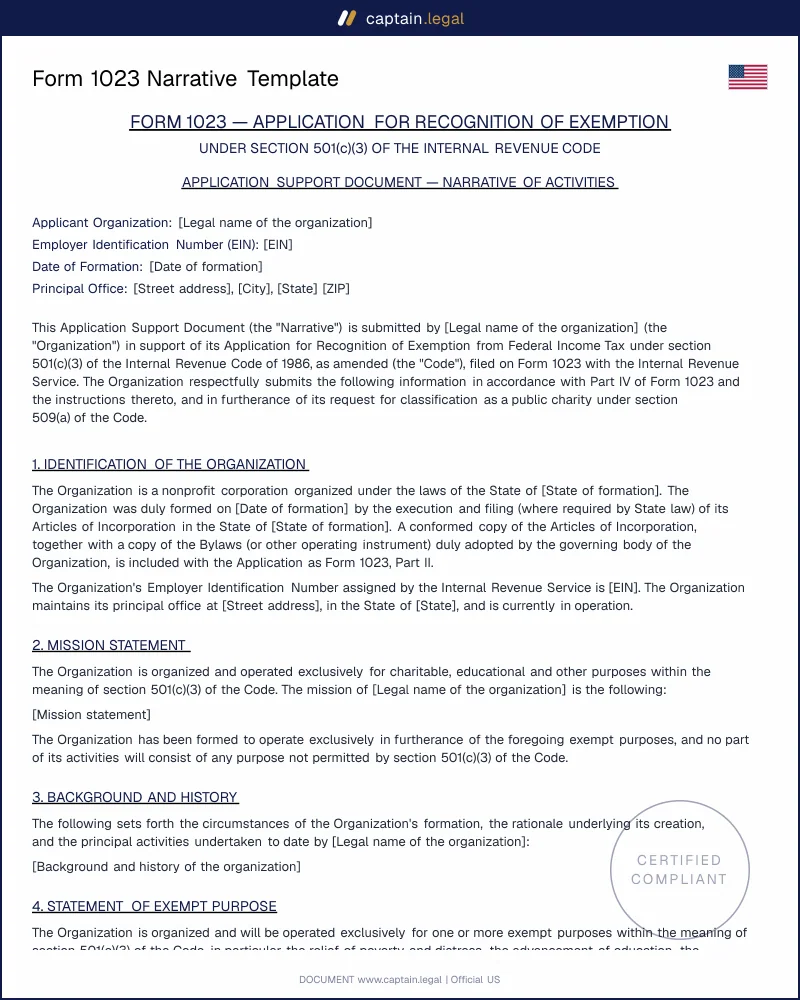
Form 1023 Narrative of Activities — 501(c)(3) Template
Secure payment
What is a Form 1023 narrative attachment?
The narrative attachment is the long-form description of activities that supplements Part IV of Form 1023. The form itself provides only a small text box, and the Instructions for Form 1023 (Rev. 12-2024) explicitly invite applicants to attach a separate document. Practitioners almost always do so, because squeezing a real nonprofit's program portfolio into a few thousand characters guarantees a deficiency letter. The attachment becomes part of the application file, is reviewed by an Exempt Organizations specialist in Cincinnati, and is later available to the public on Form 990 requests and Form 1023 disclosure under IRC §6104.
What it is not is a marketing document. A narrative that reads like a fundraising brochure, or that recycles the mission statement without describing distinct activities, will trigger a Letter 1312 or Letter 2382 asking for more detail. The IRS wants three concrete pieces of information for every program : what the activity is, how it is conducted, and how it is funded. It also wants past, present, and planned activities clearly separated, because an organization that has been operating for two years before filing must show that its actual conduct matches the organizational test and the operational test.
The narrative differs from the bylaws and the articles of incorporation in one critical respect : the articles of incorporation lock in the legal purpose and dissolution clause, while the narrative describes what you actually do with that legal shell. Both must be internally consistent ; an examiner who finds a mismatch between the stated purpose and the described activities will pause the review.
Legal framework
The Form 1023 narrative sits at the intersection of two federal tests codified in Internal Revenue Code §501(c)(3) and elaborated in Treasury Regulations §1.501(c)(3)-1. The organizational test examines whether your governing documents limit the organization to exempt purposes and dedicate its assets permanently to charitable use upon dissolution. The operational test examines whether your actual activities further those exempt purposes rather than producing private benefit or commercial gain. The narrative is the principal evidence the IRS uses to apply the operational test, which is why a vague or aspirational draft is fatal even when the articles of incorporation are flawless.
The procedural framework comes from Rev. Proc. 2024-5 (updated annually), which sets the user fee and the filing mechanics, and from the Instructions for Form 1023, which list ten specific questions the narrative should answer for each activity : the activity itself, when and where it is conducted, who conducts it, who benefits, how it is funded, and how it advances the exempt purpose. The official IRS guidance on this point is published at the IRS page on Form 1023 detail required in narrative description of activities, and it is the single source every drafter should cross-check before submission.
Form 1023 is filed electronically through pay.gov, and the entire application, including the narrative attachment, must be uploaded as a single consolidated PDF. The user fee is non-refundable, and a denial because of an inadequate narrative means refiling and paying again. Form 1023-EZ is available for small organizations meeting the gross-receipts and asset thresholds of Rev. Proc. 2024-5, but the streamlined version does not include a narrative section ; it relies on attestations, which is why most counsel still file the full Form 1023 when activities are non-trivial, when foreign operations are involved, or when the NTEE code assignment is debatable. Churches, integrated auxiliaries, and certain small public charities are not required to apply, but most do so voluntarily to obtain a determination letter that grantmakers and state regulators will accept on its face. Recent enforcement patterns reflect heightened scrutiny of organizations with related-party compensation, foreign grant-making, or revenue streams that resemble unrelated business taxable income under §512.
When do you need this document?
You need a Form 1023 narrative the moment you decide to apply for federal tax-exempt status under §501(c)(3) and do not qualify, or do not wish to use, the streamlined Form 1023-EZ. That covers most newly incorporated nonprofits with projected annual gross receipts above the Rev. Proc. 2024-5 threshold, any organization with foreign activities, supporting organizations under §509(a)(3), and any entity whose programs involve compensation arrangements with insiders. In all those cases the narrative is mandatory, and the quality of the draft will determine whether your determination letter arrives in four months or in fourteen.
The second triggering scenario is a mid-life filing, where a nonprofit has operated for one or more fiscal years on the assumption it would file later. The IRS expects the narrative to cover past, present, and planned activities, and operating history changes the drafting strategy : you must reconcile what the organization actually spent its money on with the purposes claimed in the articles. Auditors look for inconsistencies between Form 990 filings, board minutes, and the narrative, and any drift requires explanation. Founders who use Captain.Legal's corporate bylaws template to formalize governance before filing tend to produce cleaner narratives, because the conflict-of-interest policy, the officer roles, and the board approval process are already documented.
A third trigger is a change in activities material enough to warrant a new ruling. Although organizations do not refile Form 1023 in the ordinary course, a substantial program expansion, a switch from grant-making to direct service, or the addition of a fee-for-service line that approaches unrelated business territory often requires a request for a private letter ruling or a determination on reclassification. The drafting discipline of a 1023 narrative is exactly what those filings require. One edge case worth flagging : organizations applying for reinstatement after automatic revocation under §6033(j) must include a narrative that addresses why exempt status lapsed and how operations have been corrected, with detail comparable to an original Form 1023 attachment.
Key sections included in our template
The Captain.Legal narrative template mirrors the structure that Exempt Organizations specialists are trained to read, so the examiner can locate each required element without searching. Every section is drafted as prose, not bullet points, because the IRS Instructions for Form 1023 are explicit that the narrative must be in narrative form.
- The introduction and statement of exempt purpose opens the document with the legal name, state of incorporation, EIN, and date of formation, then sets out the exempt purpose in language that tracks Treas. Reg. §1.501(c)(3)-1(d). Vague claims like "raising awareness" or "supporting the community" are replaced with a specific charitable, religious, educational, or scientific purpose tied to one of the enumerated categories of §501(c)(3).
- The past activities section describes what the organization has done since formation, with dates, locations, beneficiaries, and approximate budget allocations. It exists even for brand-new entities, which note that no past activities have been conducted as of the filing date.
- The present activities section is the core of the document. Each ongoing program receives its own subsection, answering the ten questions from the IRS narrative checklist : what, when, where, who conducts, who benefits, how funded, hours devoted, expected results, and how the activity advances the exempt purpose. Practitioners typically allocate one page per active program.
- The planned activities section addresses the three-year forward horizon, aligned with the Form 1023 Part VI budget projections. The narrative ensures every projected revenue and expense line corresponds to a described activity, so the budget cannot be read as inconsistent with the program plan.
- The funding sources section discloses the expected mix of contributions, grants, program-service revenue, and any unrelated business income, with a brief explanation of how each stream supports the exempt purpose. This is also where donor-restricted gifts and grant-making policies are described.
- The NTEE code rationale explains the selected National Taxonomy of Exempt Entities code from Appendix D of the Form 1023 Instructions, which is a frequent point of clarification requests from examiners.
How to fill out this Form 1023 narrative
You start by selecting your organization type and entering the basic identifiers : legal name, EIN, state of incorporation, and fiscal year-end. From there, the template adjusts the statutory references to match your selected exempt purpose category under §501(c)(3), whether charitable, educational, religious, scientific, or another enumerated subcategory. The system then walks you through one program subsection at a time, prompting for the ten IRS narrative elements so nothing is omitted by the time you reach the funding section.
The next stage covers governance and personnel. You describe the composition of your board, the conflict-of-interest policy in force, and any compensation arrangements with officers, directors, or disqualified persons under §4958. If you have a key paid executive, the narrative must reference the underlying employment record, and the at-will employment agreement template helps you produce a board-approved compensation file that matches what the narrative says. The form then prompts for the three-year activity outlook and aligns it with the budget figures you will enter in Part VI of Form 1023 itself.
The final stage assembles the narrative into a clean, paginated PDF labeled "Part IV Narrative Attachment" with your EIN on every page, which is the format the Cincinnati EO Determinations unit expects. You download the file in Word for last-mile counsel review and in PDF for upload to pay.gov.
Common mistakes to avoid
The most frequent error is treating the narrative as a mission statement extended over five pages. Examiners are reading for activities, not for vision, and a narrative that recycles the purpose clause without describing concrete programs almost always draws a development letter. The second recurring mistake is the commercial drift problem : a draft that describes fee-for-service operations, consulting revenue, or product sales without explaining how those activities further the exempt purpose tells the examiner that the operational test may not be met. The fix is to anchor each revenue stream to a specific beneficiary class and to the exempt purpose it advances, and to disclose any expected unrelated business taxable income honestly rather than hide it.
A third pattern is omitting the past activities section because the founders consider the organization "not yet operational." Even a single board meeting, a fundraising event, or a pilot program counts as past activity and must be reported. The fourth mistake is misalignment between the narrative and the founders' equity and IP arrangements for organizations that grew out of an earlier for-profit vehicle ; the IRS will read both, and any unaddressed transfer of assets or intellectual property from the founders raises private benefit and private inurement flags. The fifth, and most damaging, is the insider compensation mistake : a narrative that says officers are "reasonably compensated" without a board-approved comparability study and a documented conflict-of-interest process invites a §4958 inquiry. Specifics, citations, and dated board approvals are the antidotes.
Frequently Asked Questions
26 verified reviews · 50 000+ downloads
- Immediate access to the document
- PDF + Word download
- Compliant with 2026 legislation
- Reviewed by lawyers
You might also like