Create my document
Login

Choose country

FranceBelgiqueEspañaUnited StatesUnited KingdomMarocDeutschlandItaliaSchweiz
Family & Divorce

Financial Affidavit for Divorce: Sworn Disclosure Made Simple

Sworn financial affidavit meeting state mandatory disclosure rules, from FL Rule 12.285 to NY DRL 236. Notary-ready income, asset, and debt statement for court.
4.8/535 reviews50 000+ downloadsInstant download
Share

A divorce or custody case turns on numbers long before it turns on arguments. The financial affidavit, also called a financial disclosure statement or sworn financial statement, is the document that puts those numbers on the record under oath. It lists your income, monthly expenses, assets, and debts in a single verified form that the court relies on to divide property and set child support and alimony. This template produces a notary-ready, sworn financial disclosure statement structured to meet the mandatory disclosure rules that apply in divorce and custody filings across all 50 states.

The form looks like bookkeeping, but it carries the weight of testimony. Every figure you enter is a statement made under penalty of perjury, and judges read inconsistencies between the affidavit and your bank records as a credibility problem, not a clerical one.

Compliant

2026 Legislation

50,000+ clients

trust us

Affordable

From $4.90 / doc

Secure payment

Instant download

Financial Affidavit for Divorce: Sworn Disclosure Made Simple

Secure payment · No subscription

Fill in the template

What is a divorce financial affidavit?

A divorce financial affidavit is a sworn, signed statement of your complete financial picture filed during a dissolution, legal separation, or custody case. It captures four categories: gross and net income from every source, recurring monthly living expenses, assets you own outright or jointly, and the debts you owe. Because it is sworn, you sign it in front of a notary, and the notarization is what converts a private worksheet into evidence a court can act on.

People often confuse the affidavit with the broader mandatory disclosure process, and the distinction matters. The financial affidavit is the summary form itself, the document on which you certify totals. Mandatory disclosure is the wider exchange of underlying proof, tax returns, pay stubs, bank statements, and retirement records that backs up the affidavit's numbers. In Florida the affidavit is Form 12.902(b) or (c); in Colorado it is the Sworn Financial Statement, JDF Form 1111; in New York it is the Statement of Net Worth under DRL 236(B). Different titles, identical function.

The affidavit is not a settlement agreement and does not divide anything. It is the factual foundation the court and both parties build the division on. If you are also negotiating terms, the affidavit feeds directly into documents like a prenuptial agreement that establishes separate property before marriage, which courts often reference when sorting marital from separate assets.

2

When do you need this document?

The most common trigger is a filed divorce or legal separation, where the court will not finalize a decree until both spouses have submitted sworn financials. In most states the clock starts at service of the petition, and you have somewhere between 20 and 45 days depending on the jurisdiction. Miss the window without an extension and you risk sanctions, a motion to compel, or a delayed trial date.

Custody and child support cases are the second major scenario, including matters between parents who were never married. Because support is guideline-driven, the court needs a verified income figure from each parent before it can run the calculation, and a parenting arrangement that allocates costs depends on accurate expense data. A modification request is the third trigger: when you ask to raise or lower support after a job loss, a raise, or a change in parenting time, the court reopens the financial picture and expects an updated affidavit reflecting current numbers.

Two edge cases legitimately complicate things. Self-employed parties and business owners face heightened scrutiny because guideline income is not the same as taxable income, and courts often require three to five years of business returns alongside the affidavit. The second is the spouse who genuinely lacks access to shared records. You cannot certify figures you have not verified, but you also cannot hide behind ignorance if a third party under your direction, an accountant or financial advisor, holds the information; courts expect you to obtain it.

3

Key clauses included in our template

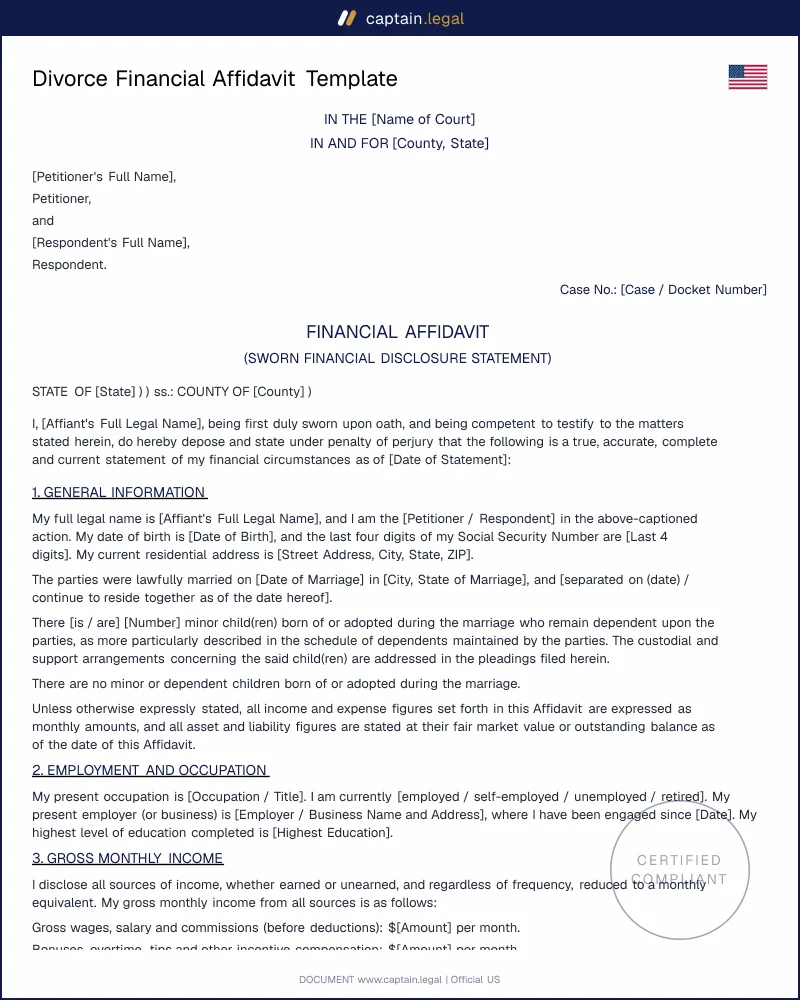
  • The sworn certification and notary block is the clause that gives the document its legal force. It states that the signer attests under penalty of perjury that the contents are true, and it provides the jurat for the notary public. Without a proper notarization the form is a worksheet, not an affidavit, and many courts will reject an unsworn filing outright.
  • The gross income from all sources section captures wages, self-employment net income, bonuses, commissions, rental income, dividends, and benefits. It is structured to separate recurring income from one-time receipts because guideline support is built on regular income, and misclassifying a one-off bonus as monthly income distorts the calculation in both directions.
  • The monthly expense schedule itemizes housing, utilities, transportation, insurance, childcare, medical costs, and debt service. The template prompts realistic figures rather than round estimates, since underreported expenses understate your need for support and overstated ones invite a challenge from the other side.
  • The asset inventory lists real estate, bank and brokerage accounts, retirement accounts, vehicles, business interests, and personal property of significant value, each with its current market value. The form flags where appraisals are typically needed, because an outdated estimate on a home or a business is one of the most litigated errors in disclosure.
  • The liability schedule records every debt by creditor, original amount, current balance, and monthly payment, covering mortgages, auto loans, student loans, credit cards, and personal loans. The clause also prompts the separation of marital from separate debt, a distinction that drives how obligations are allocated.
4

State-specific considerations

California uses the Income and Expense Declaration, Form FL-150, together with the Declaration of Disclosure under Family Code §§2104 and 2105. The state requires both a preliminary and a final declaration, and you must serve, not file, your tax returns for the prior two years alongside the form. California courts impose significant monetary sanctions for incomplete disclosure, and the duty to disclose continues throughout the case as your circumstances change. A spouse protecting business assets often coordinates this filing with broader business formation and ownership documents that establish entity value.

Florida mandates the Family Law Financial Affidavit, Form 12.902(b) for the short form under the income threshold and Form 12.902(c) for the long form above it, filed within 45 days of the petition. Under Rule 12.285, the affidavit itself cannot be waived even when both parties agree to skip other disclosures. The form must travel with three years of tax returns, pay stubs, and account statements, and objections to disclosure must be filed at least five days before the due date.

New York requires the Statement of Net Worth under DRL 236(B)(4), a sworn document covering income, expenses, assets, and liabilities that must be signed before a notary despite the 2023 amendment to CPLR 2106. New York applies equitable distribution, so the form's careful separation of marital from separate property carries real weight in how assets divide. The statement must generally be filed within 20 days of a request.

Texas does not use a single statewide affidavit form. Instead, parties typically file a sworn Inventory and Appraisement listing community and separate property and debts, and many counties impose their own local disclosure rules under the Texas Rules of Civil Procedure. Because Texas is a community property state, accurate characterization of each asset as community or separate is the central drafting task.

5

How to fill out this financial affidavit

You start by selecting the state where your case is filed, because that choice drives the form's titles, sworn-statement language, and the disclosures the court expects. From there you work through income first, entering every source at its gross figure before deductions, since guideline support calculations begin with gross income. The template then moves you into monthly expenses, prompting realistic line items rather than round numbers, and it keeps a running net figure so you can sanity-check the result against your actual cash flow.

Next comes the asset inventory, where you list each account, property, and significant item at current market value and note where a professional appraisal will be needed. The liability schedule follows the same logic, capturing each debt by creditor and balance. Once the financial picture is complete, you review the totals, sign in front of a notary, and download the finished document in Word for any last edits or in PDF for printing, signing, and filing. If your case also involves dividing personal property by hand, the affidavit pairs naturally with the family and divorce document templates in this category.

6

Common mistakes to avoid

The error that does the most damage is treating the affidavit as an estimate rather than testimony. People round figures, leave off a forgotten medical bill or an old credit card, and undercount monthly expenses because they never tracked them, then discover the gaps when opposing counsel subpoenas the bank records. Because the form is sworn, those gaps read as concealment, and a clean number that contradicts your statements destroys your credibility on everything else. Misclassifying property is the close second: confusing separate property, owned before marriage or received by gift or inheritance, with marital property changes how everything divides, and in community property states the mistake can hand half of a separate asset to the other side.

Valuation is the other recurring trap. Guessing at the value of a family business, retirement accounts, or even the marital home without an appraisal produces figures that fall apart under scrutiny. Waiting too long is just as costly. Missing the disclosure deadline can trigger a motion to compel and court sanctions, and in some states the court simply will not move your case forward until both affidavits are on file. Finally, people forget that the duty to disclose is continuing; a raise, a new job, or a major purchase during the case requires an updated affidavit, and failing to supplement is itself a violation.

Key takeaways

UNDER OATH

Every number is sworn testimony

This form is not a private budgeting worksheet. Once you sign it in front of a notary, your income, expenses, assets, and debts become evidence in the case, made under penalty of perjury. Judges compare what you list against bank records and other documents, so mismatches read as credibility issues. Treat each entry like courtroom testimony, because that is how it functions.

STATE RULES

Deadlines and requirements are state-specific

A financial affidavit only works if it matches the court rules where your divorce or custody case is filed. Many states make disclosure mandatory and time-bound, like Colorado C.R.C.P. 16.2(e) (Sworn Financial Statement within 42 days of service) and Florida Rule 12.285 (Financial Affidavit within 45 days of the initial petition). In Florida, the affidavit cannot be waived even by agreement.

RISK

Omissions can undo deals and orders

Leaving out an account, understating income, or hiding debt is not treated as a harmless mistake when the statement is sworn. Courts can view material gaps as fraud on the court, and outcomes built on bad numbers can be revisited later. In In re Marriage of Seely, 689 P.2d 1154 (Colo. App. 1984), a settlement was set aside after inadequate disclosure. A decree based on a false affidavit can be reopened.

Frequently Asked Questions

A notarized financial affidavit is a sworn statement admissible in court, and signing it commits you under penalty of perjury to the accuracy of every figure. That said, the affidavit does not by itself bind anyone to a financial outcome; it does not divide property or set support. It establishes the verified facts the court uses to make those decisions. Its legal weight comes from the oath: a knowingly false affidavit exposes you to perjury charges and can cause a later decree to be reopened, as courts have done when a spouse relied on misleading disclosure.

You can download the completed financial affidavit in both Word and PDF. The Word version is useful when your attorney or your county clerk asks for a last adjustment to wording or when local rules require a specific format. The PDF version is the one you typically print, sign before a notary, and file or serve, because it locks the formatting and reads as a clean, final document. Many courts accept either, but check your county's filing portal, since some jurisdictions require a particular form number or color of paper for matrimonial filings.

The deadline is set by state rule and varies. Florida requires the affidavit within 45 days of service of the initial petition under Rule 12.285. Colorado sets 42 days under C.R.C.P. 16.2. New York generally requires the Statement of Net Worth within 20 days of a request under DRL 236. California ties its preliminary declaration to service of the petition or response. Always confirm your county's case management order, because judges can shorten or extend these windows, and missing the date risks sanctions.

Usually not, and this surprises many couples. While some states let parties mutually waive the exchange of underlying documents like tax returns, the affidavit itself often cannot be waived. In Florida, Rule 12.285 expressly states the Financial Affidavit is required in all cases and cannot be waived even by agreement. The logic is that courts must independently verify income before approving child support, and in most states parents cannot bargain away a child's right to guideline-based support, even when both adults are trying to keep the process amicable.

The affidavit is the summary, but it rarely travels alone. Most states require you to back it with several years of tax returns, recent pay stubs, bank and brokerage statements, retirement account records, and documentation for any business interest. Massachusetts requires three years of returns under its Rule 410 disclosures; California requires the prior two years. You generally serve these on the other party rather than filing them with the court. Keep originals available, since the other side can demand to inspect them if you provide only copies.

Honest errors are correctable, which is exactly why the duty to disclose is continuing. If you discover a forgotten account or a miscalculated figure, you file an amended or supplemental affidavit rather than letting the inaccurate one stand. Courts distinguish between a corrected oversight and a concealed asset; the first is routine, the second is fraud on the court. The danger is doing nothing once you know, because an uncorrected error you were aware of starts to look intentional, and that is what gives the other party grounds to challenge your credibility or reopen a settlement.

Yes, with a caveat. Even when parents reach a custody and support arrangement privately, the court that approves it will almost always require a financial affidavit from each parent first, because support figures must be verified against real income. The affidavit gives the judge the basis to confirm the negotiated number meets the state guideline. If you are documenting the arrangement itself, the affidavit supports the financial side while the parenting terms live in a separate agreement, and the two together give the court a complete and verifiable package.

4.8/5

35 verified reviews · 50 000+ downloads

Financial Affidavit for Divorce: Sworn Disclosure Made Simple
  • Immediate access to the document
  • PDF + Word download
  • Compliant with 2026 legislation
  • Reviewed by lawyers
Fill in the template
Secure payment · No subscription
Updated on June 13, 2026

You might also like

Legal Separation Agreement Template
Marital Settlement Agreement